
5 Brilliant Ways to Find the Best IOP in North Carolina

Why Finding the Best IOP in Florida Could Be Your Turning Point
Finding the right mental health support can feel like navigating a maze in the dark. If you’re feeling stuck, overwhelmed, or let down by once-a-week therapy that isn’t cutting it, you’re not alone. The best IOP in North Carolina offers a powerful alternative: structured, intensive mental health treatment that fits into your real life.
An Intensive Outpatient Program (IOP) provides more than nine hours of evidence-based care per week—including group therapy, individual counseling, and family support—while you continue living at home, working, or attending school. It is built for people who need more than a weekly session, but who do not need to be in a hospital 24/7.
What truly makes an IOP the “best” is not slick branding or vague promises. It is whether the program actually helps you feel and function better in a measurable way.
- Evidence-Based Therapies: The program must be built on proven methods like Cognitive Behavioral Therapy (CBT) and Dialectical Behavior Therapy (DBT). These are scientifically validated techniques that teach you practical skills to calm your nervous system, change unhelpful thinking, and handle real-life stress. Without evidence-based therapy, you are talking—but not truly healing.
- Flexible and Accessible Scheduling: Life does not stop for treatment. The best programs offer morning, evening, or even fully remote sessions through virtual behavioral health, so you can keep your job, attend classes, and show up for your family while still getting intensive help.
- Comprehensive Insurance Coverage: High-quality care should be financially realistic. Top-tier IOPs work with major insurance providers like Cigna, Optum, Blue Cross Blue Shield, Aetna, and other large national plans to lower your out-of-pocket costs. Many people pay only a copay once insurance is verified.
- Specialized Tracks for Your Needs: You are not a generic patient. Whether you’re a young adult navigating life transitions, a professional dealing with burnout, a parent carrying everyone else’s load, or a trauma survivor, a specialized track ensures your treatment addresses your specific pressures and goals.
- A Clear Plan for the Future: Recovery does not end on the last day of the program. A robust aftercare plan—ongoing therapy, support groups, medication follow-up, and relapse prevention—is essential to keep you moving forward instead of sliding back.
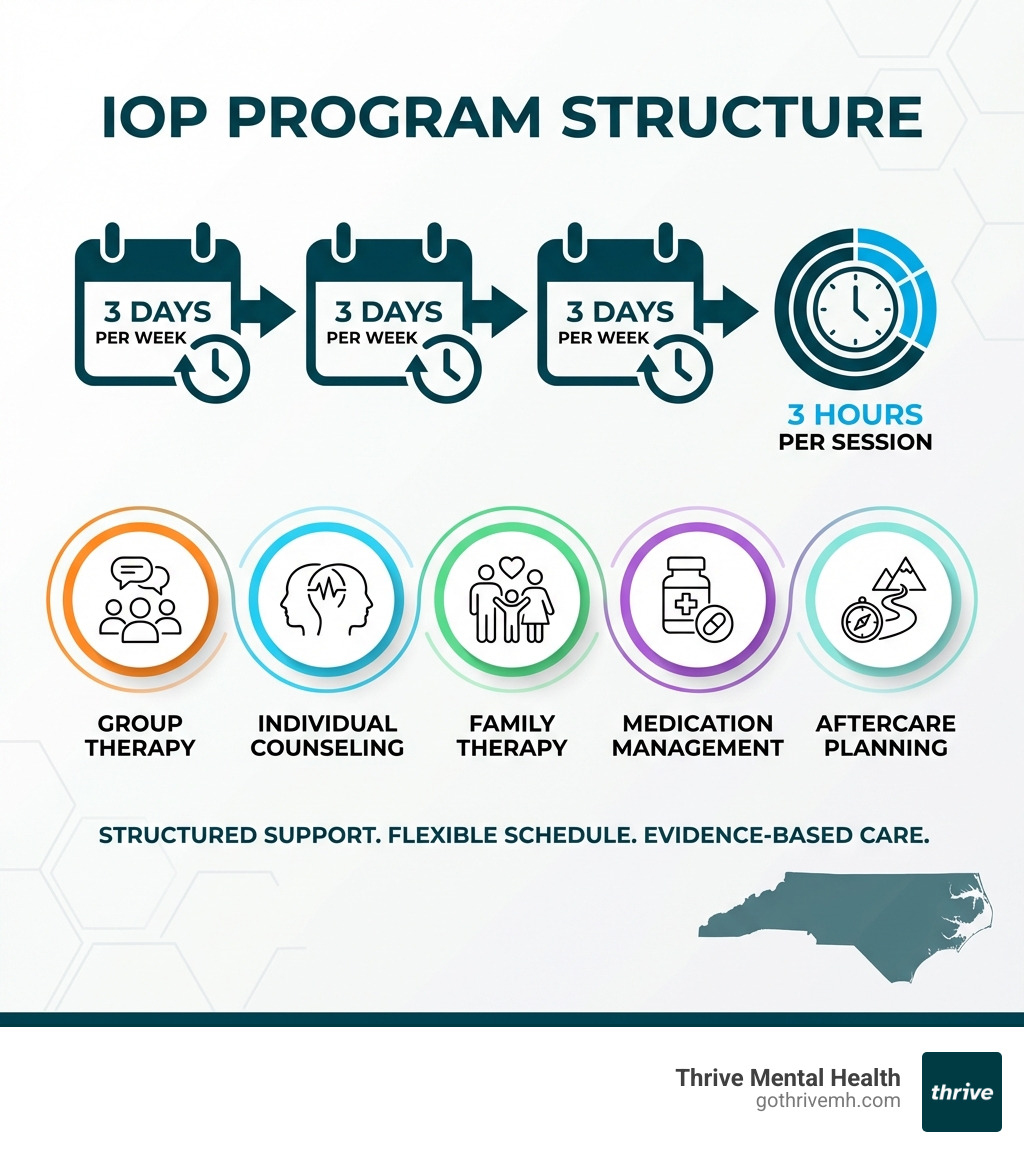
Most top-rated IOPs in Florida run for 3 days a week, with 3-hour sessions, over an 8–12 week period. They are designed to treat depression, anxiety, PTSD, and substance use disorders. Critically, they address these issues at the same time, which is vital since research shows that 80% of people with PTSD have an additional diagnosis.
Thrive Mental Health delivers virtual and hybrid IOP and PHP programs across Florida, providing expert care that fits your life. Whether you need the convenience of online treatment or prefer an in-person setting, our flexible online therapy options and virtual behavioral health services ensure you can get help without long waitlists or geographical barriers.
I’m Nate Raine, CEO of Thrive Mental Health. Over the past decade, I’ve led behavioral health innovation across five states, building high-performing IOP and PHP programs that integrate virtual and in-person care. My mission is to help you cut through the noise, avoid costly mistakes, and find a program that actually works for your life—especially if you’re in Florida and need access to the best care available through our in-person, hybrid, or virtual IOP and PHP programs.
If you feel like your symptoms are getting louder while your support stays the same, you do not have to keep white-knuckling it alone. The rest of this guide will show you exactly how to find—and start—the best IOP in Florida for your situation, including how to use insurance, what questions to ask, and how virtual options can get you help fast.
Stop Wasting Time: How to Find the Best IOP in Florida—Fast
Are you struggling with your mental health and exhausted by dead ends? Have you tried therapy that felt like it went nowhere, or bounced between providers who never really understood you? The right Intensive Outpatient Program (IOP) can be the catalyst that changes your life—but only if you know how to find it and avoid the programs that just go through the motions.
The search itself can be overwhelming, filled with confusing jargon, long waitlists, and programs that overpromise and underdeliver. This no-nonsense guide gives you 5 proven steps to cut through the noise, avoid costly mistakes, and identify the best IOP in Florida for your specific needs.
You will learn how to:
- Decide if IOP is actually the right level of care for you (and what to do if it is not).
- Spot red flags in IOP marketing and focus on what actually drives results.
- Use insurance—Cigna, Optum, Blue Cross Blue Shield, Aetna, and more—to keep costs down.
- Weigh in-person Florida options against trusted virtual IOP and IOP programs to find the best fit for your schedule and location.
- Make sure you have a plan for what happens after IOP so you do not feel abandoned on discharge day.
Do not settle for a program that does not fit your symptoms, schedule, or financial reality. Your recovery, your future, and your well-being are on the line. This is your roadmap to getting it right.
1. Know If IOP Is What You Actually Need—Don’t Waste Weeks in the Wrong Program
Not every program is right for every person. Choosing the wrong level of care is one of the most common—and most painful—mistakes in mental health treatment. It wastes your time, your money, and, worst of all, your hope.
IOP is specifically designed for individuals who need more structure and support than weekly therapy can provide, but who do not require 24/7 medical supervision in an inpatient facility. Getting this right from the start is the single most important step toward a successful recovery.
IOP vs. PHP vs. Inpatient vs. Outpatient—What’s the Difference?
Understanding where IOP fits in the continuum of care helps you ask better questions when you call programs in Florida or explore our trusted virtual and hybrid options.
-
Inpatient Treatment: This is the highest and most intensive level of care. It provides 24/7 medical supervision and psychiatric support within a secure, residential facility. Inpatient is essential for individuals experiencing acute symptoms, a severe crisis, or who may be a danger to themselves or others. The goal is stabilization in a highly structured environment, with patients living at the facility for the duration of their treatment.
-
Partial Hospitalization Program (PHP): Often called “day treatment,” PHP is a step down from inpatient care. It offers a full day of structured therapy, typically 5 days a week (20+ hours), but allows you to return home in the evenings. PHP is ideal for those who need intensive daily support to manage symptoms and build skills but have a stable and supportive home environment. It provides a bridge between 24/7 care and more independent living. Thrive offers PHP in Florida, both in-person and through virtual PHP options, so you can access this level of care throughout the state.
-
Intensive Outpatient Program (IOP): An IOP offers a more flexible but still structured approach. Clients typically attend treatment for 3–5 days a week for about 3 hours per session (9–12 hours total). This model is powerful because it allows you to immediately practice the coping skills you learn in therapy in your real-world environment—at home, work, or school. It is ideal for people stepping down from PHP or for those for whom weekly therapy is not enough. Thrive’s Intensive Outpatient Program is available virtually and in-person across Florida, giving residents multiple paths to care when local programs are full or not a good fit.
-
Outpatient Therapy: This is the most common and least intensive level of care, usually involving weekly or bi-weekly one-hour sessions with a therapist or counselor. It is best suited for individuals with mild to moderate symptoms, those who have already completed a higher level of care and are focused on maintenance, or those looking to manage everyday life stressors.
Step-Down Care Explained
Effective recovery is not a single event; it is a process. IOPs are a critical component of the “continuum of care,” often serving as a “step-down” to help individuals transition from a more intensive setting back into their daily lives.
For example, someone might:
- Complete a 5–10 day inpatient stay in Florida for stabilization if they are in acute crisis.
- Move to a PHP for several weeks—either at a local Florida center or through a program like Thrive’s virtual PHP—to build foundational skills and reduce the intensity of symptoms.
- Step down again to an IOP—at a Florida location or through a virtual IOP—where they continue practicing skills while taking on more responsibility at work, school, or home.
- Transition to standard outpatient therapy and peer support for long-term maintenance.
This gradual step-down is proven to reduce the risk of relapse and promote sustainable, long-term recovery by preventing the jarring shock of going from 24/7 support to just one hour a week.
| Treatment Level | Hours/Week | Living Situation | Typical Duration | Ideal Candidate |
|---|---|---|---|---|
| Inpatient | 24/7 | Residential Facility | Days to Weeks | In acute crisis, requires medical stabilization, or is a danger to self/others. |
| PHP | 20–25+ | At Home | 2–4 Weeks | Needs daily structure but is stable enough to live at home. Stepping down from inpatient. |
| IOP | 9–12+ | At Home | 8–12 Weeks | Needs more than weekly therapy but can manage work/school. Stepping down from PHP. |
| Outpatient | 1–2 | At Home | Ongoing | Stable symptoms, needs maintenance support, or managing life stressors. |
If you are not sure where you belong on this ladder, you do not have to guess. A free, confidential assessment with a program like Thrive can clarify whether IOP, PHP, or outpatient care is the safest next step for you.
What Does a Florida IOP Treat?
IOPs in Florida are equipped to handle complex, real-world problems—often more than one at a time. If you are dealing with depression, anxiety, trauma, or substance use, you need a program that can treat the whole you, not just one symptom in isolation.
The best programs specialize in:
- Mental health conditions: Depression, anxiety disorders, PTSD, bipolar disorder, and other mood disorders.
- Substance use disorders: Alcohol abuse, dependency on prescription drugs, or use of other substances.
- Dual diagnosis/co-occurring disorders: This is when a person has both a mental health condition and a substance use disorder. Treating both simultaneously is the gold standard for care, as one often fuels the other. In fact, according to the U.S. Department of Veterans Affairs, about 80% of people with PTSD have co-occurring conditions, making integrated treatment essential.
Many people in Florida also live with work stress, caregiving burnout, or academic pressure on top of clinical symptoms. The best IOPs weave these realities into treatment, offer family education, and coordinate with outpatient providers so you are not left to piece everything together alone.
Thrive’s mental health recovery program and our in-person and virtual IOP/PHP tracks in Florida are designed for adults and young professionals who need more than once-a-week therapy but less than inpatient care—and who want the flexibility to choose the format that best fits their life.