


What are the best online therapy services for young professionals? 2024 Relief
What Are the Best Online Therapy Services for Young Professionals? A Guide for the Stressed & Overworked
What are the best online therapy services for young professionals? The best platforms aren’t just apps, they are comprehensive support systems designed for your high-stakes career. They combine flexible scheduling that fits a 60-hour work week, licensed therapists who specialize in career stress and burnout, and robust insurance coverage to make care affordable. Instead of a generic directory, look for services that offer:
- Specialized Care: Therapists with proven experience in treating anxiety, burnout, and imposter syndrome common among ambitious professionals.
- Flexible Formats: Options for video, phone, or messaging, so you can connect on your terms, whether it’s during a lunch break or after hours.
- Insurance Integration: In-network coverage with major plans like Cigna, Optum, Florida Blue, and Aetna to minimize out-of-pocket costs.
- Higher Levels of Care: Access to Intensive Outpatient Programs (IOP) for when weekly therapy isn’t enough to manage high stress levels.
You’re not imagining it. Work is harder than it used to be. High-pressure jobs, 60-hour weeks, imposter syndrome, and toxic work cultures are driving 70% of young professionals to report anxiety, depression, or burnout. Traditional therapy doesn’t fit your schedule. You can’t take time off for appointments. You need help now, on your terms, without sacrificing your career.
That’s where online therapy comes in. It’s private, flexible, and proven to work. Research shows 70% of people see improvement in anxiety or depression within just 3 months of starting online therapy. Better yet, 98% of users find it more convenient than traditional in-person sessions, and 80% report it’s equally or more effective.
But not all online therapy services are built for ambitious professionals like you. Some platforms lack therapists who understand career stress. Others don’t accept insurance. And many don’t offer the level of care you need when weekly therapy isn’t enough.
This guide cuts through the noise. You’ll learn which platforms offer the best features for young professionals, how to vet therapists, what to expect with insurance, and when to step up to intensive outpatient programs (IOP) if you need faster results.
I’m Nate Raine, CEO of Thrive Mental Health, and I’ve spent over a decade building data-driven, tech-enabled solutions that make mental health care accessible and effective. I’ve seen how the best online therapy services for young professionals can transform lives, when they’re matched with the right platform, therapist, and level of care.
If you’re in crisis, call/text 988 right now. You are not alone.
Why Young Professionals Are Choosing Online Therapy Over Traditional Counseling

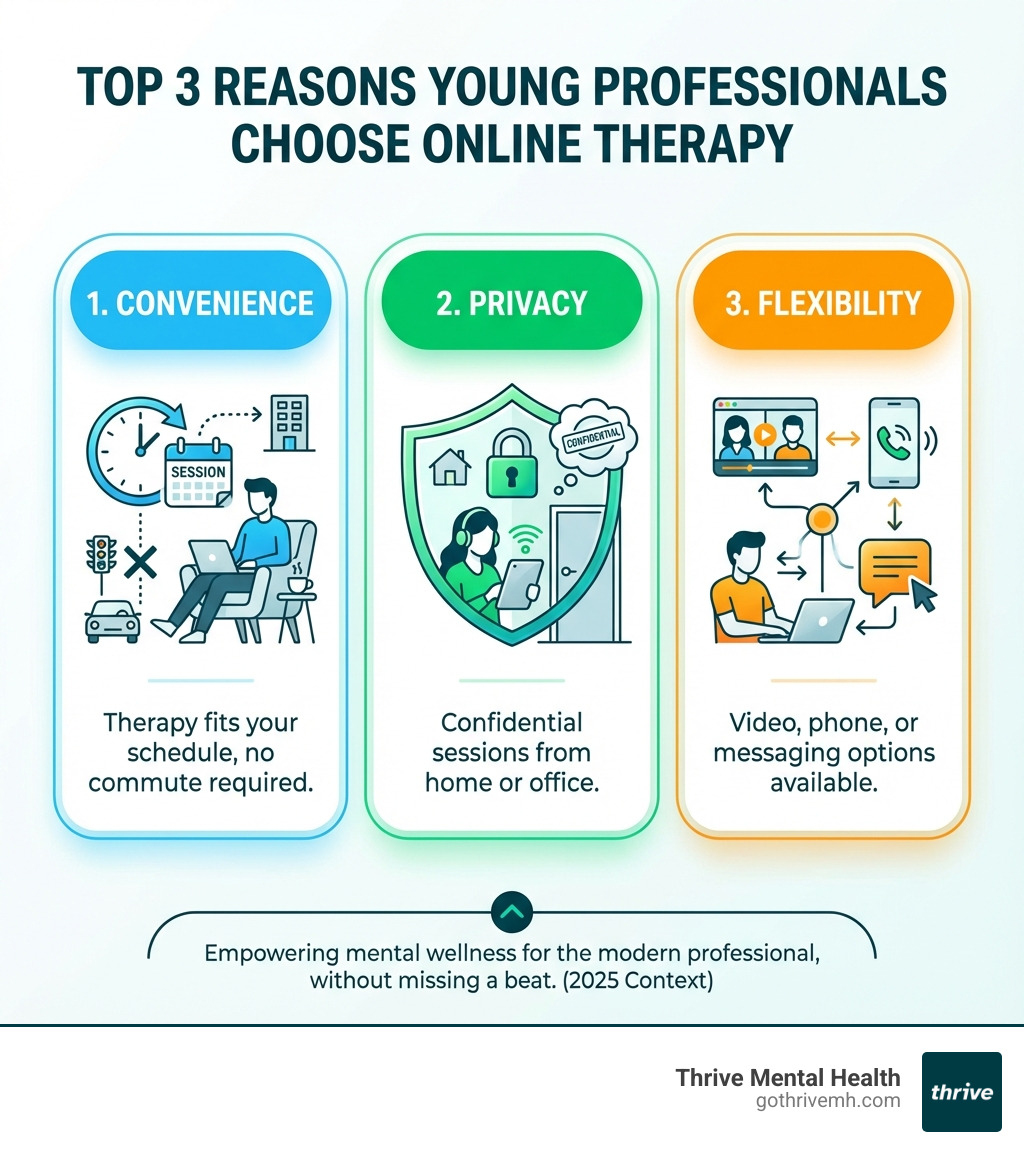
For today’s young professionals, the idea of traditional therapy, scheduling appointments, commuting to an office, and fitting it all into an already packed week, often feels like an impossible task. We know you’re juggling demanding careers, personal aspirations, and the ever-present pressure to succeed. It’s no wonder that 98% of users find online therapy more convenient than traditional in-person sessions. This isn’t just about saving time; it’s about making mental health support a realistic part of your life. Online therapy offers a solution that aligns with your lifestyle, providing the flexibility and discretion you need to prioritize your well-being without compromising your professional commitments.
Online Therapy can be a game-changer for individuals navigating the complexities of their early careers.
The Real Mental Health Challenges of Ambitious Careers
The journey of a young professional is often fraught with unique mental health challenges that can feel isolating. We’re talking about more than just everyday stress; we’re seeing:
- High-pressure jobs, long hours, and performance anxiety: The constant demand to excel can lead to chronic stress and a fear of failure, impacting self-worth.
- Navigating toxic work cultures and feeling isolated: Unsupportive environments, office politics, and a lack of genuine connection can breed feelings of loneliness and disengagement, even when surrounded by colleagues.
- Imposter syndrome: The pervasive feeling that you’re not good enough or that your achievements are undeserved, leading to constant self-doubt despite external success.
- Burnout: A state of emotional, physical, and mental exhaustion caused by prolonged or excessive stress, often characterized by feelings of cynicism and detachment from work.
- Work-life imbalance: The struggle to maintain personal well-being amidst overwhelming professional demands, leading to neglect of personal life, hobbies, and relationships.
These challenges aren’t just minor inconveniences; they can significantly impact your overall well-being and career trajectory. Understanding these pressures is the first step toward finding effective support.
Anxiety Symptoms and Their Impact on Daily Life
How Virtual Therapy Fits a 60-Hour Work Week
The beauty of virtual therapy lies in its unparalleled adaptability to your demanding schedule. Imagine this:
- No commute, after-hours appointments, lunch break sessions: You can literally step out of one virtual meeting and into a therapy session, then seamlessly transition back to work. No driving, no traffic, no wasted time. Many platforms offer evening and weekend appointments, making it feasible to get support without sacrificing precious work hours or personal time.
- Access from anywhere, total discretion: Whether you’re working from home in Phoenix, on a business trip in Los Angeles, or simply need a quiet moment in your office in Miami, your therapy session is just a click away. This level of discretion ensures your mental health journey remains private, eliminating any concerns about bumping into colleagues in a waiting room.
- Seamless integration into your digital life: For a generation that grew up with technology, online therapy feels natural. It leverages the communication methods you’re already comfortable with, video calls, messaging, and even phone calls, making the therapeutic process feel less daunting and more accessible.
This convenience is a major reason why 98% of users find online therapy more convenient than traditional in-person sessions. It breaks down barriers that have historically prevented busy professionals in Florida, California, Indiana, Arizona, and South Carolina from seeking the help they need.
What Are the Best Online Therapy Services for Young Professionals? [Your 2025 Checklist]

Choosing the right online therapy service can feel overwhelming, given the multitude of options available. For young professionals, it’s not just about finding any therapist; it’s about finding the best online therapy services for young professionals, ones that truly understand your unique pressures and can integrate seamlessly into your demanding life. Don’t waste time or money on platforms that don’t meet your specific needs. Here’s what to demand from any online therapy platform.
Must-Have Features for Your Career and Sanity
When evaluating online therapy platforms, look for these critical features that cater specifically to the young professional lifestyle:
- Flexible communication: video, chat, phone: You need options. Some days, a video session might be ideal; other days, you might prefer a quick chat message between meetings or a phone call during a commute. The best platforms offer multiple modalities, allowing you to switch based on your needs and availability. Research shows that having these varied options significantly increases user satisfaction and engagement.
- Therapists who specialize in career stress, anxiety, burnout: A generalist therapist might not fully grasp the nuances of imposter syndrome, workplace politics, or the pressure to perform at a high level. Seek platforms that allow you to filter for therapists with expertise in work-related issues, executive coaching, or specific modalities like CBT for stress management. This specialized knowledge ensures you’re getting targeted, relevant support.
- Easy scheduling, rescheduling, and a user-friendly platform: Time is your most valuable asset. A clunky interface or complicated booking process will only add to your stress. Look for intuitive platforms with clear calendars, automated reminders, and the ability to easily adjust appointments as your schedule shifts. The platform should feel like an extension of your professional tools, not a chore.
How to Vet Your Online Therapist: Don’t Get Burned
Your therapist is a critical partner in your mental health journey, so vetting them thoroughly is non-negotiable. Here’s how to ensure you’re in good hands:
- Licensed (LCSW, LMFT, LPC, PsyD) and state-verified: This is paramount. Every legitimate online therapist must be licensed to practice in your state (e.g., Florida, California, Indiana, Arizona, South Carolina). Verify their credentials on your state’s Department of Health website. Platforms typically require therapists to have a relevant academic degree, at least 3 years of experience, and at least 1,000 hours of hands-on experience.
- Experience with young professionals: Look for therapists whose bios mention experience with career development, leadership challenges, work-life balance, or specific industry pressures. This indicates they understand your world and can offer more relevant insights and strategies.
- Read reviews, bios, and check credentials: Don’t just pick the first available therapist. Dive into their profiles, read testimonials (if available), and ensure their therapeutic approach aligns with your preferences. Many reputable platforms have rigorous vetting processes, accepting fewer than 20% of therapists who apply, so trust but verify.
Scientific research on telemental health effectiveness
Subscription vs. Per-Session: What’s Best for Your Budget?
Understanding pricing models is key to making online therapy sustainable for your budget.
- Subscription plans vs. pay-per-session: Many leading online platforms operate on a subscription model, where you pay a weekly or monthly fee for a set number of sessions and/or unlimited messaging. This can range from $60-$120 per week or $95-$436 per month, depending on the platform and services. Other services offer a pay-per-session model, with costs ranging from $55-$184 per session. Consider your anticipated usage and financial predictability when choosing.
- Insurance coverage (Cigna, Optum, Florida Blue, Aetna): This is where online therapy often shines for affordability. Many major health insurance providers now cover virtual mental health services. Platforms that are in-network with popular plans like Cigna, Optum, Florida Blue, and Aetna can significantly reduce your out-of-pocket costs, often to just a copay (which can be as low as $0-$60 per session). Always verify your specific plan’s coverage before committing.
- Use HSA/FSA cards, ask about financial aid: Mental health care qualifies as an eligible expense for Health Savings Accounts (HSAs) and Flexible Spending Accounts (FSAs). Most platforms accept these cards directly. Additionally, some services offer financial aid or sliding scale fees for those who qualify, making therapy even more accessible. Don’t hesitate to inquire about these options.
Insurance Covered Online Therapy
Online vs. In-Office Therapy: Which Is Better for Busy Professionals?
The debate between online and in-office therapy often boils down to personal preference, but for busy young professionals, the scales frequently tip in favor of virtual options due to their inherent advantages in convenience and cost. Let’s look at the comparison side-by-side.
Virtual Therapy, A Convenient and Effective Approach to Counseling
| Feature | Online Therapy | In-Office Therapy |
|---|---|---|
| Effectiveness | Proven to be equally effective for most conditions (80% report it’s equally or more effective). | Highly effective, but consistency can be impacted by logistical barriers. |
| Convenience | No commute, flexible scheduling (anytime, anywhere), access from home/office. 98% find it more convenient. | Requires travel, fixed appointment times, potential for scheduling conflicts. |
| Cost | Often more affordable (e.g., $65-$100/week or $55-$184/session), better insurance coverage, HSA/FSA eligible. | Higher average costs ($100-$250/session), less likely to accept insurance upfront. |
| Privacy | High discretion (no waiting rooms), but requires secure internet connection and device. HIPAA compliant. | Complete separation of therapy space from daily life, but less anonymity in public settings. |
| Accessibility | Wider therapist selection, available in underserved areas (Florida, California, Indiana, Arizona, South Carolina). | Limited by local therapist availability and specialization. |
| Communication | Video, phone, chat, messaging between sessions. | Primarily face-to-face, limited communication between sessions. |
Online therapy effectiveness study

Does Online Therapy Actually Work? [The Data]
This isn’t just a trend; it’s a proven method for mental health support. The data is clear:
- Research: Online therapy is as effective as in-person: Multiple studies consistently validate that online therapy is just as effective as traditional face-to-face therapy for most mental health conditions. One study found that “online interventions produce outcomes comparable to face-to-face treatment.”
- 70%+ see symptom improvement: Incredible statistics show that 70% of people see improvement in anxiety or depression symptoms within just 3 months of starting online therapy. Furthermore, 80% of users report that their virtual sessions are as effective, or even more effective, than traditional in-person therapy.
- Evidence-based practices like CBT: Online platforms successfully deliver evidence-based treatments such as Cognitive Behavioral Therapy (CBT), Dialectical Behavior Therapy (DBT), and Interpersonal Psychotherapy (IPT). These modalities, proven to help individuals change thinking and behavioral patterns, translate beautifully to virtual formats, maintaining their therapeutic power while adding unprecedented accessibility.
Cost & Convenience: Save Time, Save Money, Get Better Faster
For young professionals, the value proposition of online therapy extends beyond just clinical effectiveness:
- Lower costs, no travel, fits any schedule: Online therapy significantly cuts down on overall costs. You save on gas, parking, and the time spent commuting, which for a busy professional, translates directly to money saved. The weekly cost of online therapy often ranges from $65 to $100, which can be considerably less than the $100 to $250 per session typically seen in traditional in-person settings. This affordability, combined with scheduling flexibility, means you can engage in consistent care, which is crucial for faster progress.
- Access in underserved areas (Florida, Indiana, Arizona, South Carolina, California): The traditional mental health landscape often presents significant access gaps, with only 31.64% of the United States having enough mental health practitioners to meet the population’s needs. This means over two-thirds of the US lives in an area where they do not have adequate mental health support. Online therapy bridges this gap, providing access to a wider pool of licensed therapists regardless of your physical location in states like Florida (Tampa, Miami, Orlando), Indiana (Indianapolis, Fort Wayne), Arizona (Phoenix, Scottsdale), South Carolina (Charleston, Columbia), or California (Los Angeles, San Francisco). You no longer have to compromise on quality or specialization just because of where you live.
Boost Your Career: Use Online Therapy to Beat Burnout and Get Ahead
Your career is a marathon, not a sprint. To truly excel and avoid the pitfalls of early-career burnout, investing in your mental health isn’t a luxury, it’s a strategic move. Online therapy provides the tools and support you need to manage stress, build resilience, and open up your full professional potential. Career growth starts with mental health. Learn proven strategies to manage stress, prevent burnout, and build resilience.
From Burnout to Breakthrough: Real Strategies for Workplace Wellness
Online therapy equips you with actionable strategies to steer the modern workplace:
- Coping with work stress, setting boundaries, managing anxiety: Therapists can help you identify triggers, develop healthy coping mechanisms, and learn to assertively set boundaries with colleagues and managers. This prevents work from spilling over into every aspect of your life and helps manage the anxiety that often accompanies high-stakes environments.
- Overcoming imposter syndrome: Through techniques like Cognitive Behavioral Therapy (CBT), you can challenge the negative thought patterns that fuel imposter syndrome, build self-compassion, and internalize your successes. This shift in mindset can boost your confidence and allow you to own your achievements.
- Developing resilience: Therapy fosters emotional resilience, teaching you how to bounce back from setbacks, adapt to change, and maintain a positive outlook even amidst professional challenges. These are invaluable skills for long-term career success.
The Future of Therapy: Tech, AI, and Your Mental Health Toolkit
Technology isn’t just making therapy more accessible; it’s enhancing the entire mental health toolkit available to you:
- AI-powered chatbots (pros/cons), digital journaling, guided worksheets, mindfulness apps: Many platforms now integrate AI tools that can provide immediate support, help you identify emotional patterns, or guide you through quick mindfulness exercises. While AI chatbots can offer private, non-judgmental support and help with problem-solving, they are not a substitute for human therapists. They can be a valuable supplement for between-session support, alongside digital journaling features, guided worksheets for practicing new skills, and meditation apps.
- Personalized content and self-help resources: Beyond live sessions, many online services offer a wealth of personalized content, meditations, and sleep tools accessible through their apps. These resources empower you to continue your growth and practice coping skills outside of your scheduled therapy time, making your progress more consistent and lasting.
- Seamless experience: The best online therapy services leverage technology to provide a seamless, integrated experience, from easy therapist matching and scheduling to secure communication and access to supplementary resources. This digital ecosystem is designed to support your mental health journey efficiently and effectively.
HIPAA Compliant Online Therapy
FAQs: Best Online Therapy for Young Professionals, What You Need to Know
Is online therapy really private and secure?
Yes. Top platforms are HIPAA-compliant, your data and sessions are protected by law. This means your personal health information (PHI) is safeguarded. While some older platforms faced scrutiny for data sharing, reputable services have significantly improved their privacy standards. Always check privacy policies carefully, especially for services operating in Florida, California, Indiana, Arizona, and South Carolina, to understand how your data is collected and used. Attend sessions in a private space using a secure internet connection for optimal privacy.
Can I get medication through online therapy?
Yes, but it’s important to understand the distinction. Therapy is provided by licensed counselors (LCSW, LMFT, LPC, PsyD) who cannot prescribe medication. However, many online services offer integrated care, allowing you to connect with a psychiatrist or a psychiatric provider (MD) who can conduct evaluations, prescribe medication, and manage your ongoing care. If you believe medication might be beneficial, look for platforms that offer both therapy and psychiatry services.
How much does online therapy cost with insurance?
Costs vary significantly depending on your insurance plan and the platform. Many services are in-network with major providers like Cigna, Aetna, Optum, and Florida Blue. Your out-of-pocket expense could be as low as a standard copay (often $0-$60 per session). Always verify your specific plan’s mental health benefits and coverage for telehealth services before starting. You can usually do this by calling the number on your insurance card or using the platform’s insurance verification tool.
What if I need more than once-a-week therapy?
For young professionals facing high stress, significant burnout, or mental health challenges that require more intensive support than weekly therapy, options like Intensive Outpatient Programs (IOP) or Partial Hospitalization Programs (PHP) are available. Thrive Mental Health offers virtual IOP programs with evening options designed for individuals who need structured, multi-session-per-week care but less than inpatient hospitalization. These programs combine clinical expertise, flexible scheduling, and measurable results to accelerate your progress.
Can I use online therapy if I live in a rural area?
Absolutely. One of the greatest advantages of online therapy is its ability to eliminate geographic barriers. If you live in a rural area in Florida, California, Indiana, Arizona, or South Carolina, accessing specialized mental health care can be challenging. Thrive’s virtual programs are available across these states, connecting you with licensed therapists and structured programs regardless of your location, ensuring you receive quality care without the need for extensive travel.
Summary: The Best Online Therapy Services for Young Professionals, What You Gain (and Lose If You Wait)
For ambitious young professionals navigating demanding careers, what are the best online therapy services for young professionals? They are the ones that seamlessly integrate into your life, offering flexibility, specialized support, and genuine effectiveness. We’ve seen that online therapy is the fastest, most flexible way for young professionals to manage stress, prevent burnout, and build resilience, without sacrificing your career. You gain convenience, affordability, and access to a wider network of specialized therapists, all proven to deliver results comparable to traditional in-person care.
The choice is clear: choose a service that fits your needs, schedule, and insurance. Don’t wait: the longer you delay, the more you risk your health, your job, and your future. Taking proactive steps now can prevent minor stressors from escalating into major crises, safeguarding your well-being and propelling your career forward.
Ready for support? Thrive offers virtual IOP programs with evening options. Verify your insurance in 2 minutes (no obligation) → Start benefits check or call 561-203-6085. If you’re in crisis, call/text 988.

This article is for informational purposes only and is not a substitute for individualized clinical advice or insurance verification.