






What Are the 4 Types of OCD? [2025] Fast Relief, Real Examples, and What to Do Next
OCD drains time, energy, and money. If you’re stuck washing, checking, arranging, or battling taboo thoughts, you’re not alone, 1.2% of U.S. adults are living this right now. Don’t let it steal another month.
In 5 minutes, you’ll learn:
- The 4 types of OCD (with plain examples)
- How to spot your pattern fast
- The treatment that cuts symptoms by 40-60% on average (ERP)
- How to start care quickly (virtual, IOP, or PHP) and use your insurance
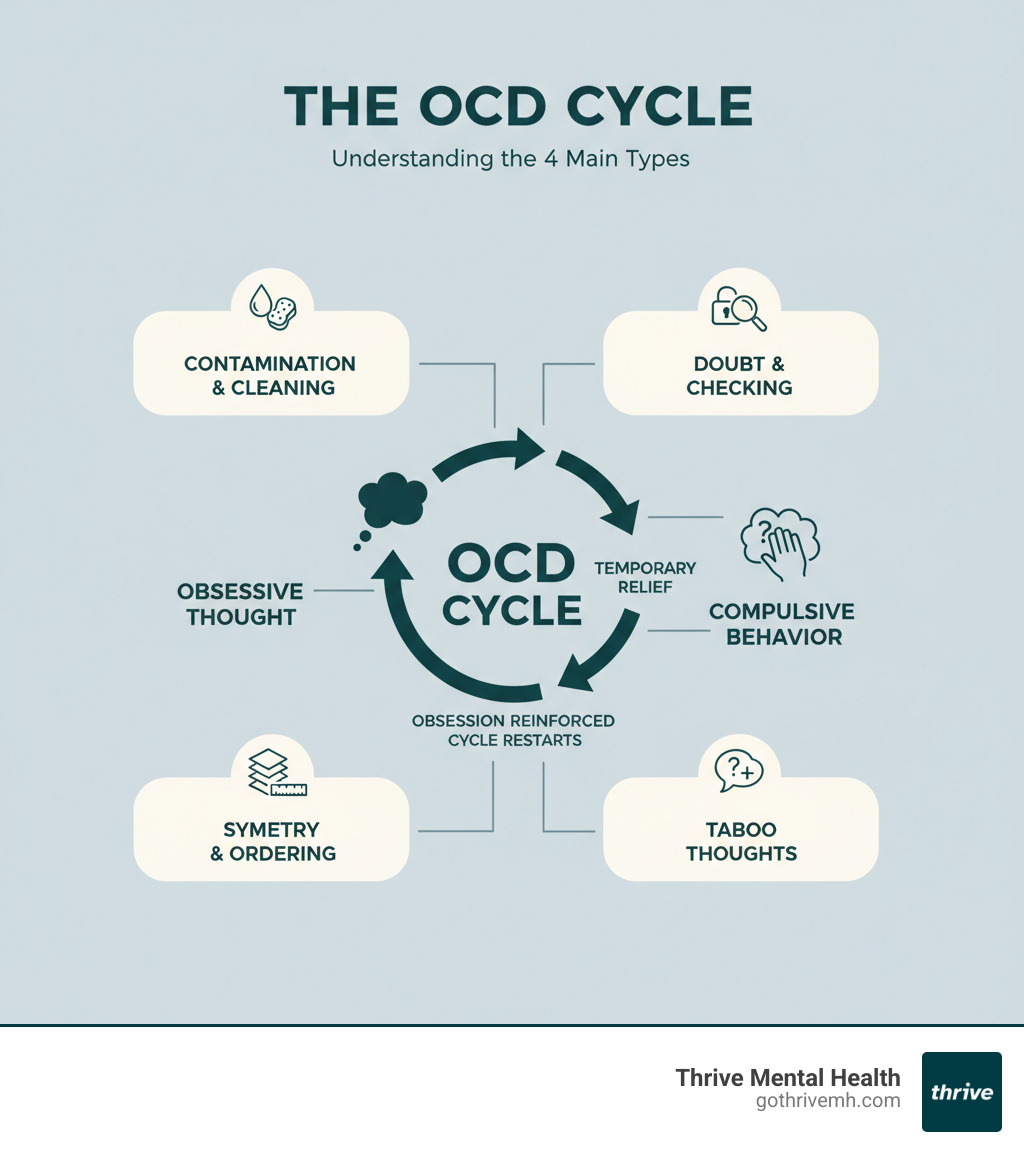
The four main categories are:
- Contamination & Cleaning: Fear of germs or dirt leading to excessive washing.
- Doubt, Harm & Checking: Fear of causing accidental harm leading to repeated checking.
- Symmetry, Ordering & “Just Right”: A need for exactness leading to arranging and counting rituals.
- Taboo & Intrusive Thoughts: Unwanted violent, sexual, or religious thoughts leading to mental rituals.
OCD is a cycle: an intrusive thought (obsession) spikes anxiety, driving a ritual (compulsion) for brief relief, then the obsession returns stronger.
Bottom line: Understanding what are the 4 types of OCD helps you ask for the right care, ERP-based treatment that breaks the cycle and gives you your time back.
Find more about what are the 4 types of ocd:
First, A Reality Check: Are OCD “Types” Official Diagnoses?
When we discuss what are the 4 types of OCD, we’re not talking about official medical diagnoses. The DSM-5-TR, the diagnostic manual used by mental health professionals across the U.S., including our OCD specialists in Florida, doesn’t divide OCD into separate types. Instead, it recognizes that symptoms cluster around common themes, which researchers call “symptom dimensions.”
These dimensions are a practical framework for understanding how OCD manifests. Scientific research confirms that obsessions and compulsions naturally group into these recognizable patterns. Regardless of the pattern, the core of OCD is the same: obsessions (unwanted, intrusive thoughts causing anxiety) and compulsions (repetitive behaviors or mental acts to reduce that anxiety).
The DSM-5-TR also uses “specifiers” to add detail to a diagnosis:
- Insight Specifiers: These describe a person’s awareness that their OCD beliefs are irrational. Insight can be “good/fair,” “poor,” or “absent/delusional.”
- Tic-Related Specifier: This is used for individuals with a current or past history of a tic disorder, which affects up to 30% of people with OCD.
So, the four types are symptom clusters, not rigid boxes. They are guideposts to help you and your therapist understand your experience and find the right treatment.
What Are the 4 Types of OCD?
Now that we understand that “types” refer to symptom dimensions, let’s dive into the four main categories. What are the 4 types of OCD? They’re not separate diseases, they’re common patterns of obsessions and compulsions identified through decades of scientific research and clinical practice, offering a valuable lens to understand the disorder.
Type 1: Contamination & Cleaning

This is the most recognized form of OCD. The core obsession isn’t about cleanliness but the catastrophic fear of what contamination could cause.
Common Obsessions:
- Fear of germs, bacteria, viruses, or dirt
- Worry about bodily fluids, chemicals, or asbestos
- Feeling “mentally contaminated” by contact with “bad” people or places
Common Compulsions:
- Excessive hand washing, showering, or grooming rituals
- Compulsive cleaning of household objects
- Avoiding crowds, public restrooms, hospitals, or touching doorknobs
- Seeking reassurance about cleanliness
The anxiety from touching a “contaminated” object can be so overwhelming that it triggers hours of compulsive cleaning, disrupting work, relationships, and daily life.
Type 2: Doubt, Accidental Harm & Checking

This type is driven by an inflated sense of responsibility and the terror of causing harm through carelessness. The obsession is a persistent, nagging doubt that something is wrong.
Common Obsessions:
- Fear of leaving the stove on, doors unlocked, or appliances running
- Worry about having hit someone with a car
- Concern about making a catastrophic mistake at work
Common Compulsions:
- Repeatedly checking locks, appliances, and light switches
- Driving back to check for an accident
- Mentally reviewing past actions to ensure safety
- Seeking reassurance that no harm was done
The cruel irony is that checking provides only fleeting relief before the doubt returns, creating an exhausting cycle that can make leaving the house a monumental task.
Type 3: Symmetry, Ordering & “Just Right” Feelings

This isn’t perfectionism; it’s an overwhelming internal pressure that things are “wrong” or “incomplete” unless they are perfectly balanced, symmetrical, or exact.
Common Obsessions:
- A need for objects to be perfectly aligned or ordered
- Intense discomfort with asymmetry or imbalance
- A feeling that things are “not right”
- Superstitious fears that something bad will happen if things aren’t perfect
Common Compulsions:
- Arranging and rearranging items for hours
- Counting rituals (e.g., performing an action a “safe” number of times)
- Repeating actions until they “feel right”
- Compulsive slowness, as simple tasks must be performed perfectly
The distress from something being “off” can be all-consuming, leading to significant delays and an inability to move on with the day until the “just right” feeling is achieved.
Type 4: Taboo, Unacceptable & Intrusive Thoughts
If you’re having thoughts of harming yourself or others, or thoughts of suicide, call or text 988 now.
If you’re in crisis, call/text 988 right now. You are not alone.

Often the most isolating type, these obsessions are disturbing and go completely against your values (ego-dystonic). Because the compulsions are often mental, it’s sometimes called “Pure O.”
Crucially, these intrusive thoughts do not reflect your true desires. They are symptoms of OCD.
Common Obsessions:
- Violent Thoughts: Unwanted urges or images of harming yourself or others.
- Sexual Thoughts: Intrusive sexual images or doubts about your orientation (SO-OCD) or fears related to children (POCD).
- Religious Obsessions (Scrupulosity): Excessive worry about sin, blasphemy, or morality.
- Existential Obsessions: Persistent, distressing worries about reality or the meaning of life.
The core fear is, “What if these thoughts mean I’m a bad person?” The compulsions are often invisible mental rituals like praying, counting, mentally reviewing events, or seeking reassurance to neutralize the thought. The shame is immense, but specialized therapists see these symptoms daily. At Thrive Mental Health, our clinicians, with specialized teams right here in Florida, are trained to treat intrusive thoughts with ERP, understanding they are symptoms, not desires.
 When Thoughts Turn Dark: Active vs Passive SuicidalityMental Health
More info about intrusive thoughts in OCD
Beyond the “Big Four”: Other OCD Manifestations & Overlaps
The four main types are a framework, not the full picture. Many people experience overlapping themes, or find their symptoms don’t fit neatly into one category. OCD often attacks what you value most, if you cherish relationships, it might manifest as Relationship OCD.
Other common manifestations include:
- Relationship OCD (ROCD): Relentless obsessions about whether your relationship is “right” or if you truly love your partner, leading to constant mental checking and reassurance seeking.
- Perinatal/Postpartum OCD: Intrusive thoughts about harming your baby, contamination fears, or checking rituals that emerge during pregnancy or after childbirth.
- Existential OCD: Distressing, looping questions about the meaning of life, reality, or consciousness that feel impossible to solve.
What about Hoarding OCD vs. Hoarding Disorder?
While they can look similar, the motivation is different. In OCD-related hoarding, saving items is a compulsion to prevent a feared catastrophe (e.g., “If I throw this away, something terrible will happen”). In Hoarding Disorder, a separate diagnosis, the distress comes from the act of parting with the items themselves, due to a perceived need to save them.
Can OCD Themes Overlap or Change Over Time?
Yes. OCD is notorious for the “whack-a-mole” effect: as you get one theme under control, another may pop up. Life stressors like a new job, a move, or parenthood can trigger new obsessions.
This is why effective treatment is so critical. Therapies like Exposure and Response Prevention (ERP) don’t just treat one obsession. They teach you how to break the underlying OCD cycle itself. You build skills to manage the pattern of obsession, anxiety, and compulsion, no matter what theme OCD throws at you next.
From Diagnosis to Results: Get the Right OCD Treatment Fast [ERP, IOP, Virtual]
The constant anxiety, guilt, and exhaustion of OCD can be crushing, often leading to depression and isolation. Physical symptoms like tension headaches or skin damage from washing are also common.
This is why a professional diagnosis is crucial. Self-diagnosis is risky, as OCD symptoms can overlap with other anxiety disorders. A qualified therapist specializing in OCD can provide an accurate assessment, helping you understand your specific symptom patterns and rule out other conditions. The best news? Treatment is effective for all types of OCD.
More info about how to treat OCD
How to Know Which Type of OCD You Might Have
To identify your potential OCD type, start by observing your symptom patterns. Notice the themes of your intrusive thoughts and the specific rituals you perform to ease the anxiety. Journaling can help reveal these patterns, providing valuable information for a therapist.
However, the most important step is a professional evaluation. An OCD specialist can conduct a thorough assessment, often using tools like the Yale-Brown Obsessive-Compulsive Scale (Y-BOCS), to clarify your diagnosis and severity.
The Gold Standard: How ERP & CBT Target All OCD Types

Regardless of your OCD type, the most effective treatments target the underlying cycle of obsessions and compulsions.
- Exposure and Response Prevention (ERP): Gradually face triggers while resisting compulsions. Many see meaningful relief within weeks; sustained gains build over sessions.
- Cognitive Behavioral Therapy (CBT): Challenge distorted beliefs and learn skills to respond differently to thoughts and urges.
For many, combining therapy with medication like SSRIs provides the best results. At Thrive Mental Health, we specialize in virtual intensive outpatient (IOP) programs that use ERP and CBT to help you get results faster. Our Florida centers offer both virtual and in-person programs and accept major insurance plans, including Florida Blue, Cigna, and Optum.
Next steps for Florida residents (choose what fits your life):
- Start an Intensive Outpatient Program (IOP)
- Explore Partial Hospitalization (PHP)
- Prefer remote care? Try Virtual Therapy
- Check coverage now: Verify Insurance
More info about Cognitive Behavioral Therapy (CBT)
Frequently Asked Questions about OCD Types
What is the most severe type of OCD?
Severity isn’t about the theme; it’s about impact. Any type can be severe if it eats hours of your day or disrupts work, school, or relationships.
Can you have all 4 types of OCD?
Yes. Themes overlap and can shift over time. ERP builds skills that work across all themes.
Is OCD treatment covered by insurance?
Often, yes. In Florida, many plans from major insurers like Florida Blue, Cigna, and Optum/United cover OCD care, including our virtual IOP. Verify Insurance.
How fast does ERP work?
Many people feel relief in weeks; structured courses commonly run 12-20+ sessions, with continued progress after.
Do I need medication for OCD?
Not always. ERP is first-line. Some people add SSRIs for extra benefit, your clinician can help decide what’s right for you.
Your OCD Type Doesn’t Define Your Recovery
Understanding what are the 4 types of OCD, Contamination & Cleaning, Doubt & Checking, Symmetry & Ordering, and Taboo Thoughts, gives you the language to get targeted, effective help.
Your theme doesn’t control your outcome. ERP-based care works across types to break the cycle of obsession, anxiety, and compulsion so you can get your time back.
Ready for support? Thrive offers specialized OCD treatment in Florida through our virtual IOP programs with evening options. Verify your insurance in 2 minutes (no obligation) → Start benefits check or call our Florida-based team at 561-203-6085. If you’re in crisis, call/text 988.

This article is for informational purposes only and is not a substitute for individualized clinical advice or insurance verification.