






Why Your Family’s Past May Be Shaping Your Present
Generational trauma is the invisible weight passed down from ancestors who survived severe trauma. It’s why you might feel anxious, hypervigilant, or emotionally numb without a clear cause in your own life. The pain didn’t start with you, but the healing can.
Quick Answer: What is Generational Trauma?
- What it is: Emotional and psychological wounds passed down from ancestors who experienced trauma like war, abuse, or discrimination.
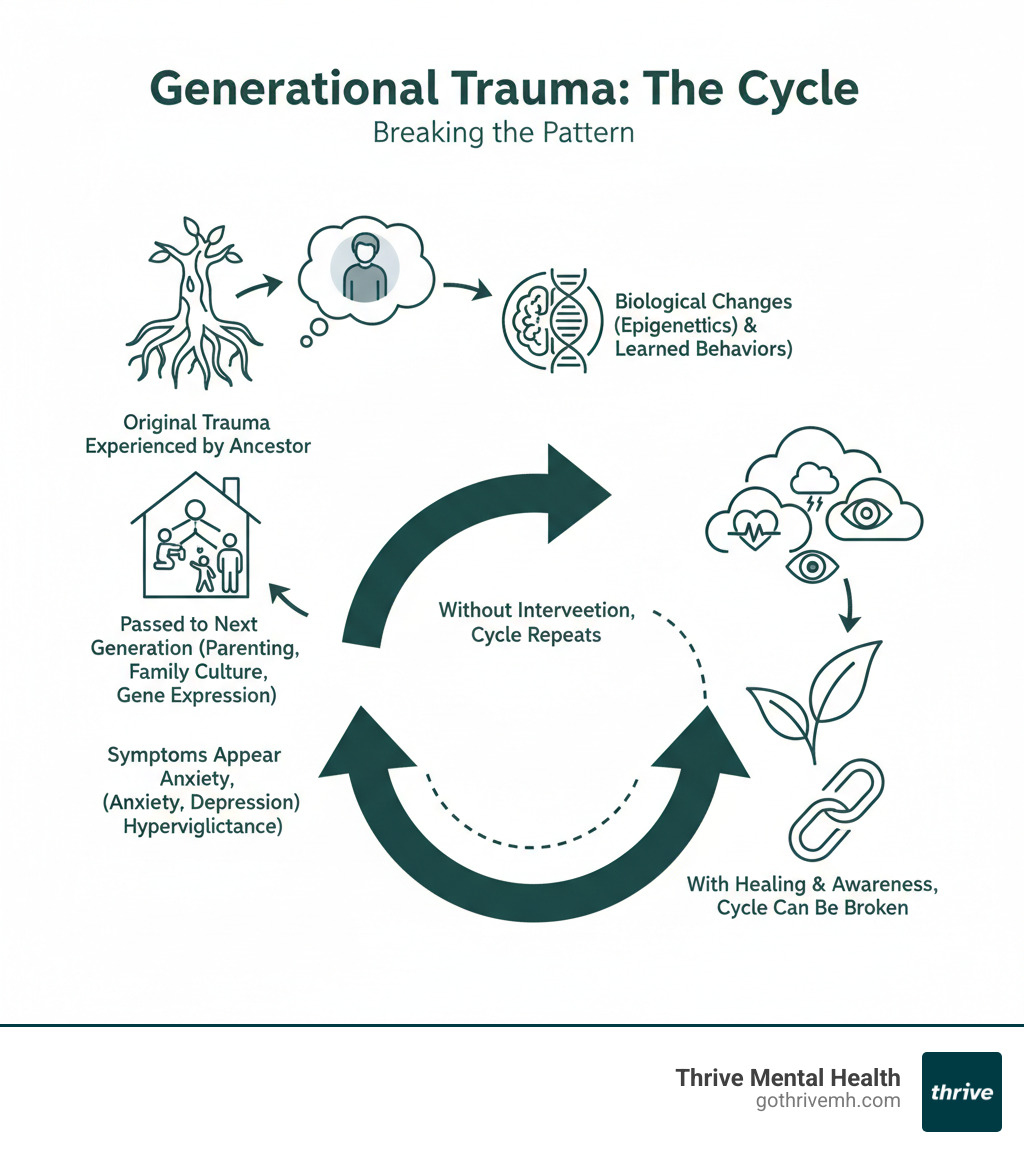
- How it spreads: Through biological changes (epigenetics), learned behaviors, and family patterns.
- Common signs: Unexplained anxiety, depression, hypervigilance, emotional numbness, and relationship issues.
- Who it affects: Descendants of Holocaust survivors, enslaved peoples, Indigenous Peoples, refugees, and any family with unresolved trauma.
- Can you heal? Yes. Awareness and evidence-based therapy can break the cycle.
If you feel like you’re carrying something that isn’t yours, you’re not imagining it. The trauma your grandparents experienced can live on in your body and mind. But understanding this is the first step to breaking the cycle. You can heal what you didn’t cause and stop the pattern from reaching the next generation.
As Nate Raine, CEO of Thrive Mental Health, I’ve seen thousands of people use our programs to break these inherited patterns. At Thrive, we build evidence-based care that addresses complex issues like generational trauma, helping people build healthier futures.
Related content about generational trauma:
What Is Generational Trauma (And How Do You Know If You Have It?)
Picture looking in a mirror and seeing your mother’s worry lines or your grandfather’s guarded eyes. That’s what generational trauma feels like: carrying emotional weight that didn’t start with you.

Also called intergenerational or historical trauma, it’s what happens when the psychological wounds of one generation are passed to the next. You don’t inherit memories; you inherit the effects of what your ancestors survived. These effects show up as unspoken family rules (“we don’t talk about feelings”), parenting styles, and a sense that the world isn’t safe, even when you are. As the American Psychological Association notes, the legacy of trauma shapes families for decades.
The concept gained traction in 1966 when studies of Holocaust survivors’ children revealed they had high rates of anxiety and depression, despite growing up in safety. They carried the unresolved grief of their parents. This pattern is seen in descendants of enslaved peoples, Indigenous communities, refugees, and families marked by abuse or oppression. It’s not just about sad stories; it’s about how suffering changes family dynamics, communication, and even biology.
Unmistakable Signs and Symptoms of Generational Trauma
Generational trauma often feels like it’s just “how you are.” But these patterns have a source. Here’s what to look for:
- Unexplained Anxiety and Depression: A constant sense of dread or sadness that doesn’t match your current life circumstances.
- Hypervigilance: Always feeling on alert, unable to relax, and scanning for danger even in safe environments.
- Mistrust of Others: Difficulty forming close, trusting relationships, often keeping people at a distance.
- Emotional Numbness: Feeling detached from your own emotions or other people, as if you’re watching life from a distance.
- Relationship Difficulties: Repeating dysfunctional or chaotic patterns in relationships without understanding why.
- Poor Self-Esteem: A deep, persistent feeling of being flawed or not good enough, rooted deeper than your own experiences.
- Substance Use: A way to numb emotional pain or quiet anxiety that feels unmanageable.
- A Sense of a Foreshortened Future: Difficulty imagining a long, thriving future, as if expecting disaster.
Many of these symptoms overlap with post-traumatic stress disorder (PTSD). Your body is responding to trauma, it just happens to be trauma that occurred before you were born. Recognizing this is key to understanding that these are not personal failings, but inherited survival responses.
The Invisible Inheritance: How Trauma Crosses Generations
Trauma’s ability to cross generations isn’t mystical; it’s a combination of biology, psychology, and social learning. As child and adolescent psychiatrist Dr. Gayani DeSilva explains, “Trauma changes us on a cellular level, and those changes can be passed on.” It travels through three main pathways.

1. The Science of Inherited Stress: Epigenetics
Epigenetics explains how trauma can literally change the way your genes work. While your DNA code doesn’t change, severe stress can flip genetic “switches” on or off. This affects functions like your body’s stress response system. Pioneering research on children of Holocaust survivors showed that these epigenetic changes can be passed down. This means you can inherit a biological tendency for a heightened stress response, making you react to daily stressors as if they were life-threatening, all because of what your ancestors endured.
2. Psychological and Social Transmission
Biology isn’t the only pathway. The emotional environment created by traumatized parents is just as powerful.
- Parenting Styles: A parent with unresolved trauma may struggle to be emotionally present or may be overly protective, shaping their child’s sense of safety and attachment.
- Attachment Theory: Children develop their core sense of trust based on caregiver responses. A parent numbed by their own trauma may struggle to provide the consistent care needed for a child to feel secure.
- Family Silence: When traumatic events are never discussed, children absorb the unspoken anxiety. This silence creates a void filled with fear and confusion, which research shows can perpetuate trauma across generations.
3. How Systemic Issues Fuel Generational Trauma
Generational trauma is magnified by social forces like systemic racism and oppression. For marginalized communities, trauma isn’t just a past event; it’s an ongoing reality.
Dr. Joy DeGruy’s term “Post Traumatic Slave Syndrome” describes how centuries of brutal oppression created survival behaviors that persist today in African American communities. Similarly, Indigenous Peoples in Florida carry the trauma of colonization and forced assimilation.
Systemic issues like healthcare disparities, poverty, and discrimination create chronic stress while blocking access to healing. This isn’t just about individual family dynamics; it’s about surviving in systems that cause harm and passing down the wounds along with the survival strategies.
The Ripple Effect: Trauma’s Impact on Health, History, and Childhood
The effects of generational trauma spill over from your mind into your body. As clinical psychologist Dr. Amanda Broderick states, “The body keeps the score across generations, manifesting psychological pain as physical ailments.” When your ancestors lived in a constant “fight or flight” state, it could alter their stress hormones and immune systems. Descendants may face higher risks for heart disease, autoimmune disorders, and chronic pain as a result. Your anxiety isn’t just in your head; your body is carrying the weight.

Real-World Examples of Affected Groups
While any family can be affected, certain communities carry a collective burden:
- Holocaust survivors’ descendants show increased rates of PTSD and anxiety.
- Indigenous Peoples carry the trauma of genocide, forced relocation, and cultural erasure.
- African Americans live with the ongoing legacy of slavery, Jim Crow, and systemic racism.
- Refugees from war-torn countries often raise children who struggle with hypervigilance and mistrust.
- Families of combat veterans feel the effects of a parent’s invisible wounds, like PTSD, which shapes the entire family’s emotional landscape.
The Link Between Adverse Childhood Experiences (ACEs) and Trauma
Generational trauma often creates the conditions for Adverse Childhood Experiences (ACEs), traumatic events in childhood like abuse, neglect, or witnessing violence. The landmark ACEs study proved these experiences dramatically increase the risk for chronic disease and mental illness later in life. A parent battling their own inherited trauma may, despite their best intentions, create an environment where ACEs are more likely. This is how the cycle continues, with each generation’s trauma compounding the last.
Building Resilience with Positive Childhood Experiences (PCEs)
But there is hope. Positive Childhood Experiences (PCEs) can buffer the impact of trauma. PCEs are the protective factors that build resilience, such as:

- Feeling able to talk to your family about feelings.
- Having supportive adults in your life.
- Feeling safe and protected at home.
- Participating in community traditions.
Research on PCEs shows that these experiences help children thrive even with high ACE scores. By intentionally creating safety, connection, and belonging, you can start to rewire your family’s legacy and stop generational trauma from taking hold.
Your Path to Healing: How to Break the Cycle of Trauma
If you recognize yourself in this article, you’ve already taken the most important step: acknowledgement. You did not cause this pain, but you can heal it. You have the power to stop these patterns from continuing.
At Thrive Mental Health, we guide people on this exact journey. Our virtual Intensive Outpatient Programs (IOP) across Florida are designed for deep-rooted trauma. We offer virtual and in-person options, including evening sessions, because healing can’t wait. For more flexible support, explore our Virtual Therapy options.
Step 1: Identifying Your Own Generational Trauma
To heal trauma, you must first see it. This is about understanding, not blame.
- Journal: Write about emotional patterns that feel bigger than your own life. Do you have fears or anxieties that don’t match your experiences?
- Create a family genogram: Map your family tree, noting major events, losses, and patterns of mental health or substance use. Visualizing the patterns can be revealing.
- Recognize unhealthy patterns: Look honestly at how your family handles stress and conflict. Silence? Explosive anger? These are often inherited coping mechanisms.
- Seek a professional mental health screening: A trained therapist can help connect your symptoms to your family’s history.
Evidence-Based Treatments That Actually Work
These therapies are proven to get to the root of inherited trauma and change how your brain and body respond to stress.
- Trauma-Focused Cognitive Behavioral Therapy (TF-CBT): Helps you challenge and change negative thought patterns inherited from trauma.
- Eye Movement Desensitization and Reprocessing (EMDR): Uses bilateral stimulation to help your brain reprocess distressing memories and reduce their emotional grip.
- Dialectical Behavior Therapy (DBT): Teaches critical skills for emotional regulation, distress tolerance, and effective communication.
- Somatic Experiencing: A body-focused therapy that helps release trapped trauma energy from your nervous system.
- Narrative Therapy: Empowers you to separate yourself from the trauma and rewrite your own life story based on your strengths and values.
At Thrive Mental Health, we integrate these approaches in our structured Intensive Outpatient Programs (IOP). You can also explore a broader NIMH overview of psychotherapies.
Why Culturally Competent Care is Non-Negotiable
If your trauma is tied to historical oppression or cultural displacement, you need a therapist who gets it. Culturally competent care is essential for true healing.
A therapist who understands your background will:
- Recognize the full context of your experience, including systemic racism or historical events.
- Build trust by creating a space where you feel seen and validated, not judged.
- Customize treatment to fit your cultural values, which may include traditional healing practices.
Finding the right fit is crucial. Resources like NAMI’s guide to finding culturally competent care can help. At Thrive, our diverse team is trained to provide respectful, culturally informed care.
Frequently Asked Questions about Generational Trauma
Can you inherit trauma from your parents?
Yes, you can inherit the effects of your parents’ trauma. This happens through a combination of epigenetic changes (which alter how your stress-response genes function) and the learned behaviors, coping mechanisms, and emotional patterns you grew up with. You don’t inherit the memories, but you can inherit the anxiety, hypervigilance, and emotional wounds.
How do you prove generational trauma?
Generational trauma isn’t “proven” with a single test. Instead, a trained mental health professional identifies it by connecting your current symptoms (like anxiety or relationship issues) to patterns of trauma, mental health struggles, and major life events across your family’s history. Tools like a family genogram are often used to map these connections and provide clarity.
Can you heal from generational trauma?
Absolutely. Generational trauma is not a life sentence. Healing is entirely possible and involves acknowledging the trauma’s impact and engaging in professional therapy to develop new, healthier coping mechanisms. Evidence-based treatments like EMDR, TF-CBT, and Somatic Experiencing are highly effective at breaking the cycle so you don’t pass the trauma to future generations.
You Don’t Have to Carry the Weight Alone
Understanding that your struggles may be tied to generational trauma is a powerful realization. This inherited pain is real, it’s treatable, and it does not have to define your future. The cycle of anxiety, hypervigilance, and painful relationship patterns can stop with you.
Healing isn’t about erasing the past. It’s about acknowledging what was passed down and making a conscious choice to build a new legacy. You now have access to language, understanding, and evidence-based treatments that previous generations did not.
At Thrive Mental Health, we’ve helped thousands of people do just that across Florida. Our virtual Intensive Outpatient Programs (IOP) are designed for complex trauma, combining therapies like EMDR and DBT with culturally competent care that honors your story.
You don’t have to do this alone. You can break the cycle.
Ready for support? Thrive offers virtual IOP programs with evening options. Verify your insurance in 2 minutes (no obligation) → Start benefits check or call 561-203-6085. If you’re in crisis, call/text 988.

This article is for informational purposes only and is not a substitute for individualized clinical advice or insurance verification.