
Buyer’s Guide: Best Inclusive, Personalized Mental Health Services

Why Generic Mental Health Care Costs You More—And What You Lose If You Settle
Which mental health services provide inclusive, personalized care? Services that deliver true results include:
- Intensive Outpatient Programs (IOP) and Partial Hospitalization Programs (PHP) with custom treatment plans
- Trauma-informed therapy that prioritizes safety and trust
- Culturally competent care with anti-racist, anti-oppression frameworks
- LGBTQIA2S+ and neurodivergent-affirming providers
- Person-centered planning where you set the goals and direct your care
- Integrated behavioral health in primary care settings
- Peer support programs led by people with lived experience
Generic therapy doesn’t work when it ignores who you are. If your therapist doesn’t understand your culture, identity, trauma, or real-world challenges, you’re paying for care that can’t fully help you. You deserve more than cookie-cutter sessions that waste your time and money.
Inclusive, personalized care means you’re seen as a whole person—not just a diagnosis. It adapts to your schedule, respects your identity, and builds on your strengths. Research shows it improves outcomes, reduces stigma, and increases quality of life. Yet many people settle for less because they don’t know what to ask for or what options exist.
I’m Nate Raine, CEO of Thrive Mental Health. For over a decade, I’ve focused on scaling access to inclusive, personalized mental health services that deliver measurable results. At Thrive, we build Intensive Outpatient (IOP) and Partial Hospitalization (PHP) programs across Florida that fit your life—not the other way around.
What Is Inclusive, Personalized Mental Health Care? [And Why You Can’t Afford to Go Without It]
You’re here because you’re tired of mental health care that doesn’t “get” you. True inclusive and personalized care is a radical shift from a one-size-fits-all model to one that celebrates your individuality and respects your unique journey. It’s an evidence-based approach that leads to better outcomes and faster recovery because it’s built around you—your values, culture, identity, and experiences.
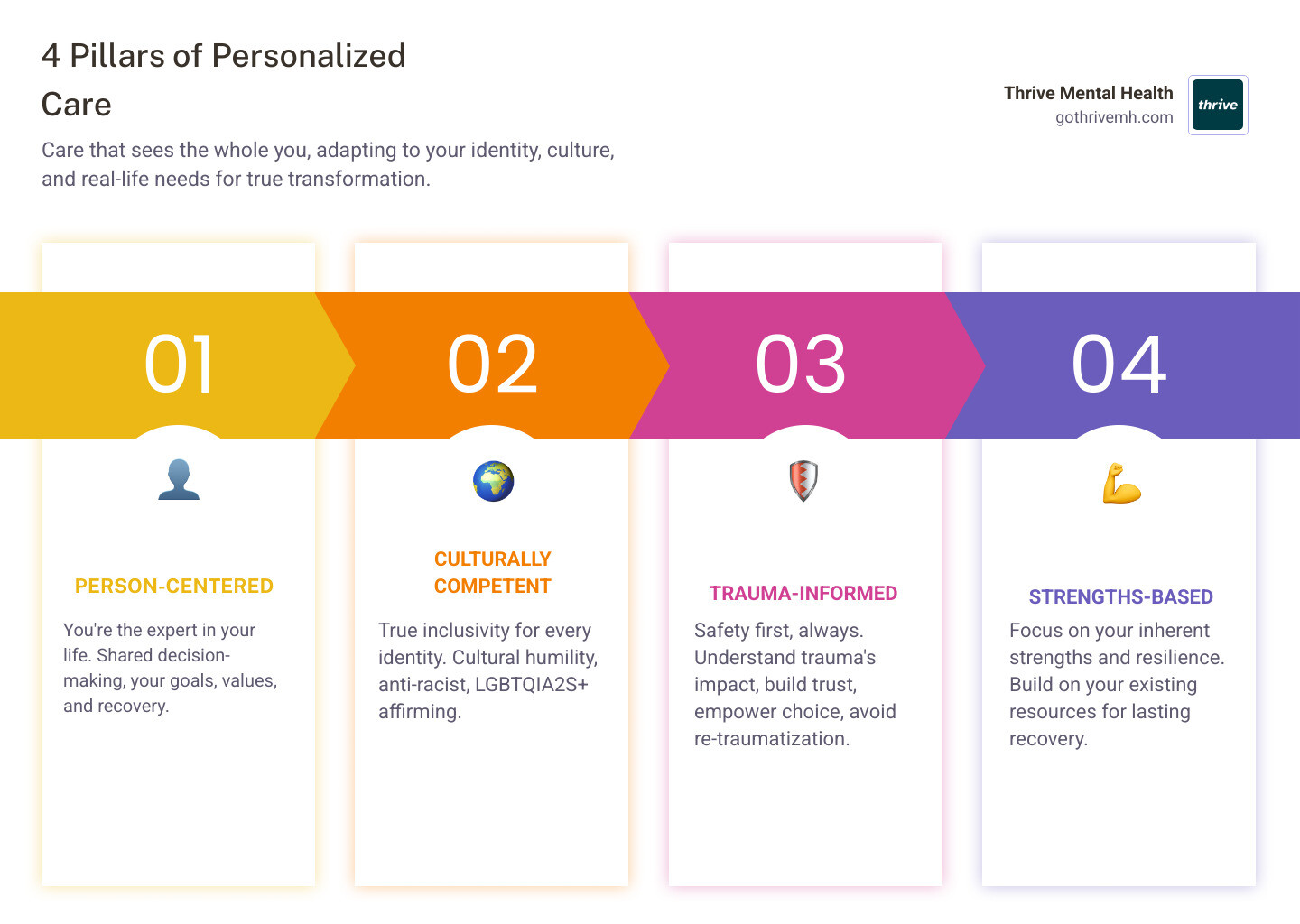
Person-Centered: You’re the Expert in Your Life
Person-centered care means your voice actively shapes your treatment plan. It’s a collaborative partnership, not a top-down directive. You are empowered to identify your goals for recovery, because you are the expert in your own life. This approach is built on shared decision-making, where your lived experience is valued as much as clinical expertise. Together, you and your care team make choices that align with your beliefs and preferences.
Research shows this model improves health outcomes, quality of life, and your sense of control. It’s about empowering you to live a self-directed life in the least restrictive environment possible, avoiding coercive care.
For more on this foundational approach, explore the Person-Centered Approach and the SAMHSA Issue Brief: Person-Centered Planning.
True Inclusivity: Care for Every Identity
True inclusivity demands cultural humility, anti-racist frameworks, and explicit affirmation of all identities. It recognizes that race, gender, sexual orientation, and disability profoundly shape your mental health experience.
- Cultural Humility, Not Just “Competence”: Care is strongest when it is anchored in an anti-racist, anti-oppression framework. This is crucial for BIPOC communities facing racial trauma and systemic barriers. Diverse teams, including case managers from the communities they serve, help create a connection grounded in shared understanding.
- LGBTQIA2S+ Affirming: Affirming care is a necessity, not a preference. You deserve a safe space that validates your identity without judgment. A trusting relationship is key to therapeutic success, and that starts with affirming who you are. For more, read about Queer-Affirming Mental Health Care.
- Neurodivergent-Affirming (ADHD, Autism): Neurodivergence is a part of human diversity, not something to be “fixed.” A neurodivergent-affirming approach adapts to support the unique strengths and challenges of individuals with ADHD, autism, and other neurological differences, often using flexible formats like virtual care to create sensory-safe environments.
- Disability and Language Access: Inclusive programs break down practical barriers by providing accessible psychotherapy and language support (such as interpreters or bilingual clinicians) so you can communicate comfortably and effectively.
Trauma-Informed: Safety First, Always
Since trauma is a common precursor to mental health conditions, a trauma-informed approach is non-negotiable. This means prioritizing your physical and psychological safety, building trust, and empowering you with choice and transparency.
Trauma-informed care avoids re-traumatizing practices like coercive interventions, which have historically eroded trust in healthcare, particularly for marginalized communities like LGBTQ+ individuals subjected to harmful practices such as so-called “conversion therapy” described by the UN in Conversion therapy can amount to torture.
Informed consent is paramount. You should receive full disclosure about treatment options so you can make autonomous decisions. The goal is to create a space where you feel safe and in control of your healing journey—whether you engage in weekly therapy, virtual IOP, or a higher level of support like PHP.
Which Mental Health Services Actually Deliver Inclusive, Personalized Care?
Now that you know what to look for, let’s identify which mental health services provide inclusive, personalized care in practice. It’s about finding providers who walk the walk, with programs designed to meet your unique needs.
Thrive’s Virtual & Hybrid IOP/PHP: The Gold Standard for Personalized, Inclusive Support

When weekly therapy isn’t enough and inpatient care is too much, Intensive Outpatient (IOP) and Partial Hospitalization (PHP) programs can bridge the gap. At Thrive, we offer structured, expert-led treatment that goes deeper than traditional therapy without disrupting your life.
What makes our IOP and PHP programs stand out is our commitment to personalization:
- Custom Treatment Plans: Your plan is crafted around your specific identity, culture, and needs. We don’t use generic solutions; we ensure your care is relevant and effective.
- Skills-Building Custom to You: We use evidence-based therapies (CBT, DBT, ACT) customized to help you build the specific life skills you need to meet your goals.
- Flexible Options for Your Life: Life doesn’t stop for therapy. We offer flexible virtual, hybrid, and evening options across Florida.
- Wraparound Care and Case Management: Our programs include robust peer support and case management to help you steer complex systems, access resources, and achieve your goals.
- Covered by Major Insurance: Our programs are covered by major insurance providers like Cigna, Aetna, Florida Blue, Optum, and Medicare, reducing the financial barrier to intensive support.
We offer these programs across our Florida locations, including Tampa Bay, St. Petersburg, Miami, Orlando, Boca Raton, West Palm Beach, Jacksonville, Fort Lauderdale, Naples, and Sarasota.
Explore our Intensive Outpatient Program (IOP) and Partial Hospitalization Program (PHP), or learn how we support flexible virtual therapy options for adults and young professionals.
Specialized Support for LGBTQ+, BIPOC, and Neurodivergent Clients—All Within Thrive
At Thrive, your identity is central to your treatment. We integrate specialized support directly into our programs:
- Affirming Care for Queer, Trans, and Nonbinary People: We provide a safe, supportive space rooted in sex positivity and harm reduction that celebrates your identity. Our clinicians are trained to address the unique mental health challenges faced by the LGBTQ+ community. For more resources, see the HRC’s QTBIPOC Mental Health and Well-being guide.
- Culturally Responsive Support for BIPOC Communities: Our care is grounded in anti-racist frameworks that address racial trauma and systemic racism. We ensure your treatment is effective and deeply respectful of your heritage and lived experience.
- Neurodivergent-Affirming Therapy (ADHD, Autism): We adapt treatments to build on your strengths, recognizing that conditions like ADHD and autism are neurological differences, not deficits. Our Thrive Virtual Therapy options are especially helpful for creating a comfortable, sensory-safe environment.
- Access and Accommodation: When possible, we work with you to address disability-related needs and language preferences so you can fully participate in care.
Community-Based and Peer Support (Integrated Within Thrive’s Programs)
Holistic recovery thrives on connection. That’s why our programs integrate community and peer support:
- Peer Specialists with Lived Experience: Our peer specialists have steerd their own recovery and provide authentic support, systems navigation, and encouragement, showing that recovery is possible.
- Wraparound Support: Case managers coordinate services, help you access community resources, and strengthen your support network. With your consent, we involve family or chosen supporters to improve treatment outcomes.
- Harm Reduction and Recovery-Oriented Care: We use a compassionate, non-judgmental harm reduction approach. Our recovery-oriented framework is consistent with models like Integrated Behavioral Healthcare and is designed to improve quality of life and health outcomes while reducing stigma.
To see if our IOP or PHP level of care is right for you, you can verify your insurance in 2 minutes or explore our blog on how to choose the right virtual IOP.
How to Find and Vet a Provider Who Won’t Waste Your Time or Money
Finding the right mental health service doesn’t have to be a daunting task. Knowing what to look for and what to ask can save you time, money, and emotional energy. Here’s how to connect with inclusive, personalized mental health services that truly fit.
10 Questions to Ask Before You Commit

Before committing, ask these questions to screen providers and ensure they align with your needs. A strong, trusting client-therapist relationship is key to effective therapy, so don’t settle.
- How do you include my identity/culture in care? Look for specifics on cultural humility and anti-racist practices.
- What does your person-centered planning look like? Ask how you’ll be involved in setting goals and making decisions.
- How do you measure progress? Effective programs track outcomes and adjust your plan accordingly.
- What’s your experience with [my condition/identity]? Be specific. Ensure they have relevant training and experience.
- How do you ensure a trauma-informed space? Ask how they create a safe, non-re-traumatizing environment.
- Do you offer virtual or hybrid options? This is crucial for flexibility and access in Florida.
- What insurance do you accept (Cigna, Aetna, Florida Blue, Optum, Medicare)? Confirm coverage upfront. Many providers, including Thrive, make it easy to verify your insurance in 2 minutes.
- Are you licensed in Florida? Ensure they are qualified to practice in your state.
- What’s your approach to family or peer involvement? Understand how they integrate your support system (with your consent).
- How do you handle crisis situations? Knowing their emergency protocol provides peace of mind.
Navigating Insurance and Costs in Florida
Understanding the financial side of care can be a hurdle. Clear information helps you make faster decisions about stepping into IOP, PHP, or virtual therapy.
- How to check your benefits: Contact your insurance provider using the number on your card or use an online verification tool like Thrive’s. Ask about your benefits for virtual and in-person IOP and PHP.
- In-network vs. out-of-network: In-network providers have contracts with your insurance, usually meaning lower costs for you. Out-of-network is typically more expensive. Thrive is in-network with many major providers to simplify access.
- Copays, deductibles, and sliding-scale options: A copay is a fixed fee per service. A deductible is what you pay before insurance kicks in. Some providers may offer sliding-scale fees based on income for certain services.
- Using Cigna, Aetna, Florida Blue, Optum, Medicare: Many plans with these insurers cover higher levels of care like IOP and PHP in Florida, including virtual and hybrid options. Getting care early is a smart investment that can reduce the need for higher-cost services later.
You can get clarity on your exact costs with Thrive’s quick insurance verification.
Where to Find the Right Therapist—Fast
The search doesn’t have to be a scavenger hunt. Here are reliable ways to find inclusive, personalized mental health services:
- Doctor Referrals: Ask your primary care physician for a referral. They often have connections to trusted mental health professionals.
- Local Community Centers: Local health clinics and LGBTQ+ centers often have directories of culturally competent providers who understand local needs in cities like Miami, Tampa, Orlando, or Jacksonville.
- Online Directories: Use online directories to filter for therapists by identity, specialty, location, and insurance.
- Word-of-Mouth: Ask trusted friends, family, or community members for recommendations.
Exploring virtual and hybrid options like Thrive’s programs can significantly broaden your access to specialized care. If you’re considering stepping up from weekly therapy, this guide on how to choose the right virtual IOP can help you compare your options.
FAQs: Inclusive, Personalized Mental Health Care
What’s the difference between “person-centered” and “personalized” care?
Person-centered care means you lead the way, setting your own goals and having your values guide your treatment. Personalized care means the program itself adapts to your specific needs, schedule, and identity. You truly need both for effective, empowering mental health support.
How do I know if a therapist is truly LGBTQ+ affirming?
Look for explicit training in queer-affirming care, inclusive language on their website or during initial consultations, and direct experience with LGBTQ+ clients. Don’t hesitate to ask specific questions about their understanding of LGBTQ+ issues and how they integrate this into their practice.
Can I get personalized care with online therapy?
Absolutely. High-quality virtual IOP/PHP and telehealth programs use detailed intake assessments to build a custom, individualized treatment plan. Research suggests that online therapy can be as effective as in-person therapy, particularly for BIPOC and LGBTQ+ individuals, offering crucial accessibility and comfort. At Thrive, you can access virtual therapy and IOP from anywhere in Florida.
Does insurance cover virtual IOP/PHP in my state?
Most major insurance plans, including Cigna, Aetna, Florida Blue, Optum, and Medicare, often cover virtual and hybrid IOP/PHP programs in Florida. However, it’s always best to verify your specific benefits with your provider first to understand your coverage, including any copays or deductibles. You can also use Thrive’s quick benefits check to confirm.
How do I know if I need IOP or PHP instead of weekly therapy?
If you feel like weekly therapy isn’t enough, your symptoms are getting in the way of work, school, or relationships, or you’re cycling in and out of crisis, a higher level of care like IOP or PHP may be appropriate. A licensed clinician can complete an assessment and recommend the right level of support.
What if I’m in crisis?
If you’re in crisis, call or text 988 right now. You are not alone.
Summary: Don’t Settle for Less—Get Inclusive, Personalized Mental Health Care That Works
Choosing the right mental health service is one of the most important decisions you’ll make for your well-being. If you stick with generic care, you risk wasted time, money, and hope, potentially prolonging your struggle. But with inclusive, personalized mental health services—like Thrive’s virtual and hybrid IOP/PHP programs—you get care that fits your life, your identity, and your goals.
Our programs are designed to empower you, offering intensive, structured support that respects who you are and where you’re going. Covered by major insurance (including Cigna, Aetna, Florida Blue, Optum, and Medicare), available evenings, and designed for real results in Florida, we offer a path to lasting recovery that goes far beyond generic weekly sessions.
If you’re wondering which mental health services provide inclusive, personalized care, look for person-centered planning, trauma-informed practices, affirming support for LGBTQIA2S+ and neurodivergent clients, and clear outcome tracking. Thrive’s IOP, PHP, and virtual therapy are built on these principles—so your treatment finally matches your real life.
Ready for support? Thrive offers virtual and hybrid IOP/PHP programs with evening options. Verify your insurance in 2 minutes (no obligation) → Start benefits check or call 561-203-6085. If you’re in crisis, call/text 988.