
Buyer’s Guide: Culturally Responsive Mental Health Services

Which Mental Health Services Actually Provide Culturally Responsive Care? [Data, Costs, Access]
Which mental health services provide culturally responsive care? The ones that don’t treat you like a generic patient. They invest in cultural training, anti-oppressive practice, and provider diversity—and they prove it with real outcomes.
If you’re BIPOC, LGBTQIA+, immigrant, or neurodivergent, you already know this: most therapy wasn’t built for you. The cost of getting it wrong is brutal—wasted time, higher relapse risk, and feeling even more alone.
Here’s what to look for if you want care that actually works:
- Culturally trained providers who ask about your lived experience and don’t flinch when you bring up racism, homophobia, transphobia, ableism, or immigration stress.
- Diverse clinical teams with broad language capabilities and staff who reflect your community.
- Evidence-based treatments (CBT, DBT, ACT, trauma therapies) adapted to your cultural context—not copy‑pasted from white, Western norms.
- Family and community involvement when you want it, especially in cultures where healing is collective, not individual.
- Virtual and hybrid options so you can access specialized care across Florida without losing hours to travel.
The gap is real:
- 54% of Americans with mental illness go untreated.
- That jumps to 63% of African Americans and 65% of Hispanic people.
- More than 50% of LGBTQIA+ youth who want help never get it.
- 50% of BIPOC clients drop out after one session in standard care.
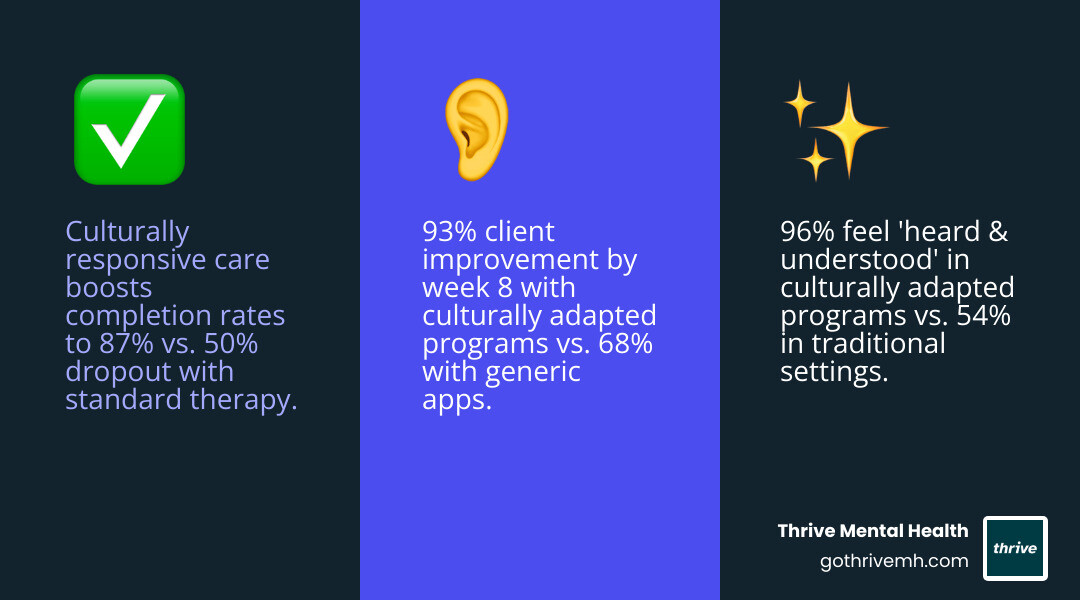
Now compare that to culturally adapted care:
- Completion through the first four sessions jumps to 87%.
- 96% of clients say they feel “heard and understood” (vs 54% in standard settings).
- By week eight, 93% of clients in culturally adapted programs improve—vs 68% using one‑size‑fits‑all mental health apps.
This isn’t a nice-to-have. Culturally responsive care changes outcomes. When you work with providers who see your full context—race, gender, sexuality, language, disability, religion, class—treatment moves faster and sticks longer.
Most therapists were trained in models created by and for white, Western, neurotypical, cisgender populations. Many still practice “colorblind” therapy, which erases the forces actually hurting you—racism, discrimination, migration trauma, poverty, religious pressure, or ableism.
The result:
- Cultural stigma and medical mistrust keep people from even walking through the door.
- A field where racial and ethnic populations are 40% of the U.S. population but only one‑sixth of psychologists.
- Clients who can’t find anyone who “gets it,” so they ghost therapy and blame themselves.
I’m Nate Raine, CEO of Thrive Mental Health. Our entire model is built around one question: Which mental health services provide culturally responsive care—and how do we become one of the few that truly do?
At Thrive Mental Health’s Virtual Therapy and IOP/PHP programs, we:
- Train providers in culturally responsive, anti-oppressive care.
- Build diverse teams across Florida.
- Adapt evidence-based care to your actual life.
- Work with major insurers like Cigna, Optum, and Florida Blue to lower the cost barrier.
If you’ve already been burned by therapy that didn’t see you, you don’t have to repeat that. You can vet providers and choose services that are built for who you really are.
Why Standard Therapy Leaves You Behind: The Hidden Cost of Ignoring Culture

Culture shapes how we see the world, express distress, and engage with treatment. When mental health services ignore this, they fail the people they aim to help. Individuals from diverse backgrounds face multi-layered challenges:
- Cultural Stigma: In many cultures, mental health conditions carry profound stigma, leading to fear and shame. One study found only 12% of Asian Americans would discuss mental health with a friend, and just 4% would see a psychiatrist.
- Medical Mistrust: Due to historical oppression and systemic racism, many communities of color distrust healthcare providers. This distrust is rooted in documented abuses and inequities, a reality confirmed by organizations like the American Psychological Association. LGBTQIA+ individuals also report avoiding care due to past negative experiences.
- Provider Bias and Misdiagnosis: Unconscious biases can lead to inaccurate diagnoses and poor treatment. African Americans are often overdiagnosed with schizophrenia and underdiagnosed with depression, while the “model minority” myth causes Asian Americans’ mental health needs to be overlooked.
- Higher Rates of Untreated Illness: While depression rates are lower in Black (24.9%) and Hispanic (19.6%) individuals than in white people (34.7%), their conditions are often more persistent and less likely to be treated. Overall, 54% of people with mental illness get no treatment, but this jumps to 63% for African Americans and 65% for Hispanic people.
The Alarming Gaps: Who Gets Left Out?
The statistics paint a stark picture of disparity:
- Lack of Provider Diversity: Racial and ethnic populations are 40% of the U.S. population but only one-sixth of psychologists. This lack of diversity in Florida makes it hard to find a provider who understands your cultural context.
- Insurance and Cost Barriers: People of color are more likely to be uninsured. Cost is a major barrier, so it’s critical to know if your plan—whether Cigna, Optum, Florida Blue, or another—covers the care you need.
- Low Mental Health Literacy: Navigating the healthcare system is complex, and many people lack the information to recognize symptoms or advocate for themselves.
| Untreated Mental Illness Rates | Group | Percentage Untreated |
|---|---|---|
| Overall U.S. Population | All | 54% |
| African Americans | BIPOC | 63% |
| Hispanic People | BIPOC | 65% |
| LGBTQIA+ Youth | LGBTQIA+ | >50% (who want care) |
How Your Background Shapes Your Recovery
Your cultural background is an active participant in your mental health journey.
- It changes how symptoms appear: Some cultures express emotional distress through physical symptoms like headaches, which can lead to misdiagnosis.
- It dictates family and community dynamics: Stigma can lead to silence, causing individuals to seek help from elders or spiritual leaders instead of mental health professionals.
- It carries intergenerational trauma: Historical oppression has lasting psychological effects. Effective treatment must acknowledge this context.
We understand your journey is unique. For more on how culture shapes help-seeking, see our blog on breaking mental health stigma.
What Actually Works: The Core of Culturally Responsive Mental Health Care

Culturally responsive care moves beyond a one-size-fits-all approach to integrate your identity, background, and experiences into every step of treatment. It’s a philosophy that makes mental health care more accessible and effective. Key components include:
- Cultural Awareness: Providers evaluate their own biases and recognize their worldview is not universal.
- Cultural Competence: Providers develop the skills to serve diverse populations effectively, moving beyond mere “tolerance.”
- Cultural Humility: A lifelong commitment to self-reflection, learning from clients, and admitting they don’t have all the answers. This practice is proven to improve outcomes and reduce dropout rates.
- Anti-Oppressive Practice: Acknowledging historical oppression, understanding intergenerational trauma, and adapting treatment to address the impact of discrimination.
Beyond “Competence”: Why Cultural Humility Gets Results
While competence is a start, cultural humility transforms therapy. It fosters a safer, more trusting environment by admitting gaps in knowledge and addressing power imbalances. Instead of using a checklist, humble providers engage in continuous self-reflection, adapting their approach to each client. This creates a space where you feel truly seen, which is paramount for healing. To dive deeper, read more on our blog.
How Thrive Providers Deliver Culturally Responsive Care
At Thrive Mental Health, we integrate these principles into our virtual and in-person IOP and PHP programs.
- Inclusive Language: We use non-stigmatizing language that validates your identity.
- Adapted Treatments: We tailor evidence-based treatments (EBTs) to fit your cultural context, ensuring they are effective for you.
- Honoring Identity: We encourage open dialogue about your beliefs and values, incorporating your cultural, racial, and intersectional identities into the healing process.
- Open Conversations: Our providers are equipped to discuss the impact of race, gender, sexual orientation, and neurodiversity on your mental health. We offer dedicated support for LGBTQIA+ individuals and neurodivergent individuals.
- Safe Spaces: We are committed to creating a validating environment where you feel heard and understood in our centers across Florida.
Learn about Thrive’s Virtual Therapy and IOP/PHP programs.
How to Find Culturally Responsive Mental Health Services [Vetting Checklist for 2025]
Finding a provider who offers real culturally responsive care can be the difference between quitting after one session and finally feeling like, “Okay, this person gets me.”
Use this as a quick, no‑BS checklist.
- Use Insurance Networks: Log in to your plan (Cigna, Optum, Florida Blue, etc.) and search for therapists, IOP, or PHP programs that name cultural responsiveness, BIPOC-affirming, LGBTQIA+-affirming, or neurodivergent-affirming care in their profiles.
- Ask for Referrals: Tap your community—friends, family, coworkers, spiritual leaders, and local organizations—who’ve found therapists that understand racism, immigration, or LGBTQIA+ realities.
- Search Locally and Virtually: Look for providers in Florida that explicitly state they offer culturally responsive or identity‑affirming care. If local options are thin, prioritize virtual programs.
- Vet Online Platforms: For virtual care, pick platforms that:
- Highlight cultural training and anti-oppressive practice.
- Employ diverse staff with multiple languages.
- Offer flexible scheduling (evenings/weekends) so you don’t have to choose between therapy and income.
| What to Look for in a Culturally Responsive Provider | Why it Matters |
|---|---|
| Explicit commitment to cultural responsiveness | Shows this is built into their practice, not an afterthought. |
| Experience with your cultural background | Increases the odds they’ll understand your stressors and strengths. |
| Ongoing cultural competence/humility training | Signals they’re still learning, not stuck in outdated models. |
| Openness to discuss racism, identity, and oppression | Lets you bring your full story into the room. |
| Flexible treatment approaches | They adapt CBT/DBT/other tools to you—not the other way around. |
| Diverse staff and inclusive environment | Reduces code‑switching and masking; you can exhale. |
| Bilingual or multilingual options | Cuts the risk of being misunderstood or minimized. |
| Focus on cultural humility | They ask, listen, and correct—not pretend to “know” your culture. |
10 Critical Questions to Ask Any Therapist Before You Start
You’re interviewing them, not the other way around. Use these questions to filter fast:
- What’s your experience with clients from my background (race, ethnicity, gender, sexuality, neurotype, or faith)?
- How do you include my cultural identity and lived experience in treatment planning?
- What specific training have you had in culturally responsive or anti-oppressive care?
- How do you handle conversations about racism, discrimination, or identity-based trauma in session?
- Are you familiar with how my community usually talks (or doesn’t talk) about mental health?
- Can you involve my family or community if I want that, and how would that work?
- What happens if our cultural or religious values clash—how do you handle that?
- Can you provide services in my preferred language, or connect me with someone who can?
- How do you practice cultural humility in your day-to-day work with clients?
- What does a “safe space” mean in your practice—and how will I know if it’s working for me?
Thrive’s Approach: Real Examples of Culturally Responsive Care
At Thrive Mental Health, our virtual and hybrid IOP/PHP programs are built from the ground up for culturally responsive care—not as an add‑on.
We provide:
- BIPOC-Affirming Therapy: Providers trained to address racial trauma, microaggressions, workplace discrimination, immigration-related stress, and systemic inequities. This is baked into our IOP and PHP programs across Florida.
- LGBTQIA+ and Neurodivergent Support: Dedicated tracks and identity-affirming care for LGBTQIA+ individuals and neurodivergent individuals, so you’re not educating your therapist about your existence.
- Family-Inclusive Models: We involve family or chosen family when you want it, honoring cultural expectations around privacy, respect, and hierarchy.
- Flexible, Virtual Access: Evening virtual IOP/PHP options so you can get structured care without quitting your job or losing childcare.
- Insurance-Friendly Care: We work with major insurers like Cigna, Optum, and Florida Blue to keep care accessible and predictable.
If you want a deeper dive into why so many workplaces and systems still miss the mark on neurodivergent and culturally diverse folks, read our related guide: Comprehensive Guide to Neurodiversity Training for Inclusive Workplaces.
You deserve more than “we treat everyone the same.” You deserve care that sees all of you and treats your culture as a source of context and strength—not an obstacle.
For Employers: Build a Mental Health Benefit That Works for Every Employee
As the workforce diversifies, culturally responsive care is no longer optional—it’s essential. Companies that prioritize Diversity, Equity, Inclusion, and Belonging (DEIB) outperform their peers by 35% and see higher employee satisfaction. This must include mental health benefits.
- Ask Your Benefits Provider: Is Your Network Truly Diverse? When evaluating benefits, ask if providers are trained to address race and social identity, offer diverse language options, and adapt treatments to different cultures.
- Offer Training on Neurodiversity and Cultural Humility: Support providers with ongoing training to strengthen their culturally responsive skills. Learn more from our guide to neurodiversity training for inclusive workplaces.
- Ensure Broad Insurance Coverage: Financial accessibility is key. Make sure your benefits are covered by major insurers like Cigna, Optum, and Florida Blue to reduce barriers to care.
- Foster a Safe Culture: Combat stigma, promote mental health literacy, and ensure employees have access to high-quality, culturally responsive care.
For employers looking to improve their mental health benefits, learn about Thrive’s employer solutions.
FAQs: Culturally Responsive Mental Health Care
What is culturally responsive mental health care in simple terms?
It’s therapy that actively considers your culture, identity, and lived experience—including race, ethnicity, gender, sexuality, language, religion, class, and neurotype—when understanding your symptoms and building a treatment plan.
Which mental health services provide culturally responsive care?
Look for services that name it clearly: identity‑affirming, BIPOC-affirming, LGBTQIA+-affirming, or culturally responsive care. Programs like Thrive’s Virtual Therapy and IOP/PHP programs train providers in cultural humility, hire diverse staff, and adapt evidence-based care to your context across Florida.
Does my therapist have to share my background for therapy to work?
No. It can help, but it’s not mandatory. What matters more is whether they invite conversations about culture and identity, listen without defensiveness, and adjust their approach based on your feedback.
Is culturally responsive therapy covered by insurance (Cigna, Optum, Florida Blue, etc.)?
Yes. There isn’t a separate billing code for “culturally responsive,” so if therapy, IOP, or PHP is covered by your plan, this care usually is too. Thrive works with most major plans, including Cigna, Optum, and Florida Blue, and can verify your insurance in about 2 minutes.
What if I live in an area with very few diverse therapists?
This is where virtual care changes the game. You can work with culturally responsive providers across state lines (within licensing rules). Thrive offers virtual IOP, PHP, and therapy across Florida so you’re not limited to whoever happens to practice in your zip code.
Summary: Which Mental Health Services Provide Culturally Responsive Care—and Why It Matters Now
Culturally responsive care isn’t a buzzword. It’s the line between dropping out after one painful session and finally feeling seen, respected, and helped. When you choose services that truly provide culturally responsive care—like diverse teams, trained in cultural humility, offering flexible virtual IOP/PHP and therapy options—you get:
- Faster trust and deeper honesty.
- Lower dropout and stronger results.
- Care that understands how racism, stigma, immigration, identity, and neurodivergence shape your mental health.
When you settle for therapy that ignores your culture, you risk wasting time, money, and emotional energy on care that was never designed for you. When you choose culturally responsive services, you’re investing in treatment that fits your real life.
If you’re asking, “Which mental health services provide culturally responsive care?”, the answer is: the ones that prove it—through training, diversity, outcomes, and the questions they ask about who you are.
Ready for support? Thrive offers virtual and hybrid IOP/PHP programs with evening options. Verify your insurance in 2 minutes (no obligation) → Start benefits check or call 561-203-6085. If you’re in crisis, call/text 988.