


Why Creative Professionals Face Unique Mental Health Challenges
What mental health treatment options work best for creative professionals? The most effective approaches combine evidence-based therapies like Intensive Outpatient Programs (IOP) and Partial Hospitalization Programs (PHP) with specialized modalities such as art therapy, expressive arts therapy, and movement-based interventions, all delivered by credentialed mental health professionals who understand the unique pressures of creative work, like the specialized programs offered by Thrive Mental Health in Florida.
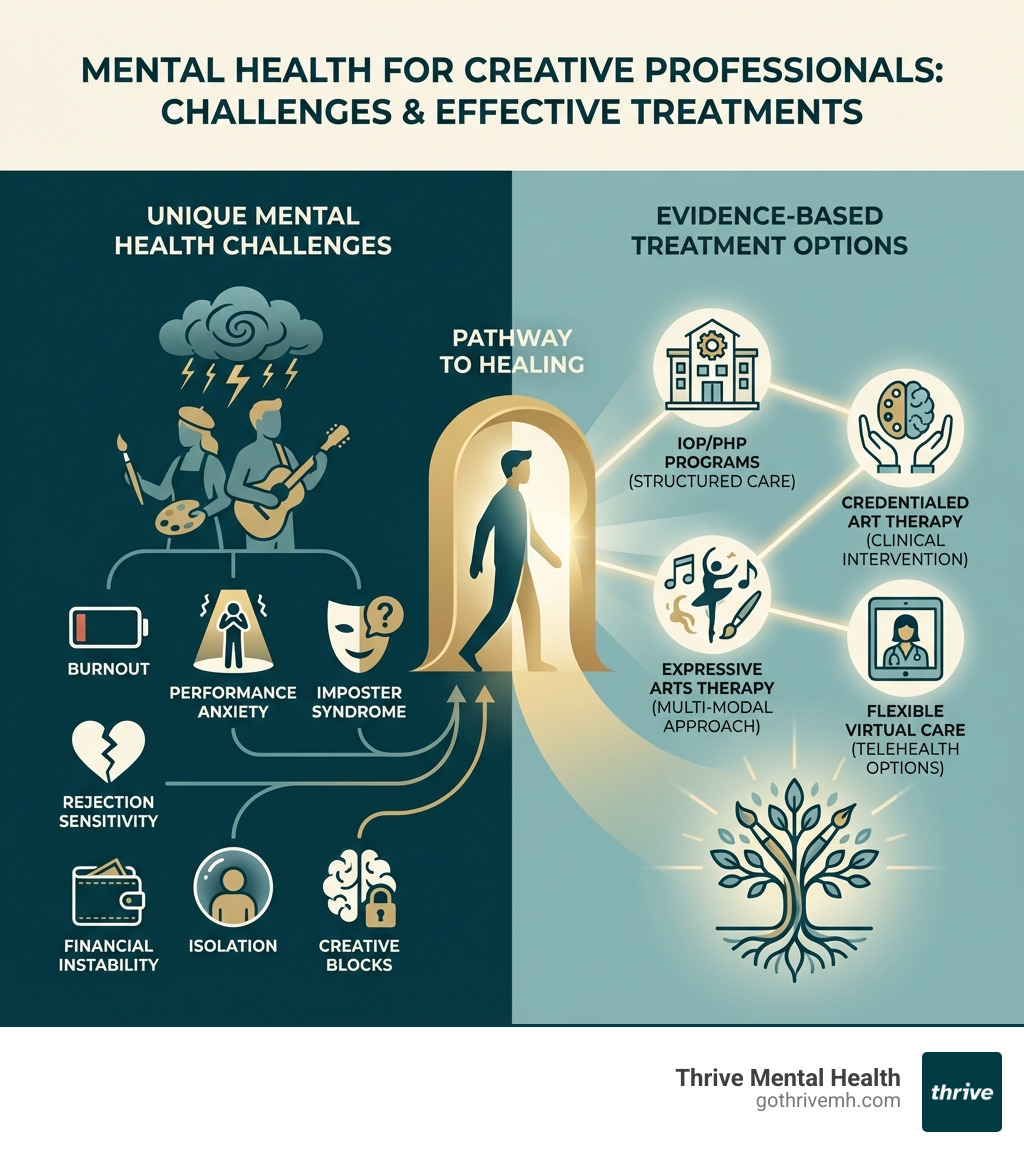
Top Mental Health Treatments for Creative Professionals:
- Intensive Outpatient Programs (IOP) & Partial Hospitalization Programs (PHP), Structured, evidence-based care that fits flexible schedules
- Credentialed Art Therapy, Clinical intervention using visual arts with a licensed therapist (not just making art alone)
- Expressive Arts Therapy, Multi-modal approach integrating movement, music, drama, and visual arts
- Dance/Movement Therapy, Body-based processing for anxiety, trauma, and burnout
- Drama Therapy & Psychodrama, Role-playing techniques for emotional release and perspective-taking
- Music Therapy, Structured musical interventions for mood regulation and emotional expression
- Virtual Therapy Options, Flexible telehealth programs that accommodate irregular creative schedules
If you’re a designer, musician, writer, or any creative professional, you already know the paradox: the same sensitivity that fuels your best work can also destroy your mental health.
Your emotional intensity isn’t a bug, it’s a feature. But it comes with a cost.
Research shows that 46% of Americans use creative activities to relieve stress, yet creative professionals face higher rates of anxiety, depression, and burnout than the general population. The constant pressure to innovate, the financial instability, the brutal sting of rejection, and the isolation of working alone all compound into a unique mental health crisis.
Traditional weekly therapy often falls short because it relies solely on talking, but your brain doesn’t always think in words. You think in images, sounds, movement, and metaphors. That’s why art therapy uses integrative techniques to engage the mind, body, and spirit in ways that verbal expression alone cannot.
Creative arts therapies aren’t about making pretty pictures. They’re clinical interventions delivered by credentialed therapists to achieve specific mental health goals. Studies show these approaches can significantly reduce anxiety and depression, improve emotional regulation, and help process trauma, especially when integrated into structured programs like IOP or PHP.
I’m Nate Raine, CEO of Thrive Mental Health, and I’ve spent over a decade building behavioral health solutions that integrate evidence-based care with innovative delivery models. At Thrive, our Florida-based programs have shown us what mental health treatment options work best for creative professionals: flexible, outcome-focused programs that respect your creative process while providing the structure you need to heal. This guide will show you exactly how to get the right support without sacrificing your craft.
Must-know What mental health treatment options work best for creative professionals? terms:
- Are there any programs that use art and mental health techniques for young professionals?
- Show me mental health centers that use therapy with art for adults.
- art and mental health
The Creative’s Curse: Why Your Mind is Your Biggest Battle
For creative professionals, the line between passion and pathology can often blur. The very qualities that fuel artistic genius, intense emotionality, deep introspection, and a drive for originality, also make us uniquely vulnerable to mental health struggles. It’s a delicate balance, and when it tips, the consequences can be devastating for both well-being and productivity.

Let’s unpack some of the unique mental health challenges that frequently plague creative minds:
- Burnout vs. Creative Block: This isn’t just feeling tired; it’s an existential exhaustion that saps joy from your craft. Burnout, often stemming from relentless deadlines, client demands, and the pressure to constantly produce, can easily manifest as a seemingly impossible creative block. The wellspring of ideas dries up, leaving you staring at a blank page or screen, feeling utterly depleted.
- Performance Anxiety: Whether it’s a gallery opening, a live performance, a book launch, or presenting a design concept, creative work often involves public scrutiny. This can trigger intense performance anxiety, a fear of judgment that can paralyze even the most seasoned professionals. The pressure to deliver “greatness” with every output is immense.
- Imposter Syndrome: Despite accolades and achievements, many creatives secretly harbor the fear that they’re not good enough, that their success is a fluke, and that they’ll eventually be “found out.” This “imposter syndrome” is rampant in fields where talent is subjective and self-worth often tied directly to output.
- The Sting of Rejection: Rejection is an inherent part of most creative careers, whether it’s a rejected manuscript, a failed audition, a lost pitch, or negative criticism. For highly sensitive individuals, which many creatives are, each rejection can feel like a deeply personal attack, eroding self-esteem and fueling self-doubt.
- Constant Pressure to Innovate: The creative economy demands novelty. There’s an unspoken expectation to constantly push boundaries, invent new forms, and stay ahead of trends. This relentless pressure to innovate can be mentally exhausting, leading to anxiety and a fear of becoming irrelevant.
- Financial Instability: Many creative professions operate within a gig economy or project-based model, leading to unpredictable income streams. The constant worry about making ends meet can be a significant source of chronic stress, impacting mental stability and overall well-being.
- Isolation: While some creative work thrives in collaborative environments, many artists, writers, and designers spend long hours working alone. This can lead to profound feelings of loneliness and isolation, disconnecting them from social support networks crucial for mental health.
These interwoven challenges highlight why a generic approach to mental health treatment may not fully address the complex needs of creative professionals. We need solutions that speak their language and acknowledge their unique psychological landscape.
Beyond the Canvas: What Mental Health Treatment Options Work Best for Creative Professionals?
When we talk about what mental health treatment options work best for creative professionals, we’re not just discussing hobbies or self-help books. We’re talking about clinical, evidence-based interventions delivered by trained professionals.
Art as a Hobby vs. Art Therapy
It’s crucial to distinguish between making art for personal enjoyment and engaging in art therapy. While doodling when you’re stressed or playing an instrument after a long day can certainly relieve tension and boost well-being, as 46% of Americans report using creative activities for stress or anxiety relief, this is not the same as professional art therapy.
Art therapy is a mental health profession. Art therapists are clinicians with master’s-level or higher degrees, trained in both art and therapy. They are credentialed mental health care professionals who use active art-making, the creative process, applied psychological theory, and human experience within a psychotherapeutic relationship to achieve specific mental health goals. This includes improving cognitive functions, fostering self-esteem, cultivating emotional resilience, promoting insight, and reducing distress.
If you are seeking professional help, ensure you are working with a credentialed art therapist. You can Find a credentialed art therapist via the ATCB.
For creative professionals struggling with more significant mental health challenges, such as severe burnout, prolonged creative blocks, or acute anxiety and depression, evidence-based programs like Intensive Outpatient Programs (IOP) and Partial Hospitalization Programs (PHP) are highly effective. These programs offer a structured, comprehensive level of care that goes beyond weekly therapy, providing multiple hours of therapy per day, several days a week. At Thrive Mental Health, we offer these programs with flexible virtual and hybrid options across Florida, designed to integrate into a professional’s life without requiring inpatient stays.
Why Talk Therapy Alone Might Not Cut It
For many creatives, traditional talk therapy, while valuable, can sometimes feel limiting. The very nature of creative thought often bypasses linear verbal processing. You think in metaphors, images, and non-verbal cues. Trying to articulate complex emotions or abstract creative struggles solely through words can be like trying to paint a masterpiece with only two colors.
Art therapy, and the broader field of expressive arts therapy, excels precisely where verbal expression falls short. It uses integrative techniques to engage the soul, body, and mind in ways that verbal articulation alone doesn’t appear to. This offers kinesthetic, sensory, perceptual, and symbolic opportunities that invite alternative modes of communication, circumventing the limitations of language. It allows us to access and process non-verbal emotions, strengthening the mind-body connection and tapping into your native creative language for healing.
Art Therapy & Expressive Arts: A Language Your Soul Already Speaks
When considering what mental health treatment options work best for creative professionals, art therapy and expressive arts therapy stand out as particularly potent. They leverage the innate ways creatives already process the world.
-
What is Art Therapy? Art therapy is the clinical and evidence-informed use of visual arts within a therapeutic relationship. It focuses on the process of creating art and the resulting artwork to explore emotions, improve self-understanding, manage behavior, reduce stress, and increase self-esteem. It’s guided by a credentialed therapist who helps you interpret your creations and connect them to your life experiences.
-
What is Expressive Arts Therapy? Expressive arts therapy takes a broader, multimodal approach. It involves a multimodal integration of varied elements of the creative arts therapies into psychotherapy and counseling. This means it might incorporate visual arts, music, dance, drama, and writing within a single therapeutic process. While creative arts therapy often specializes in one art form (e.g., music therapy), expressive arts therapy is about fluidly moving between modalities to find the most effective pathway for expression and healing. You can learn more about this integrative approach at What is Expressive Arts Therapy?.
The key difference lies in specialization versus integration. A creative arts therapist might be an expert musician who then trains as a music therapist. An expressive arts therapist, however, is proficient in using various art forms as an integrative intervention, not necessarily an expert in any single discipline, but skilled in facilitating their combined therapeutic power.
Both approaches offer profound benefits:
- Using Multiple Modalities: By engaging dance, music, drama, poetry, and visual arts, these therapies activate different parts of the brain and body, allowing for a more holistic processing of experience. For a creative, this multi-sensory engagement can feel like coming home.
- Processing Trauma Non-Verbally: Expressive Arts Therapy is particularly effective when working with trauma, both recent and long-buried. Trauma often bypasses verbal memory, residing instead in sensory and emotional fragments. Art and movement can provide a safe, non-verbal way to express and process these painful memories, allowing the body and mind to work together towards integration.
The scientific community increasingly supports these methods. There’s growing Scientific research on art therapy’s role in mental health, with studies showing its efficacy in treating conditions like anxiety, depression, and even dementia.
What mental health treatment options work best for creative professionals? [Specific Modalities]
Now, let’s look at how specific therapeutic art techniques can address the core challenges faced by creative professionals. These are guided by a therapist within a clinical context.
-
For Burnout:
 The Complete List of Tucson AZ Mental Health ClinicsMental Health
- Spontaneous Drawing & Painting: Intuitive drawing and painting with pastels, chalks, acrylics, or watercolors can be incredibly useful for expressing emotions, mood states, or relational dynamics that are difficult to put into words. It allows for a release without the pressure of a “finished product.”
- Clay Work: Clay sculpting is tactile and can take impact, making it deeply therapeutic. It can be used to represent abstract inner states, a self-image, or even other people. Manipulating the clay allows for a physical expression of emotions, changing internal chaos into a tangible form.
- Mindful Coloring (as a tool, not a cure): While adult coloring books are popular for stress relief, the American Art Therapy Association (AATA) clarifies that they are not art therapy. However, mindful coloring, when used intentionally within a therapeutic session, can serve as a grounding or meditative tool. The AATA’s stance on coloring books emphasizes that true art therapy involves a relationship with a credentialed therapist.
-
For Creative Blocks:
- Role-Playing (Drama Therapy): Drama therapy and psychodrama involve enacting scenes or roles to explore internal conflicts, gain new perspectives on relationships, or practice new behaviors. For a creative professional facing a block, this can mean embodying the “block” itself, or role-playing a successful creative process to unearth underlying psychological barriers.
- Improvisational Music: Engaging in free-form musical improvisation, even without prior musical training, can help break through rigidity. The non-linear, spontaneous nature of improvisation can open up new creative pathways and release mental constraints.
-
For Anxiety & Depression:
- Movement/Dance Therapy: Dance/Movement Therapy (DMT) focuses on the psychotherapeutic use of movement to further the emotional, cognitive, physical, and social integration of the individual. For creatives, who often feel deeply in their bodies, DMT can be powerful for regulating mood, releasing stored tension, and finding new ways to express themselves non-verbally. It helps in achieving body awareness and processing emotions through movement metaphors.
- Songwriting: For musicians and non-musicians alike, songwriting in therapy can be a profound way to process complex emotions, articulate experiences, and tell one’s story. It combines verbal and musical expression, allowing for a unique form of self-reflection and emotional release.
- Visual Journaling: This involves creating a personal journal using images, collage, drawings, and minimal text. It provides a safe space for self-expression, fostering insight and tracking emotional states without the pressure of crafting a “perfect” narrative.

Weaving Healing into Your Work: Integrating Art-Making for Daily Well-Being
Beyond formal therapy sessions, integrating art-making into your daily self-care routine is vital for creative professionals. The key here is to consciously separate your therapeutic art from your professional art. Your personal creative outlet should be a space of freedom, entirely devoid of the pressures of deadlines, client expectations, or critical judgment.

The mantra is “process over product.” In therapeutic art-making, the outcome isn’t about aesthetic appeal or marketability; it’s about the act of creation itself and the insights gained. This allows for a truly authentic exploration of your inner world.
Here are some daily creative self-care practices you can integrate:
- Intuitive Drawing and Painting: Use pastels, chalks, acrylics, or watercolors without a plan. Let your hand move freely to express whatever emotions are present. This can be a powerful way to externalize difficult feelings.
- Clay Sculpting: Keep a small amount of air-dry clay or play-doh on hand. Sculpt without intention, letting your subconscious guide your hands. Notice the textures, the resistance, and how the form changes as your mood shifts.
- Doodling for Stress Relief: A simple pen and paper can be your best friends. When you feel overwhelmed, let your mind wander and your hand doodle. This can be a meditative practice that helps clear your head.
- Playing an Instrument: If you’re a musician, dedicate time to playing purely for joy, without any performance goals. If you’re not, experiment with simple instruments like a drum, a flute, or even just your voice, making sounds that resonate with your current mood.
- Creating a “Visual Journal”: This is different from a written journal. Dedicate a sketchbook or notebook to collages, abstract paintings, scribbles, and images that reflect your day, your dreams, or your feelings. No words are necessary unless they spontaneously arise.
- Mindful Making: Engage in crafts like knitting, pottery, origami, or even cooking with a focus on the sensory experience. Feel the textures, smell the aromas, observe the colors. This grounds you in the present moment and provides a sense of accomplishment.
What mental health treatment options work best for creative professionals? [Building a Routine]
Building a consistent routine for mental well-being is crucial, especially when your professional life can be unpredictable. These practices aren’t just therapeutic; they can also feed your creative spirit indirectly.
- 10-Minute Creative Check-Ins: Start or end your day with a short burst of non-judgmental creative activity. This could be a quick sketch, a few lines of free-form writing, or a brief improvisational dance. It’s a way to touch base with your inner self.
- The “Morning Pages” Technique: From Julia Cameron’s The Artist’s Way, this involves writing three pages of longhand, stream-of-consciousness prose first thing in the morning. No editing, no rereading, just getting thoughts out. This clears mental clutter and can unearth creative insights.
- Scheduling Creative “Play” Time: Block out time in your calendar specifically for creative activities that are not work-related. Treat it as seriously as a client meeting. This protects your inner child and keeps your creative muscles limber.
- Using Apps for Guided Creativity: Explore apps that offer guided meditations with visual prompts, digital drawing tools, or music composition aids for non-musicians. These can provide structure when you feel overwhelmed by choice.
- Joining a Local Art Group for Community: Combat isolation by connecting with other creatives in a low-pressure setting. This could be a casual drawing group, a poetry slam, or a community theater workshop. The shared experience and mutual support can be incredibly fortifying. In many of Thrive’s Florida service areas, like Tampa Bay, Miami, and Orlando, there are vibrant arts communities that offer such opportunities.
Getting Help: How to Overcome Barriers to Treatment in a Creative Career
We understand that seeking mental health support, especially specialized care, can present unique challenges for creative professionals. However, overcoming these barriers is a critical step towards sustainable well-being and a thriving creative practice.
-
Time Constraints: Creative schedules are notoriously demanding and often unpredictable. Traditional 9-to-5 therapy appointments can be impossible to maintain around rehearsals, shoots, client meetings, or intense creative sprints.
- Solution: This is where flexible virtual programs truly shine. Thrive Mental Health offers virtual Intensive Outpatient (IOP) programs with evening options, specifically designed to accommodate demanding schedules. A study on the effectiveness of online art therapy in rural communities demonstrated that online formats can be a relevant and welcomed intervention, providing a judgment-free zone for self-expression. This flexibility is equally valuable for busy creative professionals, allowing access to structured care from the comfort of their home studios or while on location.
-
Cost & Insurance: Quality mental health care is an investment, and financial instability is a common stressor for creatives. The perceived cost can be a major deterrent.
- Solution: We work with many insurance providers in Florida, including Cigna, Optum, and Florida Blue, to make our programs accessible. Understanding your benefits is the first step, and we make it easy to do so. In Florida, our IOP/PHP coverage can significantly reduce out-of-pocket expenses. We encourage you to Start benefits check with us in just 2 minutes, no obligation required.
-
Stigma & Mindset: There’s a persistent myth that suffering fuels creativity, leading some creatives to resist seeking help, fearing it will dull their edge. Admitting to mental health struggles can also feel like a sign of weakness in competitive fields.
- Solution: We encourage reframing therapy as “creative maintenance” or “performance improvement.” Just as a dancer needs physical therapy or a musician needs instrument repair, a creative professional needs mental health support to keep their most vital instrument, their mind, in peak condition. The therapeutic relationship itself is a collaboration, a safe and non-judgmental space where your therapist becomes a partner in your journey, helping you steer challenges without sacrificing your unique creative voice. This collaborative approach is a cornerstone of our philosophy at Thrive, where we believe in empowering individuals through a person-centered approach.
Frequently Asked Questions about Mental Health for Creatives
Is there a proven link between creativity and mental illness?
Research suggests a correlation, not causation, between creativity and certain mental health conditions, particularly mood disorders like depression and bipolar disorder. This link is often attributed to shared traits such as heightened emotional sensitivity, openness to experience, and a tendency towards intense introspection, which fuel both creative output and vulnerability to psychological distress. It’s not that creativity causes mental illness, but rather that some of the same underlying psychological and neurological characteristics can predispose individuals to both.
How is art therapy different from just making art at home?
Art therapy is a clinical intervention guided by a credentialed therapist to achieve specific mental health goals. Unlike making art at home, which is often for enjoyment or self-expression, art therapy focuses on the therapeutic process, the relationship with the therapist, and the insights gained through facilitated art-making. The aesthetic quality of the final product is secondary; the emphasis is on emotional processing, self-findy, and working through psychological challenges in a safe, structured environment.
Can virtual therapy actually work for creative people?
Absolutely. Virtual IOP and PHP programs offer structured, intensive support that can be particularly well-suited to a creative’s often-unpredictable schedule. Many expressive and creative arts therapies, including guided visual art, writing, and movement-based exercises, have been successfully adapted for online delivery. Virtual platforms provide accessibility, convenience, and privacy, allowing creative professionals in places like Miami, Tampa, and Orlando to receive high-quality care without disrupting their work or travel commitments. This flexibility means you can access the support you need, when you need it, from almost anywhere.
Your Creativity is Your Superpower, Don’t Let It Burn You Out
Creative professionals face unique pressures that require specialized support. Integrating therapeutic art-making and seeking structured care like an Intensive Outpatient Program (IOP) can help you manage burnout, overcome creative blocks, and reclaim the joy in your work. Thrive Mental Health offers virtual and hybrid programs across Florida, designed for busy professionals. We understand what mental health treatment options work best for creative professionals because we’ve built our programs to address these exact needs with clinical excellence and compassionate care.
Ready for support? Thrive offers virtual IOP programs with evening options. Verify your insurance in 2 minutes (no obligation) → Start benefits check or call 561-203-6085. If you’re in crisis, call/text 988.

This article is for informational purposes only and is not a substitute for individualized clinical advice or insurance verification.