

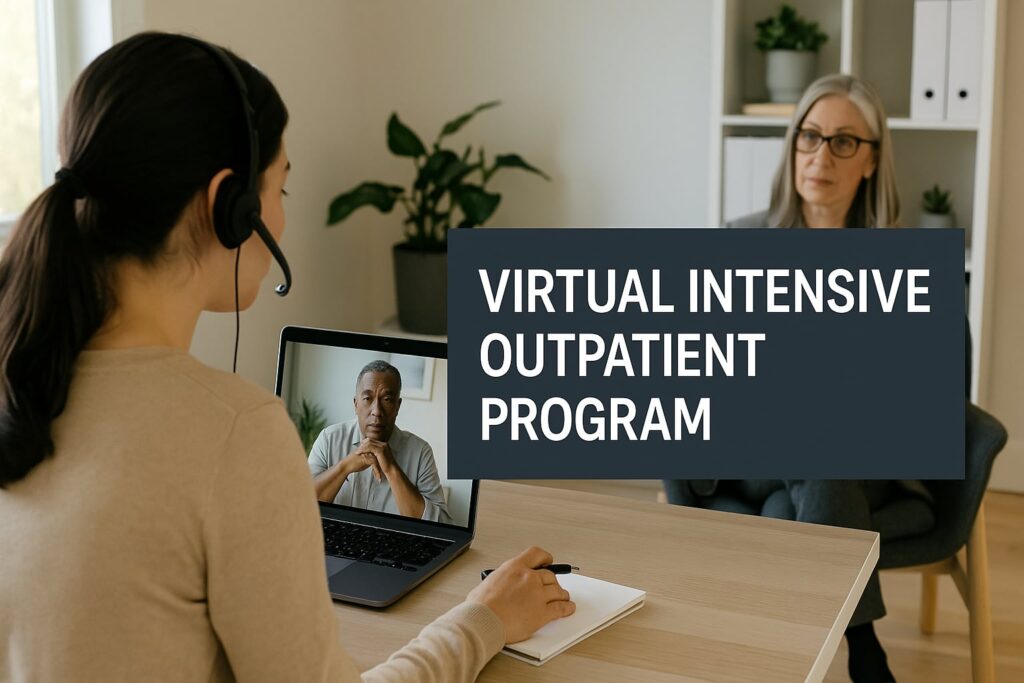
A virtual intensive outpatient program (virtual IOP) is a structured mental health treatment delivered entirely via secure video, same evidence-based curriculum as in-person IOP, same insurance coverage, same clinical outcomes, but you participate from home.
Thrive Mental Health is a Joint Commission accredited virtual IOP provider serving adults across Florida, California, Indiana, Arizona, North Carolina, and South Carolina, with Texas. We’re in-network with most major commercial insurance carriers. This is our core service. Here’s how it works, who it’s for, and what to expect.
What Virtual IOP Includes
A standard week of Thrive virtual IOP looks like this:
- 9-12 hours of structured group therapy, delivered as 3-hour sessions across 3 days per week
- 1 weekly individual therapy session with your primary clinician (50 minutes)
- Psychiatric medication management as needed, typically every 2-4 weeks
- Daily skills practice and brief journaling assignments
- 24/7 crisis support line for any patient enrolled in active treatment
The group therapy block typically combines three components: a process group (talking through what’s coming up that week), a skills group (learning specific evidence-based tools, CBT, DBT, MBT, mindfulness), and an experiential component (often art-based, somatic, or psychoeducational).
What Conditions Virtual IOP Treats
Virtual IOPs at Thrive specialize in:
- Depression, including treatment-resistant, postpartum, and post-discharge step-down
- Anxiety disorders, generalized anxiety, panic disorder, social anxiety, OCD
- PTSD and complex trauma, including EMDR-based protocols
- Bipolar disorder, mood stabilization plus skills training
- Borderline personality disorder, particularly with MBT and DBT-informed work
- Co-occurring mental health and substance use disorders
- Step-down from inpatient or PHP, continuing care after a higher level of treatment
Why Virtual Works (the Outcome Data)
The honest concern: does treatment work as well over video? Five years of post-pandemic outcome research says yes, and in many cases, better. Studies published in JAMA Psychiatry, Telemedicine and e-Health, and the Journal of Substance Abuse Treatment have repeatedly shown:
- Equivalent symptom reduction across PHQ-9 (depression), GAD-7 (anxiety), PCL-5 (PTSD), and AUDIT (alcohol use) measures
- Higher completion rates for virtual versus in-person, when treatment fits into your life, you show up
- Greater patient satisfaction, particularly among working professionals, parents, and patients in rural areas
- No reduction in therapeutic alliance, even for trauma work that requires sustained relational safety
What virtual loses in physical proximity, it gains in access, patients don’t drop out because of a 90-minute commute, a childcare gap, or a missed work shift.
Who Virtual IOP Is, and Isn’t, Right For
Virtual IOP is the right level of care if you:
- Have been in weekly therapy and aren’t getting traction
- Need more structure than once-a-week therapy provides
- Are stable enough to participate from home (no acute suicide risk, no severe withdrawal)
- Can commit 9-12 hours per week for 8-12 weeks
- Have a private space with reliable internet
- Are stepping down from inpatient or PHP
Virtual IOP is NOT the right fit if you:
- Are in acute crisis or actively suicidal, you need a higher level of care first
- Are in active severe substance withdrawal that requires medical detox
- Have psychotic symptoms that aren’t currently medication-stabilized
- Don’t have a private, stable space to participate from
If virtual IOP isn’t right for you, our intake team will tell you that during the free assessment and refer you to appropriate resources, we don’t admit anyone to a level of care that won’t help.
Insurance Coverage: What’s Actually In-Network
Virtual IOP is covered as a recognized level of care under most commercial insurance plans (CPT code H0015). Thrive is in-network with major commercial carriers across our service-area states:
- Florida: Florida Blue, UnitedHealthcare, Aetna, Cigna, Humana commercial
- California: Blue Shield of California, Anthem Blue Cross, Kaiser Permanente, Health Net, Cigna, UnitedHealthcare, Aetna
- Indiana: Anthem BCBS Indiana, UnitedHealthcare, Aetna, Cigna, Humana commercial
- North Carolina: Blue Cross Blue Shield of NC, UnitedHealthcare, Aetna, Cigna
- South Carolina: BlueChoice HealthPlan SC, BCBS SC, UnitedHealthcare, Aetna, Cigna
- Arizona: Blue Cross Blue Shield of Arizona, UnitedHealthcare, Aetna, Cigna
- Texas (July 2026): BCBS Texas, UnitedHealthcare, Aetna, Cigna
Most adults pay between $0 and $50 per day in copays after deductible. Many plans cover virtual IOP at 100% post-deductible.
Thrive does not contract with Medicaid, Medicare, or Medicaid managed care plans (Sunshine Health, Humana Healthy Horizons, Caresource, Medi-Cal, etc.). For Medicaid-covered IOP options in your state, contact your plan directly.

How to Get Started With Virtual IOP at Thrive
- Free 30-minute clinical assessment, a licensed clinician confirms whether IOP is the right level of care and what you’d be enrolled in
- Insurance verification, we verify your benefits within 24-48 hours, free, before you commit to anything
- Scheduling, choose a morning track (9 AM-12 PM) or evening track (5:30-8:30 PM) that fits your life
- Intake paperwork, completed online, typically takes 30-45 minutes
- Day 1 of programming, usually within 5-7 business days of your initial inquiry
The whole process from first call to first session takes about a week.
What Makes Thrive Different
There are dozens of virtual IOP providers now. A few specifics about how Thrive operates that prospective patients ask about:
- Joint Commission accreditation. The same gold-standard accreditation hospitals carry. It’s a quality signal that insurance medical reviewers recognize and that patients can verify independently.
- Small group sizes. 6-8 patients per group, not 12-15. Real interaction time, real therapeutic relationships.
- Same primary clinician throughout your program. Not rotating who you see, continuity matters in trauma work.
- EMDR, MBT, DBT, and CBT all delivered in program. Modalities matched to the patient, not a one-size curriculum.
- Anna Green, LMHC, LPC, leads clinical programming. She’s a contributing author of Arts Therapies and Sexual Offending (Jessica Kingsley Publishers) and brings over a decade of clinical experience across mental health, addiction, and palliative care.
- True multi-state delivery. One clinical team, six (soon seven) state licenses. You don’t need to find a different provider if you move within our service area.
Frequently Asked Questions
How is virtual IOP different from regular online therapy?
Online therapy (apps like BetterHelp, Talkspace) is once-a-week individual therapy, useful for stable mental health concerns but the same intensity as traditional outpatient. Virtual IOP is a structured program: 9+ hours per week, group + individual + medication, with a defined curriculum and treatment goals. It’s a higher level of care that insurance recognizes as such.
Can I do virtual IOP and keep working?
Yes. Most adults at Thrive continue working during IOP. Our morning (9 AM-12 PM) and evening (5:30-8:30 PM) tracks are designed specifically for working professionals. Many patients schedule sessions on lunch breaks or before/after their workday.
What if my state isn’t on your list?
We currently serve Florida, California, Indiana, Arizona, North Carolina, and South Carolina; Texas launches July 2026. We’re expanding state-by-state as Anna and the clinical team complete licensure. If you’re outside our service area, our intake team can refer you to vetted virtual IOP providers in your state.
Does insurance really cover virtual IOP at $0-$50/day?
For most commercial PPO plans after deductible, yes. Some HMO plans require prior authorization first; we handle that submission. Plans with high deductibles may have higher initial out-of-pocket cost. We verify your specific plan’s coverage during the free benefits check before you enroll, no surprises.
What happens if my treatment goals aren’t met by week 12?
Treatment length is individualized. The clinical team reassesses every 2-4 weeks. If you need more time, we extend (insurance typically authorizes up to 16 weeks). If you need a higher level of care, we transition you and coordinate with the next provider. Discharge happens when goals are met, not when a calendar runs out.
Is everything I share in group therapy confidential?
Yes. All Thrive group therapy is HIPAA-compliant. Patients sign a confidentiality agreement; staff are bound by clinical ethics and federal law. The platform is secure end-to-end and sessions are not recorded.

This article is for informational purposes only and is not a substitute for individualized clinical advice or insurance verification.