





Sarah had been in therapy for six months and was doing everything right. She attended every session, practiced her coping strategies between appointments, took her medication as prescribed, and even kept a detailed mood journal. Her therapist praised her commitment. The panic attacks were less frequent. She could identify her triggers.
Yet something felt incomplete.
On paper, Sarah was making progress. In reality, she felt like she was managing her anxiety alone in a vacuum. Her family didn’t really understand what she was going through. Her friends meant well but often gave unhelpful advice like “just think positive” or “have you tried yoga?” And when she had a difficult day between therapy sessions, she had nowhere to turn except her own increasingly exhausted willpower.
Sarah’s experience reveals a critical gap that exists in many mental health journeys: the space between professional treatment and daily life. Clinical interventions provide essential tools, insights, and medical support. But recovery doesn’t happen in fifty-minute increments once a week. It happens continuously, in real-time, as you navigate relationships, work stress, family dynamics, and unexpected challenges.
This is where support systems become not just helpful, but essential. Think of professional mental health treatment as the foundation and framework of a house. It’s absolutely necessary. But support systems are the walls, roof, and interior that make that structure livable. They’re the invisible infrastructure that transforms clinical progress into sustainable wellness.
The relationship between professional treatment and personal support networks isn’t coincidental or optional. Research consistently shows that individuals who combine evidence-based therapy with strong support systems experience significantly better outcomes than those who rely on treatment alone. Support systems provide the daily reinforcement, real-time accountability, and emotional validation that bridge the gap between therapy sessions.
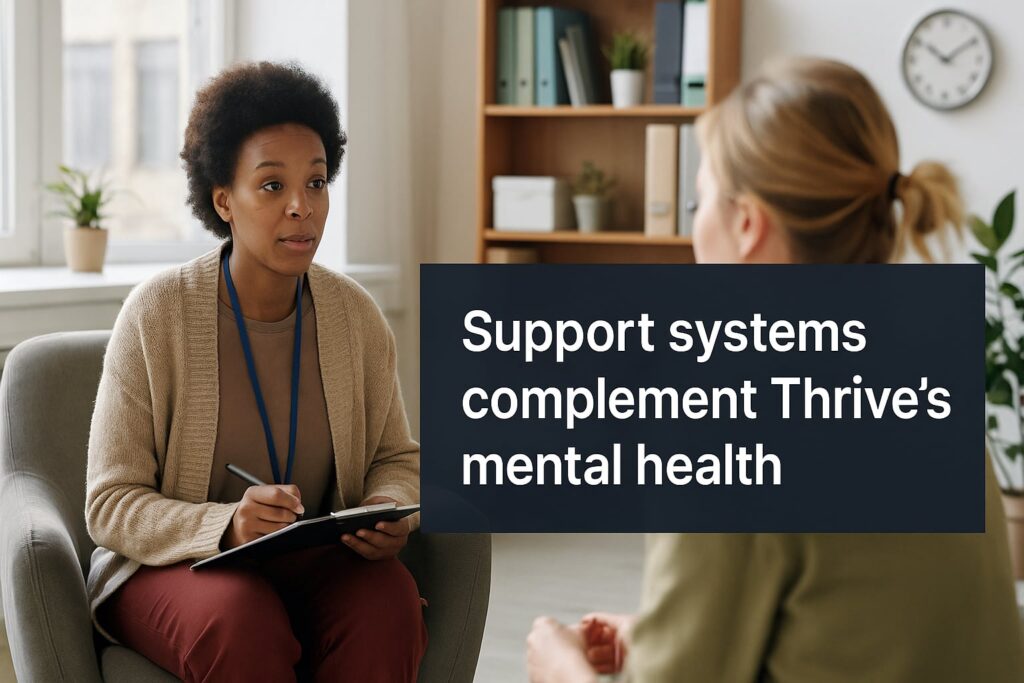
Here’s what you’ll discover in this guide: how support systems complement Thrive’s mental health treatment approaches by creating a comprehensive ecosystem for healing. We’ll explore the science behind why social connection literally rewires your brain for recovery, examine how modern treatment programs intentionally build support networks, and provide you with practical strategies for developing your own support ecosystem.
Whether you’re currently in treatment, considering professional support, or supporting someone on their mental health journey, understanding this integration transforms how you approach recovery. Because healing doesn’t happen in isolation. It happens in connection, reinforcement, and the daily practice of wellness supported by people who understand and care.
Sarah had been in therapy for six months and was doing everything right. She attended every session, practiced her coping strategies between appointments, took her medication as prescribed, and even kept a detailed mood journal. Her therapist praised her commitment. The panic attacks were less frequent. She could identify her triggers.
Yet something felt incomplete.
On paper, Sarah was making progress. In reality, she felt like she was managing her anxiety alone in a vacuum. Her family didn’t really understand what she was going through. Her friends meant well but often gave unhelpful advice like “just think positive” or “have you tried yoga?” And when she had a difficult day between therapy sessions, she had nowhere to turn except her own increasingly exhausted willpower.
Sarah’s experience reveals a critical gap that exists in many mental health journeys: the space between professional treatment and daily life. Clinical interventions provide essential tools, insights, and medical support. But recovery doesn’t happen in fifty-minute increments once a week. It happens continuously, in real-time, as you navigate relationships, work stress, family dynamics, and unexpected challenges.
This is where support systems become not just helpful, but essential. Think of professional mental health treatment as the foundation and framework of a house. It’s absolutely necessary. But support systems are the walls, roof, and interior that make that structure livable. They’re the invisible infrastructure that transforms clinical progress into sustainable wellness.
The relationship between professional treatment and personal support networks isn’t coincidental or optional. Research consistently shows that individuals who combine evidence-based therapy with strong support systems experience significantly better outcomes than those who rely on treatment alone. Support systems provide the daily reinforcement, real-time accountability, and emotional validation that bridge the gap between therapy sessions.
Here’s what you’ll discover in this guide: how support systems complement Thrive’s mental health treatment approaches by creating a comprehensive ecosystem for healing. We’ll explore the science behind why social connection literally rewires your brain for recovery, examine how modern treatment programs intentionally build support networks, and provide you with practical strategies for developing your own support ecosystem.
Whether you’re currently in treatment, considering professional support, or supporting someone on their mental health journey, understanding this integration transforms how you approach recovery. Because healing doesn’t happen in isolation. It happens in connection, reinforcement, and the daily practice of wellness supported by people who understand and care.
Decoding Mental Health Support Systems: Beyond Family and Friends
When most people think about mental health support, they picture a close friend listening over coffee or a family member offering encouragement. While these relationships matter deeply, they represent just one layer of what actually constitutes an effective support system.
A true support system operates like an ecosystem, diverse, interconnected, and serving multiple functions simultaneously. It includes the people who comfort you when you’re struggling, yes, but also those who challenge your thinking, hold you accountable to your goals, provide practical assistance, and simply share space with you during ordinary moments.
Understanding this broader definition changes everything about how you approach building support for your mental health journey.
The Support System Spectrum
Support systems exist on a spectrum from intimate to formal, each level providing distinct but complementary functions. Your intimate circle, family, close friends, romantic partners, offers emotional safety and unconditional acceptance. These are the people who know your history, understand your triggers, and provide comfort during your darkest moments.
Your extended network includes colleagues, neighbors, acquaintances, and community members. While these relationships may lack the depth of intimate connections, they provide something equally valuable: perspective, practical assistance, and social engagement that prevents isolation. The coworker who notices when you’re having a rough day, the neighbor who invites you to community events, the book club member who shares similar interests, these connections create a sense of belonging and normalcy.
Formal support structures round out the spectrum. Peer support groups connect you with others navigating similar mental health challenges. Online communities provide 24/7 access to understanding and advice. Community organizations offer structured activities and resources. Mental health programs include group therapy, family education sessions, and alumni networks.
Research consistently demonstrates that individuals with diverse support networks across all three levels show significantly better treatment adherence and recovery outcomes. The key isn’t having more people, it’s having the right mix of support types that address different needs.
How Professional Treatment Integrates Support Development
Modern mental health care has evolved beyond the traditional model of isolated individual therapy. Contemporary treatment approaches actively incorporate support system development as a core component of healing.
Family therapy sessions address relationship patterns that may be contributing to mental health struggles while teaching loved ones how to provide effective support. Group therapy creates immediate peer connections with others who truly understand your experience. Intensive outpatient programs include family education components that help your support network understand your diagnosis, treatment approach, and how they can best help.
This integration recognizes a fundamental truth: professional treatment provides the clinical foundation, but support systems provide the daily reinforcement that transforms insights into lasting change. Your therapist helps you develop coping strategies, but your support system helps you practice them in real-world situations. Your psychiatrist prescribes medication, but your support network notices when side effects emerge or symptoms return.
The relationship between professional treatment and personal support isn’t either-or. It’s both-and. Each amplifies the effectiveness of the other, creating a comprehensive ecosystem where healing can take root and flourish.
Decoding Mental Health Support Systems: Beyond Family and Friends
When most people think about mental health support, they picture a close friend listening over coffee or a family member offering encouragement. While these intimate connections matter deeply, they represent just one layer of a much more complex and powerful ecosystem.
Support systems exist on a spectrum, ranging from your innermost circle of trust to structured professional networks. Understanding this full spectrum helps you recognize support you already have and identify gaps that might be holding back your recovery.
The Support System Spectrum
Your support ecosystem operates across three distinct but interconnected levels, each serving unique functions in your mental health journey.
The Intimate Circle: This innermost layer includes family members, close friends, and romantic partners who know you deeply and provide emotional safety. These relationships offer the vulnerability space where you can share your darkest moments without fear of judgment. They’re the people who notice subtle changes in your mood, remember your triggers, and check in when you’ve been quiet too long. This circle provides emotional support, the comfort, validation, and unconditional acceptance that helps you feel less alone in your struggles.
The Extended Network: Moving outward, this layer encompasses colleagues, acquaintances, neighbors, and casual friends. While these relationships may lack the depth of your intimate circle, they provide crucial practical and social support. A coworker who covers your shift when you need a mental health day. A neighbor who brings over dinner when you’re struggling. A gym buddy who provides routine and accountability. These connections offer informational support too, sharing resources, recommending therapists, or simply normalizing mental health conversations through their own experiences.
The Formal Support Structure: The outermost layer includes peer support groups, community organizations, online communities, and structured programs. These formal networks provide specialized understanding that even loving family members may not possess. Someone who has navigated anxiety disorder understands your experience in ways others simply cannot. Support groups offer both validation and practical strategies learned through lived experience. Online communities provide 24/7 access to people who “get it” when you’re struggling at 2 AM and don’t want to burden your intimate circle.
Here’s what makes this spectrum so powerful: each level provides different types of support that the others cannot fully replicate. Your best friend offers emotional comfort but may not understand the clinical aspects of your diagnosis. Your therapist provides expert guidance but isn’t available for real-time crisis support. Your peer support group understands your experience intimately but can’t help with practical daily tasks.
Effective support requires diversity across all levels. Research consistently shows that individuals with varied support networks, spanning intimate relationships, extended connections, and formal structures, experience better treatment outcomes than those who rely heavily on just one type of support. It’s not about having dozens of people in your life. It’s about having the right mix of relationships that collectively meet your emotional, informational, practical, and social needs.
This understanding transforms how you approach building support. Instead of feeling guilty that your family doesn’t “get it” or frustrated that friends give unhelpful advice, you recognize that different relationships serve different purposes. Your recovery doesn’t depend on finding one perfect support person. It depends on cultivating a diverse ecosystem where each relationship contributes its unique strength to your healing journey.
Professional Integration Points
Modern mental health treatment has evolved far beyond the traditional model of isolated individual therapy sessions. Today’s evidence-based programs recognize that sustainable recovery requires actively building and strengthening the support networks that surround each person.
This shift represents a fundamental change in how we approach mental wellness. Rather than treating support systems as something that exists separately from clinical care, contemporary treatment models weave support development directly into the therapeutic process itself.
Family Therapy Components in Individual Treatment: Many individual therapy programs now include periodic family sessions as a standard component. These sessions aren’t just about updating loved ones on progress. They address communication patterns, help families understand mental health conditions beyond stereotypes, and teach specific skills for providing effective support. When someone is working through anxiety or depression, their family members learn how to recognize early warning signs, respond helpfully during difficult moments, and avoid well-intentioned behaviors that might actually hinder recovery.
Peer Support Integration in Group Programs: Group therapy has transformed from simply gathering people with similar challenges into structured peer support systems. Intensive outpatient programs and partial hospitalization programs deliberately create therapeutic communities where participants become support resources for each other. These connections often extend beyond the formal treatment period, creating lasting networks of people who truly understand each other’s experiences. The person sitting next to you in group today might become the friend you text when you’re struggling with a trigger next month.

Community Resource Connections Through Case Management: Treatment teams now actively help clients identify and connect with community resources that extend their support network. This might include linking someone to local support groups specific to their condition, connecting them with peer mentorship programs, or helping them access community mental health centers for ongoing support after intensive treatment ends. Case managers serve as bridges between clinical care and the broader ecosystem of community support.
The practical impact of this integration shows up in real treatment settings every day. Intensive outpatient programs typically include weekly family education sessions where loved ones learn alongside the person in treatment. These sessions cover everything from understanding medication side effects to recognizing the difference between supporting someone and enabling unhealthy patterns.
This integrated approach addresses three common misconceptions that often limit recovery success. First, many people believe support systems are only about emotional comfort, someone to vent to when you’re upset. In reality, effective support includes practical assistance, informational guidance, and social connection that goes far beyond just feeling heard. Second, there’s a persistent myth that more people always equals better support. Quality matters far more than quantity. Three deeply invested relationships provide more meaningful support than twenty superficial connections. Third, people often view professional treatment and personal support as completely separate domains. The most effective recovery happens when these elements work together intentionally, each reinforcing and amplifying the other.
Professional treatment provides the clinical foundation, evidence-based techniques, medication management when needed, and expert guidance through the recovery process. But it’s the support systems, actively developed and strengthened through treatment, that help you apply those clinical insights in your daily life. This is where healing moves from concept to reality, from the therapist’s office to your actual relationships and routines.
The Science Behind Why Support Systems Amplify Treatment Success
When you think about mental health treatment, you might picture therapy sessions, medication, or coping strategies. But here’s what most people don’t realize: some of the most powerful healing happens not in the therapist’s office, but in the moments between sessions when you’re surrounded by people who understand and support your journey.
The science behind this is fascinating. Your brain doesn’t distinguish between “clinical healing” and “social healing.” It responds to both through the same neurological pathways, creating a synergistic effect that dramatically amplifies recovery outcomes.
How Social Connection Rewires the Brain for Healing
Positive social interactions trigger a cascade of neurochemical changes that directly support mental health recovery. When you connect with someone who truly understands what you’re going through, your brain releases oxytocin, often called the “bonding hormone.” This isn’t just a feel-good chemical. Oxytocin actively reduces cortisol levels, the stress hormone that exacerbates anxiety and depression.
But the impact goes deeper. Mirror neurons in your brain activate when you observe others successfully managing challenges similar to yours. This is why group therapy and peer support are so effective. Your brain literally practices healthy coping strategies by watching others implement them, creating new neural pathways that reinforce recovery.
Research in neuroplasticity reveals that repeated positive social experiences physically reshape brain structure. Each meaningful conversation, each moment of feeling understood, each time someone validates your progress, these interactions strengthen the neural networks associated with emotional regulation and resilience.
Think of it this way: therapy teaches your brain new patterns, but support systems provide the daily repetition that makes those patterns permanent. It’s the difference between learning a language in a classroom versus living in a country where that language is spoken. Both matter, but the immersive experience accelerates and solidifies the learning.
The 24/7 Treatment Extension Effect
Professional therapy typically happens once a week for about an hour. That’s 52 hours per year. But mental health challenges don’t wait for your next appointment. They show up at 2 AM when anxiety strikes, during a difficult conversation with your boss, or when you’re navigating a family conflict.
This is where support systems become your continuous treatment extension. They provide real-time application of the coping strategies you’ve learned in therapy. When a friend recognizes your early warning signs and gently reminds you to use your grounding techniques, that’s therapy in action. When a support group member shares how they handled a similar trigger, that’s immediate, practical reinforcement.
Studies consistently demonstrate this amplification effect. Research shows that individuals who combine professional therapy with strong support networks experience significantly better treatment outcomes than those who rely on clinical intervention alone. The improvement isn’t marginal, it’s substantial, with some studies indicating up to 60% better long-term recovery rates.
Support systems also provide crucial accountability for maintaining healthy behaviors between sessions. It’s easier to skip your morning meditation or ignore your sleep schedule when no one knows. But when you’ve committed to checking in with an accountability partner, you’re more likely to follow through. This consistent practice transforms therapeutic insights from abstract concepts into lived habits.
The feedback loop works both ways. Your support network helps you recognize progress you might miss on your own. They notice when you handle a situation differently than you would have six months ago. They celebrate small victories that feel insign
The Science Behind Why Support Systems Amplify Treatment Success
When you connect with someone who truly understands what you’re going through, something remarkable happens in your brain. It’s not just emotional comfort or psychological reassurance. Your nervous system literally shifts into a different state, one that’s more conducive to healing and growth.
This isn’t metaphorical. It’s measurable neuroscience.
How Social Connection Rewires the Brain for Healing
Positive social interactions trigger a cascade of neurochemical changes that directly enhance your ability to benefit from therapy. When you share your struggles with a supportive friend or participate in a group therapy session, your brain releases oxytocin, often called the “bonding hormone.” This isn’t just about feeling warm and fuzzy. Oxytocin actively reduces cortisol levels, the stress hormone that keeps your nervous system in fight-or-flight mode.
Lower cortisol means better emotional regulation. It means the coping strategies you learn in therapy actually stick because your brain isn’t constantly flooded with stress chemicals that interfere with learning and memory formation.
But there’s more happening beneath the surface. Your brain contains specialized cells called mirror neurons that activate both when you perform an action and when you observe someone else performing that same action. In a group therapy setting, when you watch another person successfully navigate a panic attack using grounding techniques, your mirror neurons fire as if you’re practicing that skill yourself.
This is why group therapy sessions often create lasting behavioral changes that individual therapy alone might take longer to achieve. You’re not just learning coping strategies intellectually. You’re experiencing them through social modeling, which creates stronger neural pathways and more automatic responses when you need them most.
Perhaps most importantly, shared experiences with others who understand your mental health challenges create entirely new neural pathways that reinforce recovery. Every conversation where someone validates your experience, every moment when a friend recognizes your progress, every group session where you realize you’re not alone, these interactions literally reshape your brain’s architecture.
Neuroscientists call this neuroplasticity: your brain’s ability to form new connections and pathways throughout your life. Mental health recovery isn’t just about managing symptoms. It’s about building new ways of thinking, feeling, and responding to the world. Social connection accelerates this process by providing the repetition, reinforcement, and emotional safety your brain needs to make those changes permanent.
Think about it this way: your therapist might teach you a new way to challenge anxious thoughts during your weekly session. But your support system gives you dozens of opportunities each week to practice that skill in real situations, with real-time feedback and encouragement. Each practice session strengthens those new neural pathways until healthier thought patterns become your default response.
This is why support isn’t just emotional comfort. It’s biological medicine. The relationships you build, the connections you nurture, the communities you join, they’re all actively participating in your brain’s healing process, creating the neurological foundation for sustainable wellness that extends far beyond the therapy room.
Your Path Forward: Building Support That Lasts
Building effective support systems isn’t about collecting the most contacts or forcing relationships that don’t fit. It’s about intentionally creating a network of connections that genuinely reinforces your mental health journey. The most powerful support ecosystems combine professional guidance with authentic personal relationships, each playing a distinct role in your recovery.
Start where you are. Assess your current support landscape honestly, who provides emotional understanding, who offers practical help, who gives you space to be yourself without judgment. Then identify one specific area where you’d like deeper connection. Maybe that’s finding a peer support group where others understand your specific challenges. Maybe it’s having an honest conversation with a family member about what kind of support actually helps you.
Remember that support systems evolve as you do. The network that serves you in early recovery might look different from what you need six months or two years later. That’s not failure, that’s growth. The key is maintaining the habit of regularly evaluating whether your support ecosystem still matches your current needs.
Professional treatment provides the clinical foundation, the evidence-based strategies, and the expert guidance that makes recovery possible. But it’s your support system that helps you apply those insights in real-time, celebrates your progress, and reminds you why healing matters when things get difficult.
Thrive Mental Health’s approach recognizes that lasting wellness happens in relationship, both with skilled clinicians and with the people who matter most in your life. Our comprehensive programs help you develop not just coping strategies, but the communication skills and relationship tools that transform your entire support ecosystem. Get Started Now to discover how professional treatment and personal support can work together to create the foundation for sustainable mental health.

This article is for informational purposes only and is not a substitute for individualized clinical advice or insurance verification.