


Mentalization-Based Family Therapy [2025]: Stop the Blowups and Reconnect (Fast)
If you or someone you know is struggling with thoughts of self-harm or suicide, please reach out for help immediately. You are not alone. Call or text 988 in the US and Canada, or dial 111 in the UK. These services are available 24/7, free, and confidential.
If you’re in crisis, call/text 988 right now. You are not alone.
Home feel like a war zone, door slams, shutdowns, endless fights? Mentalization based family therapy (MBT-F) helps you end knee-jerk reactions and start understanding the mind behind the behavior. Expect real skills, not platitudes: fewer blowups, calmer conversations, and safer choices. Typical course: 12-18 months of family + individual sessions, with first wins often in weeks.
What you lose by waiting: more escalation, more distance, more risk. What you gain by starting: clearer communication, faster de-escalation, and a plan you can use tonight.
As Nate Raine, CEO of Thrive Mental Health, I’ve seen MBT-F reset families stuck in high-conflict cycles, especially with teen self-harm, anxiety, and BPD traits, by rebuilding curiosity, safety, and trust.
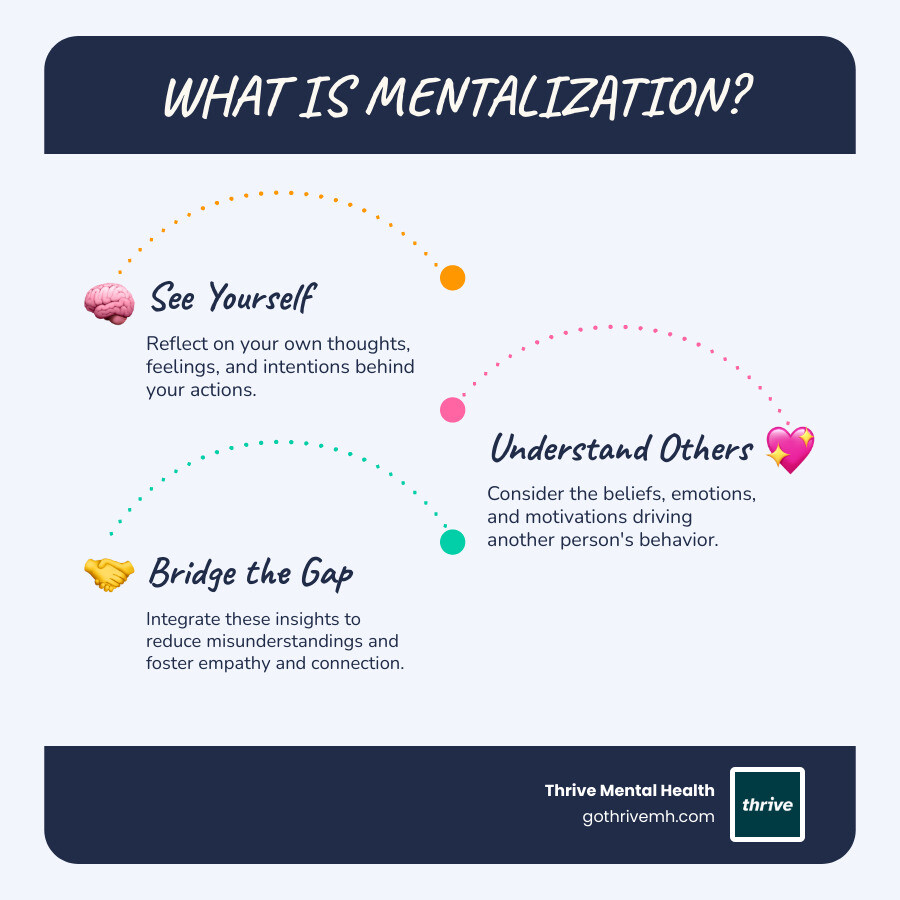
Quick look at mentalization based family therapy:
Summary: Mentalization based family therapy gives your family a repeatable, 3-step way to pause, understand, and change patterns, so arguments end faster and connection returns.
What Is Mentalization? (The #1 Skill Your Family Is Missing)
Here’s a common scene: Your teenager slams their door. Your first thought? They’re being disrespectful. But what if they’re actually overwhelmed or scared? That gap, between what you see and what’s happening inside, is where families get stuck. The skill that closes that gap is mentalization.
Mentalization is the ability to understand your own behavior, and that of others, in terms of underlying mental states (thoughts, feelings, intentions). It’s been called “holding mind in mind,” or simply: seeing yourself from the outside and others from the inside. When you mentalize, you pause before reacting. You see that a sharp tone might come from exhaustion, not anger. This skill is the foundation of healthy family relationships and central to mentalization based family therapy.
How Mentalization Develops (and Breaks Down) in Families
Mentalizing begins in infancy. When a parent accurately mirrors a baby’s emotions, the baby learns their internal states are real and recognized. This process, called social biofeedback, builds emotional self-awareness and epistemic trust, the belief that what others share is relevant. When this process is disrupted by trauma or inconsistent care, it can lead to insecure attachment, making mentalizing much harder. (Learn more about how attachment shapes mentalizing in our guide on Attachment-Based Mentalization Therapy.)
Even with good skills, mentalizing can vanish when stress or intense emotional arousal hits. During a heated argument, we often slip into pre-mentalizing modes, primitive ways of thinking that shut down empathy:
- Psychic equivalence: Your internal feeling feels like absolute reality. “I feel angry, therefore this situation is unfair.” There’s no room for other perspectives.
- Teleological mode: You only focus on observable actions. “If I can’t see the change, it didn’t happen.” The internal motivation is ignored.
- Pretend mode: Thoughts and feelings are disconnected from reality. You might talk about feelings without feeling them, staying intellectual and detached.
These modes aren’t character flaws; they’re a natural response to being overwhelmed. Because family bonds are so intense, conflicts escalate fast, causing mentalizing to fail. A preoccupied parent can’t mentalize their child’s needs, the child feels misunderstood, and the cycle continues. Understanding how mentalizing breaks down is the first step to rebuilding it with mentalization based family therapy.
How Mentalization-Based Family Therapy (MBT-F) Reboots Communication
When your family is stuck in painful patterns, mentalization based family therapy offers a way out by helping you understand the minds behind the behavior. The therapist takes a “not-knowing” stance, bringing genuine curiosity rather than claiming to have all the answers. They model how to wonder about thoughts and feelings without judgment, teaching your family to ask these questions of each other.
The therapist holds the balance in sessions, paying attention to both spoken words and body language. They help connect feelings to actions (“I felt scared, so I yelled”). When family members slip into blaming or ignoring each other’s mental states, the therapist gently intervenes to terminate these non-mentalizing interactions, creating space for reflection instead of reaction. Conversely, they actively highlight and reinforce moments of good mentalizing, like when a parent considers their child’s perspective. This happens in an atmosphere of empathy and warmth, focusing on the present moment to improve emotional regulation and rebuild trust in real time. A systematic review of MBT approaches found promising support for this method in increasing reflective functioning in families.
The Key Techniques Used in Mentalization-Based Family Therapy
MBT-F uses specific techniques to interrupt old patterns. The most powerful is the Mentalizing Loop, a three-step process:
- Notice and Name: The therapist helps the family pause and identify a painful pattern as it happens. Naming it (“the blame game”) makes it something you can work on.
- Mentalize the Moment: The therapist slows things down and invites each person to share their internal experience during that moment. This step blocks assumptions and focuses on genuine exploration of thoughts and feelings.
- Generalize and Consider Change: The insights are applied more broadly. Where else does this happen? How could you respond differently next time? This empowers conscious choices over autopilot reactions.
Other key techniques include:
- The “Pause Button”: Literally pausing a heated interaction to create breathing room and prevent impulsive reactions.
- Challenging non-mentalizing: Gently redirecting assumptions (“You’re just trying to make me angry”) toward curiosity (“What were you actually trying to do?”).
- Highlighting “good” mentalizing: Celebrating small moments of perspective-taking to reinforce success.
- Playful activities: Using games and role-playing to help younger family members practice mentalizing in an engaging way.
How MBT-F Differs From Other Family Therapies
If you’ve tried other therapies, you might wonder what makes mentalization based family therapy different. While many approaches aim to improve family dynamics, MBT-F has a unique focus: changing how you understand each other’s minds, not just what you do.
- Cognitive-Behavioral Family Therapy (CBFT) teaches specific communication and problem-solving skills. The therapist is often a directive teacher.
- Structural Family Therapy looks at the family’s organization, boundaries, hierarchies, and roles, and works to realign them.
MBT-F is different. The therapist is a curious facilitator, not a teacher or restructurer. The goal isn’t to modify specific thoughts or roles, but to improve everyone’s capacity to mentalize. The focus is on process over content. Instead of just solving a homework battle, MBT-F explores the mind behind the behavior in that moment: “What was happening in your mind that made slamming the door feel like the only option? And what happened in your parent’s mind when they heard it?”
While therapies like Cognitive Behavioral Therapy change thought patterns and Dialectical Behavior Therapy teaches emotional regulation skills, MBT uniquely improves the understanding of mental processes. It’s about building a foundation for more authentic connection. You can explore these differences more in our article on CBT vs DBT vs MBT: Key Differences Therapy.

Is MBT-F Right for Your Family? [5 Problems It Solves]

Mentalization based family therapy isn’t for everyone, but it can be transformative if your family is caught in cycles of emotional disconnect. It works best when the problem isn’t just the behavior, but the pain, fear, or confusion driving it. Here are key areas where MBT-F helps:
- Adolescent behavioral issues: For teens engaging in self-harm, expressing suicidal thoughts, or acting out, MBT-F helps everyone understand the intense mental states fueling these behaviors. Instead of just stopping the action, you address the underlying feelings of worthlessness or overwhelm.
- Persistent parent-child conflict: MBT-F provides tools to pause the same old arguments and ask, “What’s really happening here?” It shifts the focus from who’s right to understanding the minds in the room.
- Families affected by BPD or anxiety: MBT was originally designed for Borderline Personality Disorder. MBT-F helps the entire family steer emotional dysregulation without getting swept away. You learn to stay curious instead of reactive, seeing the fear behind the anger. Learn more in our guide on MBT for BPD.
- High emotional arousal: When anger or fear hijacks conversations, mentalizing shuts down. MBT-F teaches you to hit pause before things explode, creating space for understanding.
- Breakdowns in empathy and trust: When family members assume the worst about each other’s motives, MBT-F rebuilds that bridge by teaching you to genuinely wonder about each other’s internal experiences.
Benefits for Children, Adolescents, and Parents
The change happens across the family:
- For children: They build emotional intelligence, learning to identify and express their feelings constructively. This fosters resilience for life.
- For adolescents: Impulsivity often decreases as they learn to think before acting. Relationships improve, and studies show significant reductions in suicidality and self-harm for teens with borderline traits.
- For parents: You gain deeper empathy for your child, understanding that an eye-roll might be overwhelm, not disrespect. This reduces your own controlling behaviors and emotional reactions, creating a calmer home.
The ultimate goal is building secure attachments. When each person feels seen, heard, and understood, trust grows, and the family can weather any storm together.
Finding an MBT-F Program [And What to Expect]
Starting mentalization based family therapy is a commitment to real change. Your therapist acts as a facilitator with a not-knowing, curious stance, helping your family map thoughts and feelings to behaviors in real time.
- Training matters: Look for formal MBT-F training/supervision (e.g., Anna Freud Centre models).
- Commitment: Plan for 12-18 months. Consistency beats intensity.
- Motivation: You’ll practice pausing in the moment, vital for fast de-escalation.
Where to start (fast):
- Explore our Mentalization-Based Treatment Virtual IOP: https://gothrivemh.com/treatment-modalities-virtual-iop/mentalization-based-treatment-virtual-iop/
- Prefer a broader Virtual IOP overview? https://gothrivemh.com/treatment-modalities-virtual-iop/
- Check coverage in 2 minutes → https://gothrivemh.com/verify-insurance/
Local + insurance: For families in Florida, Thrive offers virtual and hybrid Intensive Outpatient (IOP) and Partial Hospitalization (PHP) programs. We accept many plans, including Cigna, Optum, and Florida Blue.
What to look for in a practitioner:
- Licensure (LMFT, LCSW, psychologist)
- Specific MBT-F training and live supervision experience
- Track record with your needs (e.g., adolescent self-harm, BPD traits)
- A calm, curious stance that keeps sessions safe and productive
Frequently Asked Questions about Mentalization-Based Family Therapy
Q: How long does MBT-F take?
A: Most families do 12-18 months. Many see fewer blowups within the first few weeks.
Q: Is MBT-F covered by insurance?
A: Often, yes, especially in IOP/PHP levels of care. We accept Cigna, Optum, Florida Blue, and more. Check your benefits in 2 minutes: https://gothrivemh.com/verify-insurance/
Q: Can we do MBT-F virtually?
A: Yes. Thrive offers virtual and hybrid options with evening sessions for families throughout Florida.
Q: How is MBT-F different from regular family therapy?
A: Instead of just teaching skills, MBT-F trains your family to understand the minds behind behaviors, so you can de-escalate faster and rebuild trust.
Q: Who is MBT-F best for?
A: Families facing teen self-harm/suicidality, BPD traits, anxiety, or constant parent, child conflict who want fewer crises and more connection.
Start Reconnecting with Your Family Today
Mentalization based family therapy helps you replace hot reactions with clear understanding, so your home gets calmer and safer, fast.
Ready for support? For families in Florida, Thrive offers virtual IOP programs with evening options. Verify your insurance in 2 minutes (no obligation) → Start benefits check or call 561-203-6085. If you’re in crisis, call/text 988.

This article is for informational purposes only and is not a substitute for individualized clinical advice or insurance verification.