
Home Sweet Home: Understanding Sexuality in Domestic Spaces

Why Understanding Home Sexuality Matters for Your Identity and Well-Being
Home sexuality refers to the complex relationship between one’s sexual orientation, gender identity, and their experience of domestic space—how LGBTQ+ individuals steer, create, and redefine what “home” means in a world built on heteronormative assumptions.
Quick Answer: What is Home Sexuality?
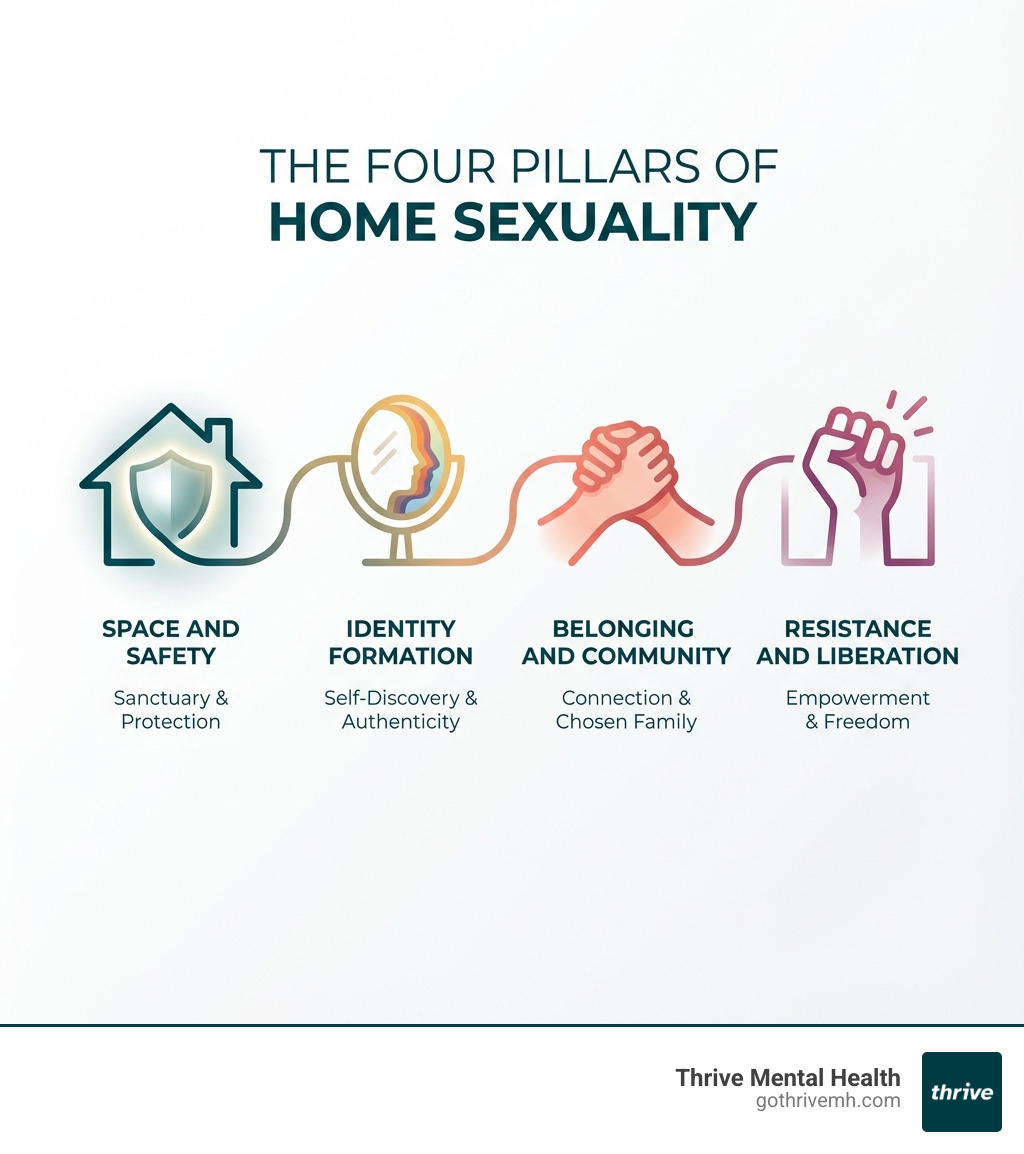
- Physical Space: How LGBTQ+ people experience and transform domestic environments
- Emotional Safety: The tension between home as sanctuary vs. site of rejection
- Identity Formation: How domestic life shapes sexual and gender identity development
- Resistance: Creating alternative living arrangements that challenge traditional family structures
- Belonging: The search for spaces where one can be authentically themselves
For many LGBTQ+ individuals, home isn’t just a physical location—it’s a contested space where identity, safety, and belonging collide. Research shows that approximately 3.5% to 7.1% of adults in the United States identify as lesbian, gay, bisexual, or transgender, with younger generations coming out in greater numbers than ever before. Yet the domestic sphere—from childhood kitchens to adult living rooms—remains deeply shaped by heteronormative expectations about who belongs, who loves whom, and what family should look like.
The concept of home sexuality emerged from ethnographic research with older lesbian feminist activists who spent decades creating alternative intimate and public living spaces. Their experiences reveal how domestic spaces like kitchens became sites for challenging cultural norms, building chosen families, and resisting patriarchal structures. This isn’t just academic theory—it’s about real people navigating real conflicts between authenticity and acceptance, often within their own four walls.
The stakes are high. Non-heterosexual teens are 2 to 3 times more likely to experience suicidal ideation and self-harm than their heterosexual peers. Adults face liftd rates of anxiety and depression, often exacerbated by family rejection or the exhausting work of hiding their true selves at home. Understanding home sexuality helps us recognize these challenges and create pathways toward safer, more affirming domestic lives.
I’m Nate Raine, CEO of Thrive Mental Health, and over the past decade, I’ve worked at the intersection of mental health innovation and evidence-based care to help individuals steer complex identity challenges, including how home sexuality impacts well-being and belonging. At Thrive, we’ve built programs in Florida specifically designed to support adults and young professionals who are working to reconcile their authentic identities with the domestic spaces they inhabit.
Simple home sexuality glossary:
Beyond Four Walls: What ‘Home’ Really Means for LGBTQ+ Individuals

For many, the word “home” conjures images of comfort, safety, and unconditional love. But for a significant portion of the LGBTQ+ community, this ideal often clashes with a more complex reality. While home can indeed be a sanctuary, a place where we find refuge and express our authentic selves, it can just as easily become a conflict zone, a space where heteronormativity and societal expectations create an environment of tension, judgment, or even outright rejection.
We understand that the meaning of ‘home’ is multifaceted for lesbians, particularly when viewed through the lens of their lived experiences and cultural contexts. The traditional, often heteronormative, definition of family and domesticity frequently excludes or marginalizes queer relationships and living arrangements. This tension forces many LGBTQ+ individuals to forge their own paths, creating “chosen families” that provide the love, support, and belonging often absent from their families of origin.
The concept of home is not static; it evolves with our lives and the cultural landscape. For older lesbians, who have witnessed decades of societal change, the very definition of home has been a journey of constant re-evaluation and creation. This evolving concept highlights the resilience and creativity within our community to carve out spaces of authenticity and acceptance.
Considering the demographic shifts, the LGBTQ+ population in the United States is growing. Gallup polls show that the percentage of adults identifying as LGBT rose from 3.4% in 2012 to 4.5% in 2017, largely driven by millennials, and reached 7.1% in 2022. This growing visibility underscores the urgent need for a deeper understanding of how diverse sexualities and gender identities shape our domestic lives, from the quiet corners of our bedrooms to the busy heart of our kitchens.
How do childhood memories shape the adult understanding of home?
Our earliest memories of home, especially those tied to spaces like the childhood kitchen, often leave an indelible mark on our adult understanding of domesticity. For many, these memories are a source of nostalgia, warmth, and foundational comfort. However, for LGBTQ+ individuals, these early experiences can also be fraught with trauma, confusion, or a nascent sense of being “other.”
The research highlights how “the concept of ‘home’ evolve[s] over time, from early memories of childhood kitchens to contemporary domestic lives.” A kitchen, for instance, might be remembered as a place of family gathering and love, but also as a site where gender roles were rigidly enforced, or where unspoken anxieties about one’s emerging identity first took root. These generational differences in experience mean that while some may carry fond memories, others might carry the burden of past expectations or rejections. As adults, we often find ourselves either recreating the comforting aspects of those early homes or actively dismantling and rebuilding them to align with our authentic selves. This process of forging new traditions and redefining domestic life is a powerful aspect of home sexuality.
How do these experiences differ from broader LGBTQ+ trends?
While there are universal themes of seeking belonging and navigating identity within the LGBTQ+ community, the experiences of specific groups, such as older lesbians, can present unique nuances. The ethnographic study on older lesbian feminist activists in London, for instance, offers insights into a particular generational cohort whose understanding of home was shaped by distinct social and political movements.
Their experiences might diverge from those of younger LGBTQ+ individuals who grew up in more accepting times, or from gay men, bisexual, or transgender individuals who face different forms of societal pressure and prejudice. For example, while gay men might have historically created public spaces like bars for community building, lesbians often focused on creating intimate, domestic, and private networks. These specific lesbian experiences, often rooted in feminist activism, emphasize the creation of alternative intimate and public living spaces as a direct response to heteronormativity and patriarchy. Understanding these divergences helps us appreciate the rich mix of LGBTQ+ experiences and ensures we don’t paint all identities with a single brush.
The Kitchen Table as a Battlefield: Reclaiming Domestic Space
For many, the kitchen is merely a place to prepare food. But for older lesbians, as revealed in ethnographic research, the domestic kitchen has served as a powerful site for exploring cultural norms, aspirations, and social inequalities. It’s a space where traditional gender roles are often challenged, and where the aspirations for a loving, equitable domestic life can clash with the realities of a heteronormative world.
We’ve observed that lesbians have historically created alternative intimate and public living spaces in various ways to counter the pervasive influence of heteronormativity and patriarchy. These strategies often involve:
- Communal Living: Forming households with friends, chosen family, or other queer individuals to share resources, support, and create a collective sense of belonging.
- Dedicated Queer Spaces: Establishing homes that are explicitly recognized as safe havens for LGBTQ+ people, fostering open expression and community.
- Redefining Domestic Labor: Challenging traditional divisions of labor within the home, with tasks shared based on skill and preference rather than gender.
- Intentional Design: Curating living environments that reflect queer aesthetics, values, and relationships, rather than conforming to mainstream domestic ideals.
- Activist Hubs: Using homes as centers for organizing, meeting, and supporting social and political movements, blurring the lines between private and public life.
These alternative living arrangements are not just about shelter; they are acts of resistance, revealing profound insights into the experiences of heteronormativity and patriarchy. They highlight the constant work involved in creating a space where one can thrive authentically. This ethnographic inquiry into the connections between sexuality, domesticity, and the concept of ‘home’ shows us that the personal is indeed deeply political.
How has the kitchen served as a site of exploration?
The kitchen, traditionally seen as the heart of the home and often associated with women’s unpaid labor, takes on unique significance in the context of home sexuality. As a focal point for understanding cultural norms, customs, duties, ideas, aspirations, expectations, and values, it becomes a microcosm of broader societal structures.
For older lesbians, the kitchen was often a space where they could subvert or redefine these norms. Cooking and care, instead of being gendered duties, became expressions of love and community. Social gatherings around the kitchen table fostered deep connections and provided a safe space for dialogue. It was a site where the aspiration for a life free from patriarchal constraints could be enacted, even if the reality of social inequalities still loomed. The kitchen transformed from a symbol of domestic confinement into a vibrant center for domestic life, a place for both connection and, at times, conflict as new ways of living were negotiated and established.
How does the concept of home sexuality challenge traditional family structures?
The very essence of home sexuality lies in its inherent challenge to traditional understandings of home and family structures. The book mentioned in our research explicitly explores how lesbians have created alternative intimate and public living spaces, directly confronting the confines of heteronormativity and patriarchy.
Traditionally, “family” has been equated with the nuclear unit of a heterosexual couple and their biological children. However, the experiences of LGBTQ+ individuals, particularly lesbians, demonstrate a radical reimagining of kinship. This involves:
- Deconstructing the Nuclear Family: Moving beyond the assumption that a family must conform to a husband-wife-children model.
- Redefining Kinship: Recognizing that family bonds can be formed through love, commitment, and shared experience, rather than solely through blood or legal marriage. This includes “chosen families,” which become vital support systems.
- Non-Monogamous Households: Exploring diverse relationship structures that may not fit traditional monogamous ideals.
- Communal Living Arrangements: Building collective households where multiple adults, and sometimes children, share space and responsibilities, fostering deep community ties.
- Challenging Patriarchy: Creating domestic spaces where power dynamics are intentionally re-evaluated, and gender-based hierarchies are dismantled.
These alternative structures not only provide vital support and belonging for LGBTQ+ individuals but also broaden society’s understanding of what constitutes a family. The historical context is crucial here; for a long time, homosexuality was pathologized, even listed in diagnostic manuals like the ICD-10 until 1990. The removal of homosexuality as a mental disorder by major health organizations, including the World Health Organization, has been a significant step in validating diverse sexualities and, by extension, diverse family structures. This scientific research on the history of homosexuality’s classification underscores the societal shift that allows for these challenges to traditional norms.
Building a Home, Building a Movement: The Politics of Home Sexuality

The journey to define and create home sexuality has always been intertwined with broader social justice movements. For many LGBTQ+ individuals, especially those who came of age during the feminist and gay rights movements, the act of creating a home was inherently political. It wasn’t just about finding a place to live; it was about carving out spaces of safety, affirmation, and liberation in a world that often denied their very existence. This is what we call “political homemaking”—the intentional creation of domestic environments that challenge oppressive norms and foster radical self-acceptance.
The personal was, and remains, political. The struggles faced in our private lives—the need for acceptance, the desire for love, the right to form a family—became the fuel for collective action. This historical context of de-pathologization, where homosexuality was gradually removed from medical classifications by bodies like the APA in 1973 and the WHO in 1990, provided a scientific and social foundation for this movement. It affirmed that queer identities were not illnesses to be cured but natural variations of human experience.
For those navigating identity exploration, understanding this history is empowering. At Thrive Mental Health, we offer virtual therapy options across Florida that can provide support and guidance through these complex personal journeys. You can find more info about virtual therapy for identity exploration here: More info about virtual therapy for identity exploration.
How do life histories inform the creation of home sexuality?
The life histories of older, feminist lesbian activists are invaluable in understanding the creation of home sexuality. These individuals, many of whom came out in eras marked by significant social stigma and discrimination, had to invent new ways of living and loving. Their understanding of “home” was not handed to them but carefully built through collective action and personal resilience.
Their life stories serve as powerful data, illustrating how activism directly shaped their identities and their domestic arrangements. They resisted heteronormativity by consciously choosing to live in communities of care, often with other lesbians, creating networks of mutual support that functioned as chosen families. These homes became sites of political organizing, consciousness-raising, and the forging of new cultural norms that celebrated queer identities. Their experiences teach us that a home, particularly for marginalized groups, is often a deliberate construction, a testament to endurance and the power of self-definition.
What role has activism played in defining ‘home’?
Activism has played an indispensable role in defining and expanding the concept of “home” for LGBTQ+ individuals. The women’s liberation movement and the Gay Liberation Front, among others, provided the fertile ground for queer people to articulate their needs and desires for safe and affirming living spaces.
Historically, this involved:
- Creating Lesbian-Only Spaces: The establishment of women’s land, communes, and shared housing offered refuge from patriarchal structures and provided environments where lesbian relationships could flourish openly.
- Consciousness-Raising Groups: These gatherings, often held in private homes, allowed individuals to share experiences, build collective understanding, and develop strategies for personal and political change, changing private dwellings into public forums for empowerment.
- The Fight for Legal Recognition and Safety: Activism pushed for legal protections in housing, family law, and anti-discrimination measures, seeking to ensure that LGBTQ+ individuals had the right to create and inhabit homes without fear of eviction, harassment, or violence.
- Challenging Domestic Norms: By advocating for diverse family structures and rejecting traditional gender roles within the home, activism fundamentally redefined what a “family” and a “home” could be.
This collective effort to redefine domesticity is a testament to the power of community and advocacy. The American Psychological Association’s stance on affirmative responses to sexual orientation, which encourages support and validation rather than attempts to change one’s orientation, further underscores the importance of creating affirming environments, both in society and within our homes. Read more about the APA’s position here: APA’s stance on affirmative responses to sexual orientation.
Finding Your Safe Space: Support for Navigating Identity and Belonging
Navigating our sexual and gender identity can be a complex journey, and for many, the domestic sphere adds another layer of challenge. When home isn’t a place of unconditional acceptance, the emotional toll can be immense. The persistent stress of heteronormativity—the societal expectation that everyone is, or should be, heterosexual—can lead to feelings of isolation, anxiety, and depression. Family conflict, particularly rejection from loved ones, is a significant contributor to mental health challenges within the LGBTQ+ community.
We believe that no one should have to steer these complexities alone. Finding community support, whether through local LGBTQ+ centers, online groups, or chosen family, is crucial for fostering a sense of belonging. Moreover, the importance of affirming therapy cannot be overstated. This type of mental healthcare validates an individual’s experiences, helps them process trauma, and equips them with coping strategies to build resilience.
At Thrive Mental Health, we are committed to providing accessible and expert-led support for Floridians. Our virtual and in-person programs, including Intensive Outpatient (IOP) and Partial Hospitalization (PHP) programs, are available for adults and young professionals across the state. We work with major insurance providers like Cigna, Optum, and Florida Blue, making quality care more attainable.
If you’re in crisis, call/text 988 right now. You are not alone.
When is professional support needed?
It’s common to experience periods of questioning or difficulty when it comes to identity and belonging. However, there are clear signs when professional support can make a significant difference. You might consider reaching out if you’re experiencing:
- Persistent feelings of isolation or loneliness, even when surrounded by others.
- Ongoing family conflict or rejection that impacts your mental and emotional well-being.
- Significant anxiety or depression directly related to your sexual or gender identity.
- Difficulty creating a sense of belonging, either within your family, peer groups, or broader community.
- Overwhelm when navigating complex relationships, especially those impacted by your identity.
- Trauma from past experiences of discrimination or non-acceptance in domestic spaces.
These challenges can be overwhelming, and we offer specialized programs designed to help. For more intensive support, our Intensive Outpatient Programs (IOP) provide structured therapy multiple times a week, allowing you to build skills and process emotions in a supportive environment. You can find more info about Intensive Outpatient Programs (IOP) here: More info about Intensive Outpatient Programs (IOP).
What are the benefits of affirming mental healthcare?
Affirming mental healthcare offers profound benefits, especially for those navigating complex issues related to home sexuality and identity. It’s not just about treating symptoms; it’s about fostering holistic well-being. The benefits include:
- Validation of Experience: An affirming therapist understands and respects your identity, validating your feelings and experiences rather than pathologizing them. This reduces the burden of having to constantly explain or justify your existence.
- Reduced Minority Stress: LGBTQ+ individuals often experience “minority stress,” which stems from chronic exposure to prejudice and discrimination. Affirming therapy helps you process this stress, build resilience, and develop healthy coping mechanisms.
- Building Resilience: By providing tools and strategies, therapy empowers you to steer societal challenges, family tensions, and internal conflicts with greater strength.
- Developing Coping Strategies: You’ll learn practical ways to manage anxiety, depression, and the emotional impact of non-affirming environments.
- Fostering Self-Acceptance: Therapy creates a safe space to explore your identity, accept your authentic self, and cultivate self-compassion, leading to greater confidence and peace.
This approach aligns with broader anthropological and sociological frameworks, recognizing that social inequalities and heteronormative pressures significantly impact individual well-being. Our programs at Thrive Mental Health are designed to deliver measurable results in a flexible format, allowing you to integrate therapy into your life while building a stronger sense of self and belonging.
Frequently Asked Questions about Home and Sexuality
What does ‘heteronormativity at home’ mean?
Heteronormativity is the assumption that heterosexuality is the default or “normal” sexual orientation. At home, this can manifest as expectations around marriage, gender roles (e.g., who cooks or cleans), family structure, and the erasure of non-heterosexual identities and relationships. It’s the unspoken assumption that everyone is straight, and that family life should conform to a traditional male-female dynamic.
How can I create a more inclusive and affirming home?
Creating an affirming home involves conscious effort. Use inclusive language, display art or symbols that represent diverse identities, respect chosen families, challenge traditional gender roles, and foster open communication where everyone feels safe to be their authentic self. It means actively dismantling heteronormative assumptions and celebrating the diversity of love and family that exists within your walls.
Why is ‘chosen family’ so important in the LGBTQ+ community?
For many LGBTQ+ individuals, biological families may be unaccepting or hostile. A “chosen family” is a network of friends, partners, and community members who provide the love, support, and sense of belonging that is traditionally expected from one’s family of origin. They are a vital source of resilience and validation, offering emotional, practical, and social support that is crucial for mental well-being and thriving.
Conclusion
The concept of home is far more than just a physical structure; it is a profound and complex construction deeply intertwined with our identities, our relationships, and our sense of belonging. For LGBTQ+ individuals, understanding home sexuality is about recognizing how domestic spaces can be sites of both profound challenge and powerful liberation. From challenging archaic cultural norms in the kitchen to actively creating alternative family structures, queer individuals have consistently redefined what it means to be “at home.”
This journey towards authentic domesticity is a testament to resilience and the human need for connection. However, when home isn’t a safe space, or when the weight of societal expectations becomes too heavy, the impact on mental health can be severe. At Thrive Mental Health, we understand these intricate connections. We are here to support adults and young professionals throughout Florida who are navigating these challenges. Our programs are designed to help you create a life where your home—and your identity within it—is truly a place of peace and affirmation.
Ready for support? Thrive offers virtual and hybrid IOP/PHP programs with evening options. Verify your insurance in 2 minutes (no obligation) → Start benefits check or call 561-203-6085. If you’re in crisis, call/text 988.