






Understanding Autism Levels: What the DSM-5 Classification Really Means
Autism levels refer to the three-tier classification system introduced in the DSM-5 to describe the varying support needs of individuals with Autism Spectrum Disorder (ASD). Here’s what each level means:
| Level | DSM-5 Description | Support Required | Key Characteristics |
|---|---|---|---|
| Level 1 | “Requiring Support” | Minimal assistance | Difficulty initiating social interactions; inflexibility causes interference in one or more contexts; can often function independently with some support |
| Level 2 | “Requiring Substantial Support” | More intensive help | Marked deficits in verbal/nonverbal communication; social impairments apparent even with supports; repetitive behaviors obvious to others |
| Level 3 | “Requiring Very Substantial Support” | Extensive daily assistance | Severe communication deficits; very limited social initiation; extreme difficulty coping with change; behaviors markedly interfere with all areas of functioning |
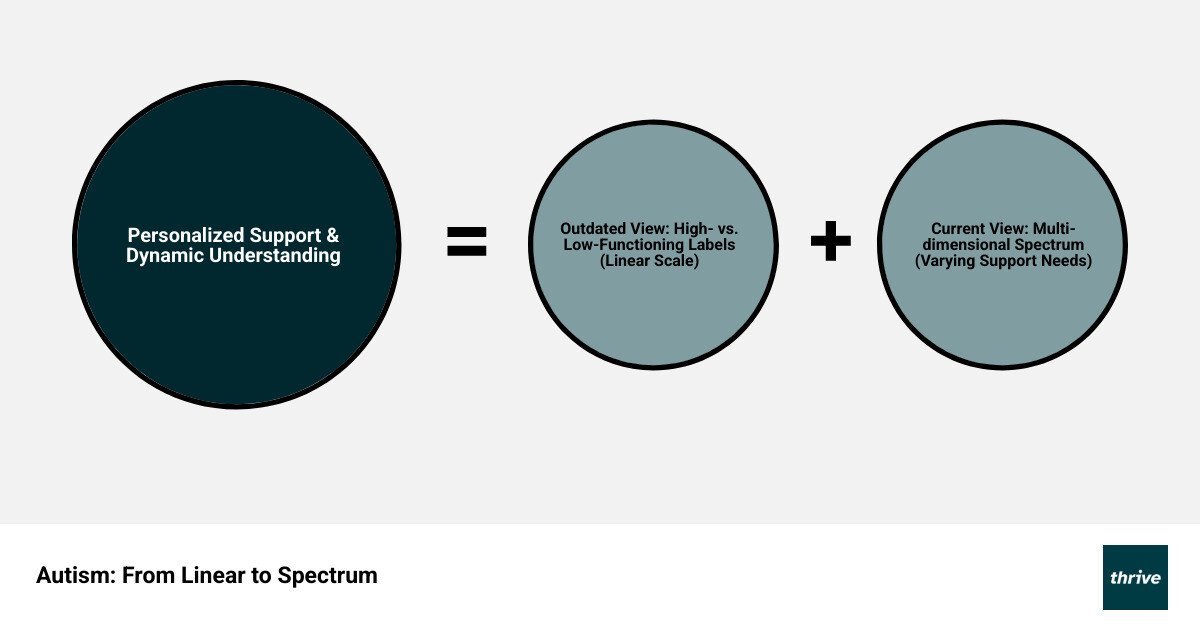
The term “spectrum” captures something important: autism doesn’t follow a straight line from “mild” to “severe.” Two people at the same level might need completely different types of support. One might excel at work but struggle with sensory overload. Another might have strong friendships but need help with daily routines.
The DSM-5 classification system, introduced in 2013, replaced older diagnostic labels like Asperger’s Syndrome and PDD-NOS with a unified diagnosis of Autism Spectrum Disorder. The three levels help clinicians, families, and individuals understand current support needs, but they’re not permanent labels. Research shows that between 11% and 58% of individuals experience changes in autism severity over time, influenced by factors like early intervention, educational environment, co-occurring conditions, and access to appropriate therapies.
Here’s what matters most: These levels are snapshots, not life sentences. They describe how much support someone needs right now, not their potential or worth. Many individuals diagnosed at higher levels develop skills and find environments that reduce their support needs. Others may require more assistance as new life challenges emerge.
As Nate Raine, CEO of Thrive Mental Health, I’ve spent over a decade working at the intersection of mental health, behavioral science, and evidence-based care, including supporting families in Florida navigating autism levels and co-occurring mental health challenges. Understanding autism levels helps us build personalized treatment plans that address the whole person, not just a diagnosis.
Autism levels terms to remember:
What is Autism Spectrum Disorder (ASD)? [The 2025 Diagnostic Guide]
Autism Spectrum Disorder (ASD) is a complex neurodevelopmental condition that impacts how individuals perceive the world and interact with others. It involves persistent challenges with social communication, as well as restricted interests and repetitive patterns of behavior. While signs often appear in early childhood, typically between 2 and 3 years old, the full extent of support needs can vary widely and sometimes aren’t consistently visible until school age.
The term “spectrum” is crucial here. It acknowledges that autism presents differently for each person, encompassing a wide range of symptoms and support requirements. This means that two individuals with an ASD diagnosis might have very different experiences and abilities. For example, some children with ASD may have lower than usual intelligence, while others have usual to high intelligence.
The Centers for Disease Control and Prevention (CDC) indicates that approximately 1 in 36 children in the United States are identified with an ASD diagnosis. Boys are about four times more likely to be diagnosed with ASD than girls. However, research suggests that girls and women are often underdiagnosed due to factors like “masking” (camouflaging autistic traits) and historical diagnostic biases based primarily on male presentations.
A common misconception is the link between vaccines and autism. We want to be clear: many well-conducted research studies have debunked this claim, showing no link between ASD and any vaccines. The original study that fueled this debate was retracted due to poor design and questionable research methods.
Key Diagnostic Criteria for ASD
To provide a standardized framework for diagnosis, medical professionals in North America use the Diagnostic and Statistical Manual of Mental Disorders, Fifth Edition (DSM-5). According to the DSM-5, an individual must meet specific criteria across two core areas to receive an ASD diagnosis:
-
Persistent deficits in social communication and social interaction across multiple contexts: This includes difficulties in:
- Social-emotional reciprocity: Abnormal social approach, failure of back-and-forth conversation, reduced sharing of interests/emotions, or failure to initiate/respond to social interactions.
- Nonverbal communicative behaviors: Poorly integrated verbal and nonverbal communication, abnormalities in eye contact and body language, or a lack of facial expressions.
- Developing, maintaining, and understanding relationships: Difficulty adjusting behavior to social contexts, challenges with imaginative play or making friends, or an absence of interest in peers.
-
Restricted, repetitive patterns of behavior, interests, or activities (at least two must be present): This can manifest as:
- Stereotyped or repetitive motor movements, use of objects, or speech: Simple motor stereotypes (e.g., hand-flapping), lining up toys, echolalia (repeating words/phrases), or idiosyncratic phrases.
- Insistence on sameness, inflexible adherence to routines, or ritualized patterns of verbal or nonverbal behavior: Extreme distress at small changes, difficulties with transitions, rigid thinking patterns, or needing to take the same route or eat the same food.
- Highly restricted, fixated interests that are abnormal in intensity or focus: Strong attachment to unusual objects or excessively circumscribed interests.
- Hyper- or hyporeactivity to sensory input or unusual interests in sensory aspects of the environment: Indifference to pain/temperature, adverse response to specific sounds/textures, excessive smelling/touching of objects, or visual fascination with lights/movement.
Additionally, these symptoms must:
- Be present in the early developmental period (though they may not become fully manifest until social demands exceed limited capacities, or may be masked by learned strategies in later life).
- Cause clinically significant impairment in social, occupational, or other important areas of current functioning.
- Not be better explained by intellectual disability or global developmental delay.
Early Signs and Core Areas of Difference
Recognizing early indicators of ASD is crucial for timely intervention, which can significantly improve outcomes. While the presentation varies, some potential early signs in children, as noted by the National Institute of Mental Health, include:
- Limited or atypical eye contact.
- Difficulty sharing enjoyment or interest in activities with others.
- Challenges responding to social bids for attention.
- Difficulty with back-and-forth conversational flow.
- Tendency to focus on parts of objects rather than the whole.
- Repetitive physical movements or vocalizations (stimming).
- Intense, focused interests that are unusual for their age.
- Heightened or reduced sensitivity to sensory input (e.g., sounds, textures, lights, smells).
We understand that observing these signs can be concerning, but early detection and custom support can make a profound difference. If you have concerns, we encourage you to seek professional guidance.
The 3 Official Autism Levels Explained [DSM-5 Chart]
The DSM-5’s system of autism levels provides a framework for understanding the varying intensity of support an individual requires. It’s not about labeling a person as “high functioning” or “low functioning,” but rather about identifying specific challenges in social communication and restricted/repetitive behaviors that necessitate different degrees of assistance.
Here’s a more detailed look at how the DSM-5 defines these three autism levels:
| Level | Social Communication Impairments | Restricted/Repetitive Behaviors | Required Support |
|---|---|---|---|
| Level 1: “Requiring Support” | Difficulty initiating social interactions; clear examples of atypical or unsuccessful responses to social overtures from others. May appear to have decreased interest in social interactions. | Inflexibility of behavior causes significant interference with functioning in one or more contexts. Difficulty switching between activities. Problems of organization and planning hamper independence. | Requires support |
| Level 2: “Requiring Substantial Support” | Marked deficits in verbal and nonverbal social communication skills; social impairments apparent even with supports in place; limited initiation of social interactions; and reduced or abnormal responses to social overtures from others. | Inflexibility of behavior, difficulty coping with change, or other restricted/repetitive behaviors appear frequently enough to be obvious to the casual observer and interfere with functioning in a variety of contexts. Distress and/or difficulty changing focus or action. | Requires substantial support |
| Level 3: “Requiring Very Substantial Support” | Severe deficits in verbal and nonverbal social communication skills cause severe impairments in functioning, very limited initiation of social interactions, and minimal response to social overtures from others. | Inflexibility of behavior, extreme difficulty coping with change, or other restricted/repetitive behaviors markedly interfere with functioning in all spheres. Great distress/difficulty changing focus or action. | Requires very substantial support |
Level 1 Autism: “Requiring Support”
Individuals with Level 1 autism typically experience noticeable impairments in social communication and flexibility, particularly without adequate support. They may be able to speak in full sentences and engage in conversations, but often struggle with the back-and-forth nature of social interactions or understanding subtle social cues. For example, they might find it difficult to initiate a conversation or respond appropriately to social overtures from others. Their attempts to make friends might come across as unusual or unsuccessful.
In terms of behaviors, inflexibility can cause significant interference in one or more areas of their lives. This might manifest as difficulty switching between activities, or problems with organization and planning that hinder their independence. While these symptoms may be less outwardly noticeable, they can cause significant distress, leading to sensory meltdowns or challenges in maintaining employment.
Beneficial supports for Level 1 autism often focus on developing coping strategies and enhancing social skills. These can include:
- Social skills coaching: Learning explicit rules and strategies for social interactions.
- Therapy for co-occurring conditions: Addressing anxiety, depression, or ADHD, which are common alongside ASD. For example, our Understanding Functioning Autism Symptoms in Adults article provides more insights into how these symptoms manifest.
- Educational and workplace accommodations: Implementing modifications like clear instructions, quiet workspaces, or flexible schedules.
- Executive function coaching: Strategies to improve organization, planning, and task initiation.
Level 2 Autism: “Requiring Substantial Support”
For individuals with Level 2 autism, deficits in social communication are more pronounced, even with supports in place. They might use simple sentences or have limited verbal communication, and their interactions may be restricted to narrow special interests. Nonverbal communication, such as eye contact and body language, can appear markedly odd. They may have limited initiation of social interactions and reduced or abnormal responses to others’ social overtures.
Restricted and repetitive behaviors are typically obvious to casual observers and interfere with functioning across various contexts. Inflexibility, difficulty coping with change, and distress when altering focus or action are common.
Substantial supports for Level 2 autism are designed to address these more significant challenges and promote greater independence. These often include:
 The Easiest Way to Use Bilateral Stimulation for Daily RegulationMental Health
- Speech-language therapy: To improve verbal and nonverbal communication skills, and potentially introduce Augmentative and Alternative Communication (AAC) systems.
- Occupational therapy: To help with daily living skills, sensory integration, and fine motor skills.
- Applied Behavioral Analysis (ABA): A scientifically validated approach to understanding behavior and reinforcing desired skills.
- Social skills groups: Structured environments to practice social interactions.
- Educational support: Individualized Education Programs (IEPs) in smaller classroom settings or specialized schools.
- Vocational training: Programs designed to develop job-specific skills and workplace readiness.
Our Intensive Outpatient Programs (IOP) in Florida can provide structured, comprehensive support for individuals and young professionals with Level 2 autism, helping them build essential life skills and manage co-occurring mental health conditions.
Level 3 Autism: “Requiring Very Substantial Support”
Level 3 autism represents the highest degree of support needs. Individuals at this level experience severe deficits in both verbal and nonverbal social communication skills, leading to marked impairments in daily functioning. They might be nonverbal or have very limited intelligible speech. Social interactions are often minimal, initiated only to meet basic needs, and responses to others’ overtures are minimal or absent.
Inflexibility of behavior is extreme, causing significant interference in all aspects of life. Individuals may have great difficulty coping with change, and restricted/repetitive behaviors can be highly disruptive. They may exhibit severe aggression or self-injurious behaviors, and experience profound distress when routines are altered. Level 3 autism is considered a disability due to its significant impact on daily life.
Very substantial supports are required across most settings to ensure safety, well-being, and skill development. These can include:
- Intensive, individualized therapies: A combination of speech, occupational, and behavioral therapies provided at a high frequency.
- Daily living skills training: Focused instruction on self-care, hygiene, and household tasks.
- Sensory integration therapy: To help regulate responses to sensory input.
- Medication management: For co-occurring conditions such as anxiety, aggression, or sleep disorders, prescribed by a qualified physician.
- Residential care or 24/7 support: Structured living environments with constant supervision and assistance.
Partial Hospitalization Programs (PHP) can offer a robust, structured environment for individuals needing intensive daily support and therapeutic interventions, bridging the gap between inpatient care and less intensive outpatient services.
Beyond the Label: Why Your Autism Level Isn’t Permanent
While ASD is a lifelong neurodevelopmental condition, the manifestation and impact of its symptoms are far from static. Your autism level is a snapshot, a clinical assessment of current support needs, not a fixed prediction of your future. We see this dynamic nature play out in the lives of many individuals we support throughout Florida.
Research consistently shows that autism levels can change over time. A review of evidence indicates that estimates of change in autism symptom severity range from 11% to 58% across different cohorts. Some individuals show remarkable decreases in symptom severity (7% to 29%), while others may experience increases (8% to 29%). These changes are influenced by a complex interplay of internal and external factors.
The current DSM-5 severity scores, while helpful for initial diagnosis, have limitations. They primarily focus on core autism symptoms and may not fully capture the impact of co-occurring conditions like anxiety, depression, or intellectual disability, which significantly affect an individual’s functional abilities and overall well-being. A multidimensional approach, considering adaptive skills, quality of life, and environmental factors, provides a more comprehensive understanding.
How Terminology Has Evolved
Our understanding and language around autism have evolved significantly over the decades. Before the DSM-5’s introduction in 2013, several diagnostic terms existed, often creating confusion and fragmentation:
- Autistic Disorder (classic autism): This was the most well-known form, characterized by significant impairments in social interaction, communication, and restricted, repetitive behaviors.
- Asperger’s Syndrome: Often described as “high-functioning autism,” individuals with Asperger’s had social challenges and restricted interests but typically had average or above-average intelligence and no significant language delays. With the DSM-5, Asperger’s is now encompassed within the broader ASD diagnosis, often corresponding to autism levels 1 or 2.
- Pervasive Developmental Disorder Not Otherwise Specified (PDD-NOS): This was a catch-all category for individuals who didn’t meet the full criteria for other PDDs but still had significant social and communication impairments.
- Childhood Disintegrative Disorder (CDD): A rare and severe condition where a child developed typically for at least two years before experiencing a significant regression in skills across multiple areas.
The shift to a single “Autism Spectrum Disorder” diagnosis in the DSM-5 was intended to reflect the continuous nature of autism and reduce diagnostic inconsistencies.
It’s also important to distinguish conditions that were once thought to be related but are now understood differently:
- Rett Syndrome: While individuals with Rett Syndrome may exhibit some autistic-like behaviors, it is a distinct genetic neurological disorder, primarily affecting girls, and is no longer considered a type of autism.
More recently, the concept of “profound autism” has emerged. This term is used to describe individuals with high core symptom severity, co-occurring intellectual disability, and little to no language, who require extensive long-term care. It aims to highlight the specific and substantial needs of this subgroup, ensuring they receive appropriate recognition and support.
Factors That Influence Changes in Autism Levels
The journey through the autism spectrum is highly individualized, and many factors can influence shifts in an individual’s support needs over time:
- Early Diagnosis and Intervention: Timely access to therapies like speech-language therapy, occupational therapy, and behavioral interventions can significantly impact developmental trajectories. Early intervention, especially during preschool years, has been shown to lead to improved social communication skills and overall functioning.
- Educational Environment: The type of educational setting plays a crucial role. Inclusive environments with appropriate accommodations can foster growth, while children with intellectual disability, for instance, often attend special education settings, which, while providing support, may limit exposure to neurotypical environments.
- Access to Therapies: Ongoing access to custom therapies is key. This includes not only traditional in-person services but also increasingly accessible options like Virtual Therapy, which can be particularly beneficial for individuals who may experience sensory overwhelm or anxiety in traditional clinical settings. Studies suggest online therapy can be as effective as in-person therapy, with participants reporting feeling calm and safe in text-based formats.
- Co-occurring Mental Health Treatment: The majority of individuals with autism also have co-occurring conditions such as anxiety, depression, or ADHD. Addressing these mental health challenges through therapy and, when appropriate, medication, can profoundly impact an individual’s ability to function and thrive.
- IQ and Language Ability: These developmental characteristics are significant predictors of how autism severity may change. Individuals with higher IQ and fluent language abilities often show greater reductions in symptom severity.
- Family and Community Support: A supportive home environment, positive family processes, and strong community connections can act as protective factors, helping individuals steer challenges and build resilience.
- Sex Differences: Interestingly, some studies suggest that young autistic girls show a higher likelihood of reductions in severity compared to young autistic boys.
- Neuroplasticity: The brain’s remarkable ability to reorganize itself by forming new neural connections allows for continuous learning and adaptation throughout life, contributing to potential changes in an individual’s presentation of autism.
At Thrive Mental Health, we understand that these factors are not just theoretical; they are the levers we can pull to empower individuals and young professionals in our Florida locations. By providing comprehensive, evidence-based care that integrates mental health support, we aim to foster environments where everyone can reach their full potential.
Frequently Asked Questions about Autism Levels
Can an individual’s autism level change over time?
Yes, absolutely. While autism is a lifelong condition, an individual’s support needs, and therefore their assigned autism level, can change significantly over their lifetime. With effective therapies, environmental accommodations, and personal development, someone diagnosed at a higher level may require less support later, and vice-versa. The level is a snapshot of current needs, not a life sentence, and is highly influenced by factors like early intervention, educational opportunities, and co-occurring mental health treatment.
What is the difference between Level 1 Autism and Asperger’s Syndrome?
Before 2013, Asperger’s Syndrome was a separate diagnosis for individuals who experienced social challenges and restricted interests but typically did not have significant language or cognitive delays. With the introduction of the DSM-5, Asperger’s Syndrome was incorporated into the broader diagnosis of Autism Spectrum Disorder. Today, most people who would have previously been diagnosed with Asperger’s Syndrome would now receive a diagnosis of Autism Spectrum Disorder, Level 1. This means they require minimal support for their social communication and restricted/repetitive behaviors.
How do clinicians determine a person’s autism level?
Clinicians determine an individual’s autism level based on the severity of challenges in two core areas: social communication and restricted, repetitive behaviors. They use a combination of diagnostic tools (like the Autism Diagnostic Observation Schedule, ADOS, and the Autism Diagnostic Interview-Revised, ADI-R), direct observation, and detailed interviews with the individual and their caregivers. This comprehensive assessment helps them understand how much support is needed for daily functioning across various contexts.
Your Path Forward: Getting the Right Support
Understanding autism levels is a crucial step in navigating the complex world of Autism Spectrum Disorder. It helps us appreciate that each individual’s journey is unique, requiring custom support rather than a one-size-fits-all approach. These levels are practical guides for identifying current needs, but they don’t define a person’s potential or identity. We firmly believe in neurodiversity-affirming care, which recognizes autism as a natural variation of the human brain, not something to be “cured.”
At Thrive Mental Health, we are dedicated to providing comprehensive mental health support that empowers adults and young professionals with ASD, particularly in addressing co-occurring conditions like anxiety and depression. Our virtual Intensive Outpatient (IOP) programs in Florida combine clinical expertise with flexible scheduling. We work to deliver measurable results, helping individuals develop coping mechanisms, improve social skills, and manage the challenges that can arise with autism, fostering greater independence and overall well-being. Whether you’re in Tampa Bay or another part of Florida, we’re here to help you thrive.
Ready for support? Thrive offers virtual IOP programs with evening options. Verify your insurance in 2 minutes (no obligation) → Start benefits check or call 561-203-6085. If you’re in crisis, call/text 988.

This article is for informational purposes only and is not a substitute for individualized clinical advice or insurance verification.