


Sick of Waiting? Break the Cycle, Get Real Recovery Without Putting Life on Hold
PHP vs IOP for eating disorders are two of the most effective treatment options when weekly therapy isn’t enough, but choosing the wrong one can delay your recovery or derail your life. If you’re struggling to balance your eating disorder with work, school, or family, this guide will help you decide which program actually fits your schedule and severity level.
Quick Answer: PHP vs IOP for Eating Disorders
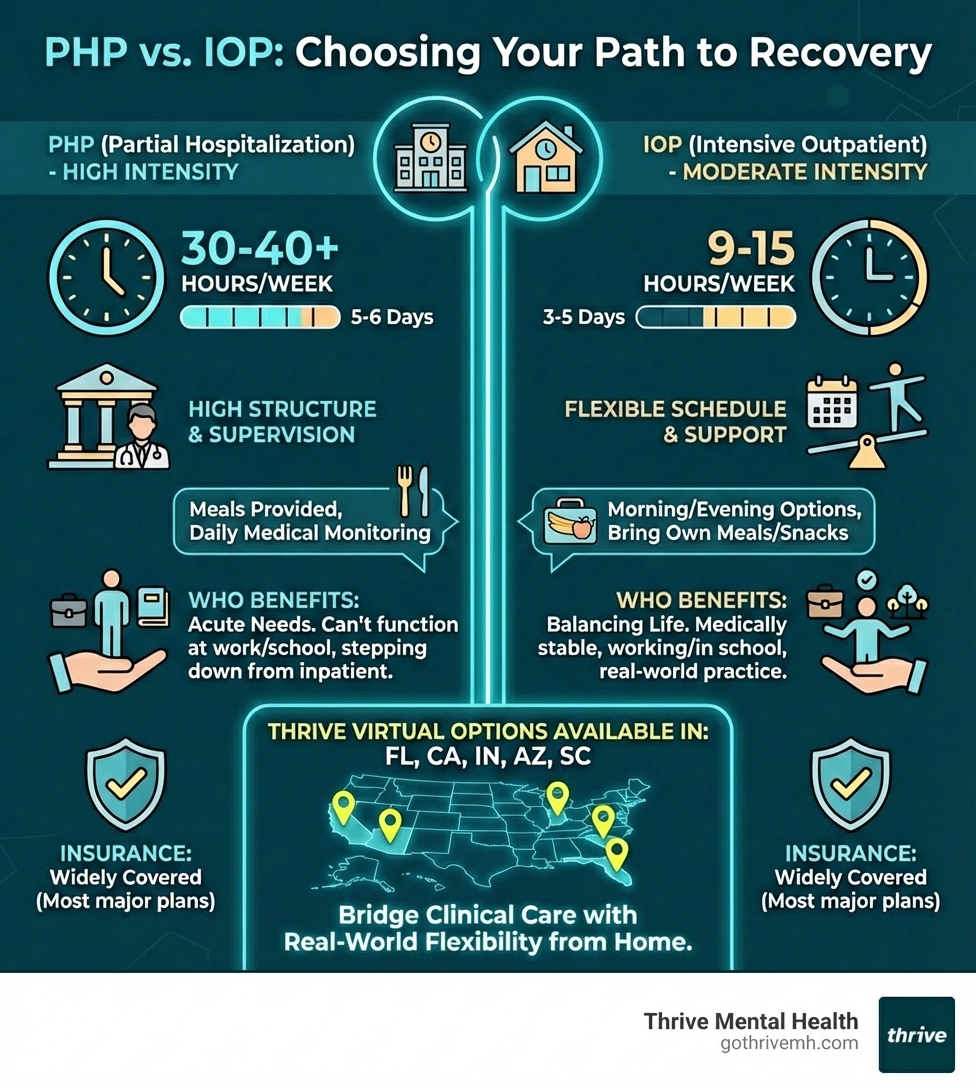
| Factor | PHP (Partial Hospitalization) | IOP (Intensive Outpatient) |
|---|---|---|
| Time Commitment | 5-6 days/week, 6-8 hours/day | 3-5 days/week, 3 hours/day |
| Best For | Need daily structure, can’t function at work/school, stepping down from inpatient | Medically stable, balancing life responsibilities, motivated for real-world practice |
| Structure | Highly supervised, meals provided, daily medical monitoring | Flexible schedule (morning/evening), bring own meals or supported snacks |
| Support Level | Maximum daily support without overnight stay | Structured support while living at home |
| Insurance | Covered by most plans (Cigna, Aetna, Optum, Florida Blue) | Covered by most plans (Cigna, Aetna, Optum, Florida Blue) |
| Virtual Options | Yes, available at Thrive in Florida | Yes, available at Thrive in Florida |
You know weekly therapy isn’t cutting it. Maybe you’re losing control of eating behaviors, your weight is dropping or spiking, or you’re hiding food from people you love. You need more help, now, but you can’t afford to vanish from your life for months in residential care.
That’s where PHP and IOP come in. Both are day programs, you go home every night. Both use the same proven therapies: CBT, DBT, nutrition counseling, and group support. But they differ in intensity, time commitment, and who they’re designed for.
The stakes are real. Choose too little support, and you risk relapse. Choose too much, and you might lose your job or fall behind in school. This guide will help you pick the program that matches your medical needs, your schedule, and your insurance coverage, so you can start recovering without putting your entire life on hold.
I’m Nate Raine, CEO of Thrive Mental Health, and I’ve spent over a decade building tech-enabled behavioral health programs that bridge clinical care with real-world flexibility. I’ve helped thousands of people steer the decision between PHP vs IOP for eating disorders, and I know the difference it makes when you get matched to the right level of care from day one.
If you want to understand how levels of care typically work across the industry, you can also review the American Psychiatric Association practice guideline for eating disorders as a reference while you read this guide.
If you’re in crisis, call/text 988 right now. You are not alone.
PHP vs IOP: What’s the Real Difference? [Time, Structure, Results]
When you’re exploring treatment options for an eating disorder, the acronyms PHP and IOP often come up. While both are critical levels of care that offer more support than traditional weekly therapy, they are distinct in their intensity, structure, and daily time commitment. Understanding these differences is key to finding the program that best supports your recovery journey without disrupting your entire life.
At Thrive Mental Health, we specialize in providing both virtual and in-person Partial Hospitalization Programs (PHP) and Intensive Outpatient Programs (IOP) across Florida. Our goal is to make evidence-based treatment accessible and effective, custom to your unique needs.
What Is a Partial Hospitalization Program (PHP) at Thrive?
A Partial Hospitalization Program (PHP) is a highly structured day treatment program designed for individuals who require significant support and intensive care but do not need 24/7 medical supervision or an overnight stay in a residential facility. Think of it as a bridge between inpatient care and less intensive outpatient options.
In a Thrive PHP, you’ll engage in comprehensive treatment for a substantial portion of your day, typically 5 to 6 days a week, for 6 to 8 hours each day. This intensive schedule means you’re immersed in a therapeutic environment, receiving consistent guidance and support. Despite the name, PHP does not take place in a hospital setting. Instead, it provides a therapeutic space where you can focus solely on your recovery while still returning to the comfort of your own home or a transitional living facility at night.
A core component of our PHP is the provision of supervised meals. We understand that eating can be a significant source of anxiety and disordered behaviors for individuals with eating disorders. Our staff guides you through therapeutic meals and snacks, helping you re-establish regulated eating patterns and build a healthier relationship with food. This means you won’t be responsible for bringing your own meals or snacks; they’ll be provided according to your personalized meal plan.
PHP also includes daily medical check-ins and monitoring. Our team, including nurse practitioners, conducts weekly evaluations, monitors your medical stability, and completes necessary lab work and testing. This close medical oversight is crucial for ensuring your physical health remains stable as you progress through treatment. Furthermore, medication management is often available within a PHP, providing integrated care for any co-occurring mental health conditions.
The ideal candidate for PHP is someone who is medically stable but struggling significantly to maintain stability in daily life. This might mean you’re so overwhelmed by your eating disorder that you cannot meet the requirements of work, school, or social life. PHP offers the necessary structure and intensive support to interrupt harmful behaviors and develop crucial coping skills in a safe, controlled environment.

What Is an Intensive Outpatient Program (IOP) at Thrive?
An Intensive Outpatient Program (IOP) offers a step down in intensity from PHP, providing structured care while allowing for greater flexibility to maintain daily responsibilities. It’s designed for individuals who need more support than traditional weekly therapy but don’t require the full-day commitment of a PHP.
At Thrive, our IOP typically involves 3 to 5 days a week, with sessions lasting about 3 hours each day. This schedule is intentionally designed to be flexible, often with morning or evening options, so you can continue with your job, attend classes, or fulfill family obligations. This allows you to integrate your recovery into your real life, practicing new skills and coping mechanisms in your everyday environment.
While IOP provides significant structure, it offers less continuous supervision than PHP. The focus shifts more towards applying learned recovery skills in your home environment. You’ll still receive comprehensive therapeutic support, but with more independence. For instance, in IOP, you are typically responsible for bringing your own meals and snacks, which are then checked by staff to ensure adherence to your meal plan. This promotes a sense of autonomy and prepares you for managing your eating independently.
IOP is ideal for individuals who are medically stable and ready to actively use recovery skills at home. This level of care is often a step down from a PHP or residential treatment, or it can be a starting point for those who need more focused attention than standard outpatient care but don’t require the higher intensity of PHP. The goal of an IOP is to help you develop coping skills and form healthy eating habits that empower you to function peacefully outside of the treatment environment.

Who Should Choose PHP vs IOP? [Find Your Fit, Don’t Guess]
Choosing the right level of care is a deeply personal decision that impacts the effectiveness of your treatment and your ability to maintain daily life. We’re here to help you make an informed choice between PHP vs IOP for eating disorders based on your specific needs, circumstances, and recovery goals.
PHP: When You Need Maximum Support
PHP is often the best choice when your eating disorder symptoms are significantly impacting your daily functioning, and you need a high level of structure to regain control.
You should consider a PHP if:
- You can’t function at work or school: If your eating disorder behaviors or mental health struggles are making it impossible to perform your job, attend classes, or manage daily tasks, PHP provides the intensive support needed to stabilize. You may be so overwhelmed that you cannot meet basic daily requirements.
- You need daily structure to stop dangerous behaviors: If you’re engaging in frequent disordered eating behaviors (e.g., restricting, bingeing, purging, excessive exercise) that you struggle to interrupt on your own, PHP’s consistent monitoring and therapeutic interventions are crucial. The structured environment helps prevent these behaviors and provides immediate support.
- You’re stepping down from inpatient or residential care: PHP serves as an excellent transition from higher levels of care, offering continued intensive support as you reintegrate into daily life. It helps you solidify the progress made in a more restrictive environment.
- You have co-occurring mental health or substance use issues: Eating disorders often co-occur with other conditions like anxiety, depression, or substance use disorders. PHP can address these complex needs comprehensively, providing integrated treatment for all conditions. As noted by experts like the Substance Abuse and Mental Health Services Administration (SAMHSA), treating these conditions simultaneously is more effective.
- Your home is safe, but you need daytime supervision: While your home environment might be supportive, you may still require structured supervision during the day to manage your eating disorder symptoms effectively. PHP offers this crucial daytime oversight without requiring you to live away from home.
If you find yourself nodding along to these points, a PHP could be the lifeline you need to stabilize and build a strong foundation for recovery. To learn more about when PHP might be the right choice, check out our detailed guide: How to Know If You Need PHP for Eating Disorders.
IOP: When You’re Ready for Flexibility
IOP is designed for individuals who are making progress in their recovery and need continued structured support, but with the flexibility to engage more fully in their daily lives.
You should consider an IOP if:
- You’re medically stable, but need more than weekly therapy: If your physical health is stable, but weekly therapy isn’t providing enough support to manage ongoing eating disorder thoughts or behaviors, IOP offers a critical intermediate step. It gives you the structure you need without overwhelming your schedule.
- You’re balancing work, school, or family: IOP’s shorter daily sessions and fewer days per week make it ideal for those who need to maintain their professional, academic, or personal commitments. Our morning and evening options are specifically designed to accommodate these schedules.
- You’re motivated to practice skills in real life: IOP thrives on your readiness to apply recovery skills directly into your daily routine. It’s about learning in a therapeutic setting and immediately implementing those learnings at home, work, or school. This real-world practice is vital for long-term recovery.
- You have strong support at home: Having a safe and supportive home environment is beneficial for IOP success. It provides a foundation where you can practice new coping mechanisms and rely on loved ones while still receiving professional guidance.
Here are some signs you’re ready for IOP:
- You can eat meals with minimal supervision.
- You know your triggers and want to work on them.
- You want to avoid relapse while living your life.
IOP is a powerful tool for those who are ready to take a more active role in their recovery, leveraging structured support to build resilience and autonomy.

What Happens in PHP & IOP at Thrive? [Inside the Program]
Regardless of whether you choose a PHP or an IOP at Thrive Mental Health, you can expect a comprehensive, evidence-based treatment approach custom to your unique needs. Our programs are designed to address the multifaceted nature of eating disorders, integrating various therapeutic modalities to foster lasting recovery.
Here’s a closer look at what our PHP and IOP programs offer:
- Individual Therapy: We believe in personalized care. In our PHP, patients typically engage in individual therapy twice weekly, allowing for deep dives into underlying psychological issues and personalized coping strategies. IOP also includes weekly individual sessions with a therapist, ensuring consistent one-on-one support. These sessions are crucial for addressing the unique challenges and goals of your recovery.
- Group Therapy (CBT, DBT, skills): Group therapy is a cornerstone of both our PHP and IOP programs. PHP offers group therapy typically five to six days a week, while IOP involves several hours of group therapy roughly three to five days per week. These groups foster a sense of community, reduce isolation, and allow you to learn from peers who share similar experiences. We use evidence-based behavioral therapies such as Cognitive Behavioral Therapy (CBT) and Dialectical Behavior Therapy (DBT) to help you challenge distorted thoughts, develop emotional regulation skills, and build effective coping mechanisms.
- Family Therapy and Education: Eating disorders impact the entire family system. In both PHP and IOP, we emphasize the importance of family involvement. Family therapy sessions are crucial for educating loved ones about eating disorders, improving communication, and building a supportive home environment for recovery. For adolescents, we often incorporate Family-Based Treatment (FBT), an evidence-based model that actively involves parents and caregivers in the recovery process to support lasting recovery and behavior cessation.
- Nutrition Counseling with a Registered Dietitian: A healthy relationship with food is central to eating disorder recovery. Our programs include regular sessions with a registered dietitian. In PHP, patients meet with their dietitians once weekly to establish a meal plan and discuss nutritional guidelines. In IOP, you also receive nutritional counseling to develop healthy eating habits and address any food-related anxieties.
- Supported Meals and Snacks: As mentioned, PHP provides all meals and snacks, ensuring they adhere to your personalized meal plan and offering a structured environment for eating. In IOP, you typically bring your own meals and snacks, which are then checked by staff to ensure they meet your nutritional requirements. This approach helps you practice independent meal planning and consumption with expert support.
- Medication Management: For individuals with co-occurring mental health conditions, medication can be a vital part of treatment. Our PHP programs offer opportunities for medication management, with psychiatric support available. While IOP typically does not include medication management services, we can coordinate with your external psychiatrist to ensure integrated care.
- Relapse Prevention and Coping Skills: A significant focus of both PHP and IOP is equipping you with practical tools for long-term recovery. We teach relapse prevention skills, help you identify triggers, and develop adaptive coping mechanisms to manage daily stressors that might hinder your recovery. The goal is to empower you to function peacefully outside of the treatment environment, confident in your ability to steer challenges.
Our multidisciplinary team, comprising therapists, dietitians, medical professionals, and other specialists, works collaboratively to provide comprehensive and personalized care, ensuring you receive the support you need at every step of your recovery journey. For more details on what our IOP program entails, visit our Thrive IOP Program page.
Virtual PHP & IOP: Real Recovery, Real Life
In today’s world, accessing high-quality eating disorder treatment shouldn’t be a barrier to recovery. That’s why Thrive Mental Health is proud to offer virtual and hybrid PHP and IOP programs that deliver the same clinical quality and measurable results as in-person care, but with unparalleled flexibility.
Our virtual programs are designed to fit seamlessly into your life, ensuring you can receive the intensive support you need without sacrificing your work, school, or family commitments. This means you can access our expert-led treatment from the comfort and privacy of your home in Florida.
Key benefits of our virtual and hybrid options include:
- Same Clinical Quality, More Flexibility: Our virtual programs follow the same rigorous treatment protocols and are led by the same experienced clinical team as our in-person centers. The only difference is the delivery method, offering you convenience without compromise.
- Evening and Weekend Options: We understand that life doesn’t stop for treatment. Our flexible scheduling includes evening programming and, in some cases, weekend options, making it easier to integrate therapy into your existing routine. This is particularly beneficial for those in IOP who need to maintain their daily responsibilities.
- Covered by Most Insurance: We believe that access to care should not be limited by financial constraints. Our virtual and hybrid PHP and IOP programs are covered by most major insurance providers, including Cigna, Aetna, Optum, and Florida Blue, among others. We work diligently to help you understand your benefits and maximize your coverage.
- Available Across Our Service Areas: Thrive Mental Health proudly serves communities across Florida. Our virtual programs extend our reach, allowing individuals throughout the state to access the specialized care they deserve, regardless of their proximity to a physical center. This ensures that expert-led treatment is truly accessible anywhere, anytime.
Studies have consistently shown that virtual PHP and IOP can have the same level of effectiveness as residential care and in-person programs, offering comparable outcomes in terms of sustained sobriety and reduced symptoms. This means you don’t have to choose between effective treatment and living your life, you can have both.
To explore how our flexible, virtual options can support your journey to recovery, learn more about Thrive’s Virtual Therapy Programs.
PHP vs IOP for Eating Disorders: FAQs
We know you have questions, and we’re here to provide clear, direct answers about PHP vs IOP for eating disorders.
Can I work or go to school during PHP or IOP?
IOP is built for your schedule, most people keep working or studying. Its flexible nature, often with morning or evening sessions, allows you to maintain your daily responsibilities. PHP, however, is a full-time commitment. Due to its intensive nature, requiring 6-8 hours a day, 5-6 days a week, you’ll likely need to pause or significantly reduce your outside work or school responsibilities to fully engage in treatment.
Which is better for severe eating disorders?
If you’re medically stable but need daily, intensive support to manage severe eating disorder behaviors and struggles with daily functioning, PHP is generally the better option. It provides a higher level of structure and supervision. If you’re medically unstable or experiencing acute medical complications due to your eating disorder, you would first need an inpatient or residential level of care for medical stabilization before transitioning to PHP or IOP. IOP is for those who are medically stable and ready to step down from a higher level of care or who need more support than weekly therapy but less than PHP.
Does insurance cover PHP and IOP?
Yes, most major insurance plans, including Cigna, Aetna, Optum, and Florida Blue, typically cover both PHP and IOP for eating disorders. The extent of coverage depends on your specific plan, medical necessity, and the program’s adherence to clinical guidelines. We encourage you to Verify your insurance in 2 minutes with us for a no-obligation benefits check.
Are virtual programs as effective as in-person?
Yes, robust data and studies have found that virtual PHP and IOP programs can be just as effective as in-person residential or outpatient care. They lead to markedly better treatment outcomes, including sustained symptom reduction and relapse prevention. The added benefits of virtual care include increased accessibility, greater flexibility, and the ability to practice recovery skills in your natural environment, all from the privacy of your home.
How do I know which program is right for me?
The right program depends on several individual factors, including the severity of your symptoms, your medical stability, the level of structure you need, your ability to manage daily responsibilities, and the support available in your home environment. The best way to determine the right fit is to get a free assessment from Thrive Mental Health. Our expert clinicians will evaluate your unique situation and help match you to the appropriate level of care, no guesswork involved. We’ll consider your co-occurring conditions, personal circumstances, and geographic availability to ensure you get the most effective treatment.
Summary: PHP vs IOP for Eating Disorders, Choose Fast, Heal Faster
Choosing between a PHP and IOP for eating disorders is a pivotal decision on your path to recovery. It’s the difference between staying stuck in the cycle of your eating disorder and confidently moving forward to reclaim your life. PHP offers a high level of structure, comprehensive daily support, and medical monitoring for those who need intensive care without an overnight stay. It’s ideal when your eating disorder significantly impacts your daily functioning. IOP, while still providing structured therapeutic interventions, offers greater flexibility, allowing you to balance recovery with work, school, or family responsibilities. It’s designed for individuals who are medically stable and ready to practice new coping skills in their real-world environment.
Both programs are powerful tools for healing. They use evidence-based therapies like CBT, DBT, and nutrition counseling, and both prioritize relapse prevention and the development of essential coping skills. Importantly, both PHP and IOP are widely covered by insurance, including major providers like Cigna, Aetna, Optum, and Florida Blue, and are available through our effective virtual and hybrid programs across Florida.
Don’t let the confusion of PHP vs IOP for eating disorders delay your healing. Your recovery can start now, with a program designed to fit your life, not disrupt it.
For detailed information on our programs:
Ready for support? Thrive offers virtual IOP programs with evening options. Verify your insurance in 2 minutes (no obligation) → Start benefits check or call 561-203-6085. If you’re in crisis, call/text 988.

This article is for informational purposes only and is not a substitute for individualized clinical advice or insurance verification.