


Your Guide to Intensive Mental Health Treatment
H0035 is the HCPCS billing code that represents mental health partial hospitalization services provided for less than 24 hours. If you’re researching this code, you likely need to understand what Partial Hospitalization Programs (PHPs) are, who qualifies for them, how they’re billed, or whether your insurance will cover this level of care.
What You Need to Know About H0035:
- Code Definition: HCPCS H0035 = Mental health partial hospitalization, treatment, less than 24 hours
- Billing Structure: One unit per day (per diem), regardless of hours provided that day
- Minimum Requirements: Most payers require 20+ hours per week across 4-5 days
- Who Uses It: Outpatient hospitals and Medicare-certified community mental health centers
- Coverage: Typically covered by Medicare, Medicaid, and most private insurers (including Cigna, Optum, Florida Blue)
- Medical Necessity: Requires physician certification that the patient would otherwise need inpatient psychiatric care
Why This Matters
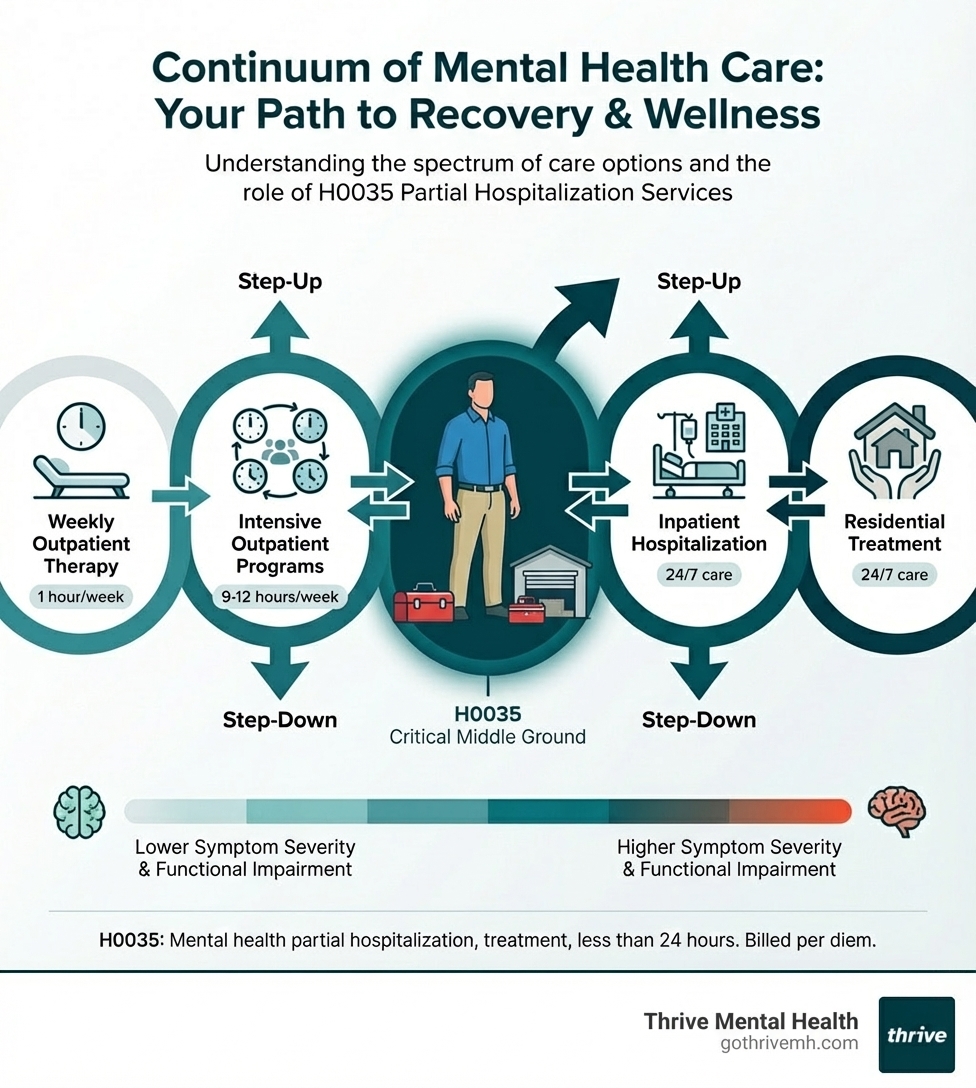
Approximately 1 in 5 adults experiences mental illness each year, with 5.5% living with serious mental illness. For many facing acute mental health crises, PHPs billed under H0035 offer a critical middle ground, more intensive than weekly therapy, less restrictive than 24-hour hospitalization. Research shows patients in partial hospitalization programs demonstrate significant improvements in symptom severity, functional status, and quality of life while avoiding the disruption and cost of inpatient admission.
Whether you’re a provider navigating billing compliance, a patient trying to understand your treatment options, or a family member researching coverage, getting H0035 right matters for both clinical outcomes and financial sustainability.
I’m Nate Raine, CEO of Thrive Mental Health, where we’ve built leading PHP programs in Florida that integrate clinical excellence with operational precision. Over the past decade leading healthcare innovation initiatives, I’ve seen how proper implementation of H0035 billing directly impacts whether patients can access the intensive care they need. Let me walk you through everything you need to know.
If you or someone you know is in crisis or having thoughts of self-harm, please call or text 988 (Suicide & Crisis Lifeline) right now. You are not alone.
H0035 helpful reading:
- how long is a partial hospitalization program
- iop vs php
- Which partial hospitalization programs offer flexible scheduling for full-time employees?
What is a Partial Hospitalization Program (PHP) and Who Needs It?
A Partial Hospitalization Program (PHP) is a time-limited, structured mental health treatment program provided in an outpatient hospital setting or a Medicare-certified community mental health center. It’s designed for individuals with acute mental health needs who require intensive support, but don’t need 24-hour inpatient care. Think of it as a bridge, it offers more intensive support than weekly outpatient therapy but is less restrictive than inpatient hospitalization.
For the approximately 1 in 5 adults in the United States who experience mental illness each year, and the 5.5% living with serious mental illness, PHPs play a crucial role. They provide a vital step-down option from inpatient care, helping individuals transition back to their daily lives with structured support. Conversely, PHPs can also serve as an effective alternative to inpatient hospitalization, providing crisis stabilization and intensive treatment to prevent a higher level of care. Studies confirm that patients who participate in PHPs show significant improvements in symptom severity, functional status, and quality of life. This makes PHPs a cost-effective alternative to inpatient care for many.
Clinical Indications and Admission Criteria
So, who is a good candidate for a PHP? We typically see individuals with:
- Severe depression: When symptoms are debilitating and impacting daily functioning.
- Anxiety disorders: Including generalized anxiety disorder, panic disorder, or social anxiety disorder, especially when severe and impairing.
- Complex PTSD: Requiring intensive, structured therapy to manage trauma symptoms.
- Suicidality risk: Patients who are experiencing active suicidal ideation but can safely manage their impulses in an outpatient setting with daily monitoring.
- Functional impairment: An inability to function at home, work, or school due to mental health symptoms.
- Step-down from inpatient care: Individuals transitioning from a hospital stay who need continued intensive support to maintain stability.
Admission to a PHP requires a physician’s certification, confirming that without this intensive outpatient care, the individual would likely need inpatient psychiatric care. This “medical necessity” is the cornerstone of PHP admission and billing.
However, PHPs are not for everyone. Common exclusion criteria include:
- Primary medical instability: Requiring acute medical attention.
- Active detoxification needs: For substance use, which typically requires a specialized detox program.
- Cognitive impairment: Severe cognitive deficits that prevent meaningful participation in group therapy.
- Severe active psychosis: Requiring a more contained environment.
How PHP Differs from Intensive Outpatient (IOP)
While both Partial Hospitalization Programs (PHPs) and Intensive Outpatient Programs (IOPs) offer structured mental health treatment that is more intensive than traditional weekly therapy, they differ significantly in their intensity and time commitment. Think of them as different levels on the same continuum of care.
Here’s a quick comparison:
| Feature | Partial Hospitalization Program (PHP) | Intensive Outpatient Program (IOP) |
|---|---|---|
| Time Commitment | 20+ hours per week (typically 4-6 hours/day, 5 days/week) | 9-12 hours per week (typically 3 hours/day, 3-4 days/week) |
| Service Intensity | High intensity; close to inpatient level without overnight stay | Moderate intensity; more support than weekly therapy |
| Level of Care | Best for acute symptoms, significant functional impairment, or step-down from inpatient care | Best for moderate symptoms, improving functioning, or step-down from PHP |
| Daily Structure | Highly structured, often full days of therapeutic activities | Structured, but allows more flexibility for work/school/family |
| Ideal Candidate | Needs stabilization, constant support, or avoiding inpatient care | Needs continued support to build coping skills, maintain recovery |
At Thrive Mental Health, we offer both virtual and in-person IOP and PHP options for adults and young professionals across Florida. We’re designed for people who need more than once-a-week therapy but less than inpatient care.
The Anatomy of a PHP: Core Services & Program Structure
A Partial Hospitalization Program is truly a comprehensive approach to mental health treatment. It’s not just about spending more hours in therapy; it’s about the depth and breadth of services provided. At Thrive Mental Health, we believe in combining clinical expertise with flexible scheduling and measurable results.
PHP services are delivered by a multidisciplinary team, under the direction of a physician. This team approach ensures person- and family-centered treatment, addressing all facets of an individual’s mental health needs. The structured programming is designed to provide a therapeutic environment where healing and growth can occur. You can find more info about PHP programs on our website.

What Services Are Included Under H0035?
When we bill for services under H0035, it encompasses a range of core therapeutic components designed to stabilize acute symptoms and build lasting coping skills. These typically include:
- Individual Therapy: One-on-one sessions with a therapist to address personal issues, develop coping strategies, and work towards individualized treatment goals.
- Group Therapy: The cornerstone of most PHPs, covering various evidence-based modalities like Cognitive Behavioral Therapy (CBT) and Dialectical Behavior Therapy (DBT). These groups foster peer support and allow clients to practice new skills in a safe environment.
- Family Counseling: Focused on improving family dynamics, communication, and support systems, especially when family issues impact the patient’s treatment.
- Medication Management: Daily psychiatric evaluation and medication management by a psychiatrist or psychiatric nurse practitioner to ensure optimal medication efficacy and address any side effects.
- Psychoeducation: Learning about mental health conditions, symptoms, and effective management strategies.
- Skills Training: Practical sessions focused on developing coping skills, emotion regulation, interpersonal effectiveness, and relapse prevention.
- Case Management: Coordination of care with other providers, community resources, and discharge planning to ensure a smooth transition to a lower level of care.
- Discharge Planning: A crucial component, ensuring a clear plan for continued care and support post-PHP.
Typical Daily Schedule and Time Commitment
To qualify for H0035 billing, programs must meet specific intensity requirements. Most payers, including Medicare, Medicaid, and private insurers like Cigna, Optum, and Florida Blue, require a minimum of 20 hours per week of therapeutic programming. This usually translates to:
- Minimum of 4-6 hours of services per day for adults.
- Provided at least 4 days, but not more than 5 days, out of a seven-day calendar period.
A sample daily schedule might look something like this:
- Morning: Group therapy (e.g., CBT for depression, DBT skills group), followed by medication management and individual check-ins.
- Mid-day: Psychoeducation session on a relevant topic (e.g., stress management, healthy boundaries), followed by lunch (often a communal activity to foster social skills).
- Afternoon: Activity therapy (e.g., art therapy, mindfulness, recreational therapy) or another group session focused on relapse prevention or processing.
This consistent, structured environment provides the intensive support needed for individuals to stabilize, learn, and grow, surrounded by a supportive peer community and expert clinical staff.
The Ultimate Guide to Billing with HCPCS Code H0035
Understanding the billing intricacies of HCPCS code H0035 is paramount for both providers and patients. Accurate billing ensures that providers can sustain their crucial services, and patients can access the care they desperately need without unnecessary financial barriers. It all hinges on demonstrating medical necessity, understanding payer policies, and adhering to strict compliance guidelines. We constantly steer these waters to ensure our patients in Florida receive seamless care.

We always refer to comprehensive guidelines like the CMS Medicare Billing Guidelines to ensure we’re up-to-date with federal regulations.
Establishing Medical Necessity: Your Documentation Must Be Flawless
The golden rule of H0035 billing? If it wasn’t documented, it didn’t happen. Establishing medical necessity is the bedrock of reimbursement, and it requires meticulous record-keeping. Payers will scrutinize documentation to ensure the PHP services are truly warranted. Key elements include:

- Treatment Plan Goals: Clear, measurable, and individualized goals that directly address the patient’s acute symptoms and functional impairments.
- Daily Progress Notes: Detailed notes for each session, clearly linking interventions to the patient’s treatment goals, documenting their response, and showing observable progress. Avoid vague or “cloned” notes; they are a major red flag for auditors.
- Attendance Logs: Accurate records of patient attendance, including start and end times for each day, to verify that the minimum required hours are met.
- Physician Certification: Monthly certification by a physician confirming that PHP remains medically necessary and that the patient would otherwise require inpatient care.
- Linking Documentation to ICD-10 Codes: Ensuring that the services provided directly correlate with the patient’s diagnosed ICD-10 mental health conditions, validating the medical necessity.
Without robust documentation, even the most clinically effective treatment may face denial.
Billing Mechanics for H0035: Units, Modifiers, and Rates
H0035 is typically billed per diem, meaning “per day.” This simplifies billing somewhat, as you generally bill one unit per day of service, regardless of the specific number of individual or group sessions provided on that day, as long as the program’s minimum daily hour requirements are met.
Modifiers: Modifiers provide additional information about the service rendered.
- Modifier HA: Some payers may require this modifier for services provided to children or adolescents. Given our focus on adults and young professionals, this is less common for us, but it’s important for providers serving younger populations to be aware.
- Modifier 95 or GT: For telehealth services, these modifiers are crucial. Many payers now allow H0035 billing for virtual PHP services, but require the appropriate telehealth modifier to indicate the service was delivered via synchronous (real-time) audio-visual technology.
Reimbursement Rates: These can vary significantly based on several factors:
- Payer Type: Medicare, Medicaid, and private insurance companies (like Cigna, Optum, and Florida Blue) each have their own fee schedules and negotiated rates. While the national average reimbursement can range from $82.34 to $504.33, these are broad averages, and actual rates depend heavily on the specific payer and contract.
- Geographic Location: Rates are often adjusted based on the cost of living and healthcare in specific regions. For our locations in Florida, we see variations reflective of local market conditions.
- Provider Type: Hospital-based PHPs may have different reimbursement rates compared to freestanding community mental health centers.
It’s vital for providers to verify reimbursement rates directly with insurance providers or medical billing departments, as payer policies are constantly evolving.
How to Avoid Common Denials and Billing Pitfalls
Denials are frustrating and costly. Here are the most common reasons for H0035 claim denials and how to avoid them:
- Insufficient Documentation of Medical Necessity: This is the #1 reason. Ensure all notes clearly justify the PHP level of care.
- Missing Pre-authorization: Always confirm patient eligibility and obtain pre-authorization before starting services. A lack of authorization is an automatic denial.
- Not Meeting Minimum Daily/Weekly Hours: If your program falls short of the payer’s required hours (typically 20+ hours per week, 4-6 hours/day), the claim will be denied.
- Billing for Non-Covered Services: Ensure all services provided within the PHP are covered under the payer’s guidelines for H0035. For example, purely recreational activities are often not covered.
- Incorrect Modifiers: Using the wrong modifier, or forgetting one entirely, can lead to denials, especially for telehealth services.
- Lack of Physician Certification: Failure to obtain or update the required physician certification for ongoing medical necessity.
- Frequency Limits: Some payers cap the number of billable days per week (often 5) or per episode of care (e.g., 4 weeks).
- Cloned or Vague Notes: Auditors can easily spot notes that are copied and pasted or lack specific patient details, leading to denials for insufficient documentation.
Always refer to detailed resources like the AAPC code H0035 definition for specific coding guidance. Regular internal audits and staff training are your best defense against these pitfalls.
Staying Compliant and Future-Proofing Your Program
In the dynamic landscape of mental healthcare, maintaining compliance and adapting to future trends is not just good practice, it’s essential for the long-term viability and impact of any PHP. At Thrive Mental Health, we are committed to providing evidence-based treatment that is both accessible and sustainable.
Key Compliance Laws and Audit Readiness
Compliance isn’t a one-time check-box; it’s an ongoing commitment. Several key laws and practices govern H0035 billing and PHP operations:
- HIPAA (Health Insurance Portability and Accountability Act): Ensures patient privacy and the secure handling of protected health information. Strict adherence is non-negotiable.
- False Claims Act (FCA): Prohibits submitting false or fraudulent claims to federal healthcare programs. Intentional or reckless disregard for billing rules can lead to severe penalties.
- Mental Health Parity and Addiction Equity Act (MHPAEA): This critical law mandates that coverage for mental health and substance use disorder services must be no more restrictive than for medical/surgical benefits. Understanding MHPAEA is crucial for ensuring fair coverage for PHP services.
To ensure audit readiness, we implement:
- Internal Audits: Regular chart audits focusing on documentation accuracy, attendance records, and alignment with treatment goals. This helps us catch and correct issues proactively.
- Staff Training: Comprehensive and ongoing training for all PHP staff on clinical documentation, billing requirements, and compliance protocols.
- Credentialing: Carefully tracking and maintaining current staff credentials and licenses, as expired credentials can lead to claim denials.
Devoting time and resources to these compliance activities is an investment in the program’s long-term viability and our patients’ trust.
The Future of PHP: Virtual Services and Value-Based Outcomes
The mental healthcare landscape is continually evolving, with two major trends impacting H0035 billing and PHP services:
- Virtual PHP Models: The rise of telehealth has transformed access to care. We’ve seen a significant shift towards virtual and hybrid PHP programs, making intensive treatment more accessible to individuals across Florida. This requires careful attention to telehealth billing modifiers (like 95 or GT) and staying updated on payer-specific policies regarding virtual services.
- Value-Based Care: This model is increasingly tying reimbursement to patient outcomes rather than just the volume of services. For PHPs, this means a greater emphasis on measuring outcomes like:
- Reduced rehospitalization rates.
- Improvements in symptom severity (e.g., using validated tools like PHQ-9 for depression and GAD-7 for anxiety).
- Improved functional status and quality of life.
- Client satisfaction.
By consistently tracking and demonstrating these measurable results, providers can negotiate competitive H0035 rates with payers, proving the value and effectiveness of their programs. This focus on outcomes ensures that PHPs are not only clinically effective but also financially sustainable in a value-driven healthcare system.
Frequently Asked Questions about H0035 and PHP
What is the main difference between HCPCS code H0035 (PHP) and H0015 (IOP)?
H0035 is a per diem code for Partial Hospitalization Programs (PHP), which represents a higher intensity of care, typically requiring 20 or more hours of structured therapeutic services per week. H0015 is a code often used for Intensive Outpatient Programs (IOP), which are less intensive, usually requiring 9-12 hours per week. While H0035 is almost always per diem, H0015 can be billed hourly or per diem depending on the specific payer and state regulations.
How long will my insurance cover a Partial Hospitalization Program?
The duration of PHP coverage varies significantly by your individual insurance plan, medical necessity, and ongoing clinical reviews. Many plans initially authorize a specific period, such as 1-2 weeks, and then require regular clinical updates and documentation to extend authorization. It’s crucial to verify your benefits directly with your insurance provider (e.g., Cigna, Optum, Florida Blue) and understand your specific plan’s requirements for PHP services.
Can H0035 be used for both mental health and substance abuse treatment?
Yes, H0035 is primarily designated for mental health partial hospitalization. It can be used for individuals with co-occurring mental health and substance use disorders, especially when the mental health condition is the primary focus of treatment. However, some payers may have specific HCPCS codes for substance abuse-focused PHPs (e.g., H0015 for SUD IOP). Always check individual payer policies to ensure the correct code is used for the patient’s primary diagnosis and treatment focus.
Get the Expert Support You Deserve
HCPCS code H0035 is more than just a billing number; it represents a lifeline for individuals needing intensive mental health support. Understanding how Partial Hospitalization Programs work is the first step toward accessing a level of care that can stabilize a crisis, build critical coping skills, and pave the way for long-term recovery. Thrive Mental Health provides expert-led, evidence-based PHP services designed to deliver measurable results and help you get back to your life.
Ready for support? Thrive offers virtual IOP programs with evening options. Verify your insurance in 2 minutes (no obligation) or call 561-203-6085. If you’re in crisis, call/text 988.

This article is for informational purposes only and is not a substitute for individualized clinical advice or insurance verification.