





Stop Worrying Yourself Sick, CBT for General Anxiety Disorder Gets You Results Fast
Cognitive behavioral therapy for general anxiety disorder is the most effective, research-backed treatment for stopping chronic worry and racing thoughts, without years of therapy or lifelong medication. Here’s what you need to know:
Quick Answer: CBT for GAD
- What it is: A short-term, skills-based therapy that rewires how you think and respond to worry.
- How it works: Identifies thought traps, challenges catastrophic thinking, and teaches you to face fears instead of avoiding them.
- Results: 60-70% of people see major improvement in 10-20 sessions.
- Timeline: Most notice relief within weeks, not months.
- Cost: Covered by most insurance plans (Cigna, Aetna, Optum, Florida Blue, Blue Cross Blue Shield).
- Format: Available in-person or virtually through programs like Thrive’s virtual IOP.
If you’re trapped in a cycle of constant worry, you know how exhausting it is. Generalized Anxiety Disorder (GAD) isn’t just “being a worrier”, it’s a condition of uncontrollable anxiety that hijacks your brain and body, marked by racing thoughts, muscle tension, and sleep problems.
What Is Generalized Anxiety Disorder (GAD)?
GAD is diagnosed using criteria from the DSM-5 (the manual clinicians use to classify mental health conditions). In plain language, it typically involves:
- Excessive anxiety and worry more days than not for at least 6 months
- Worry about a number of events or activities (work, health, finances, relationships, safety, and more)
- Difficulty controlling the worry once it starts
- At least three of the following in adults: restlessness, being easily fatigued, trouble concentrating, irritability, muscle tension, or sleep disturbance
- Symptoms that cause real distress or get in the way at work, school, or in relationships
GAD affects over 6 million adults in the U.S., but it is frequently missed or misdiagnosed. Many people:
- Assume they are just “type A” or a natural worrier
- Get treated only for physical symptoms (like headaches, stomach issues, or insomnia)
- Are told to “just relax” or “stop overthinking” instead of being offered real treatment
The good news? CBT is proven to work faster and last longer than medication alone. It’s not endless talk therapy; it’s a skill-building program that delivers measurable results in as few as 10 sessions, with lower relapse rates and no side effects.
At Thrive Mental Health, we’ve helped thousands overcome anxiety using evidence-based cognitive behavioral therapy for general anxiety disorder. We’ve seen how the right treatment, delivered with the right intensity through virtual IOP, can change lives for adults and young professionals across Florida.
Cognitive behavioral therapy for general anxiety disorder vocabulary:
What Is Cognitive Behavioral Therapy (CBT) and Why Does It Work So Fast?
Living with generalized anxiety disorder feels like being caught in a perpetual loop of “what ifs.” This isn’t a character flaw; it’s a cycle of thoughts, feelings, and behaviors that cognitive behavioral therapy (CBT) can effectively untangle.
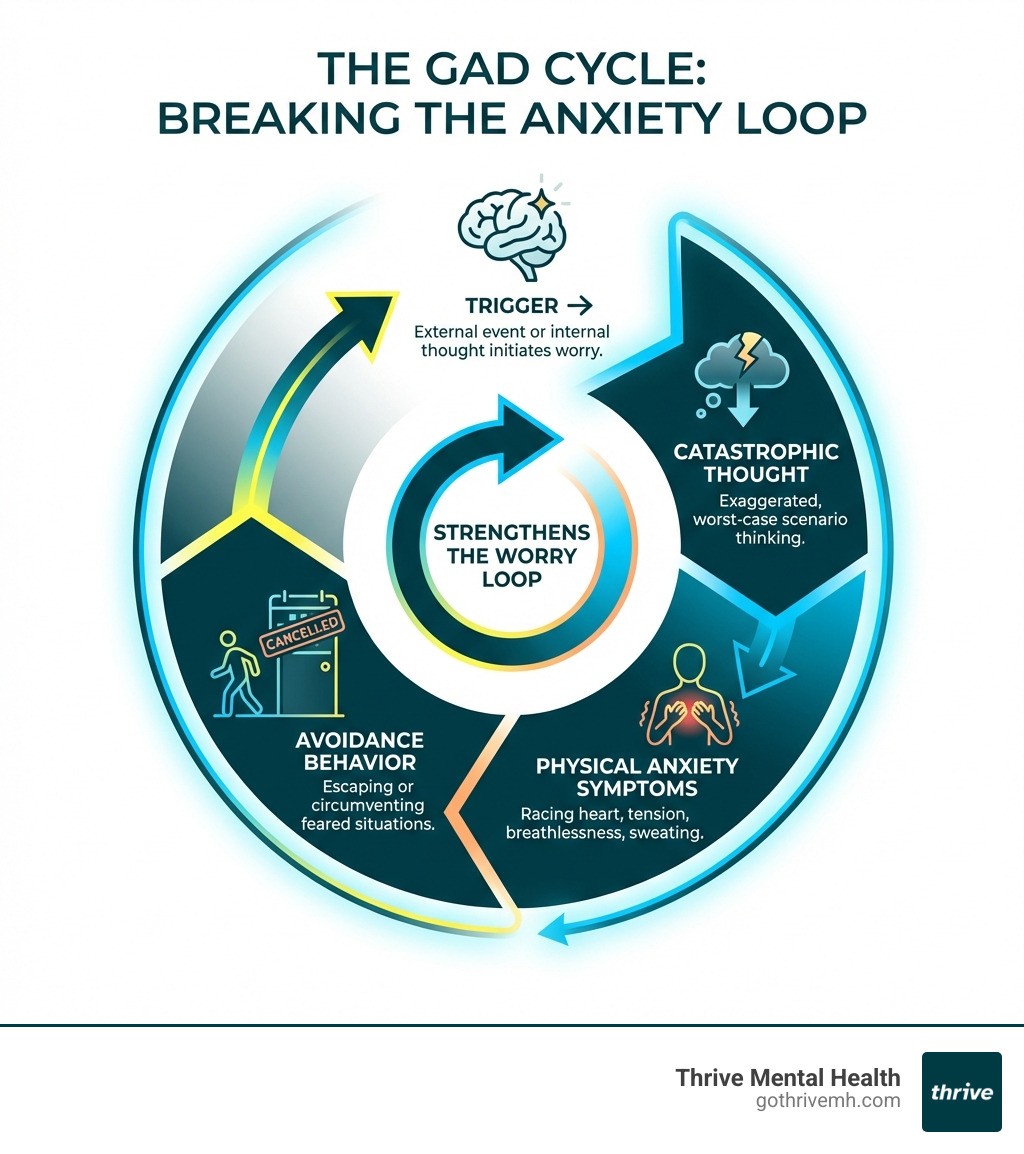
CBT is a structured, goal-oriented therapy based on a simple principle: how we interpret situations (thoughts) directly influences how we feel (emotions) and what we do (behaviors). For example, interpreting a missed call from your boss as a sign you’ll be fired (thought) triggers intense anxiety (feeling), which leads to avoidance (behavior). This reinforces the anxiety cycle. CBT helps you break this cycle by identifying and modifying these unhelpful patterns.
The first step is psychoeducation, understanding what GAD is and how it’s maintained. Many people with GAD believe worrying prevents bad things from happening, a “meta-worry” that CBT directly addresses. Next, through functional analysis, we map your unique worry patterns to pinpoint triggers and target them effectively.
Unlike therapy that can go on for years, CBT is collaborative, short-term, and skill-based. Our programs at Thrive Mental Health often involve 10 to 20 sessions, with clients learning concrete skills they can use immediately. Research consistently shows that CBT for GAD is the gold standard for effective treatment, outperforming other therapies and medication with lower relapse rates.
The Science Behind CBT for GAD: What’s Really Going On in Your Brain?
CBT is effective because it targets the core psychological drivers of generalized anxiety disorder:
- Avoidance Theory of Worry: People with GAD often worry to avoid more intense emotional or physical distress. Worry becomes a “safety behavior” that prevents you from learning that feared outcomes are unlikely or manageable.
- Metacognitive Model: This focuses on “worrying about worry.” You might hold negative beliefs about worry (it’s uncontrollable, dangerous) and positive ones (it’s useful for problem-solving). CBT helps challenge these conflicting beliefs.
- Intolerance of Uncertainty: This is a central driver of GAD. The struggle with ambiguity leads to a constant, exhausting effort to predict and control every outcome. CBT specifically helps you develop a healthier relationship with the unknown.
- Emotion Dysregulation: Many with GAD find their emotions intolerable and try to suppress them. This backfires, intensifying anxiety. CBT teaches you to understand, tolerate, and regulate your emotions instead of escaping them.
Is CBT Right for You? [Pros, Cons, and What to Expect]
Here’s an honest look at the benefits and limitations of CBT for generalized anxiety disorder:
Benefits:
- Long-term skills: You learn to be your own therapist long after sessions end.
- No medication side effects: A powerful alternative or complement to medication.
- High success rates: Up to 70% of people experience major improvement.
- Lower relapse risk: Addresses the root cause of GAD for sustainable results.
Limitations:
- Requires effort: CBT is an active process involving homework and practice. Your effort directly impacts your results.
- Can be uncomfortable: Facing fears is challenging but done in a controlled, supportive way.
- Needs a trained therapist: The guidance of a licensed CBT therapist is crucial. Thrive Mental Health offers this expert support virtually and in-person across Florida.
4 CBT Techniques That Crush General Anxiety Disorder, Step by Step

At Thrive Mental Health, we focus on practical, actionable tools that deliver measurable results for generalized anxiety disorder.
1. Cognitive Restructuring: Stop Believing Every Scary Thought
GAD distorts your thinking, leading to exaggerated fears. Cognitive restructuring teaches you to act like a detective for your own mind, challenging these unhelpful thought patterns. You’ll learn to spot common “thinking traps” like catastrophizing (assuming the worst) and black-and-white thinking. Using tools like thought records, you’ll learn to examine the evidence for your anxious thoughts, build more balanced thinking, and tackle meta-worry (worrying about worry itself).
2. Exposure Therapy: Face Your Fears, Shrink Them for Good
One of the most powerful ways to reduce anxiety is to gradually face what you fear. Exposure therapy helps you confront thoughts and situations you’ve been avoiding, teaching you they aren’t as dangerous as your anxiety claims. For GAD, this often involves:
- Imaginal exposure: Confronting “worst-case scenarios” in your mind to learn you can tolerate the discomfort.
- Behavioral experiments: Testing anxious predictions in the real world to challenge your intolerance of uncertainty.
We help you build an exposure hierarchy, starting with small steps and progressing to more challenging situations. Thrive’s evidence-based virtual IOP integrates these powerful techniques.
3. Relaxation and Mindfulness: Reset Your Body’s Alarm System
Anxiety lives in your body as muscle tension and a rapid heartbeat. Calming your physiological response is essential. We teach proven techniques like:
- Progressive muscle relaxation (PMR): Tensing and relaxing muscle groups to release physical tension.
- Diaphragmatic breathing: “Belly breathing” to slow your heart rate and activate your body’s relaxation response. Recent breathing exercises research confirms its effectiveness for acute anxiety.
- Mindfulness: Observing anxious thoughts and sensations without judgment, allowing them to pass. [Mindfulness practice](https://www.usnews.com/news/health-news/articles/2023-07-12/stressed-depressed-mindfulness-training-could-offer-long-term-relief#:~:text=WEDNESDAY%2C%20July%2012%2C%202023%20(,for%20at%20least%20six%20months.) is a core component of modern CBT for GAD.
Explore Thrive’s Virtual Therapy for Anxiety to practice these techniques from home.
4. Problem-Solving Skills: Take Control of Real-Life Worries
Sometimes worries are tied to real problems. Problem-solving training gives you a structured way to tackle them. You’ll learn to:
 Rest Easy: How CBT-I Can Transform Your SleepMental Health
- Break down overwhelming problems into smaller, manageable steps.
- Brainstorm and evaluate solutions instead of getting stuck in a worry loop.
- Create concrete action plans to increase your sense of control.
- Differentiate between solvable worries you can act on and unsolvable ones to manage with other CBT skills.
CBT vs. Medication for GAD: What’s Faster, Safer, and Lasts Longer?
When facing generalized anxiety disorder, many people wonder whether to pursue therapy, medication, or both. Here’s the evidence-based answer.

Research shows CBT is highly effective, with up to 70% of individuals experiencing major relief. One study found that CBT is as effective as medication and superior six months after treatment ends.
While medications like SSRIs and SNRIs can help manage symptoms, they don’t teach coping skills. Symptoms often return when medication is stopped. CBT provides lifelong tools, leading to lower relapse rates and more sustainable peace of mind.
Here’s a quick comparison:
| Feature | Cognitive Behavioral Therapy (CBT) | Medication (e.g., SSRIs/SNRIs) |
|---|---|---|
| Primary Goal | Teach coping skills, change thought/behavior patterns | Reduce symptoms by altering brain chemistry |
| Duration | Short-term (10-20 sessions), skills last a lifetime | Ongoing as long as symptoms persist |
| Side Effects | None (can be uncomfortable during exposure) | Drowsiness, nausea, weight gain, sexual dysfunction, withdrawal |
| Relapse Risk | Lower long-term | Higher if discontinued without addressing underlying issues |
| Mechanism | Behavioral and cognitive change, learning | Chemical rebalancing in the brain |
| Empowerment | High (client learns to manage own anxiety) | Moderate (symptom relief without skill acquisition) |
| Cost | Covered by most insurance, one-time investment in skills | Covered by most insurance, ongoing expense |
Should You Combine CBT and Medication? [What the Research Shows]
For severe symptoms, a combination of CBT and medication can be beneficial, especially for rapid symptom reduction. At Thrive Mental Health, our virtual IOP programs are designed to coordinate seamlessly with your prescriber for integrated care. However, it’s crucial to focus on long-term recovery, not just short-term relief. Careful coordination is key, as some medications can interfere with the learning process in therapy. Most major insurance plans (Cigna, Optum, Florida Blue, Aetna) cover CBT and combined treatment.
CBT for Kids and Teens with GAD: What Parents Need to Know
GAD also affects children and teens, showing up as excessive worry, perfectionism, and a constant need for reassurance. Adapting CBT for younger clients involves creative, age-appropriate techniques to make therapy engaging, with a key focus on helping them learn to tolerate uncertainty.
Family involvement is crucial. We teach parents how to support their child’s progress at home. Interventions are custom to the child’s developmental stage and can be coordinated with school support.
Explore Thrive’s Virtual Therapy for Teens for specialized, age-appropriate CBT.
The Future of CBT: Faster, Easier, and More Accessible Than Ever
The field of cognitive behavioral therapy for general anxiety disorder is constantly evolving. At Thrive Mental Health, we stay at the forefront of these innovations to offer you the best possible care.
- Transdiagnostic CBT (Unified Protocol): This streamlined approach treats the shared root causes of anxiety, depression, and other emotional disorders at the same time, making treatment more efficient.
- Internet-delivered CBT (I-CBT): Proven to be as effective as in-person therapy, I-CBT breaks down barriers to care, allowing you to get help from home.
- Virtual Reality (VR) exposure therapy: This next-gen technology creates safe, controlled virtual environments to confront fears, enhancing the effectiveness of exposure therapy.
- Mobile apps for skills practice: Apps help you track symptoms and practice CBT skills between sessions, empowering you to take an active role in your recovery.
- Personalized, modular CBT: The future of CBT is treatment custom precisely to your unique needs, challenges, and preferences.
More about Thrive’s flexible Virtual IOP and how we integrate these cutting-edge approaches.
How Virtual IOP Makes CBT for GAD Work for Busy Lives
At Thrive Mental Health, our virtual Intensive Outpatient (IOP) programs are designed for your busy schedule, making cognitive behavioral therapy for general anxiety disorder accessible and effective.
- Overcome barriers: Get expert care with no commute and no long waitlists.
- Flexible scheduling: Our programs, including evening options, fit around your work, school, or family commitments.
- Accessible care: We are in-network with most major insurance providers and operate across Florida.
- Measurable results: We use evidence-based assessments to track your progress weekly, so you can see tangible improvements in your anxiety.
FAQs: Cognitive Behavioral Therapy for General Anxiety Disorder
How long does CBT take to work for GAD?
Most people see big changes in 10-20 sessions. Some feel better after just a few weeks, with significant symptom reduction typically reported after ten sessions, especially when using structured programs like Thrive’s virtual IOP.
Is CBT for GAD covered by insurance?
Yes, most major plans (Cigna, Aetna, Blue Cross Blue Shield, Optum, Florida Blue, and others) cover CBT. We encourage you to always verify your specific benefits with your provider or use Thrive’s quick online tool to verify your insurance.
Can I do CBT for GAD on my own?
Self-help books and apps can offer some guidance, but working with a licensed therapist (like those at Thrive Mental Health) provides personalized strategies, expert feedback, and accountability, leading to better and faster results. Many clients benefit most from structured, higher-intensity support such as virtual intensive outpatient programs.
What if I’ve tried therapy before and it didn’t work?
CBT is different, it’s highly structured, skills-based, and backed by extensive research. Thrive’s programs are custom to your needs, track your progress with measurable outcomes, and focus on teaching you concrete tools for lasting change. Even if past therapy felt like “just talking,” CBT offers a more targeted, results-driven approach.
Is virtual CBT as effective as in-person?
Yes, studies show virtual CBT works just as well for most people, offering comparable effectiveness with the added benefits of convenience and accessibility. Thrive provides virtual CBT for GAD across Florida through our flexible Virtual IOP and hybrid options.
Summary: Why CBT for GAD Is Your Fastest Path to Peace
Cognitive behavioral therapy for general anxiety disorder is the #1 proven way to break the cycle of worry, without endless meds or years in therapy. You’ll learn skills that last, see results in weeks, and finally get your life back. Don’t wait, every day you delay is another day lost to anxiety.
Ready for support? Thrive offers virtual IOP programs with evening options. Verify your insurance in 2 minutes (no obligation) → Start benefits check or call 561-203-6085. If you’re in crisis, call/text 988.
Related reading: How Virtual IOPs Cut Recovery Time by 50%, What to Expect at Thrive

This article is for informational purposes only and is not a substitute for individualized clinical advice or insurance verification.