
EMDR and Somatic Therapy: Healing Trauma from Head to Toe

Stop Feeling Stuck—Find the Trauma Therapy That Actually Works
EMDR and somatic therapy are two of the most powerful, evidence-based approaches for healing trauma—but they work in very different ways. If you’re trying to decide which one is right for you (or whether combining them makes sense), here’s what you need to know:
| EMDR Therapy | Somatic Therapy |
|---|---|
| Reprocesses traumatic memories using bilateral stimulation (eye movements, tapping) | Releases trauma stored in your body through nervous system regulation |
| Structured 8-phase protocol focusing on thoughts and beliefs | Fluid, body-centered approach focusing on physical sensations |
| Best for specific traumatic memories, flashbacks, PTSD | Best for chronic pain, disconnection from body, physical anxiety |
| More directive, faster pace | Less directive, slower pace |
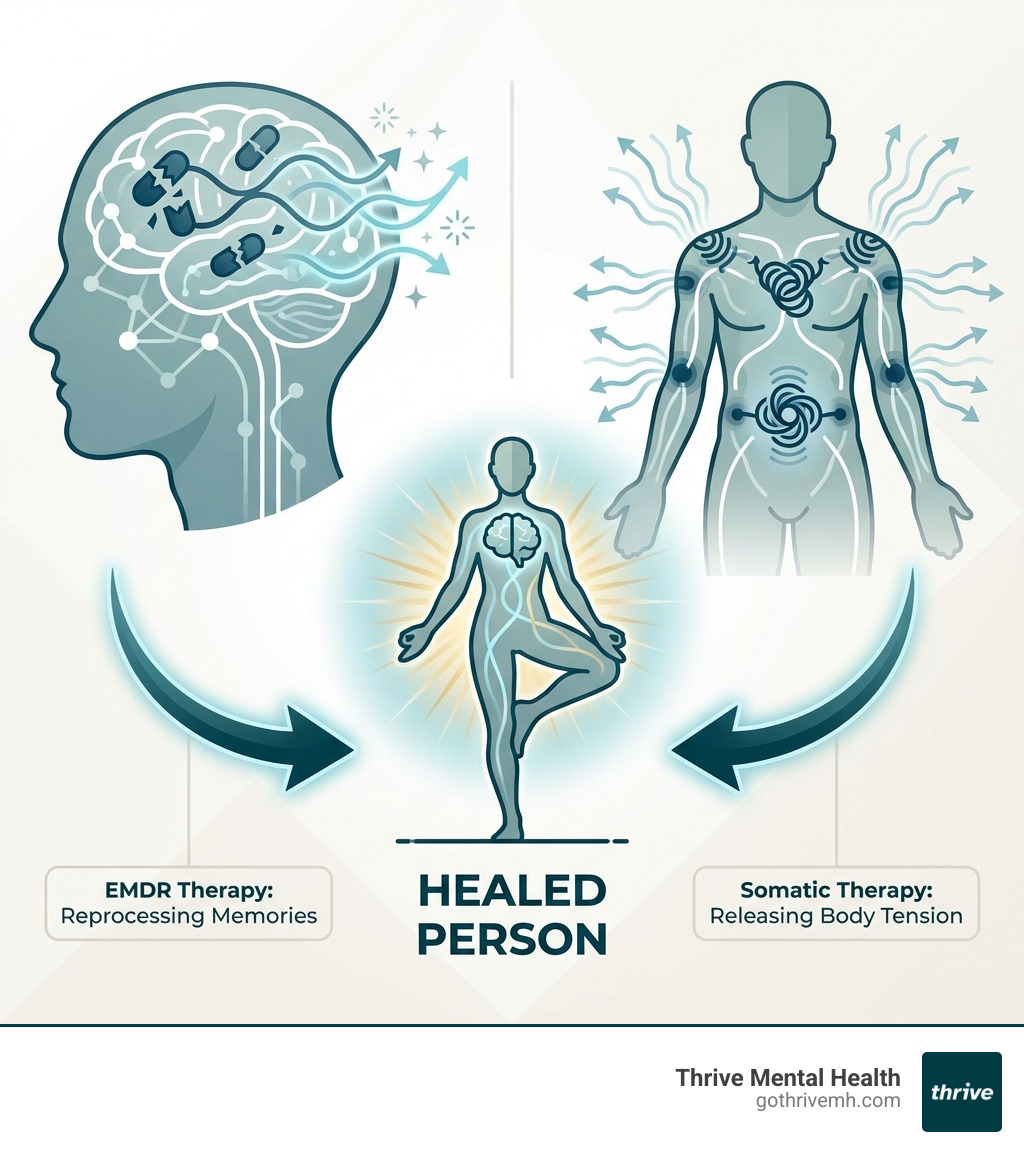
Both are “bottom-up” therapies that work with your body, not just your thoughts. Many people find the most relief by combining them—using somatic work to prepare your nervous system, then EMDR to reprocess stuck memories.
You’re not “broken” if traditional talk therapy hasn’t worked. Trauma gets stored in your body and brain in ways that require specialized tools to open up. That’s where EMDR and somatic therapy come in.
The reality? Over 45 randomized clinical trials support EMDR’s effectiveness for PTSD, and it’s recommended as a first-line treatment by most international clinical practice guidelines. Somatic Experiencing has also been found effective for PTSD in research studies. If you’ve been struggling with symptoms like chronic anxiety, physical tension, flashbacks, or feeling “stuck,” these therapies can help you finally move forward.
I’m Nate Raine, CEO of Thrive Mental Health, where our Florida-based team has guided hundreds of clients through evidence-based trauma treatment, including integrated approaches combining EMDR and somatic therapy. We’ve seen how powerful these modalities are—especially when used together for complex trauma and nervous system healing.
Emdr and somatic therapy terms you need:
What is EMDR? The Brain’s “Reboot” for Traumatic Memories
Imagine your brain has a natural healing system, much like your body’s ability to recover from a physical wound. When we experience a traumatic event, sometimes this system gets overwhelmed, and the memory gets “stuck”—it’s not processed properly. This can lead to symptoms like flashbacks, nightmares, anxiety, and hypervigilance, making it feel like the past is constantly intruding on the present.
This is where Eye Movement Desensitization and Reprocessing (EMDR) therapy comes in. Developed by Dr. Francine Shapiro in the late 1980s, EMDR is a structured psychotherapy designed to help your brain complete its natural healing process for these “stuck” memories. Its guiding principle is the Adaptive Information Processing (AIP) theory, which suggests that just as your body strives for healing, so does your brain. When an adverse experience occurs, the associated thoughts, feelings, body sensations, and images get stored dysfunctionally. EMDR aims to connect this dysfunctional information with your brain’s adaptively stored information, restoring the nervous system’s wisdom.

How does it work? EMDR uses bilateral stimulation (BLS), typically guided eye movements, but sometimes alternating sounds or tactile stimulation (like tapping), while you focus on a traumatic memory. This dual attention stimulation helps your brain reprocess the memory in a way that reduces its emotional intensity. It’s thought that BLS stimulates the relaxation response (the parasympathetic nervous system), allowing fragmented memories to be integrated into your adaptive memory networks. The goal isn’t to erase the memory, but to transform it so it no longer triggers distress.
EMDR follows a systematic 8-phase approach:
- History Taking: Your therapist gathers information about your trauma history and current symptoms, helping to identify target memories for processing.
- Client Preparation: You learn coping skills and relaxation techniques to manage any emotional distress that might arise during therapy.
- Assessment: You identify a specific traumatic image, negative belief about yourself, and associated body sensations.
- Desensitization: This is the core reprocessing phase, where you focus on the memory while engaging in BLS, allowing your brain to process the information.
- Installation: You strengthen a positive belief about yourself in relation to the memory.
- Body Scan: You mentally scan your body to check for any residual tension or uncomfortable sensations, which are then reprocessed if present.
- Closure: Your therapist helps you return to a calm state, often using relaxation techniques.
- Reevaluation: At the start of subsequent sessions, you revisit previously processed memories to ensure they remain desensitized.
EMDR therapy is widely recognized as an evidence-based treatment for post-traumatic stress disorder (PTSD). Research shows EMDR is effective for PTSD, with over 30 published randomized controlled trials demonstrating its effectiveness in both adults and children. In fact, most international clinical practice guidelines recommend EMDR therapy as a first-line treatment for PTSD. Beyond PTSD, EMDR has also shown efficacy for conditions like major depression, anxiety, substance use, and chronic pain. If you’re interested in learning more about this powerful approach, you can find more info about EMDR Therapy.
What is Somatic Therapy? Releasing Trauma Trapped in Your Body
While EMDR works with the brain’s processing of memories, somatic therapy takes a different route, focusing on the body itself as a key to healing. The core principle of somatic therapy is the understanding that trauma isn’t just a mental or emotional experience; it’s deeply imprinted in your physical body and nervous system. When we face a threat, our bodies instinctively react with fight, flight, or freeze responses. If these natural responses are interrupted or unable to complete their cycle, the energy and physiological arousal can become “trapped” in the body, leading to a dysregulated nervous system.
Somatic therapy, particularly Somatic Experiencing (SE) developed by Dr. Peter Levine, aims to help you release this stored trauma energy. Dr. Levine’s profound findy was that “The nervous system can become injured or wounded just like any part of the body.” The therapy helps restore balance to the nervous system by allowing these thwarted biological responses to complete. It’s often rooted in the Polyvagal Theory, which explains how our nervous system influences our social engagement, fight-flight, and freeze responses.

In somatic therapy, we focus on connecting your mind and body, recognizing that trauma can manifest through physical sensations like chronic pain, tension, numbness, or even digestive issues. The goal is to process unresolved trauma held in the body, helping you regain a sense of safety and control.
Here are some common somatic techniques you might encounter:
- Titration: This involves experiencing small, manageable amounts of distress or sensation at a time, like slowly introducing a drop of intense color into clear water. This careful, gradual approach prevents re-traumatization and allows your system to process safely.
- Pendulation: This is the natural rhythmic oscillation between states of activation (distress, tension) and states of calm (safety, relaxation). Your therapist will guide you to notice these shifts, helping your nervous system learn to self-regulate.
- Resourcing: This involves connecting with internal and external sources of comfort, strength, and safety. It could be recalling a positive memory, focusing on a pleasant sensation, or imagining a safe place, building your capacity to handle difficult emotions.
- Body Awareness/Tracking: This is the fundamental practice of paying close attention to physical sensations, impulses, and movements in your body without judgment. It helps you become more embodied and understand your body’s wisdom.
Somatic Experiencing has been found to be an effective treatment for PTSD, and it’s commonly used to treat other types of trauma as well. A 2017 randomized controlled study specifically evaluated the effectiveness of somatic psychotherapy for PTSD and found positive benefits, demonstrating its potential for healing. If you’re curious about this body-centered approach, you can learn how somatic therapy works.
EMDR vs. Somatic Therapy: Comparing Two Paths to Healing
Both emdr and somatic therapy are incredibly powerful “bottom-up” approaches to healing trauma, meaning they prioritize working with the body and nervous system rather than primarily intellectualizing or analyzing events. They both emphasize the importance of the therapeutic relationship, client safety, and restoring nervous system balance. However, their methods and primary focus differ significantly, offering distinct pathways to recovery.
| Feature | EMDR Therapy | Somatic Therapy (e.g., Somatic Experiencing) |
|---|---|---|
| Core Mechanism | Bilateral stimulation (eye movements, tapping) to reprocess memories. | Body awareness, titration, pendulation to release trapped physiological arousal. |
| Primary Focus | Reprocessing specific traumatic memories, thoughts, and beliefs. | Releasing stored physical tension and regulating the nervous system. |
| Approach | Structured, 8-phase protocol, more directive. | Fluid, experiential, less directive, follows body’s lead. |
| Pace | Can be quicker in processing specific memories. | Slower, gentle pace, emphasizes building capacity gradually. |
| Trauma View | Dysfunctional memory storage in neural networks. | Incomplete biological responses leading to nervous system dysregulation. |
| Techniques | BLS, cognitive interweaves, positive belief installation. | Tracking sensations, breathwork, movement, grounding, resourcing. |
| Typical Session | Focus on a target memory with BLS, then discussion. | Guided attention to body sensations, allowing for natural discharge. |
Focus: Reprocessing a Memory vs. Releasing a Sensation
The fundamental difference lies in their primary point of intervention. EMDR therapy’s main focus is on reprocessing specific traumatic events, images, thoughts, and beliefs. It asks, “How is this memory affecting your present perception and beliefs about yourself?” Its structured approach aims to transform the negative cognitive and emotional impact of these memories. For example, if you hold a belief like “I am helpless” stemming from a trauma, EMDR works to shift that to a positive belief like “I am capable.”
Somatic therapy, on the other hand, puts its primary focus on bodily sensations and the physical manifestations of trauma. It asks, “Where do you feel this trauma in your body, and what does your body need to complete its response?” It’s particularly effective if you experience a strong physical reaction to stress, chronic physical tension, or feel a deep disconnection from your body. The goal is to help you discharge the physiological energy that became “stuck” during the traumatic event, allowing your nervous system to return to a more regulated state.
Technique: Structured Protocols vs. Fluid Body-Based Exploration
EMDR therapy is characterized by its structured, 8-phase protocol. The therapist guides you through each phase, using specific techniques like bilateral stimulation (eye movements, taps, or sounds) to facilitate the reprocessing of memories. It’s a methodical journey through your trauma history, working to desensitize disturbing memories and install more adaptive responses.
Somatic therapy, while having foundational principles and techniques, tends to be more fluid and experiential. It doesn’t typically follow a rigid, step-by-step protocol in the same way EMDR does. Instead, it relies on your body’s organic process, using techniques like breathwork, mindful movement, and guided attention to internal sensations. The SIBAM framework (Sensation, Imagery, Behavior, Affect, Meaning) is often used to help track and understand your experience, allowing your body to lead the healing process.
Trauma Processing: How Each Approach Helps You Heal
EMDR processing helps you heal by essentially “rebooting” the way your brain stores traumatic memories. By engaging the brain during bilateral stimulation, it facilitates the integration of fragmented memories, allowing them to be stored in a less distressing way. This leads to desensitization—the reduction of emotional charge associated with the memory—and the installation of more positive, adaptive beliefs about yourself and the event.
Somatic processing helps you heal by facilitating the discharge of stored energy and completing the self-protective responses that were interrupted during a traumatic event. When your body is allowed to tremble, shake, cry, or move in ways that complete these thwarted responses, it releases the accumulated physiological tension. This process helps your nervous system recalibrate, moving from a state of chronic dysregulation (fight, flight, or freeze) to one of greater resilience and calm.
For a deeper dive into the nuances of these two powerful modalities, you can explore a deeper comparison of EMDR and Somatic Therapy.
The Power of Integration: Using EMDR and Somatic Therapy Together
While EMDR and somatic therapy are distinct, their integration offers a profoundly holistic path to healing, especially for complex trauma. Many experts believe that if the body is not integrated into EMDR therapy, full and effective trauma treatment is unlikely. Trauma leaves an imprint on the body, and neglecting this can hinder progress. This is why combining emdr and somatic therapy can be so transformative.
Benefits of an Integrated EMDR and Somatic Therapy Approach
Combining these two modalities offers a synergistic effect, addressing trauma from both cognitive and physiological angles.
- Somatic Work as Preparation: Somatic techniques are invaluable for preparing your nervous system before engaging in EMDR. For individuals with complex trauma or a history of feeling overwhelmed, starting with somatic exercises can increase your capacity to sense and feel your body in a safe, regulated manner. This builds crucial internal resources, helping you stay grounded when EMDR begins to access distressing memories.
- Increasing Body Awareness: Somatic approaches improve your body awareness, which is vital for effective EMDR. During the “Body Scan” phase of EMDR, for instance, a strong connection to your physical sensations allows for more thorough processing of residual tension.
- Building Nervous System Capacity: Somatic therapy helps regulate a dysregulated nervous system, expanding your “window of tolerance.” This increased capacity means you’re less likely to become overwhelmed or re-traumatized during EMDR sessions.
- Preventing Overwhelm during EMDR: When somatic principles like “titration” (processing small, manageable amounts of material) are integrated into EMDR, it creates a much gentler experience. This significantly reduces the risk of getting flooded by traumatic content, a common concern for clients.
- Faster, Deeper Processing: By addressing both the mental and physical aspects simultaneously, the healing process can be more comprehensive and often more rapid. Somatic interventions can be scripted into the eight phases of EMDR therapy, leading to lasting integration of trauma processing.
- Addressing Both Cognitive and Physical Symptoms: Many trauma survivors experience both distressing thoughts/memories and chronic physical symptoms like pain or tension. An integrated approach tackles both, leading to more complete relief.
What is “Somatic EMDR”? A Gentler, More Embodied Path
“Somatic EMDR” isn’t a separate therapy but an approach that intentionally weaves somatic principles and techniques throughout the traditional EMDR protocol. It’s often described as a gentler, more embodied way of healing trauma. While traditional EMDR is highly effective, some practitioners find that without a strong foundation in somatic principles, it can sometimes feel too intense for clients, especially those with complex trauma.
Somatic EMDR emphasizes:
- Titration: As mentioned earlier, this careful, “drop-by-drop” approach to processing ensures you don’t get overwhelmed.
- Non-violence Principles: The process is guided by deep respect for your nervous system’s pace and capacity, avoiding forceful confrontation with trauma.
- Mindfulness Integration: Greater emphasis is placed on mindful awareness of internal sensations, movement impulses, breath, and boundaries throughout all phases of EMDR.
- S.A.F.E. EMDR: This specific integrated approach (Somatic and Attachment Focused EMDR) further integrates attachment theory, focusing on the therapeutic relationship and creating a secure environment. It adapts traditional EMDR phases to include more preparation and resource development, particularly beneficial for complex trauma and attachment issues.
This integrated approach helps you connect with your body’s wisdom, allowing for a more organic and often profound release of trauma.
Who Benefits Most from Combining EMDR and Somatic Therapy?
While both modalities are effective on their own, the combination of emdr and somatic therapy is particularly powerful for certain individuals:
- Complex Trauma Survivors: Those who have experienced prolonged, repeated, or relational trauma (C-PTSD) often benefit immensely. Somatic work helps regulate the deeply dysregulated nervous system, while EMDR addresses the multitude of fragmented traumatic memories.
- Individuals with Attachment Wounds: Early attachment trauma can leave deep imprints on the nervous system and impact relationship patterns. The integrated approach provides tools for both nervous system repair and reprocessing relational wounds, including preverbal memories and dissociation.
- Those with Chronic Pain or Physical Symptoms: When trauma manifests as chronic physical discomfort, the body-centered focus of somatic therapy combined with EMDR’s reprocessing of underlying traumatic memories can offer significant relief.
- People Who Feel Disconnected from Their Bodies: Somatic work helps re-establish a healthy connection to bodily sensations, which then supports deeper and safer emotional processing in EMDR.
- Individuals Who Struggle with Dissociation: Somatic techniques can help ground and orient individuals who tend to dissociate, making EMDR processing safer and more effective.
At Thrive Mental Health, we understand the nuances of complex trauma. In Florida, we offer comprehensive programs that can integrate these powerful modalities. Our expert-led virtual and in-person Intensive Outpatient (IOP) and Partial Hospitalization (PHP) programs are designed to provide the specialized support you need. You can explore treatment for complex trauma and see how our Florida-focused approach can help.
How to Choose: Is EMDR, Somatic, or a Combination Right for You?
Deciding between EMDR, somatic therapy, or a combined approach is a personal journey, and the “right” choice often depends on your unique needs, how trauma manifests for you, and your comfort level with different therapeutic styles. Our role as therapists is to guide you, but understanding the distinctions can empower your decision.
The therapeutic relationship is paramount in both EMDR and somatic therapy, especially in trauma work. You need to feel safe, seen, and understood by your therapist. This strong connection creates the foundation for deep healing. Finding a trained professional who specializes in trauma and ideally has experience in both modalities is crucial.
When considering your options, it’s also important to factor in practicalities like insurance coverage. Here in Florida, many major providers like Cigna, Optum, and Florida Blue offer coverage for evidence-based trauma therapies like EMDR. We encourage you to verify your specific benefits with your provider. Thrive Mental Health offers specialized trauma care programs across Florida, making it accessible for residents throughout the state.
When to Consider EMDR First
EMDR might be a more direct starting point if:
- You have specific traumatic memories: If your distress is clearly linked to one or a few distinct, identifiable events (e.g., a car accident, a specific assault, a sudden loss), EMDR can be highly effective at reprocessing these.
- You experience flashbacks and nightmares: These symptoms often indicate that traumatic memories are not properly processed and are intruding into your present experience. EMDR directly targets this reprocessing.
- You prefer a structured process: EMDR’s 8-phase protocol offers a clear roadmap, which can be reassuring for some individuals.
- You have difficulty verbalizing trauma: Unlike traditional talk therapy, EMDR doesn’t require you to extensively recount or describe the traumatic event in detail, focusing instead on the emotional and somatic sensations connected to it.
When to Consider Somatic Therapy First
Somatic therapy might be a more appropriate initial step if:
- You experience chronic physical symptoms: If trauma manifests as persistent body pain, tension, digestive issues, fatigue, or other physical ailments, somatic therapy can help release this trapped energy.
- You feel numb or disconnected from your body: Trauma can lead to dissociation or a sense of not being “in your body.” Somatic therapy helps you gently and safely reconnect with your internal experience.
- You experience overwhelming physical anxiety: If anxiety primarily manifests as physical sensations (racing heart, shallow breathing, muscle tremors) rather than just thoughts, somatic therapy can teach you to regulate these responses.
- You desire a mind-body integrated approach: If you feel an intuitive pull towards healing that involves your physical self, somatic therapy provides tools to listen to and work with your body’s wisdom.
A conversation with a qualified trauma therapist is the best way to determine the most suitable path for you. They can assess your history, symptoms, and preferences to recommend an individualized treatment plan, potentially incorporating the strengths of both EMDR and somatic therapy.
Frequently Asked Questions about EMDR and Somatic Therapy
Is EMDR a type of somatic therapy?
No, they are distinct modalities. EMDR is a structured psychotherapy focused on reprocessing memories using bilateral stimulation. Somatic therapy is a broader, body-centered approach focused on releasing trauma stored in the nervous system. However, they are both “bottom-up” therapies that acknowledge the body’s role in trauma and complement each other beautifully.
Can you do EMDR and somatic therapy at the same time?
Yes, many therapists are trained in both and integrate them. This often involves using somatic techniques to build safety and regulate the nervous system before and during EMDR’s memory reprocessing phases, creating a more holistic and often gentler treatment experience. This integrated approach can prevent overwhelm and facilitate deeper, more lasting healing.
Which is better for complex trauma (C-PTSD)?
Many experts believe an integrated approach combining EMDR and somatic therapy is highly effective for C-PTSD. At our Florida treatment centers, our clinical team specializes in this combination. Somatic therapy helps manage the nervous system dysregulation and bodily symptoms common in C-PTSD, while EMDR can then safely reprocess the multiple underlying traumatic memories. For complex, relational, or developmental trauma, this combination often provides the most comprehensive healing.
Your Healing Journey Starts Now
The journey to healing from trauma can feel overwhelming, but with the right tools and support, profound change is possible. Both EMDR and somatic therapy are powerful, evidence-based modalities that offer unique pathways to resolution. When integrated, emdr and somatic therapy create a comprehensive approach that addresses trauma from head to toe—reprocessing distressing memories while releasing physical tension and regulating your nervous system.
The “right” path for you depends on your individual needs and how trauma has impacted your life. At Thrive Mental Health, we are committed to making expert-led trauma treatment accessible to all Floridians. Our programs, available with virtual and in-person options throughout Florida, are designed to guide you through this process with clinical expertise and compassionate care. We believe everyone deserves to move beyond their past and build a future rooted in resilience and well-being.
Ready for support in Florida? Thrive offers virtual and hybrid IOP/PHP programs with evening options. Verify your insurance in 2 minutes (no obligation) → Start benefits check or call our Florida-based team at 561-203-6085. If you’re in crisis, call/text 988.