

When Weekly Therapy Fails: Is a PHP for Anxiety Your Answer?
PHP for anxiety (Partial Hospitalization Program) is an intensive treatment option designed for individuals whose anxiety symptoms are severe enough to disrupt daily life but who don’t require 24-hour inpatient care. If you’ve been searching for this term, you’re likely experiencing debilitating anxiety that weekly therapy hasn’t resolved, or you need a structured step-down from inpatient care.
Quick Answer: What is a PHP for Anxiety?
- What it is: A structured, daytime mental health program offering 25-30 hours of treatment per week
- Who it’s for: People with severe anxiety symptoms that impair work, school, or relationships
- What you get: Daily therapy (individual and group), skills training (CBT, DBT, ERP), medication management, and peer support
- Duration: Typically 2-4 weeks (10-20 treatment days)
- When to consider it: When weekly therapy isn’t enough, after a hospital discharge, or when anxiety makes daily functioning nearly impossible
Why PHPs Work for Severe Anxiety
Nearly 30% of adults experience anxiety disorders at some point in their lives, but not all anxiety is created equal. Some people experience worry that responds well to weekly therapy. Others face daily panic attacks, constant dread, or avoidance so severe they can’t leave home, work, or maintain relationships.
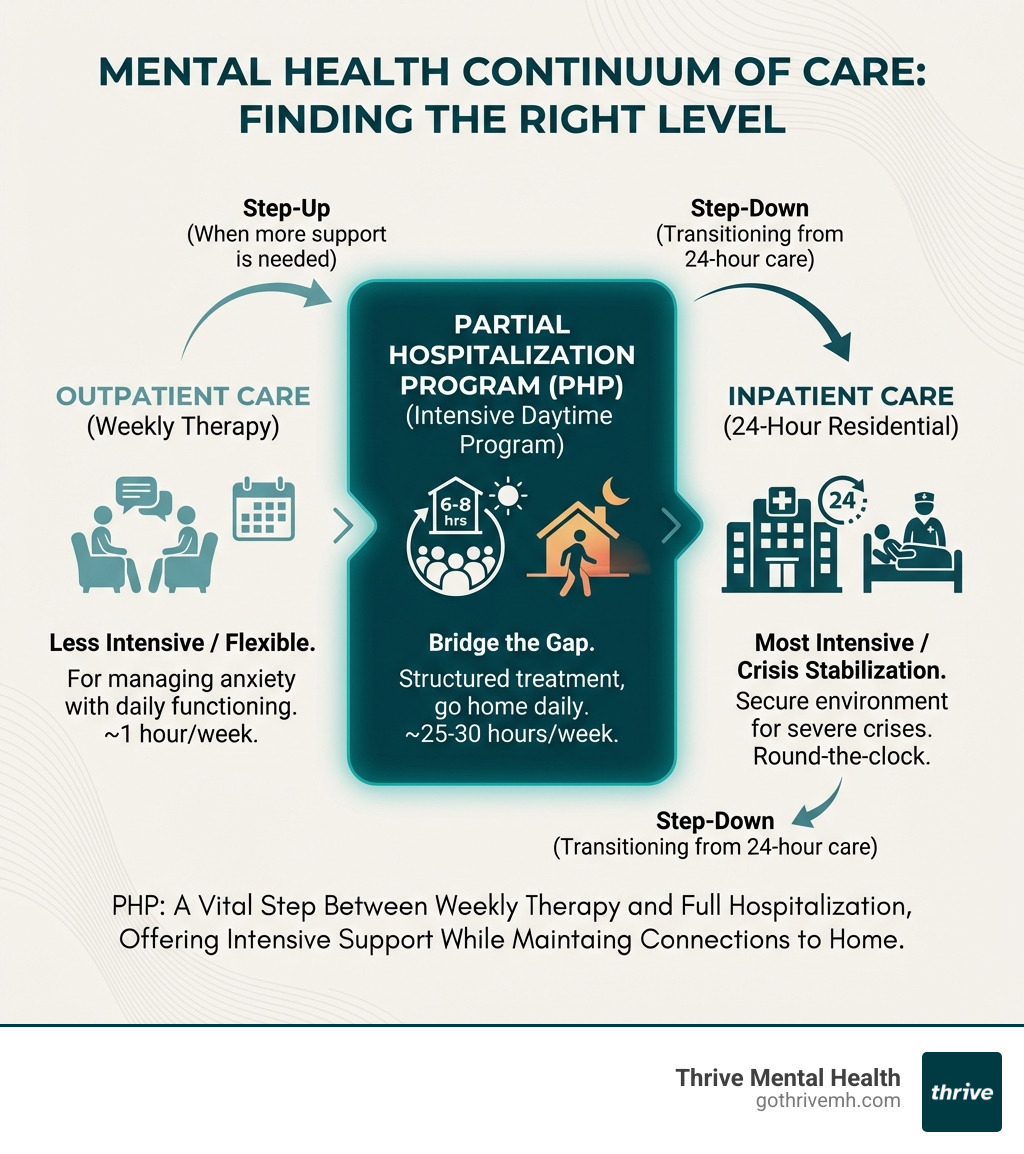
That’s where a PHP for anxiety becomes essential. It bridges the gap between traditional outpatient therapy (which may not be intensive enough) and inpatient hospitalization (which may be more restrictive than necessary). You attend treatment during the day, usually 6-8 hours, five days a week, then return home each evening to practice new skills in real-world settings.
I’m Nate Raine, CEO of Thrive Mental Health, and I’ve spent over a decade building evidence-based behavioral health systems that combine clinical excellence with real-world accessibility. Throughout my career, I’ve seen how PHP for anxiety transforms outcomes for people who’ve struggled for years, providing the intensity and structure needed to break the cycle of severe symptoms and regain control of their lives.
Essential PHP for anxiety terms:
Is a PHP for Anxiety Right for You? [Key Indicators]
Deciding on the right level of mental health care can feel daunting, especially when anxiety clouds your judgment. If you’re reading this, it’s likely you’ve already recognized that your anxiety is more than just occasional nervousness; it’s a persistent force that’s chipping away at your daily life. We’re here to help clarify when a PHP for anxiety might be your most powerful ally.
When to Consider a Step-Up in Care
You might be wondering if your anxiety warrants the intensive structure of a PHP. The answer often lies in the severity of your symptoms and their impact on your daily functioning. When is a PHP for anxiety recommended for treatment? Consider a PHP if:
- Your daily functioning is significantly impaired: This means your anxiety is making it hard to go to work, attend school, maintain relationships, or even manage basic self-care tasks. You might be constantly dreading social interactions, unable to leave your home due to panic, or struggling with decisions.
- Outpatient therapy isn’t enough: You’ve tried weekly therapy sessions, perhaps even with different therapists or modalities, but your symptoms persist or worsen. This is a clear sign you need a higher level of support and more frequent therapeutic intervention.
- You’re transitioning from inpatient care: A PHP for anxiety serves as a vital bridge from inpatient hospitalization. It provides the structured support you need to reintegrate into daily life, applying coping skills in a real-world setting without the abrupt shift to minimal support.
- You need intensive support but not 24/7 supervision: You don’t require round-the-clock monitoring or medical stabilization in a hospital, but you need more than just a few hours of therapy per week. A PHP offers that middle ground, allowing you to return home each evening.

If these points resonate with you, it’s a strong indicator that you could benefit from a more intensive approach. For individuals experiencing severe mental health needs, exploring options like ours can be a game-changer. More info about high-acuity care.
Anxiety Disorders Best Suited for PHP Treatment
What types of anxiety disorders are best suited for PHP for anxiety treatment? PHPs are designed for a wide spectrum of anxiety conditions that have become debilitating. Our programs, available virtually and in-person throughout Florida, cater to adults and young professionals struggling with:
- Generalized Anxiety Disorder (GAD): If you experience persistent, excessive worry about various aspects of life (health, work, family, finances) for months on end, and find it hard to control, a PHP can provide the tools to manage this constant dread.
- Panic Disorder: For those who suffer from recurrent, unexpected panic attacks that are severely disruptive and lead to avoidance behaviors (agoraphobia), a PHP offers a safe environment to learn coping strategies and exposure therapy.
- Social Anxiety Disorder (Social Phobia): If intense fear of social situations leads to significant avoidance and impairs your ability to work, study, or socialize, a PHP can help you gradually confront these fears and build social skills.
- Obsessive-Compulsive Disorder (OCD): While often categorized separately, OCD frequently co-occurs with anxiety. PHPs with a strong emphasis on Exposure and Response Prevention (ERP) therapy are highly effective for managing obsessive thoughts and compulsive behaviors.
- Post-Traumatic Stress Disorder (PTSD): For individuals whose daily functioning is significantly impacted by trauma-related anxiety, flashbacks, and avoidance, a PHP can provide a structured, supportive setting for trauma processing and skill-building.
Here are some common symptoms we address in our PHP for anxiety programs:
- Constant, uncontrollable worry
- Debilitating panic attacks
- Avoidance of essential daily activities
- Intrusive thoughts and compulsive behaviors
- Flashbacks and hypervigilance
- Significant distress in social situations
- Inability to relax or concentrate
- Physical symptoms like rapid heartbeat, shortness of breath, and muscle tension
Understanding the nuances of anxiety disorders is crucial for effective treatment. Anxiety Disorders can manifest in many forms, but the common thread is their ability to steal your peace and limit your life.
PHP vs. IOP: What’s the Real Difference?
It’s common to confuse Partial Hospitalization Programs (PHPs) with Intensive Outpatient Programs (IOPs), as both offer more intensive care than traditional weekly therapy. However, there are crucial distinctions, primarily in the intensity and time commitment. What is the difference between a PHP and an Intensive Outpatient Program (IOP) for anxiety?
| Feature | Partial Hospitalization Program (PHP) | Intensive Outpatient Program (IOP) |
|---|---|---|
| Time Commitment | 25-30 hours per week (5 days/week, 6-8 hours/day) | 9-12 hours per week (3-5 days/week, 2-4 hours/day) |
| Structure | Highly structured, more medical oversight, often requires full-time focus | Structured but more flexible, allows more integration with daily life |
| Supervision | Higher medical and psychiatric oversight, often daily contact with psychiatrists | Less frequent medical oversight, but still includes medication management |
| Best For | Severe symptoms needing stabilization, step-down from inpatient care, high-acuity needs | Moderate to severe symptoms, step-down from PHP, maintaining daily responsibilities |
| Goal | Rapid stabilization, intensive skill acquisition, crisis intervention | Skill refinement, relapse prevention, maintaining progress while reintegrating |
A PHP for anxiety provides a safe, structured environment that mimics the intensity of inpatient care during the day, allowing for rapid stabilization and skill development. It’s ideal if your anxiety is so severe that it prevents you from functioning and you need significant daily support.
An IOP, on the other hand, is a step down from a PHP. It offers substantial support and therapy but with a more flexible schedule, allowing you to gradually re-engage with work, school, or other responsibilities while still receiving intensive treatment. Many individuals transition from a PHP to an IOP as they progress in their recovery journey.
At Thrive Mental Health, we offer both virtual and in-person IOP and PHP programs across Florida. Our programs are designed to meet you where you are, offering flexibility and personalized care. Learn more about virtual IOP programs.
A Day in a PHP for Anxiety: What Really Happens [Schedule & Therapies]
When you commit to a PHP for anxiety, you’re not just signing up for a few therapy sessions; you’re immersing yourself in a comprehensive healing environment. We understand that the unknown can be anxiety-provoking in itself, so let’s shed some light on what you can expect from our evidence-based programs.
A Typical Day in a PHP
What can someone expect on a typical day in a PHP for anxiety? A typical day in a PHP is carefully structured to maximize therapeutic benefit, usually running for 6-8 hours, Monday through Friday. It’s a full-time commitment to your mental well-being. Here’s a general overview:
- Morning Check-in & Goal Setting (e.g., 9:00 AM, 10:30 AM): Your day often begins with a group session where you check in with your peers and therapists, sharing your current emotional state and setting personal goals for the day. This fosters a sense of community and accountability.
- Skills-Based Groups (e.g., 10:45 AM, 12:00 PM): This is where much of the practical learning happens. You’ll participate in groups focused on specific therapeutic modalities like Cognitive Behavioral Therapy (CBT) and Dialectical Behavior Therapy (DBT). These sessions teach you concrete skills to manage anxiety symptoms, regulate emotions, and improve interpersonal effectiveness.
- Lunch Break (e.g., 12:00 PM, 1:00 PM): A supervised break for a meal, allowing for informal socialization and a chance to recharge.
- Psychoeducation or Process Groups (e.g., 1:00 PM, 2:00 PM): These groups dig deeper into understanding anxiety, its causes, and its impact. Process groups provide a space to explore personal issues, share experiences, and receive support from peers and therapists in a safe setting.
- Experiential or Activity Therapy (e.g., 2:00 PM, 3:30 PM): This might include art therapy, yoga, mindfulness exercises, or other therapeutic activities that help you process emotions, reduce stress, and develop healthier coping mechanisms in a non-traditional format.
- Individual Therapy & Medication Management (Throughout the day, as scheduled): Throughout the week, you’ll have scheduled one-on-one sessions with your primary therapist to address your specific needs and tailor your treatment plan. If medication is part of your treatment, you’ll also have regular contact with a psychiatry provider for management and adjustments.
Patients participate Monday through Friday for 6 hours during the day and return home in the evening. This allows you to apply the skills you learn directly in your home environment, a crucial step in sustainable recovery.

Core Therapies That Drive Recovery in a PHP for Anxiety
What are the key components and therapies offered in a PHP for anxiety? Our programs are grounded in evidence-based practices, ensuring you receive the most effective treatments available. We believe in individualized care, tailoring our approach to your unique needs. Here are the core therapies we use:
- Cognitive Behavioral Therapy (CBT): This foundational therapy helps you identify negative thought patterns that fuel your anxiety and replace them with healthier, more realistic ways of thinking. CBT is indicated for all childhood anxiety disorders and is highly effective for adults.
- Dialectical Behavior Therapy (DBT): Originally developed for borderline personality disorder, DBT skills are incredibly powerful for anxiety, teaching you mindfulness, emotion regulation, distress tolerance, and interpersonal effectiveness. These skills are essential for managing intense anxiety.
- Exposure and Response Prevention (ERP): Often considered the gold standard for OCD and phobias, ERP gently guides you to confront feared situations or thoughts without engaging in compulsive behaviors or avoidance. This helps break the cycle of anxiety and fear.
- Acceptance and Commitment Therapy (ACT): ACT helps you accept difficult thoughts and feelings rather than fighting them, while committing to actions that align with your values. This approach builds psychological flexibility, reducing the impact of anxiety on your life.
- Medication Management: For many, medication can be a helpful component in managing severe anxiety symptoms, especially when combined with therapy. Our programs include regular contact with psychiatry providers to assess, prescribe, and adjust medications as needed. SSRIs are often a first-line option for anxiety disorders, and our team ensures you receive the most appropriate pharmacological support.
- Family Involvement: We recognize the vital role family plays in recovery. Many programs encourage family participation through family therapy sessions or informational meetings, creating a stronger support system for you outside of treatment. This helps how a PHP for anxiety helps individuals transition back to daily life after treatment.
These comprehensive therapeutic approaches are led by experienced mental health professionals, including psychologists, who are experts in how psychologists help with anxiety disorders.
 Beginner’s Guide to IOP & PHP Mental Health Treatment DifferencesMental Health
Program Duration and Aftercare Planning
How long does a PHP for anxiety typically last for treatment? The duration of a PHP is individualized, but a typical length of stay is 10 weekdays, or roughly 2-4 weeks. This timeframe allows for intensive symptom stabilization and robust skill acquisition. Our treatment teams, working collaboratively with you and your family, determine the duration based on your progress and individual needs.
A crucial aspect of any effective PHP is robust aftercare planning. How does a PHP for anxiety help individuals transition back to daily life after treatment? As your symptoms stabilize and you gain confidence in your new skills, we work with you to develop a personalized transition plan. This often involves:
- Step-Down to IOP: Many individuals transition from a PHP for anxiety to an Intensive Outpatient Program (IOP). This provides continued structured support while allowing for greater integration into daily life, offering a gradual step-down in intensity.
- Outpatient Therapy: Connecting you with individual outpatient therapists and group therapy options for ongoing support.
- Relapse Prevention Strategies: Equipping you with a personalized set of tools and strategies to identify early warning signs and manage potential setbacks.
- Building Resilience: Our focus is not just on reducing symptoms but on building lasting resilience, empowering you to steer life’s challenges with confidence.
We believe in providing holistic, continuous support through our wraparound care options to ensure your progress extends far beyond your time in the program.
How to Access PHP for Anxiety: A Step-by-Step Guide to Admission, Costs, and Insurance
Taking the first step towards intensive treatment can feel overwhelming, but we’re here to guide you through every stage. Our goal at Thrive Mental Health, serving communities throughout Florida, is to make accessing care as seamless as possible.
The Admission Process for a PHP for Anxiety
How does one get admitted into a PHP for anxiety? Our admission process is designed to ensure that a PHP is the most appropriate level of care for your specific needs.
- Initial Assessment: The first step is to contact us for an initial assessment. This helps us understand your current symptoms, history, and treatment goals. You can get started with an assessment directly on our website or by calling us.
- Clinical Evaluation: If a PHP appears to be a good fit, you’ll undergo a more thorough clinical evaluation with a mental health professional. This assessment determines the severity of your anxiety and confirms that our program aligns with your clinical needs.
- Referral Process: While you can initiate contact directly, we often work with referrals from your existing mental health provider or physician. This ensures continuity of care and helps us integrate your past treatment history into your new plan.
- Verifying Eligibility: We’ll help you steer the complexities of insurance to verify your coverage and financial eligibility for the program.
- Creating a Personalized Treatment Plan: Once admitted, our interdisciplinary team will collaborate with you to develop a personalized treatment plan custom to your unique challenges and recovery goals.
Our compassionate intake specialists are ready to answer your questions and guide you through each step, making the process as clear and stress-free as possible.
Navigating Costs and Insurance Coverage
What are the potential costs and insurance considerations for a PHP for anxiety? We understand that cost is a significant concern for many. PHPs are an intensive form of treatment, and while they can be an investment in your long-term well-being, many insurance plans offer coverage.
- Insurance Verification: We work with a wide range of insurance providers to help you understand your benefits. We are in-network with major insurance companies like Cigna, Optum, and Florida Blue, among others, across our Florida locations.
- In-Network Providers: Being in-network with your insurance typically means lower out-of-pocket costs for you. Our team will verify your benefits and explain any co-pays, deductibles, or co-insurance you may be responsible for.
- Out-of-Pocket Costs: The exact out-of-pocket costs will depend on your specific insurance plan, deductible, and coverage details. We strive to be transparent about all costs upfront.
- Flexible Options: If you have questions about your specific plan or would like to discuss payment options, our team is here to assist you.
We encourage you to verify your insurance benefits directly on our website for a quick and confidential estimate of your coverage.
How to Prepare for Your First Day
Preparing for a PHP for anxiety can help ease any apprehension you might feel. It’s a significant step, and a little preparation goes a long way. How can individuals prepare for entering a PHP for anxiety?
- Mental Preparation: Acknowledge that seeking intensive help is a positive and courageous step. Engage in mindfulness practices to calm your mind and focus on the positive changes you want to achieve. Set personal goals for what you want to gain from the program.
- Logistical Arrangements:
- Transportation: Arrange reliable transportation to and from our in-person facilities, or ensure you have a quiet, private space for virtual sessions.
- Schedule Adjustment: If you are attending an in-person program, you will be participating Monday through Friday for 6-8 hours daily. This will require a temporary leave from work or school. Inform your employer or academic institution about your upcoming absence and provide any necessary documentation.
- Childcare/Family Support: If you have dependents, arrange for their care during your program hours.
- What to Bring (for in-person programs): Comfortable clothing, a journal, any prescribed medications, and a water bottle are typically useful. Avoid bringing valuables.
- Creating a Support System: Inform close friends or family members about your program. Establishing regular check-ins with them can provide crucial emotional support outside of program hours. This also helps them understand your journey and how they can best support your transition back to daily life.
By taking these proactive steps, you can enter your PHP for anxiety program feeling more prepared, focused, and ready to accept the healing process.
Frequently Asked Questions about PHP for Anxiety
How long does a PHP for anxiety typically last?
The duration is personalized, but a typical length of stay is 2-4 weeks (or 10-20 treatment days). The goal is to stabilize your symptoms and equip you with skills before stepping down to a lower level of care like an IOP.
Can I still work or go to school during a PHP?
It is very challenging. A PHP is an intensive, full-time commitment (around 6-8 hours per day, 5 days a week) designed for a short period to help you stabilize. Most people take a temporary leave from work or school to focus fully on their recovery.
What is the main benefit of a PHP over weekly therapy for severe anxiety?
The primary benefit is intensity and structure. PHP provides daily, immersive therapeutic work, including multiple therapy groups, individual sessions, and skills practice in a supportive environment. This intensity accelerates stabilization and skill acquisition in a way that a single weekly session cannot for severe symptoms.
Conclusion: Take the Next Step Toward Lasting Anxiety Relief
A PHP for anxiety is an effective, intensive option for severe anxiety when other methods aren’t enough. It provides the structure, comprehensive therapies, and support needed to regain control and build lasting coping skills. If your anxiety is significantly impairing your life, and weekly therapy isn’t enough, a PHP offers a powerful pathway to healing.
At Thrive Mental Health, we offer expert-led, evidence-based PHP programs designed for real-world results, available both in-person and virtually across Florida. Our mission is to make high-quality, intensive treatment accessible, helping adults and young professionals find lasting relief from anxiety.
Learn more about our Partial Hospitalization Program (PHP).
Ready for support? Thrive offers virtual IOP programs with evening options. Verify your insurance in 2 minutes (no obligation) → Start benefits check or call 561-203-6085. If you’re in crisis, call/text 988.

This article is for informational purposes only and is not a substitute for individualized clinical advice or insurance verification.