






Understanding What Asperger Syndrome Symptoms Really Mean Today
Asperger syndrome symptoms are no longer diagnosed under that name, but the characteristics many people associate with Asperger’s are very real, and they now fall under Autism Spectrum Disorder (ASD), specifically Level 1 ASD. If you’ve been searching for “Asperger’s,” you’re likely trying to understand social challenges, intense interests, or repetitive behaviors in yourself or someone you care about.
Quick Answer: Core Asperger Syndrome Symptoms (Now Level 1 ASD)
- Social Communication Challenges: Difficulty with eye contact, reading facial expressions, understanding sarcasm, or engaging in back-and-forth conversations
- Restricted Interests & Repetitive Behaviors: Intense focus on specific topics, strict routines, distress over changes, repetitive movements like hand-flapping
- Other Common Signs: Sensory sensitivities (to light, sound, or touch), clumsy movements, monotone speech, difficulty regulating emotions
The medical community stopped using “Asperger’s syndrome” in 2013 when the DSM-5 merged it into a single Autism Spectrum Disorder diagnosis. But the symptoms people experienced didn’t disappear, they’re just understood differently now.
What used to be called Asperger’s typically describes individuals who are highly capable in many areas but face real challenges in social situations and adapting to change. Many weren’t diagnosed until adulthood, after years of feeling like they didn’t quite fit in. Research shows boys are about four times more likely to be diagnosed than girls, though many girls and women are underdiagnosed because they “mask” their symptoms more effectively.
Here’s what matters: recognizing asperger syndrome symptoms is the first step toward getting support that actually works. Whether you’re an adult wondering if this explains lifelong struggles, or you’re concerned about someone else, understanding these patterns can open up access to therapy, workplace accommodations, and strategies that make daily life easier.
As Nate Raine, CEO of Thrive Mental Health, I’ve worked with hundreds of individuals navigating asperger syndrome symptoms and the broader autism spectrum, helping them access evidence-based care that fits their lives, not the other way around. Our team understands that late diagnoses are common, and we’ve built programs that meet adults where they are, with flexible virtual and in-person options.
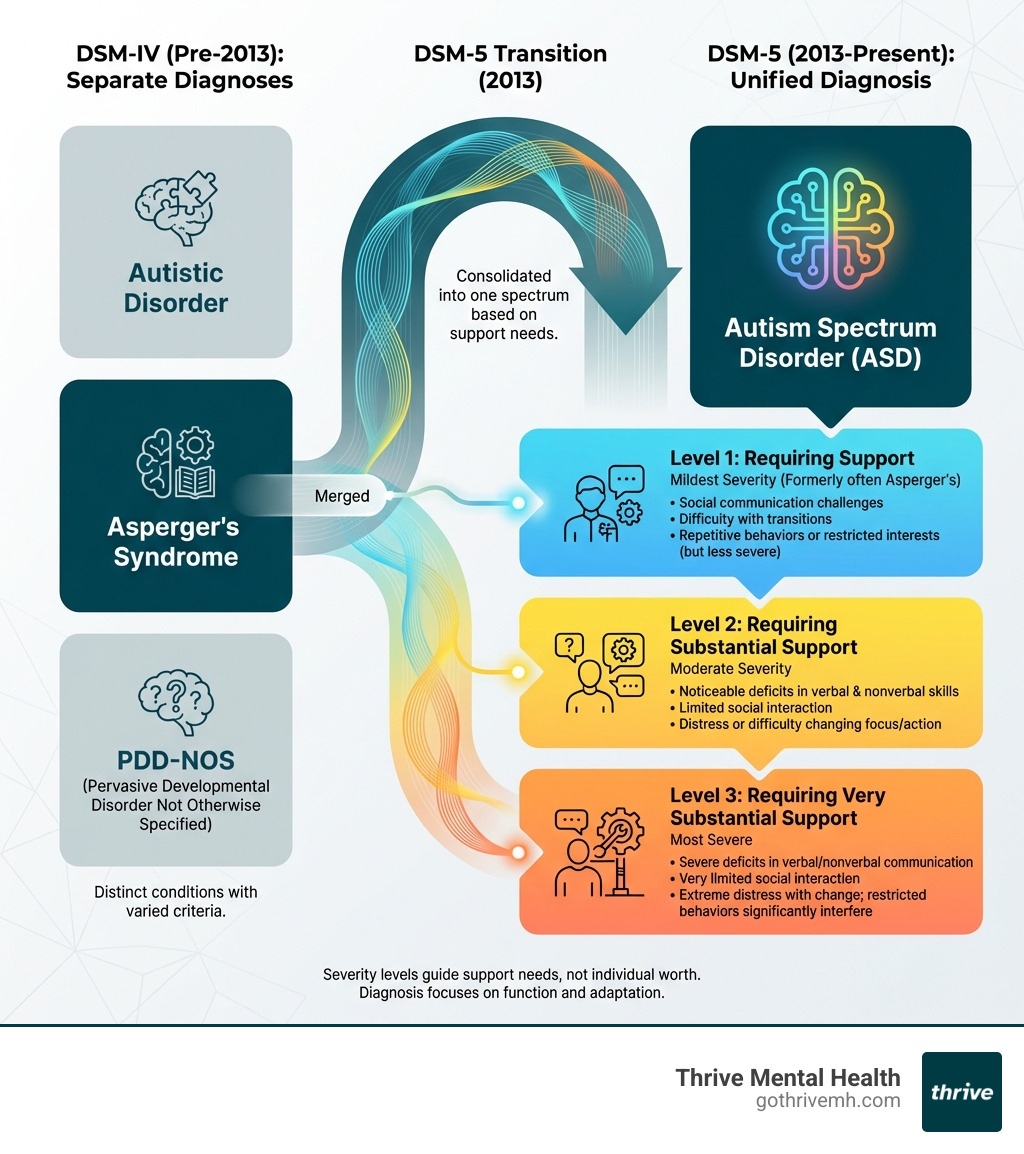
Why Doctors Don’t Say ‘Asperger’s’ Anymore [The DSM-5 Shift]
The term “Asperger’s syndrome” was first used in the 1980s to describe individuals with “high-functioning autism” or autism with lower support needs. For many years, it was a distinct diagnosis that helped people understand their unique challenges. However, in 2013, the Diagnostic and Statistical Manual of Mental Disorders, Fifth Edition (DSM-5), made a significant change.
This update brought Asperger’s syndrome, along with other related conditions like pervasive developmental disorder not otherwise specified (PDD-NOS), under the single umbrella diagnosis of Autism Spectrum Disorder (ASD). This shift was not because the symptoms disappeared, but because experts recognized that autism exists on a wide spectrum, with varying degrees of support needs.
Now, what was once called Asperger’s syndrome is typically referred to as Level 1 Autism Spectrum Disorder. This means individuals require support, but generally have lower support needs compared to those at Level 2 (requiring substantial support) or Level 3 (requiring very substantial support). This change aimed to provide a more flexible and inclusive framework for understanding and supporting autistic individuals.
The DSM-5 now defines ASD as a neurodevelopmental disorder characterized by persistent deficits in social communication and interaction, and restricted, repetitive patterns of behavior, interests, or activities. This new classification acknowledges the wide range of presentations within the autism spectrum, ensuring that support can be custom to an individual’s specific needs rather than a rigid diagnostic label.
At Thrive Mental Health, we understand that for many, the term “Asperger’s” still resonates with their personal experience. We honor that identity while providing care that aligns with current diagnostic understanding. Our goal is to help individuals steer their unique challenges within the autism spectrum, offering custom programs for adults and young professionals across Florida.
To better illustrate this diagnostic evolution, let’s look at how the criteria have shifted:
| Feature | DSM-IV Asperger’s Syndrome (Old) | DSM-5 Autism Spectrum Disorder, Level 1 (Current) |
|---|---|---|
| Diagnostic Category | Separate Pervasive Developmental Disorder | Unified Autism Spectrum Disorder (ASD) |
| Social Interaction | Qualitative impairment in social interaction (2+ symptoms) | Persistent deficits in social communication and social interaction (all 3 areas) |
| Restricted/Repetitive Behaviors | Restricted, repetitive, and stereotyped patterns of behavior, interests, and activities (1+ symptom) | Restricted, repetitive patterns of behavior, interests, or activities (2+ types) |
| Language Delay | No clinically significant general delay in language | No general language delay (though pragmatic language use is impaired) |
| Cognitive Delay | No clinically significant cognitive delay | No intellectual disability |
| Impairment | Clinically significant impairment in social, occupational, or other important areas of functioning | Symptoms cause clinically significant impairment in social, occupational, or other important areas of current functioning |
| Onset | Symptoms typically evident in early childhood | Symptoms must be present in the early developmental period |
| Relationship to ASD | Distinct from Autistic Disorder | Integrated as part of the ASD spectrum, specifically Level 1 (requiring support) |
This table highlights that while the name has changed, the core characteristics that defined Asperger’s are now recognized as a specific presentation within the broader ASD. You can learn more about this broader context in our article, The Spectrum of Autism: Recognizing Diverse Forms.
The 3 Core Groups of Asperger Syndrome Symptoms
When we talk about asperger syndrome symptoms, we’re referring to a pattern of characteristics that manifest primarily in social communication, interests, and behaviors, and often include sensory differences. These are the key areas we observe and address in our programs.

While every individual on the autism spectrum is unique, these three categories help us understand the common experiences:
- Social Communication & Interaction Challenges: Difficulties with the “unwritten rules” of social engagement, understanding others’ perspectives, and nonverbal communication.
- Restricted Interests & Repetitive Behaviors: A strong preference for routines, intense focus on specific topics, and often repetitive physical movements.
- Other Common Characteristics: This includes sensory sensitivities, differences in motor coordination, and unique speech patterns.
It’s also important to note that individuals on the autism spectrum frequently experience co-occurring conditions, which can complicate symptom presentation and require integrated treatment. Common co-occurring conditions include:
- Anxiety disorders
- Depression
- Attention-Deficit/Hyperactivity Disorder (ADHD)
- Obsessive-Compulsive Disorder (OCD)
- Sleep disorders
- Gastrointestinal issues
Our approach at Thrive Mental Health is to look at the whole person, addressing not just the primary asperger syndrome symptoms but also any co-occurring mental health challenges to provide truly comprehensive support.
1. Social Communication & Interaction Challenges
One of the most defining aspects of what was formerly known as Asperger’s syndrome, and now Level 1 ASD, is the unique way individuals steer social communication and interaction. These challenges are often subtle but can significantly impact relationships and daily functioning.
We often observe:
- Difficulty with Nonverbal Cues: Trouble understanding or using nonverbal communication like eye contact, facial expressions, and body language in social situations. This can make social interactions feel like a puzzle without all the pieces.
- Challenges Building Relationships: Individuals may struggle with initiating or maintaining relationships with peers, sometimes preferring the company of adults or much younger children. They might not seek out others to share enjoyable or interesting things.
- One-Sided Conversations: Engaging in long, detailed monologues about topics of personal interest without noticing whether the listener is engaged or trying to change the subject. The “give-and-take” of typical conversation can be difficult.
- Difficulty with Empathy and Understanding Others’ Feelings: Appearing not to understand or empathize with others’ emotions. This isn’t a lack of caring, but often a challenge in “reading” and interpreting social cues. They might say things without fully considering the emotional impact on the listener.
- Literal Interpretation: Taking language very literally, which can lead to misunderstandings, especially with figures of speech, idioms, humor, or sarcasm. “It’s raining cats and dogs” might cause genuine confusion.
- Less Make-Believe Play: In childhood, there might be less spontaneous, varied make-believe play than expected for their age.
- Trouble Adjusting Behavior: Difficulty adjusting behavior to suit different social contexts, such as a casual conversation versus a formal meeting.
For adults, these challenges can become particularly pronounced in professional settings or romantic relationships, where unspoken social rules are paramount. Many adults with these asperger syndrome symptoms learn to “mask” or hide their natural behaviors to fit in, which can be exhausting. Our programs, including virtual intensive outpatient (IOP), help adults in Florida develop strategies to steer these complexities. For more insights, explore our article on Understanding Functioning Autism Symptoms in Adults.
2. Restricted Interests & Repetitive Behaviors
Another hallmark of asperger syndrome symptoms (now Level 1 ASD) involves patterns of behavior, interests, and activities that are often described as restricted or repetitive. These traits can be both a source of challenge and, often, a remarkable strength.
We frequently see:
- Intense, Narrow Interests: Individuals often develop unusually strong, focused interests in specific topics. This might be anything from baseball statistics to how airplanes work, historical facts, or a particular scientific field. They can amass an impressive depth of knowledge on these subjects.
- Strict Routines and Distress Over Change: There’s a strong need to follow strict routines and a significant aversion to changes, even minor ones. Unexpected shifts can cause considerable distress, anxiety, or even violent outbursts, as the predictability of their world is disrupted.
- Repetitive Movements (Stimming): This refers to self-stimulatory behaviors, often called “stimming,” which can include repeated movements like hand twisting, flapping, humming, body rocking, or spinning. These movements can serve as a way to self-regulate, cope with sensory input, or express excitement.
- Fascination with Parts of Objects: Rather than engaging with an object’s overall function, there might be an intense fascination with its parts, for example, the wheels of a toy car rather than the car itself.
- Repetitive Use of Phrases: Repeating certain words or phrases over and over, sometimes out of context (echolalia), or using a limited range of expressions.
- Insistence on Sameness: This can extend to rigid thinking, greeting rituals, or needing to take the same route or eat the same food daily.
While these behaviors can sometimes interfere with daily life or social acceptance, the intense focus and deep knowledge in specific areas can also be incredible assets in academic or professional fields. Our programs help individuals harness these strengths while developing coping mechanisms for the challenging aspects. For those interested in understanding specific behaviors, you might find our article on Understanding Autism Hyperactivity Symptoms: Solutions insightful.
3. Other Common Asperger Syndrome Symptoms
Beyond the core social and behavioral patterns, other asperger syndrome symptoms can significantly impact an individual’s experience of the world. These often relate to how sensory information is processed and how the body moves and communicates.

Some of these additional characteristics include:
- Sensory Sensitivities: Individuals often have unusual reactions to sensory input. This can manifest as hypersensitivity (being overly responsive) to light, sound, smell, taste, or touch (e.g., finding certain fabrics unbearable, being overwhelmed by loud noises, or strong smells). Conversely, some may exhibit hyposensitivity (being under-responsive), seeking out intense sensory experiences. These sensitivities can make certain environments, like crowded public spaces or noisy offices, incredibly challenging.
- Clumsy or Uncoordinated Movements: Many individuals exhibit differences in motor coordination, appearing clumsy or uncoordinated. This can affect fine motor skills (like handwriting) and gross motor skills (like balance or coordination in sports). They might have an unusual gait or posture.
- Atypical Speech Patterns: While language development might be on schedule in terms of vocabulary and grammar, the way language is used can be distinct. This might include a monotone, flat, or unusually fast or rigid voice. They might use formal language in informal settings or speak with a peculiar rhythm.
- Emotional Regulation Difficulties: Challenges in understanding and managing emotions can lead to difficulty coping with frustration, anxiety, or anger. This might result in emotional outbursts or meltdowns, especially when overwhelmed or routines are disrupted. Anxiety, stress, and excessive worry are also commonly reported.
Recognizing these varied asperger syndrome symptoms is crucial for providing effective support. Our programs at Thrive Mental Health consider these nuances, offering strategies for sensory regulation, emotional management, and communication skill-building to help individuals thrive. Explore more about identifying these signs in our guide on Key Indicators of Spectrum Disorder: What to Look Out For.
Beyond Symptoms: Unseen Strengths and Getting an Adult Diagnosis
While we’ve focused on asperger syndrome symptoms and challenges, acknowledge the incredible strengths and unique perspectives that often accompany these traits. This is at the heart of the neurodiversity movement, which views neurological differences as natural variations in the human brain, not deficits.

Many individuals with what was formerly known as Asperger’s syndrome possess remarkable strengths, such as:
- Exceptional Attention to Detail: A keen eye for specifics that others might miss, leading to precision in work and hobbies.
- Strong Focus and Persistence: The ability to concentrate on a task or interest for extended periods, often leading to mastery.
- Pattern Recognition and Logical Thinking: A natural aptitude for identifying patterns, understanding systems, and applying logical reasoning to complex problems.
- Honesty and Directness: A straightforward communication style, often valuing truth and integrity above social niceties.
- Deep Knowledge: The capacity to become experts in their areas of special interest, contributing valuable insights.
For many adults, these strengths might be recognized, but the underlying challenges in social contexts can lead to a feeling of being different or misunderstood. Often, individuals reach adulthood without a formal diagnosis. This can be due to effective “masking” in childhood, or simply because their challenges weren’t fully understood or recognized by healthcare providers.
The good news is that it’s never too late to seek an adult diagnosis. If you’ve been struggling with social difficulties, intense interests, or sensory sensitivities your whole life and suspect you might be on the autism spectrum, reaching out to a healthcare provider is a powerful step. A diagnosis can provide clarity, self-understanding, and access to appropriate support and accommodations.
The diagnostic process for adults typically involves a comprehensive evaluation by a psychologist or psychiatrist specializing in ASD. This includes in-depth interviews about current and childhood symptoms, discussions with family members (if possible), and various assessments. We offer resources like Am I Autistic? to help you explore these questions. Understanding your neurotype can be a profoundly validating experience, opening doors to custom strategies and a community that understands. Our Adult Autism Support Services are designed to guide you through this journey.
What Really Causes Autism? (And How to Get Support That Works)
The question of what causes autism, including the collection of asperger syndrome symptoms, is complex and not yet fully understood. However, extensive research points to a combination of genetic and environmental factors. ASD is a neurodevelopmental condition, meaning it involves differences in brain development and function.
Genetics Play a Significant Role
Experts widely agree that genetics are a primary contributing factor to ASD. Gene changes play an important role, and these can be:
- Inherited: Often passed down within biological families. If there’s a family history of ASD, the likelihood of a child having ASD increases.
- Spontaneous: Occurring for the first time in a child without any family history of ASD.
Numerous genes have been implicated, and research continues to uncover the intricate genetic landscape of autism. For more information on the hereditary aspect, you can explore resources like Are Siblings at Greater Risk of Autism.
Environmental Factors and Brain Differences
While genetics load the gun, environmental factors are thought to pull the trigger. These can include:
- Prenatal and Perinatal Factors: Complications during pregnancy or birth, advanced parental age, or certain maternal conditions.
- Brain Differences: Research consistently shows structural and functional differences in the brains of individuals with ASD, affecting areas related to social cognition, communication, and executive functions.
It’s important to dispel myths:
- Vaccines Do Not Cause Autism: Decades of rigorous scientific research, including extensive studies, have definitively concluded that there is absolutely no link between childhood vaccinations and autism. The original study that suggested a link was retracted due to fraudulent data and has been thoroughly debunked. We strongly encourage following recommended vaccination schedules to protect against serious diseases. For more information, see Extensive research shows no link between vaccines and autism.
Getting Support That Works
Since ASD is a brain difference, not a disease, there’s no “cure.” Instead, effective support focuses on managing challenges and enhancing strengths. Because ASD affects each person differently, individualized treatment plans are essential.
At Thrive Mental Health, we offer comprehensive, evidence-based interventions custom to adults and young professionals. These may include:
- Cognitive Behavioral Therapy (CBT): Helps individuals identify and change unhelpful thought patterns and behaviors, particularly effective for managing anxiety, depression, or emotional regulation difficulties often co-occurring with ASD.
- Social Skills Training: Teaches explicit strategies for navigating social interactions, understanding nonverbal cues, and improving communication.
- Occupational Therapy: Addresses sensory sensitivities and helps develop strategies for daily living skills and environmental accommodations.
- Speech-Language Therapy: Focuses on pragmatic language skills, such as conversational turn-taking, understanding social language, and vocal modulation.
- Parent and Family Education: Providing psychoeducation and strategies for families to support their loved ones.
We believe in making high-quality mental healthcare accessible. Our virtual and in-person programs, including Neurodivergent Intensive Outpatient Treatment, are available across Florida (Tampa Bay, St. Petersburg, Miami, Orlando, Boca Raton, West Palm Beach, Jacksonville, Fort Lauderdale, Naples, Sarasota). We work with various insurance providers, including Cigna, Optum, and Florida Blue, to ensure our services are within reach. For more on finding effective coping strategies, check out Finding Clarity: Autism Counseling and Coping Mechanisms.
Frequently Asked Questions about Asperger’s and ASD
What is the difference between Asperger’s and Level 1 ASD?
Asperger’s syndrome was a diagnosis under the old DSM-IV manual, characterized by social and communication challenges without significant language or cognitive delays. In the current DSM-5, these characteristics are now diagnosed as Autism Spectrum Disorder (ASD), Level 1, which indicates that the individual requires support but has lower support needs than those at Levels 2 or 3.
Is Asperger’s syndrome genetic?
Research strongly suggests that genetics play a significant role. Autism Spectrum Disorder, which includes what was formerly known as Asperger’s, often runs in families. However, it’s a complex mix of genetic and environmental influences, and not every case is inherited.
Can you be diagnosed with Asperger’s as an adult?
Yes, many people are diagnosed with ASD later in life. While the term “Asperger’s” is no longer used for new diagnoses, an adult can be diagnosed with ASD, Level 1. This often happens when social or professional demands highlight lifelong challenges that were previously overlooked or misdiagnosed.
Ready for Support That Understands You?
Recognizing and understanding asperger syndrome symptoms (now Level 1 ASD) is the first, crucial step toward a more fulfilling life. Whether you’re seeking clarity for yourself or a loved one, knowing these signs empowers you to find the right support.
At Thrive Mental Health, we specialize in providing personalized care for adults and young professionals navigating the autism spectrum. Our programs are designed to meet your unique needs, combining clinical expertise with flexible scheduling and measurable results. We offer both virtual and in-person options across Florida, ensuring that expert support is accessible to you.
We understand the journey can be challenging, but you don’t have to walk it alone. Our team is here to help you develop coping strategies, improve social communication, manage sensory sensitivities, and build on your unique strengths. Find how our Comprehensive Autism Therapy from Personalized Treatments to Online Support Programs can make a real difference.
Ready for support? Thrive offers virtual IOP programs with evening options. Verify your insurance in 2 minutes (no obligation) → Start benefits check or call 561-203-6085. If you’re in crisis, call/text 988.

This article is for informational purposes only and is not a substitute for individualized clinical advice or insurance verification.