


Obsessed With Relief? Break Free from the OCD Cycle for Good
If you feel like OCD is running your life, you are not weak, broken, or “crazy.” Your brain is stuck in a loop.
Exposure and response prevention therapy for obsessive compulsive disorder (ERP) is the most powerful, evidence-based way to break that loop. It doesn’t just take the edge off, it targets the core OCD cycle that keeps you checking, washing, fixing, or overthinking until you’re exhausted.
Here’s what matters most:
- ERP helps about 80% of people find significant relief, and about one-third become fully symptom-free.
- The skills you learn are portable. You can use them at home, at work, and in every city Thrive serves across Florida.
- Unlike medication alone, ERP is designed for long-term freedom, not just short-term symptom reduction.
ERP for OCD at a Glance:
- What it is: A specialized therapy where you gradually face your fears (exposure) while resisting the urge to perform compulsions (response prevention).
- Effectiveness: Around 80% of people see major improvement; about one-third become fully symptom-free.
- Timeline: Most people complete 12-20 sessions, often noticing improvement within weeks.
- Who it helps: All OCD subtypes, including contamination fears, harm obsessions, checking rituals, and intrusive thoughts.
- How it works: ERP rewires your brain’s anxiety response, teaching it that feared outcomes don’t happen and you can tolerate distress without rituals.
Think of OCD as an oversensitive fire alarm. Your compulsions are like frantically checking for smoke every time you light a candle, they bring temporary relief but make the alarm more sensitive. ERP teaches your brain to recognize false alarms and stop the exhausting cycle.
I’m Nate Raine, CEO of Thrive Mental Health. For over a decade, I’ve focused on building accessible, evidence-based programs that work. Our intensive outpatient (IOP) and partial hospitalization (PHP) teams across Florida, including Tampa Bay, Miami, Orlando, and Jacksonville, have helped thousands break free from OCD using structured exposure and response prevention therapy for obsessive compulsive disorder.
At Thrive, we deliver ERP through flexible virtual IOP/PHP programs and trusted in-person centers, so you can access high-level care without putting your life on hold.
Handy exposure and response prevention therapy for obsessive compulsive disorder terms:
- ocd symptoms
- how to treat ocd
- intrusive thoughts ocd
- Virtual IOP & PHP programs
- Verify your insurance for OCD treatment
What is ERP Therapy and Why Is It the Gold Standard for OCD?
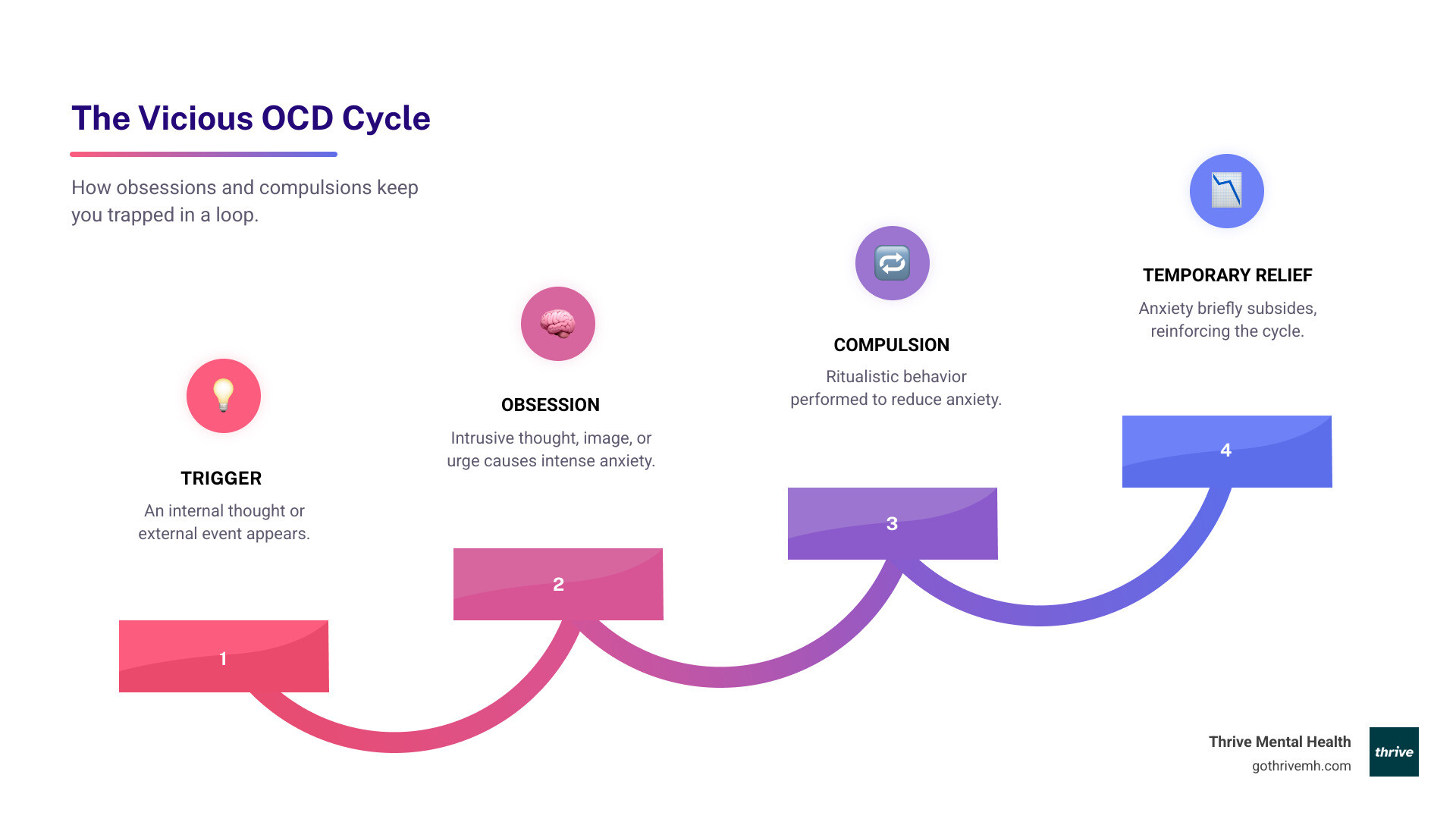
Exposure and Response Prevention (ERP) therapy is a specialized form of cognitive behavioral therapy (CBT) that breaks the vicious cycle of OCD. It’s a strategic process of facing your fears (exposure) and courageously resisting the urge to perform rituals (response prevention).
Imagine you fear germs from a doorknob. ERP guides you to touch the doorknob and then, with support, to not wash your hands. You learn to sit with the discomfort as your anxiety rises and then falls on its own. This process, called habituation, teaches your brain the feared outcome doesn’t happen. ERP also promotes inhibitory learning, creating new, non-threatening associations that override the old fear response. You’re not just getting used to anxiety; you’re teaching your brain a healthier reaction.
Decades of research confirm ERP as the first-line, evidence-based treatment for OCD, helping a remarkable 80% of people find significant relief Scientific research on ERP effectiveness. When we say “gold standard,” we mean it’s the most effective treatment available for this disorder and the backbone of Thrive’s OCD-focused IOP and PHP programs across Florida.
The science behind how ERP rewires your brain
ERP effectively “rewires” the neural pathways that fuel the OCD cycle. This is grounded in Mowrer’s Two-Factor Model, which explains how OCD develops and persists. First, a neutral trigger (like a light switch) gets paired with anxiety through classical conditioning. Second, a compulsion (like hand washing) provides temporary relief, reinforcing the behavior through operant conditioning. Your brain learns: “Do the ritual, feel better.”
ERP systematically dismantles this faulty learning. By facing triggers (exposure) and blocking the ritual (response prevention), you break the reinforcement cycle. Your brain learns a new, more accurate lesson: “I touched the switch, did nothing, and the anxiety passed on its own.” This recalibrates your brain’s alarm system, leading to long-term change, not just a temporary fix. The goal is to manage anxiety without resorting to life-disrupting compulsions.
How ERP differs from traditional talk therapy
Unlike traditional talk therapy that focuses on insight, ERP is an action-oriented treatment. Simply understanding why you feel compelled to check the stove doesn’t stop the behavior. ERP targets the doing, or, more accurately, the not doing, of the compulsion.
It’s a pragmatic, hands-on approach that directly targets symptoms. We create a structured, personalized plan, starting with manageable challenges and gradually working up to bigger fears. Talking about fears can sometimes become a mental compulsion (reassurance seeking), but ERP forces an experiential encounter. You learn from direct experience that your fears are unfounded and your rituals are unnecessary.
At Thrive Mental Health, ERP is delivered within higher-support levels of care, like Virtual IOP/PHP, so you can practice exposures intensively, get real-time coaching, and see faster, measurable progress.
The Power of Exposure and Response Prevention Therapy for Obsessive Compulsive Disorder
The power of exposure and response prevention therapy for obsessive compulsive disorder is transformative. It’s not just about reducing symptoms; it’s about reclaiming your time, energy, relationships, and work performance from OCD.
At Thrive Mental Health, we’ve seen countless individuals in Florida achieve breakthroughs because ERP offers a direct, evidence-based path to freedom.

ERP’s effectiveness is backed by decades of research. It stands out because it directly confronts the core mechanisms of OCD, equipping you with lifelong skills for resilience. This leads to profound, long-term results and robust relapse prevention.
ERP vs. Medication: What the Statistics Say
When treating OCD, both medication and ERP have a role, but ERP is the most effective long-term solution.
- ERP Alone: Studies show ERP is highly effective on its own, with about 80% of individuals experiencing significant improvement. More than 3 in 10 people are symptom-free after completing therapy.
- Medication (SSRIs) Alone: SSRIs can reduce symptoms, but benefits often cease when the medication is stopped, leading to higher relapse rates compared to ERP.
- Combination Therapy: Combining medication and ERP shows similar outcomes to ERP alone, but is more effective than medication alone. This suggests ERP is the key driver of long-term change.
The most compelling fact is that relapse rates are lower with ERP than with any other approach Studies show lower relapse rates for ERP. ERP empowers you with skills, not just symptom management. You learn to be your own therapist long after treatment ends.
If you’re balancing OCD with a demanding job or school schedule in places like Miami, Tampa, Orlando, or Jacksonville, Thrive’s virtual IOP and PHP programs let you access intensive ERP without pausing your life.
How long does ERP take and what results can I expect?
While every journey is unique, a typical course of exposure and response prevention therapy for obsessive compulsive disorder is predictable.
- Typical Treatment Course: Most people complete 12-20 one-hour sessions. The exact number depends on symptom severity and your commitment to practicing between sessions.
- Expected Symptom Reduction: Real-world data shows an average 43% reduction in OCD severity after just 12 weeks of ERP. This demonstrates how focused and effective the treatment is.
- Improvement vs. Recovery: While 80% of people experience significant improvement, about one-third are considered “recovered.” Recovery means symptoms no longer interfere with daily life and you have the tools to manage intrusive thoughts without compulsions. It’s about living life on your terms, not OCD’s.
If you’re unsure whether you’ll be covered for intensive ERP in Florida, you can verify your insurance in minutes. Thrive works with major plans like Cigna, Optum, Florida Blue, and more, so cost doesn’t have to be the reason you stay stuck.
Facing Your Fears: What an ERP Session Actually Looks Like
An ERP session is an active, collaborative process. In a safe, supportive space, whether virtual from your home in Tampa, Miami, Orlando, or anywhere else in Florida, you and your therapist will tackle your OCD head-on. Your therapist will guide you through planned exposures, tracking your anxiety on a 0-100 Subjective Units of Distress Scale (SUDS). This helps you see your anxiety decrease over time without performing compulsions.
A significant part of ERP happens between sessions. You’ll receive homework assignments to practice exposures in your daily life, which is where the real brain-rewiring happens.
Building your fear hierarchy: The roadmap to recovery
Your fear hierarchy is your personalized roadmap to recovery, built collaboratively with your therapist.
- Identify Triggers: We start by detailing your specific obsessions and the compulsions or avoidance behaviors you use to cope.
- Rank Fears: You’ll list all your triggers and rate each one on the SUDS scale, from least to most distressing.
- Create a Plan: This ranked list becomes your step-by-step treatment plan. We start with manageable challenges at the bottom of the hierarchy, building your confidence as you climb one rung at a time.
If your symptoms are intense or disruptive to work, school, or relationships, building and working through this hierarchy inside a structured IOP or PHP program can speed up progress and give you daily support.
ERP exercises for common OCD subtypes
ERP is customized to any OCD subtype. Here are some examples of exercises we use at Thrive Mental Health:
-
Contamination OCD:
- Touch a contaminated object (like a public doorknob or trash can) and delay hand washing.
- Eat food that has briefly touched a dirty surface.
- Sit on a public bench without cleaning clothes afterward.
- Response Prevention: Resisting washing, showering, or using sanitizer.
-
Checking OCD:
- Leave the house after checking locks or the stove only once.
- Drive over a bump without circling back to check.
- Send an important email without re-reading it multiple times.
- Response Prevention: Resisting re-checking, seeking reassurance, or mentally reviewing.
-
Harm OCD (Intrusive Thoughts):
- Note: These exercises must be done under the guidance of a trained ERP therapist. If you are in crisis or have thoughts of harming yourself or others, call or text 988 immediately.
- Hold a kitchen knife while allowing intrusive thoughts, without performing a neutralizing ritual (like praying or thought replacement).
- Read or watch news stories about violent events without seeking reassurance that you are a good person.
- Be alone with a loved one while allowing intrusive thoughts, without avoiding them.
- Response Prevention: Resisting mental rituals, avoidance, or reassurance seeking.
-
Just Right / Perfectionism OCD:
 Free Online Therapy: Finding Help When Every Penny CountsMental Health
- Intentionally misalign objects on a desk and leave them that way.
- Send an email with a minor, intentional typo.
- Draw a picture and leave it slightly unfinished or asymmetrical.
- Response Prevention: Resisting the urge to re-order, re-do, or check for completeness.

Is ERP Right for You? Who Benefits and What Are the Challenges
Exposure and response prevention therapy for obsessive compulsive disorder is a powerful tool, but it’s important to know if it’s the right fit and what level of care you may need.
At Thrive Mental Health, our comprehensive assessments determine the best course of action, with virtual IOP and PHP programs available across Florida. If weekly therapy hasn’t been enough, these higher-support options can close the gap between “struggling” and “finally making real progress.”
Who can benefit from exposure and response prevention therapy for obsessive compulsive disorder?
ERP is incredibly versatile and effective for a broad spectrum of people with OCD.
- All OCD Subtypes: Whether you struggle with contamination fears, intrusive thoughts, checking, or symmetry needs, ERP can be custom to your specific symptoms.
- All Ages: Research shows ERP is effective for children, teens, and adults, with the approach adapted to each developmental stage ERP is effective for all OCD subtypes and across age groups.
- Motivated Individuals: The most crucial factor for success is your readiness to change. If you are tired of OCD controlling your life and are willing to do the work, ERP can be transformative.
- Co-occurring Conditions: ERP can also be beneficial for those with managed co-occurring conditions like depression or other anxiety disorders.
Whether you live in Orlando, Miami, Jacksonville, Tampa, or anywhere else in the state, you can access ERP through Thrive’s virtual programs without having to relocate or pause your career.
The real challenges of ERP (and how to overcome them)
We believe in being honest: ERP is hard work. It requires courage and commitment to step outside your comfort zone. But the rewards are immeasurable.
- It’s Challenging: Facing your fears without your usual compulsions is difficult. You will feel anxious. This is an expected and necessary part of the process.
- Initial Anxiety Spike: During exposures, your anxiety will likely increase before it decreases. This is temporary and a sign that the therapy is working.
- Temptation to Quit: Because it’s hard, the urge to quit can be strong. This is your OCD trying to keep you in its familiar, miserable cycle. Dropout rates are estimated at 20-30%, which highlights the difficulty.
- The Solution is Support: A skilled ERP therapist is your most valuable ally. They provide the structure, encouragement, and expertise to guide you through the discomfort safely. At Thrive Mental Health, our therapists are specifically trained in ERP and deliver it in IOP and PHP formats so you’re not fighting OCD alone between short, weekly sessions. A strong support system of family and friends can also make a significant difference.
If you’re unsure whether ERP in an intensive program is covered under your plan, you can verify insurance online. Thrive works with many major insurers, including Cigna, Optum, and Florida Blue, to keep effective OCD treatment accessible.
How to Find an ERP Therapist and Start Your Recovery
Finding a therapist trained specifically in exposure and response prevention therapy for obsessive compulsive disorder is the most critical step in your recovery. You need a specialist who understands the nuances of OCD and how to apply this powerful treatment effectively, especially if you’re considering a higher level of care like IOP or PHP.
Finding a specialist in exposure and response prevention therapy for obsessive compulsive disorder
Don’t settle for a general therapist. Look for a specialist with specific training and experience in ERP for OCD.
- Use Provider Directories: The International OCD Foundation (IOCDF) offers an excellent database of qualified OCD specialists.
- Use Specific Search Terms: When searching online, use phrases like “ERP therapist” or “CBT for OCD” to find properly trained clinicians.
- Find Local or Virtual Providers: At Thrive Mental Health, we have ERP-trained teams providing care throughout Florida, serving cities like Tampa Bay, St. Petersburg, Miami, Orlando, and Jacksonville. We make evidence-based care accessible through virtual and in-person programs.
- Check Your Insurance: Before committing, verify that the provider accepts your insurance. Thrive works with major providers like Cigna, Optum, and Florida Blue. You can easily verify your insurance on our website.
When you contact a potential therapist, ask about their specific training in ERP and their experience treating your type of OCD.
If you know that weekly therapy hasn’t been enough, exploring a structured Virtual IOP/PHP for OCD can give you the frequency, accountability, and intensity ERP needs to work.
Your first few sessions: What to expect
Knowing what to expect can ease the anxiety of starting therapy. Your first few sessions are about building a strong foundation for recovery.
- Initial Assessment: Your therapist will conduct a thorough evaluation to understand your specific symptoms, their severity, and their impact on your life.
- Psychoeducation: You’ll learn about the OCD cycle and the science behind why ERP works. Understanding the treatment empowers you to engage with it fully.
- Building the Fear Hierarchy: You will collaboratively create your personalized fear hierarchy, which will guide your treatment step-by-step.
- Setting Goals: Together, you’ll establish clear, measurable goals. What does a life free from OCD’s grip look like for you?
- Building an Alliance: Most importantly, you’ll build a trusting, supportive relationship with your therapist, ensuring you feel safe as you begin this challenging but rewarding work.
For those who need more than weekly sessions, we’re here to help. Learn about structured treatment options like Virtual IOP/PHP that are designed for adults and young professionals who need intensive, flexible, evidence-based care.
Frequently Asked Questions about ERP for OCD
We know you have questions, and we’re here to provide clear, straightforward answers about exposure and response prevention therapy for obsessive compulsive disorder.
How successful is exposure and response prevention for OCD?
ERP is considered the most effective treatment for OCD, with studies showing that around 80% of people who complete it experience significant symptom relief. Even more impressively, more than 3 out of 10 people are fully symptom-free after completing therapy. The skills learned also lead to lower relapse rates compared to medication alone, empowering you with lasting tools for managing your mental health.
Can you do ERP on your own?
While self-help resources and books on ERP exist, we strongly recommend undertaking ERP under the guidance of a trained therapist. A professional can help you create an appropriate and safe fear hierarchy, ensure you are not performing subtle compulsions (which can undermine the therapy), and provide crucial support and encouragement when the anxiety becomes intense. Trying to do it alone can be overwhelming and less effective.
If you’ve already tried self-help but still feel stuck, a structured IOP/PHP program can give you the daily support, coaching, and repetition ERP needs to work.
Does ERP make OCD worse at first?
ERP intentionally provokes anxiety by having you face your fears. So, yes, you will likely feel an increase in anxiety during exercises, especially in the initial stages. However, this is a necessary and temporary part of the process. It’s how your brain learns that the feared outcome doesn’t happen and that the anxiety will naturally decrease on its own. With consistent practice, the anxiety you feel during exposures will diminish, a process called habituation, leading to long-term relief.
Is ERP covered by insurance in Florida?
Many insurance plans, including Cigna, Optum, Florida Blue, and others, provide coverage for ERP within outpatient, IOP, or PHP levels of care. Coverage depends on your specific plan, deductibles, and medical necessity. You can verify your insurance quickly online to see your options for ERP-based treatment in your state.
Is ERP available through virtual programs?
Yes. ERP can be highly effective through secure virtual sessions when delivered by trained clinicians. At Thrive, our virtual IOP and PHP programs bring expert-led ERP to adults and young professionals across Florida, so you can access gold-standard OCD treatment without traveling to a specialty center.
For more on living with OCD and finding effective treatment, you can also read our related guide: how to treat ocd.
Take Control of Your Life Today
You’ve learned that exposure and response prevention therapy for obsessive compulsive disorder is the most powerful, evidence-based treatment available. It’s not a quick fix, but it is a highly effective, structured path to reclaiming your life from OCD, especially when delivered in the right level of care.
Key Takeaways:
- ERP is the Gold Standard: It consistently outperforms other therapies and medication alone for long-term success and relapse prevention.
- It’s Challenging but Effective: ERP demands courage, but it delivers profound and lasting relief from OCD symptoms.
- Higher Levels of Care Help You Go Faster: If weekly therapy hasn’t been enough, ERP delivered in IOP/PHP can give you the intensity and support you’ve been missing.
- Recovery is Possible: You do not have to live with OCD forever. With the right support and commitment, you can break free.
At Thrive Mental Health, we offer expert-led, evidence-based programs designed to help you succeed. Our virtual and in-person Intensive Outpatient (IOP) and Partial Hospitalization (PHP) programs in Florida are built on ERP principles to deliver real results.
If you’re worried about cost or coverage, you can verify your insurance in minutes. We work with many major insurers, including Cigna, Optum, and Florida Blue, to keep care accessible.
Ready for support? Thrive offers virtual IOP programs with evening options. Verify your insurance in 2 minutes (no obligation) → Start benefits check or call 561-203-6085. If you’re in crisis, call/text 988.

This article is for informational purposes only and is not a substitute for individualized clinical advice or insurance verification.