


When Weekly Therapy Isn’t Enough, What Comes Next?
Editor’s Note: This article discusses topics related to mental health crises, including suicidal ideation. If you or someone you know is in crisis, please call or text 988 to reach the Suicide & Crisis Lifeline.
A mental health PHP program (Partial Hospitalization Program) provides intensive, structured treatment for 4-8 hours a day, 5 days a week, while you go home every night. It’s designed for people who need more support than weekly therapy but don’t require 24/7 inpatient care.
Quick Answer: What Is a Mental Health PHP Program?
- Structure: 20-35 hours of treatment per week, daytime only
- Location: Return home each evening (no overnight stay)
- Duration: Typically 2-6 weeks, depending on progress
- Cost: $350, $750 per day, often covered by insurance (including Cigna, Optum, Florida Blue, and others)
- Best For: Major depression, anxiety, PTSD, bipolar disorder, or substance use when weekly therapy isn’t working.
You’ve been going to therapy, but it’s not enough. Your symptoms are getting worse, and you need more help, but inpatient hospitalization feels too extreme. This is where a mental health PHP program fits in.
PHP gives you daily, expert-led support without the disruption of a hospital stay. You attend treatment during the day and go home to sleep in your own bed, practicing new skills in your real life. It’s one of the most effective ways to treat serious mental health conditions without putting your life on hold. Studies show that PHP programs reduce psychiatric symptoms by up to 60%, improve daily functioning, and help prevent costly hospital readmissions.
At Thrive Mental Health, we’ve seen how these programs help people in Florida recover faster and stay connected to their lives. Our teams provide access to evidence-based care, including high-performing IOP and mental health PHP program teams.
Ready for support? Thrive offers virtual IOP programs with evening options. Verify your insurance in 2 minutes (no obligation) or call 561-203-6085. If you’re in crisis, call/text 988.
What Is a Mental Health PHP Program? [How It Works, Who It Helps]
A Partial Hospitalization Program (PHP) is a structured day-treatment program providing intensive care for adults with significant mental health concerns. It offers more support than weekly therapy or an Intensive Outpatient Program (IOP) but without the 24/7 supervision of inpatient hospitalization.
At Thrive Mental Health, our mental health PHP program delivers hospital-level care during the day, allowing you to return home each evening. This model lets you practice new coping skills in your everyday environment while maintaining connections with family and community. A typical PHP involves 20 to 35 hours of therapy per week, usually spread across 5 days.
Our PHP services are available across Florida, with locations in Tampa Bay, Miami, and Orlando. We provide the clinical intensity needed to stabilize symptoms and build resilience, all while you sleep in your own bed at night.
What Does a Typical PHP Day Look Like?
A day in our mental health PHP program is structured to maximize therapeutic benefit, with about 6 hours of activities designed for your recovery. While schedules are flexible, a sample day includes:
- Morning Check-in & Goal Setting: Start the day with a group session to set goals and discuss challenges with peers and therapists.
- Group Therapy Sessions: Participate in multiple sessions to share experiences, gain insights, and practice new skills in a supportive setting.
- Individual Counseling: Meet one-on-one with your primary therapist to work on personal issues and track progress.
- Lunch Break: A structured break for nourishment and informal social interaction.
- Skills Workshops (CBT, DBT, Mindfulness): Learn practical, evidence-based techniques like Cognitive Behavioral Therapy (CBT) for managing thoughts and Dialectical Behavior Therapy (DBT) for emotional regulation.
- Activity Therapy or Experiential Groups: Engage in holistic therapies like art, music, or yoga to promote self-expression and relaxation.
- End-of-Day Wrap-up: Process the day’s learnings and prepare for the evening, ensuring you feel supported as you return home.
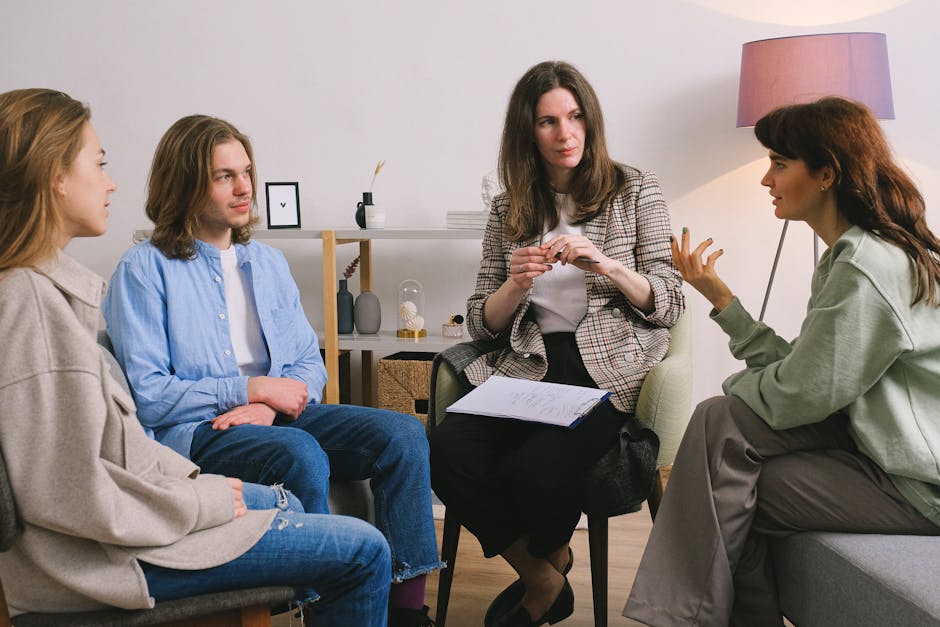
Our interdisciplinary team of psychiatrists, therapists, nurses, and case managers guides you through this schedule, ensuring comprehensive care.
Who Benefits Most from a PHP?
A mental health PHP program is ideal for individuals who need intensive support but don’t require 24-hour supervision. You might be a good candidate if you:
- Experience severe symptoms: Including major depression, anxiety, PTSD, bipolar disorder, OCD, or co-occurring substance use disorders.
- Are not progressing in weekly therapy: If your symptoms persist or worsen despite consistent outpatient therapy, a PHP offers the intensity needed to break through.
- Are at risk of hospitalization: PHP can be an alternative to inpatient care if you are medically stable and have a safe home environment. It also serves as a step-down from inpatient treatment.
- Require daily structure and support: The structured environment helps you regain control and build essential life skills.
- Need medication monitoring: PHP provides regular contact with psychiatry providers for medication management and adjustments.
At Thrive Mental Health, we conduct a thorough assessment to determine if a mental health PHP program is the right fit for you.
Related: Understanding Suicidal Ideation
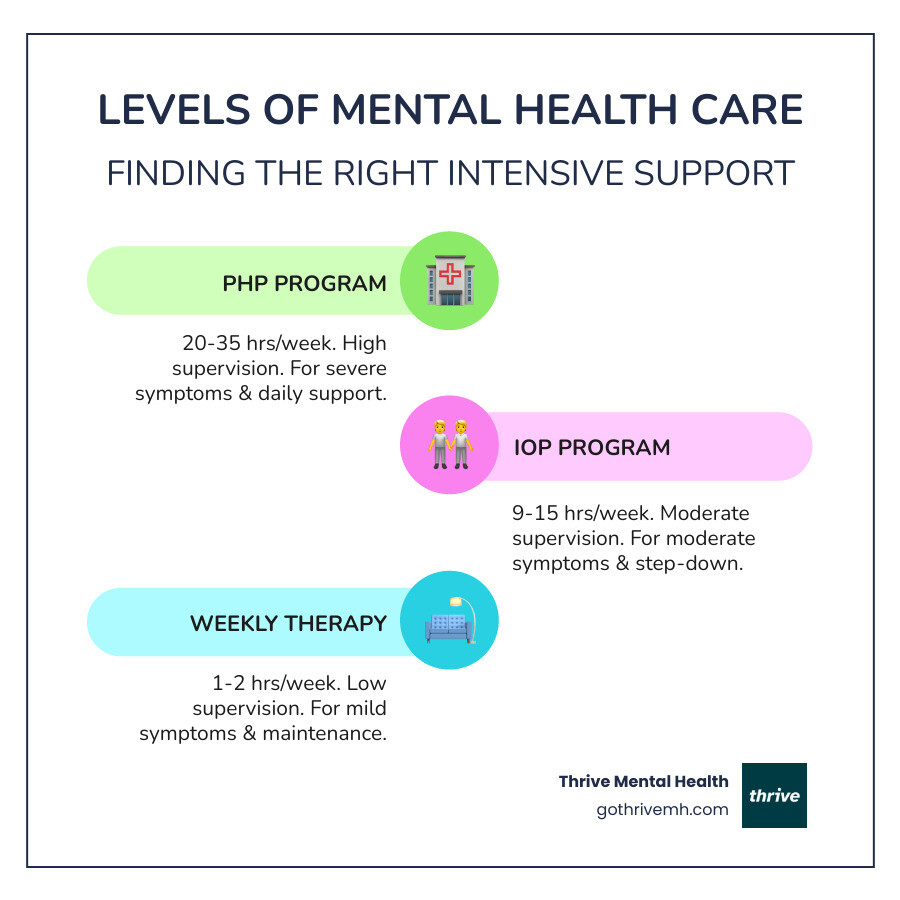
PHP vs. IOP vs. Weekly Therapy: Which Is Right for You?
Navigating the landscape of mental health treatment options can feel overwhelming. Beyond traditional weekly therapy, there are more intensive programs like Partial Hospitalization Programs (PHPs) and Intensive Outpatient Programs (IOPs). Understanding the differences is key to choosing the path that best suits your needs. At Thrive Mental Health, we offer a continuum of care to ensure you find the right level of support.
Here’s a snapshot comparing these common treatment modalities:
| Level | Hours/Week | Supervision | Cost/Day | Best For |
|---|---|---|---|---|
| PHP | 20-35 | High | $350, $750 | Severe symptoms, daily support |
| IOP | 9-15 | Moderate | $200, $500 | Moderate symptoms, step-down |
| Weekly Therapy | 1-2 | Low | $100, $250 | Mild symptoms, maintenance |
PHP vs. IOP: What’s the Real Difference?
While both PHPs and IOPs offer more structured and frequent treatment than weekly therapy, they differ significantly in intensity, time commitment, and the level of support provided. Choosing between a mental health PHP program and an IOP often comes down to the severity of your symptoms, your need for structure, and your ability to function independently.
- Time Commitment: This is arguably the most apparent difference. A mental health PHP program requires a substantial time commitment, typically 20-35 hours per week, often attending 5 days a week for 4-8 hours each day. In contrast, an Intensive Outpatient Program (IOP) involves less time, usually 9-15 hours per week, spread across 3-5 days for 2-4 hours per day.
- Intensity and Clinical Oversight: PHPs are designed for a higher level of care. They offer a more structured daily schedule and more comprehensive support, often including more frequent access to medical professionals like psychiatrists for medication management and nurses for monitoring. This higher staff-to-patient ratio and increased medical oversight make PHP ideal for those with more acute symptoms. IOPs, while still structured, provide a bit more flexibility and less frequent medical oversight, focusing more on coping strategies and life skills.
- Cost: Due to the increased intensity, longer hours, and higher level of clinical supervision, PHP programs are generally more expensive than IOPs. Daily costs for PHP can range from $350, $750, while IOPs might range from $200, $500 per day. However, it’s crucial to remember that both are often covered by major insurance plans, making them accessible options.
IOPs are often a step-down option after completing a PHP, or they can be an entry point for individuals who need more than weekly therapy but don’t require the full intensity of a PHP. Our IOP Services at Thrive are designed to provide that crucial intermediate level of care, allowing you to maintain your daily responsibilities while continuing your recovery journey.
Why Not Inpatient? The Power of Freedom + Structure
When facing significant mental health challenges, the idea of inpatient hospitalization often comes to mind. Inpatient treatment provides 24/7 supervision, a highly restrictive environment, and is typically reserved for severe crises where round-the-clock medical and psychiatric care is essential. While life-saving in acute situations, it comes with a high cost, significant disruption to your life, and can feel isolating.
This is where a mental health PHP program truly shines. It offers a powerful alternative by providing intensive, structured treatment during the day, but with the invaluable freedom to return home each night. This model allows you to:
- Practice skills in the real world: You learn new coping mechanisms, communication skills, and emotional regulation techniques in a supportive clinical setting, then immediately apply them in your daily life. This real-world practice is vital for sustainable recovery.
- Maintain your life, job, or family commitments: Unlike inpatient care, PHP allows you to stay connected to your responsibilities. Many individuals find ways to manage part-time work or school, continue parenting, and engage with their support systems, preventing the profound disruption that hospitalization can cause.
- Experience healing without isolation: Being able to go home each evening fosters a sense of normalcy and connection that is often lost in inpatient settings. You can lean on your family and friends for support, strengthening those bonds while still receiving expert clinical care.
- Reduce the risk of readmission: PHPs are often an ideal step-down from inpatient care. They provide the necessary support to solidify gains made in a hospital setting and prevent relapse, acting as a crucial bridge back to independent living.
At Thrive, we believe in empowering you to heal without completely putting your life on hold. Our mental health PHP program offers a unique balance of intensive clinical support and personal freedom, helping you build a sustainable foundation for long-term wellness.

What to Expect in a PHP Program: Real Results, Real Support
When you enroll in a mental health PHP program at Thrive, you commit to a holistic recovery journey designed for real results. From day one, you’ll receive a custom care plan based on a thorough assessment of your history and goals, with daily progress tracking to ensure your treatment remains effective.
Our interdisciplinary team is the backbone of our program and includes:
- Board-Certified Psychiatrist: For medication management and diagnosis.
- Licensed Therapists: To lead individual and group therapy using evidence-based methods.
- Nurses: For medical monitoring and support.
- Case Managers: To coordinate care and connect you with community resources.
This team works together to provide integrated treatment using proven therapies like:
- Cognitive Behavioral Therapy (CBT): To change negative thought patterns and behaviors.
- Dialectical Behavior Therapy (DBT): To improve emotional regulation, distress tolerance, and mindfulness.
- Medication Management: With regular psychiatric oversight to optimize your regimen.
- Family Therapy: To educate loved ones and foster a supportive home environment.
- Experiential Therapies: Such as art, music, or yoga to promote self-expression and well-being.
Studies consistently show that PHPs reduce psychiatric symptom severity and improve quality of life, relationships, and physical health.
Pros and Cons: Is a PHP Program Worth It?
Understanding the benefits and drawbacks of a mental health PHP program can help you decide if it’s the right choice.
 Effective BPD Therapy Treatment OptionsMental Health
Benefits of a Mental Health PHP Program:
- Intensive Support, Retain Freedom: Get daily clinical care while returning home each night, maintaining a sense of normalcy.
- Real-Life Skill Practice: Immediately apply new coping skills in your daily life, which is vital for long-term success.
- Peer Support and Community: Connect with others who understand your struggles in a supportive group setting, reducing isolation.
- Cost-Effective Alternative: PHP is generally less expensive than inpatient hospitalization and is often covered by insurance.
- Improved Quality of Life: Research shows PHPs lead to significant reductions in symptoms and improved daily functioning.
Potential Drawbacks of a PHP Program:
- Significant Time Commitment: The schedule requires 20-35 hours per week, which can be hard to balance with full-time work or school.
- Disruption to Daily Life: You may need to take a leave of absence or adjust your commitments during the program.
- Not for Acute Crisis: PHP is not suitable for individuals who need 24/7 medical supervision, are in an unsafe home environment, or require medical detox.
For many, the benefits of intensive, real-world healing far outweigh the challenges, making a mental health PHP program a transformative experience.
Getting Started: Admission, Cost, and Insurance [Florida]
Taking the first step toward intensive treatment can feel daunting, but at Thrive Mental Health, we make the process as straightforward as possible at our Florida locations.
How to Get Admitted into a PHP:
The admission process for our mental health PHP program involves a few key steps:
- Initial Contact: Reach out for a no-obligation consultation.
- Clinical Evaluation: A mental health professional will conduct an assessment to determine if PHP is the right level of care for you.
- Insurance Verification: We help you steer your insurance coverage early to clarify benefits and any out-of-pocket costs.
- Fast Admission: Once eligibility is confirmed, we aim for admission within 24-48 hours. We know that getting support quickly is crucial.
Typical Duration and Cost:
The duration of a mental health PHP program varies but typically lasts 2 to 6 weeks. Some intensive models have a length of stay around 10 weekdays. Daily cost can range from $350, $750, which is often more cost-effective than inpatient hospitalization and is frequently covered by insurance.
How Insurance Typically Covers PHP Services:
Most major health insurance plans in Florida cover PHP services, including providers like Cigna, Optum, and Florida Blue. The Affordable Care Act (ACA) classifies mental health care as an essential health benefit, so most plans must provide coverage.
Our team at Thrive Mental Health will verify your insurance benefits and provide an estimated cost. To make this easier, you can Verify Your Insurance in 2 Minutes on our website with no obligation. We are committed to making treatment accessible through our virtual and in-person programs.
FAQs: Mental Health PHP Program [People Also Ask]
Can I work or go to school during PHP?
While a mental health PHP program offers the flexibility to return home each evening, it requires a significant time commitment of 20-35 hours per week. This intensive schedule often makes it challenging to maintain full-time work or school responsibilities. Some individuals may be able to manage part-time commitments, especially with virtual or evening program options, but most find it necessary to reduce or pause their work/school obligations to fully engage in treatment. We encourage you to discuss your specific situation with our team during your assessment to explore the best way to balance your recovery with other responsibilities. Explore our Virtual Therapy at Thrive options for more flexibility.
Is virtual PHP as effective as in-person?
Yes, absolutely. The COVID-19 pandemic significantly accelerated the adoption and refinement of virtual mental health programs, including PHP. Studies have shown that virtual PHP can be just as effective as in-person programs, offering comparable or even improved outcomes. For instance, research indicates that virtual PHP services proved effective during the COVID-19 pandemic, with attendance rising from 84.5% to 89.5%, hospitalization rates dropping from 16.5% to 8.9%, and 74.3% of patients reporting condition improvement. Studies show virtual PHP can match in-person results, with high attendance and strong outcomes. Virtual programs offer the added benefits of convenience, reduced travel time, and the ability to receive intensive care from the comfort of your own home, making them an excellent option for many.
What happens after I finish PHP?
Completing a mental health PHP program is a significant milestone, but it’s just one step in your ongoing recovery journey. At Thrive, we emphasize continuity of care and comprehensive aftercare planning to ensure your progress is sustained. After completing PHP, the typical next step is to transition to a less intensive level of care, such as an Intensive Outpatient Program (IOP) or traditional weekly outpatient therapy. Your treatment team will work with you to develop a personalized aftercare plan, which might include:
- Stepping down to an IOP for continued structured support.
- Individual therapy sessions with a therapist.
- Participation in support groups.
- Ongoing medication management with a psychiatrist.
- Connection to community resources.
This custom plan helps you integrate the skills learned in PHP into your daily life and provides ongoing support to prevent relapse and maintain your well-being.
How fast can I start a PHP program?
We understand that when you’re ready for help, you need it quickly. At Thrive Mental Health, we strive to make the admission process efficient. Most individuals can start a mental health PHP program within 1-2 days after completing their initial assessment and having their insurance benefits verified. Our team is dedicated to streamlining this process, ensuring you can access the intensive support you need without unnecessary delays.
Does insurance cover PHP?
Yes, in most cases. A mental health PHP program is considered a medically necessary treatment, and the majority of major health insurance plans in Florida provide coverage. This includes leading providers such as Cigna, Optum, Florida Blue, and many others. We recommend verifying your specific benefits, as coverage can vary based on your plan’s deductible, co-pay, and coinsurance. Our admissions team at Thrive can assist you with a no-obligation insurance verification to help you understand your coverage and any potential out-of-pocket costs.
Summary: Why a Mental Health PHP Program at Thrive Can Change Your Life
When weekly therapy isn’t enough and inpatient care feels too extreme, a mental health PHP program at Thrive Mental Health offers a powerful solution. We provide intensive, expert-led support during the day, empowering you to stabilize symptoms, build coping skills, and practice them in your real-world environment, all while returning home each night.
Our programs in Florida combine clinical expertise with measurable results. If you’re struggling with severe depression, anxiety, PTSD, or other conditions, a PHP can bridge the gap, helping you recover faster while staying connected to your life.
Related: How to Know If You Need More Than Therapy
Ready for support? Thrive offers virtual IOP programs with evening options. Verify your insurance in 2 minutes (no obligation) or call 561-203-6085. If you’re in crisis, call/text 988.
If you’re in crisis, call/text 988 right now. You are not alone.

This article is for informational purposes only and is not a substitute for individualized clinical advice or insurance verification.