
IOPs That Work: A Deep Dive into Evidence-Based Treatment

Why Most Mental Health Treatment Fails (and How Evidence-Based IOPs Succeed)
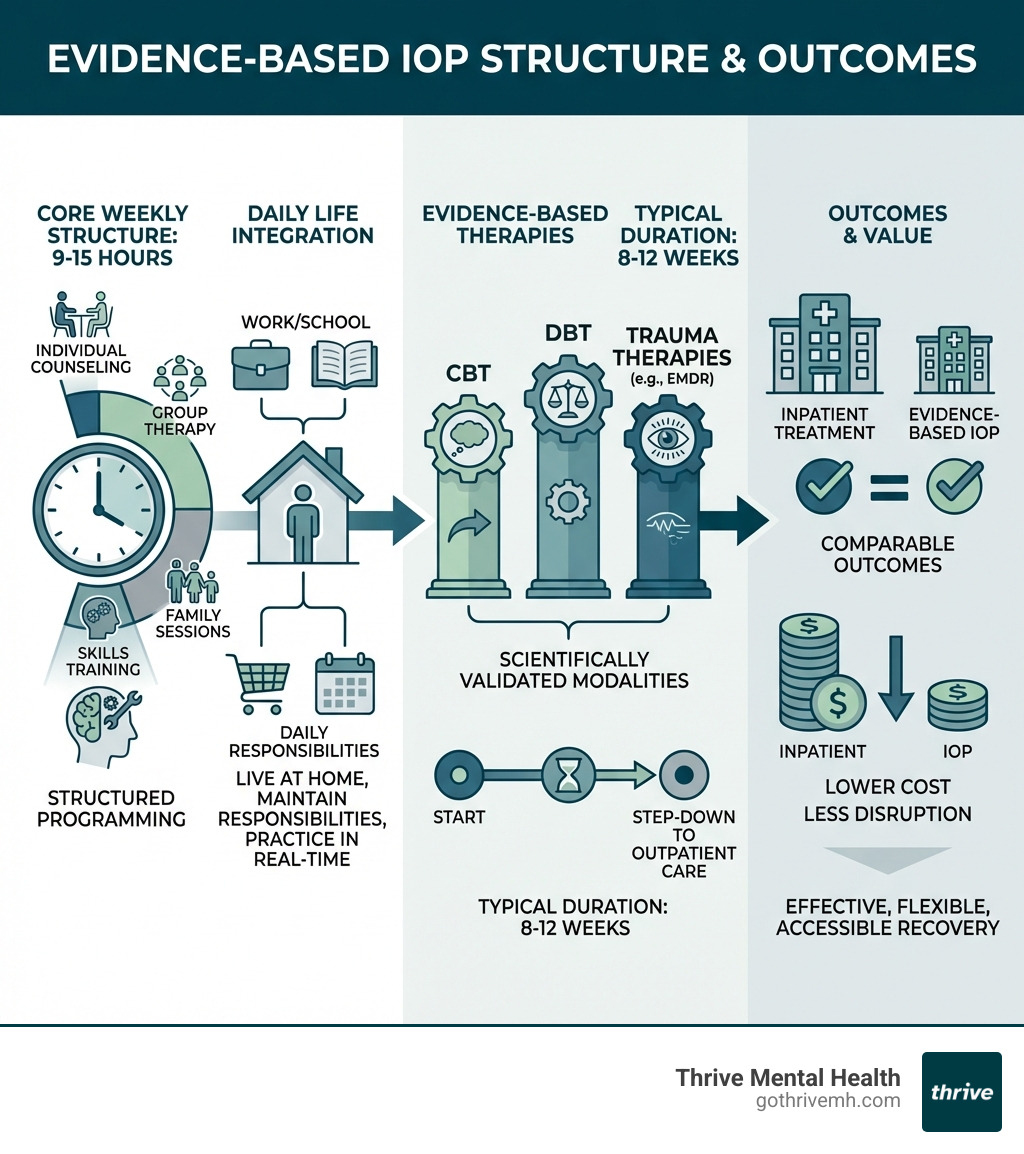
Evidence based IOP is an Intensive Outpatient Program that uses scientifically validated treatment methods proven to deliver measurable results for mental health and substance use disorders. Unlike traditional therapy, evidence-based IOPs provide 9-15 hours of structured clinical care per week while you continue living at home—combining the intensity of residential treatment with the flexibility of outpatient care.
Quick Answer: What Makes an IOP “Evidence-Based”?
- Scientifically validated therapies (CBT, DBT, EMDR) backed by peer-reviewed research
- Structured programming with 9-15 hours of clinical contact per week
- Measurable outcomes tracked through standardized assessments
- Licensed clinicians trained in specific therapeutic modalities
- Integrated treatment for co-occurring mental health and substance use disorders
- Flexibility to maintain work, school, and family responsibilities
- Outcomes comparable to inpatient care at nearly half the cost
The treatment gap is real. Weekly therapy isn’t enough when you’re drowning in depression, spiraling with anxiety, or trapped in active addiction. But taking a month off for inpatient treatment? That’s not realistic when you have a job to keep, classes to attend, or a family counting on you.
This is where most people get stuck—and where most treatment systems fail them.
Traditional outpatient therapy meets once a week, maybe twice. That’s 2-3 hours of support while you’re trying to manage 168 hours of life. Research shows that for moderate to severe symptoms, weekly therapy simply isn’t intensive enough to create lasting change. You learn a skill on Tuesday, then spend six days white-knuckling it until your next session.
Inpatient or residential care offers round-the-clock support, but requires stepping away from everything—your job, your routine, your support system. For many people, that’s not just impractical. It’s impossible. And when treatment is inaccessible, people don’t get better. They get worse.
Evidence based IOP programs bridge this gap. They deliver the clinical intensity of inpatient treatment—multiple sessions per week, integrated therapies, comprehensive care—without requiring you to put your life on hold. You attend structured programming for 9-15 hours weekly, then practice what you’ve learned in real-time, in your actual environment, with the safety net of ongoing clinical support.
The research is clear: for most individuals with substance use disorders or mental health conditions who don’t require 24-hour medical supervision, IOPs achieve outcomes comparable to residential services—with significantly lower costs, less disruption, and the ability to build sustainable recovery skills in the environment where you actually live.
But not all IOPs are created equal. The term “evidence-based” isn’t just a marketing phrase. It’s a promise that the treatments you’ll receive have been rigorously tested, scientifically validated, and proven to work.
I’m Nate Raine, CEO of Thrive Mental Health, and I’ve spent over a decade building healthcare systems that integrate clinical excellence with data-driven outcomes. At Thrive, we’ve designed our evidence based IOP programs to deliver measurable results for individuals, families, and organizations across Florida.
What “Evidence-Based” Actually Means (and Why You Should Demand It)
When we talk about an Intensive Outpatient Program (IOP), we’re referring to a structured form of outpatient care that provides a higher level of support than traditional weekly therapy. Typically, participants engage in 9 to 15 hours of clinical programming per week, allowing them to live at home, maintain their daily responsibilities, and integrate newly learned coping skills into their real-world environment.
But what lifts an IOP from simply “intensive” to truly “evidence-based”? It means the treatment methods employed have been rigorously tested through scientific research, proving their effectiveness in producing positive, measurable outcomes. It’s not just about “talk therapy” or well-intentioned advice; it’s about interventions that have a track record of success.
The Substance Abuse and Mental Health Services Administration (SAMHSA) is a key resource in defining and promoting evidence-based practices. They emphasize that such practices are interventions that have been rigorously tested through controlled research studies, demonstrating measurable effectiveness. This commitment to scientific validation ensures that the care we provide is the “gold standard” for addiction and mental health treatment.
As research published in PMC indicates, evidence-based IOPs are recognized for their direct services to individuals with substance use disorders or co-occurring mental and substance use disorders who don’t require medical detoxification or 24-hour supervision. This approach is a critical part of the continuum of care, delivering impactful treatment while allowing individuals to remain connected to their lives. You can find More info about Intensive Outpatient Programs on our site.
The Core Components of a Successful Evidence-Based IOP
A truly successful evidence based IOP isn’t just a collection of therapy sessions; it’s a carefully constructed program designed to address all facets of an individual’s well-being. At Thrive, we ensure our programs are built upon a foundation of proven components:
- Comprehensive Assessment: Before any treatment begins, we conduct a thorough evaluation to understand your unique needs, history, and goals. This includes assessing for co-occurring mental health conditions, which are common among individuals seeking IOP care.
- Individualized Treatment Plan: Based on your assessment, we develop a personalized plan that outlines specific therapeutic goals and the modalities best suited to help you achieve them. This ensures your treatment is custom, not one-size-fits-all.
- Licensed Clinicians: Our programs are led by a multidisciplinary team of highly qualified and licensed professionals, including therapists, counselors, and psychiatrists. Their expertise ensures you receive care that is both compassionate and clinically sound.
- Individual Therapy: One-on-one sessions provide a safe space to dig deeper into personal challenges, process emotions, and develop individualized coping strategies.
- Group Therapy: Group sessions are a cornerstone of IOP, offering peer support, shared experiences, and the opportunity to practice new skills in a supportive community. This environment is crucial for reducing feelings of isolation and fostering a sense of belonging.
- Family Involvement: Where appropriate, we encourage family participation through psychoeducation and counseling. Research consistently shows that engaging families can significantly improve treatment outcomes and create a stronger support system.
- Medication Management: For many, medication plays a vital role in stabilizing symptoms and supporting recovery. Our programs integrate psychiatric evaluation and ongoing medication management when indicated, ensuring a holistic approach to care.
- Aftercare Planning: Recovery is a journey, not a destination. A successful IOP prepares you for life post-program with a robust aftercare plan, connecting you with ongoing resources, support groups, and less intensive levels of care as needed.
How an Evidence-Based IOP Differs from Other Care
Understanding the different levels of mental health and addiction care can be confusing. An evidence based IOP occupies a unique and vital space within the continuum of treatment, offering a middle ground between traditional outpatient therapy and more restrictive residential or inpatient programs.
Here’s a comparison to help clarify where IOPs fit:
| Feature | Traditional Outpatient Therapy | Intensive Outpatient Program (IOP) | Partial Hospitalization Program (PHP) | Residential Treatment (Inpatient) |
|---|---|---|---|---|
| Time Commitment | 1-2 hours/week | 9-15 hours/week | 20-30+ hours/week | 24/7 (live-in) |
| Living Situation | Lives at home | Lives at home | Lives at home or in sober living | Lives at facility |
| Clinical Intensity | Low | Moderate to High | High | Very High |
| Ideal Candidate | Mild symptoms, stable support | Moderate-severe symptoms, needs structure but can function at home | Severe symptoms, needs daily structure, not safe to be alone for long periods | Acute crisis, unsafe at home, needs medical supervision |
| Cost-Effectiveness | High | Very High | High | Moderate |
As you can see, an IOP provides significantly more support and structure than weekly therapy, without the complete disruption of residential care. This makes it an incredibly cost-effective and practical option for many. For a deeper dive into the differences, explore our guide on PHP vs IOP.
The Therapies That Drive Real Results in an IOP

The heart of any evidence based IOP lies in the therapeutic modalities it employs. We don’t just offer therapy; we offer effective therapy – interventions proven by science to foster healing and build resilience. This often involves an integrated treatment approach, especially crucial for individuals with co-occurring mental health conditions and substance use disorders. We combine various modalities to create a comprehensive, individualized treatment experience. To learn more about common therapy types, check out A Guide to Common Types of Therapy and Their Uses.
Cognitive Behavioral Therapy (CBT)
Cognitive Behavioral Therapy (CBT) is one of the most widely used and extensively researched evidence-based therapies. It’s built on the principle that our thoughts, feelings, and behaviors are interconnected. In an IOP setting, CBT helps you:
- Identify negative thought patterns: We’ll work together to recognize the automatic negative thoughts that contribute to distress or unhealthy behaviors.
- Challenge cognitive distortions: You’ll learn to question and reframe unhelpful or irrational thoughts, replacing them with more balanced and realistic perspectives.
- Behavioral experiments: We’ll guide you through practical exercises to test your beliefs and practice new behaviors in real-world situations.
- Skill-building for coping: CBT equips you with concrete coping skills to manage stress, anxiety, depression, and cravings.
A large body of evidence demonstrates CBT’s efficacy for treating both substance use disorders and a wide range of mental health conditions. It’s a cornerstone of our approach to empowering you with tools for lasting change. Find more about The Benefits of CBT in Mental Health Treatment.
Dialectical Behavior Therapy (DBT)
Developed to treat Borderline Personality Disorder, Dialectical Behavior Therapy (DBT) has proven remarkably effective for individuals struggling with intense emotions, self-harm, and interpersonal difficulties. Within an IOP, DBT focuses on teaching four core skill sets:
- Emotional regulation skills: Learning to identify, understand, and manage intense emotions without being overwhelmed by them.
- Distress tolerance: Developing strategies to cope with painful emotions and difficult situations without resorting to destructive behaviors.
- Interpersonal effectiveness: Improving communication skills to build healthier relationships, assert needs, and steer conflicts effectively.
- Mindfulness: Practicing present-moment awareness to reduce judgment and increase acceptance.
For those in trauma treatment, DBT’s emphasis on building skills in emotional regulation and distress tolerance is incredibly helpful, providing practical tools to steer intense emotions. Explore The Ultimate List of DBT Skills for Emotional Mastery.
Other Powerful Modalities
Beyond CBT and DBT, our evidence based IOPs integrate other powerful, scientifically-backed therapeutic approaches, customized to your needs:
- Eye Movement Desensitization and Reprocessing (EMDR): Highly effective for processing traumatic memories, EMDR uses bilateral stimulation (like eye movements) to help the brain reprocess distressing experiences, reducing their emotional impact. This is particularly valuable for trauma survivors. Learn more about this modality at Treatment Modalities: Virtual IOP/Eye Movement Desensitization and Reprocessing (EMDR).
- Motivational Interviewing (MI): This collaborative, goal-oriented approach helps individuals explore and resolve ambivalence about change, strengthening their motivation to pursue recovery goals.
- Art Therapy: Engaging in creative expression can be a powerful way to process emotions, reduce stress, and gain self-awareness, especially for those who find it difficult to articulate their experiences verbally.
- Somatic Experiencing: This therapy focuses on the body’s physiological responses to trauma, helping individuals release stored tension and regulate their nervous system.
- Family Therapy: Addiction and mental health issues impact the entire family system. Family therapy helps improve communication, resolve conflicts, and create a more supportive home environment.
The Proof Is in the Data: Success Rates and Outcomes

At Thrive Mental Health, we don’t just believe in our programs; we prove their effectiveness. The power of an evidence based IOP is not just in its philosophy but in its measurable results. We are committed to clinical excellence and data-driven outcomes, ensuring that the care you receive is truly making a difference.
Research consistently demonstrates that intensive outpatient programs utilizing evidence-based therapies achieve outcomes comparable to more intensive inpatient treatment settings while offering significant advantages in terms of cost-effectiveness and quality of life. A comprehensive review published in Psychiatric Services highlights this parity in effectiveness.
Key outcomes associated with evidence-based IOPs include:
- Reduced Symptoms of Depression and Anxiety: Participants often experience significant reductions in the severity of mental health symptoms, leading to improved mood, reduced worry, and a greater sense of well-being.
- Increased Abstinence for Substance Use Disorders: For individuals struggling with addiction, IOPs lead to higher rates of sustained sobriety by equipping them with relapse prevention skills and a strong support network.
- Improved Daily Functioning: Beyond symptom reduction, successful IOPs help individuals regain their ability to manage daily tasks, maintain healthy relationships, perform effectively at work or school, and engage in meaningful activities.
- Cost-Effectiveness: SAMHSA research indicates that IOPs are a highly cost-effective approach to addiction treatment, delivering significant value to both individuals and healthcare systems by providing intensive therapy without the high costs of residential care.
- Addressing Co-occurring Conditions: One of the most significant advantages is the capacity to address co-occurring mental health conditions alongside substance use disorders. Many individuals seeking addiction treatment also struggle with depression, anxiety, PTSD, or other mental health challenges. Evidence-based IOPs provide integrated treatment that addresses both simultaneously, significantly improving outcomes and reducing relapse likelihood.
The critical role of aftercare and continued support cannot be overstated. IOPs are most effective when they are part of a continuum of care, often serving as a step-down from more intensive settings or a step-up from less intensive services. Our programs carefully plan for your next steps after IOP completion, ensuring you have ongoing resources, mutual-help group connections (like AA or Smart Recovery, both widely recognized community-based supports), and strategies for long-term relapse prevention. We believe that continuity of care over a long duration is a critical factor in treatment success.
How to Find an Evidence-Based IOP That Fits Your Life [Checklist]
Choosing the right Intensive Outpatient Program is a crucial step toward healing. With so many options available, know how to identify a truly evidence based IOP and avoid programs that might promise much but deliver little. The rise of virtual IOPs, like those offered by Thrive Mental Health in Florida, has expanded access significantly, making quality care available anywhere, anytime. Our Guide to Finding the Best Virtual IOP Options offers even more insights.
Questions to Ask Before You Commit
When evaluating an IOP, we encourage you to be an informed consumer. Don’t hesitate to ask direct questions that get to the heart of their approach:
- What specific evidence-based practices do you use, and how are they integrated into the program? Look for programs that can clearly articulate their use of CBT, DBT, EMDR, Motivational Interviewing, and other proven modalities, and explain how these therapies will be applied to your specific needs.
- Are your clinicians licensed, and what are their qualifications and experience in the specific conditions you treat? Ensure the staff are appropriately credentialed and have expertise in treating your primary concerns, whether it’s depression, anxiety, trauma, or substance use disorders.
- How do you measure progress and outcomes? A quality evidence-based program should have clear metrics for tracking your improvement, such as symptom reduction scales or abstinence rates.
- What is the staff-to-client ratio, and how much individualized attention can I expect? A lower ratio often indicates more personalized care.
- What does aftercare look like, and how will you support my long-term recovery after the IOP concludes? A robust aftercare plan is a hallmark of a successful program, demonstrating a commitment to your sustained well-being.
Navigating Insurance and Financing
We understand that the cost of treatment is a significant concern for many. The good news is that the Mental Health Parity and Addiction Equity Act (MHPAEA) of 2008 generally requires health insurance plans to provide mental health and substance use disorder benefits that are no more restrictive than medical and surgical benefits. This means that if your plan covers medical care, it should also cover mental health and addiction treatment, including IOPs.
At Thrive Mental Health, we work with a wide range of insurance providers, including major carriers like Cigna, Aetna, UnitedHealthcare, and Florida Blue (in Florida, of course!). Many of our programs are covered as in-network benefits, which can significantly reduce your out-of-pocket costs. We also understand that navigating in-network vs. out-of-network benefits can be complex, and our team is here to help you verify your coverage and understand your financial responsibilities.
We believe that financial considerations should never be a barrier to accessing life-changing care. For residents in Florida, we strive to make our evidence based IOPs as accessible as possible. If you’re worried about financing, we encourage you to explore your options. You can learn more about verifying your benefits on our Virtual IOP Insurance page.
Frequently Asked Questions about Evidence-Based IOPs
How long does an IOP program typically last?
Answer: Most IOPs last 8-12 weeks, but the duration is based on individual progress and clinical need. The goal is to step down to a lower level of care, like weekly therapy, once you’ve met your treatment goals.
Can I keep my job or attend school during an IOP?
Answer: Yes. That’s a primary benefit of an IOP. Programs, especially virtual ones, offer flexible scheduling, including evening options, to accommodate work, school, and family responsibilities.
Is an IOP just for substance abuse?
Answer: No. While effective for substance use disorders, evidence-based IOPs are also a primary treatment for mental health conditions like depression, anxiety, PTSD, bipolar disorder, and eating disorders, especially when symptoms are too severe for weekly therapy alone.
Your Next Step to Healing
Choosing an evidence based IOP is choosing a path to healing that is backed by science and designed for real-world success. We believe you shouldn’t have to choose between your life and your mental health. Our programs offer the intensive, structured support you need, delivered with the flexibility to integrate seamlessly into your daily life.
At Thrive Mental Health, we are dedicated to providing expert-led, virtual and hybrid IOP/PHP programs across Florida. Our commitment to evidence-based practices means you receive care that is proven to work, helping you achieve lasting recovery and a renewed sense of well-being.
If you’re in crisis, call/text 988 right now. You are not alone.
Ready for support? Thrive offers virtual and hybrid IOP/PHP programs with evening options. Verify your insurance in 2 minutes (no obligation) → Start benefits check or call 561-203-6085. If you’re in crisis, call/text 988.