


EMDR vs. Exposure Therapy: Which PTSD Treatment Will Actually Help You Heal Faster?
EMDR vs. exposure therapy are two of the most effective treatments for PTSD, but they heal trauma in fundamentally different ways. Both are backed by strong research and endorsed by top health organizations, delivering similar results. The best choice isn’t about which is “better”, it’s about which is a better fit for you, your life, and your recovery goals.
| Factor | EMDR | Exposure Therapy (PE) |
|---|---|---|
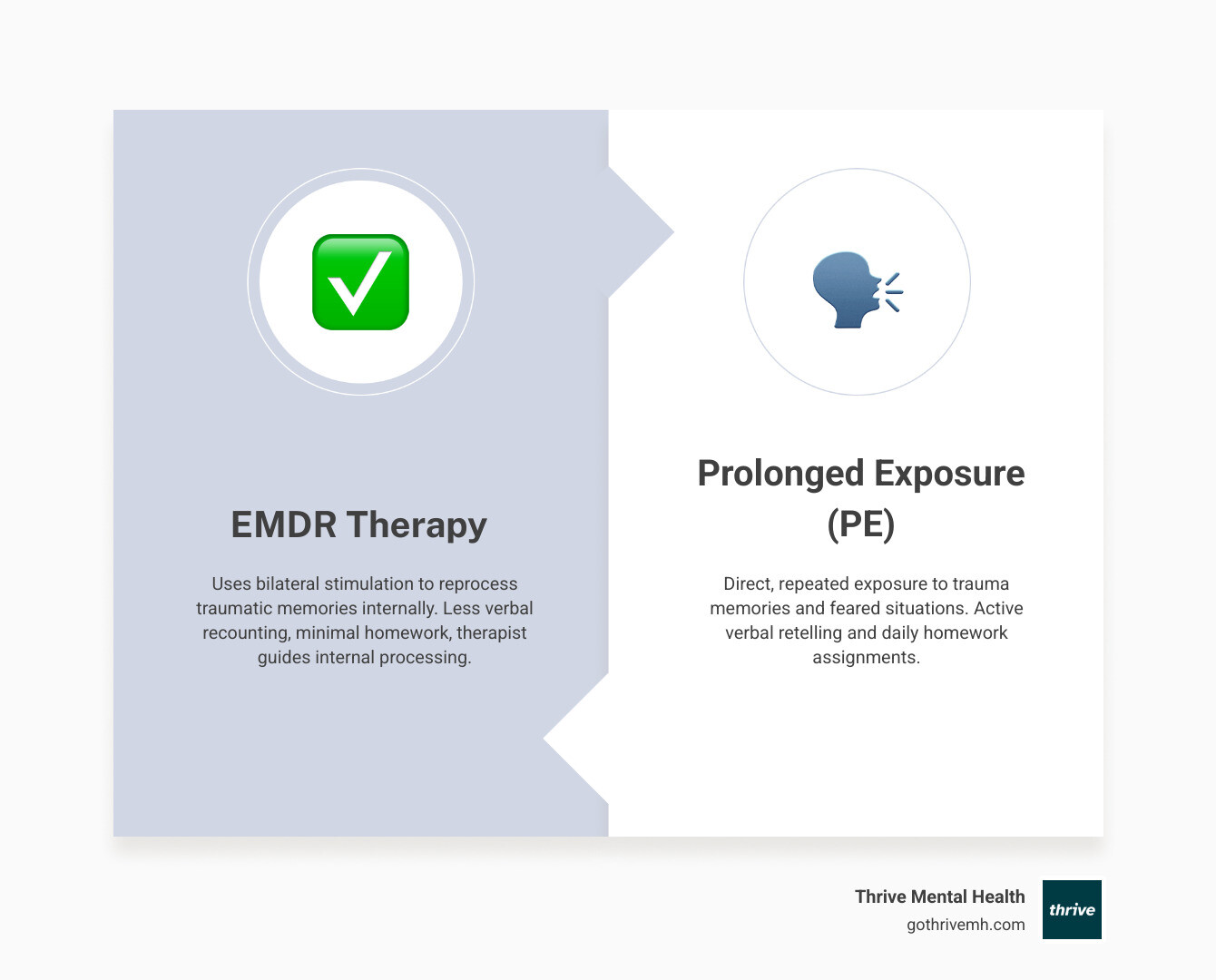
| Core Mechanism | Uses bilateral stimulation (eye movements, tapping) to reprocess traumatic memories internally | Uses direct, repeated exposure to trauma memories and feared situations |
| Session Focus | Internal processing with therapist as guide | Active verbal engagement and structured confrontation |
| Homework Load | Little to none | Daily assignments and exposure practice |
| Therapist Role | Guides processing, provides support | Guides exposure, provides psychoeducation |
| Typical Duration | 3-15 sessions | 8-15 sessions |
| Effectiveness | Highly effective, endorsed by APA/VA/WHO | Highly effective, endorsed by APA/VA/WHO |
EMDR works by stimulating your brain’s natural processing system while you hold traumatic memories in mind. You don’t have to describe every detail out loud. Instead, you follow bilateral stimulation (like watching a therapist’s finger move back and forth) while your brain does the heavy lifting internally.
Prolonged Exposure (PE) takes a different approach. You repeatedly recount your trauma in detail during sessions and gradually face trauma-related situations in real life. The goal is to break the connection between the memory and your fear response through direct, structured confrontation.
As the CEO of Thrive Mental Health, I’ve seen how both EMDR and exposure therapy help people recover from trauma in our Intensive Outpatient (IOP) and Partial Hospitalization (PHP) programs across Florida. Our mission is to make evidence-based trauma treatment accessible through flexible, expert-led care.
My goal is to give you a clear, evidence-based comparison so you can make an informed choice for your healing journey, and so you do not waste another six months in a treatment that does not match your needs.
What is EMDR? Opening Up Your Brain’s Natural Healing Process
Eye Movement Desensitization and Reprocessing (EMDR) is an evidence-based therapy designed to help you process distressing memories. Developed by Francine Shapiro, EMDR operates on the idea that trauma can get “stuck,” preventing your brain’s natural healing. EMDR uses bilateral stimulation (BLS), like rhythmic eye movements or tapping, to jumpstart this process, allowing memories to be properly stored without their emotional charge.
While you focus on a traumatic memory, the BLS helps your brain reprocess it, similar to what happens during REM sleep. This reduces the memory’s distress, turning it from a painful experience into a neutral narrative. A key feature is that you don’t need to describe your trauma in detail for it to work; you focus internally while your brain does the heavy lifting.
We offer trauma-focused virtual therapy, including EMDR, within higher levels of care like IOP and PHP so you can get consistent, structured support without putting your life on hold. Our programs are available to clients throughout Florida through secure online sessions and trusted local centers. This allows you to engage in transformative therapy from the comfort of your home or a nearby Thrive location. More info about our trauma-focused virtual therapy.

The 8 Phases of EMDR Therapy
EMDR follows a structured, eight-phase protocol to ensure a safe therapeutic journey:
- History Taking: We identify target memories, triggers, and future goals.
- Preparation: We build a trusting therapeutic relationship and teach you coping skills to manage emotional distress.
- Assessment: We pinpoint the target memory, its associated negative belief, emotions, and body sensations.
- Desensitization: The core processing phase. You focus on the memory while engaging in BLS, allowing your mind to make new connections until the distress decreases.
- Installation: We strengthen a positive belief, integrating it with the reprocessed memory.
- Body Scan: We check for any residual physical tension related to the memory and process it until you feel calm.
- Closure: Every session ends with grounding techniques to ensure you leave feeling stable.
- Re-evaluation: At the start of the next session, we check that the processing is stable and address any new material.
What an EMDR Session Actually Feels Like
An EMDR session is an internal journey. You will bring a traumatic memory to mind while your therapist guides you through sets of bilateral stimulation (eye movements, tones, or tapping). You are encouraged to let your mind free-associate, noticing any thoughts, feelings, or sensations that arise. The therapist checks in periodically, but the focus is on internal processing, not detailed verbal retelling.
Many clients in our virtual and in-person programs describe EMDR as intense but contained: the hardest work happens in the session, rather than in hours of homework afterward. Over time, the memory’s emotional charge tends to drop sharply, and it becomes something you can remember without feeling hijacked by panic, shame, or fear.
What is Prolonged Exposure (PE)? Facing Fear to Break Its Power
Prolonged Exposure (PE) is a highly effective cognitive behavioral therapy (CBT) for PTSD. Developed by Dr. Edna Foa, PE is based on the idea that avoiding trauma-related thoughts and situations maintains PTSD. By confronting them in a safe, controlled way, you can process the trauma and learn that these cues are not dangerous.
The goal of PE is to break the cycle of avoidance. By repeatedly facing traumatic memories and feared situations, you habituate to the distress and learn that your anxiety will naturally decrease. This process, known as emotional processing, helps you reclaim the parts of your life that trauma has taken away.
Thrive Mental Health integrates PE into our Intensive Outpatient (IOP) and Partial Hospitalization (PHP) programs when it is the right clinical fit. This means you get frequent sessions, coaching, and accountability so you are not doing the hardest exposure work alone between occasional appointments.

The Core Components: Imaginal and In Vivo Exposure
PE therapy consists of two main components:
- Imaginal Exposure: You will vividly and repeatedly recount the traumatic memory aloud in the present tense. These accounts are recorded for you to listen to daily, which helps you process the emotions and habituate to the distress.
- In Vivo Exposure: This involves gradually confronting real-life situations, places, or objects you avoid due to trauma. We create a fear hierarchy, and you work through it step-by-step, staying in each situation until your anxiety subsides.
By combining these two forms of exposure, PE helps you directly challenge the fear and avoidance that keep PTSD alive. Want to learn more about how we approach trauma-focused care? Read our blog post: What is trauma-focused therapy?.
The Role of Homework in PE
Homework is a critical component of PE where much of the real-world progress happens. Assignments include daily listening to your imaginal exposure recording and practicing in vivo exposure tasks from your fear hierarchy. Tracking your anxiety levels during these tasks is essential.
In an IOP or PHP setting, your treatment team helps you plan, troubleshoot, and review this homework multiple times per week, which can make the process more manageable and increase follow-through. Your commitment to this daily work is directly linked to the therapy’s success, empowering you to actively dismantle the avoidance patterns that fuel PTSD.
EMDR vs Exposure Therapy: The Ultimate Head-to-Head Comparison
When considering EMDR vs exposure therapy for PTSD, it is helpful to look at their distinct characteristics side-by-side. While both are highly effective, their mechanisms, session structures, and client experiences differ significantly.
| Factor | EMDR | Exposure Therapy (PE) |
|---|---|---|
| Core Mechanism | Uses bilateral stimulation (eye movements, tapping, sounds) to facilitate adaptive reprocessing of distressing memories. | Uses direct, repeated confrontation (imaginal and in vivo) with traumatic memories and feared stimuli to promote emotional processing and habituation. |
| Session Focus | Client focuses internally on target memory while engaging in BLS; therapist guides the process and checks in periodically. | Client actively verbalizes and recounts traumatic memory in detail; therapist provides psychoeducation and support; focuses on distress reduction. |
| Homework Load | Generally minimal between-session work, focusing more on stabilization or self-soothing techniques if needed. | High homework compliance is critical, including daily listening to session recordings and practicing in vivo exposure tasks. |
| Therapist Role | Facilitator of the client’s internal processing; less direct interpretation or cognitive restructuring. | Active coach and guide, providing direct instructions for exposure, challenging avoidance, and offering cognitive reframing. |
| Typical Duration | Can be shorter, with some clients experiencing significant relief in 3-5 processing sessions, though a full course often ranges from 6-12+ sessions. | Typically 8-15 weekly sessions, each lasting 60-90 minutes, with consistent homework. |
| Memory Processing | Targets the memory network, integrating it into adaptive information pathways without requiring full verbal detail. | Directly re-experiences the memory, allowing for new learning and reduction of fear associations through repeated engagement. |
| Client Experience | Can feel less verbally demanding; processing occurs internally, potentially leading to rapid shifts in perception and emotion. | Can be emotionally intense due to repeated recounting and direct confrontation; requires significant emotional tolerance during sessions and homework. |
| Avoidance Behaviors | Addresses avoidance as a symptom stemming from unprocessed memories; often reduces naturally as memories are reprocessed. | Directly targets and reduces avoidance behaviors through systematic exposure and habituation. |
How They Tackle Traumatic Memories
EMDR and PE approach traumatic memories differently. EMDR uses bilateral stimulation to help your brain reprocess the memory internally, often without needing to describe the trauma in detail. The goal is to integrate the memory into a more adaptive network.
In contrast, PE involves directly confronting the memory by repeatedly recounting it in vivid detail. This structured retelling helps you learn that the memory is not dangerous, reducing fear through habituation.
The In-Session Experience: What to Expect
The in-session experience for EMDR vs exposure therapy feels quite different.
- EMDR: More internal and reflective. You focus on a memory while the therapist guides you through bilateral stimulation, allowing your brain to do the work silently. Many people appreciate that they do not have to tell their story over and over out loud.
- PE: More verbally active. You will spend significant time recounting the trauma in detail, directly engaging with the distressing emotions in a structured way with your therapist as an active coach.
If you are in a higher level of care like IOP or PHP, you may combine these sessions with skills groups (for example, grounding, distress tolerance, or emotion regulation) so you have more tools to manage the intensity between appointments.
Time Commitment and Homework: A Key Difference in emdr vs exposure therapy
A major practical difference is the homework. PE requires a significant time commitment, including daily listening to session recordings and practicing real-world exposure tasks. This intensive homework is crucial for success.
EMDR, on the other hand, involves minimal between-session assignments. This lower homework load can be a deciding factor for those with busy schedules, caregiving responsibilities, or demanding careers in Florida cities like Miami, Tampa, Orlando, or Jacksonville who need therapy that fits around their lives.
Whichever you choose, a structured program like Thrive’s Intensive Outpatient Program can give you extra support, accountability, and measurable progress week by week.
The Evidence: Which Therapy Gets Better, Faster Results?
When it comes to treating PTSD, both EMDR vs exposure therapy stand out as highly effective, evidence-based interventions. The good news is that you do not have to choose between an effective and an ineffective treatment; both are rigorously supported by research.
What the Research Says About Efficacy
Research consistently shows that both EMDR and PE produce equivalent, significant improvements in PTSD severity, depression, and functioning, outperforming waitlist or usual care conditions. A key randomized controlled trial in JAMA Psychiatry confirmed these parallel outcomes. JAMA Psychiatry (Schnurr et al., 2007).
Another study found that for patients with comorbid PTSD, both PE and EMDR led to a significant loss of diagnosis (57% and 60%, respectively) compared to a waitlist (28%). Dropout rates and overall outcomes were similar, with both therapies showing strong positive effects.
 7 Effective Mental Health Treatment Options for Creative ProfessionalsMental Health
Furthermore, a comprehensive meta-analysis found no significant difference between EMDR and other psychological treatments in reducing PTSD symptoms, achieving remission, or treatment dropout rates. This reinforces that EMDR is on par with other gold-standard therapies. You can review an overview of the science here: Scientific research on PTSD treatment comparison.
Endorsements from Top Health Organizations
The robust evidence for both EMDR and PE has led to strong endorsements from leading professional organizations worldwide:
- The American Psychological Association (APA) guidelines list both PE and EMDR as strongly recommended treatments for PTSD.
- The Department of Veterans Affairs (VA) recommendations and Department of Defense (DoD) also include both therapies as first-line treatments.
- The World Health Organization (WHO) similarly endorses both, recognizing their efficacy for trauma recovery.
These endorsements mean that regardless of which therapy you choose, you are pursuing a treatment backed by extensive scientific research and clinical consensus.
Long-Term Remission and Relapse Rates
The goal of trauma therapy is not just short-term relief but lasting recovery. Both EMDR and PE demonstrate durable long-term outcomes. A 6-month follow-up study by Nijdam et al. (2012) found that clients in both therapy groups maintained significant improvements, with no statistical difference in relapse rates. Study by Nijdam et al. (2012). This pattern holds across multiple analyses: gains from both PE and EMDR tend to hold over time, equipping you with resilience long after treatment ends.
In a structured program like Thrive’s IOP or PHP, you also build daily routines, coping skills, and support systems that make it easier to maintain those gains once you step down to weekly therapy.
Which Is Right for You? Making the Best Choice for Your Recovery
Choosing between EMDR vs exposure therapy is not about which is “better,” but which is the best fit for you. The right choice depends on your personal preferences, symptoms, co-occurring conditions, and practical realities like time, energy, and support.
At Thrive Mental Health, we provide compassionate and effective trauma treatment through Intensive Outpatient (IOP), Partial Hospitalization (PHP), and virtual therapy. Our programs are available across Florida, with services in major areas like Tampa Bay, Miami, Orlando, and Jacksonville.
We work with major insurance providers like Cigna, Optum, and Florida Blue, and you can quickly check your benefits online: Verify your insurance.
Consider EMDR If…
- You prefer less homework or have a lifestyle that makes daily assignments challenging.
- You find the idea of verbally retelling your trauma in explicit detail too distressing or overwhelming.
- You are comfortable with a more internal, less verbally focused processing style.
- You respond well to somatic (body-based) and sensory-based interventions.
- You have physical limitations that make in vivo (real-life) exposure difficult.
Consider Exposure Therapy If…
- You prefer a highly structured, behavioral approach with clear, measurable steps.
- You are highly motivated and committed to completing daily homework assignments.
- You want to directly and systematically confront avoidance behaviors to break their power.
- You appreciate a therapy that provides a transparent rationale for how fear is reduced.
- You have a strong cognitive orientation and benefit from a direct, logical approach.
Important Considerations for emdr vs exposure therapy: Dissociation, C-PTSD, and Safety
Certain factors can influence your treatment plan:
- Complex PTSD (C-PTSD) and Dissociation: If you have C-PTSD or significant dissociative symptoms, a stabilization phase is crucial before processing trauma. EMDR’s gradual approach may be more tolerable for some, especially when combined with skills work in an IOP or PHP.
- Active Substance Use: Substance use typically must be addressed before starting deep trauma work, often in a structured program like an Intensive Outpatient Program (IOP) or Partial Hospitalization Program (PHP). This helps you build stability so trauma processing does not derail your recovery.
- Safety and Stability: A qualified therapist will first ensure you have a safe environment and adequate coping skills. Processing trauma requires a solid foundation.
The best choice is made in collaboration with a trained mental health professional who can assess your unique needs. If you are in Florida, our team can help you decide whether EMDR, PE, or a combination within a higher level of care is right for you.
Frequently Asked Questions about EMDR and Exposure Therapy
Is EMDR or exposure therapy faster?
Both are considered brief therapies, typically 8-15 sessions. EMDR may feel faster due to less homework and rapid in-session shifts, with some clients reporting significant relief in as few as 3-5 processing sessions. However, studies show their overall effectiveness and treatment duration are comparable for achieving PTSD remission.
In a structured IOP or PHP program, you may move through either approach more efficiently because you are engaging in therapy multiple days per week.
Which is more difficult, EMDR or exposure therapy?
“Difficulty” is subjective and highly dependent on individual tolerance and preference. PE can feel difficult due to direct, repeated recounting of the trauma and daily homework assignments that require confronting feared situations. EMDR can also bring up strong emotions, but the processing is often contained within the session and can feel less verbally demanding, which some clients find less overwhelming.
Do I have to talk about my trauma in detail?
In PE, yes, detailed, repeated retelling of the traumatic memory is a core component of imaginal exposure. In EMDR, you will identify the memory and its associated distress, but you do not need to provide a lengthy, detailed verbal account to the therapist for it to be effective. The processing is more internal.
Can I do these therapies if I have other mental health issues?
Yes, both are often used for clients with co-occurring conditions like depression or anxiety. However, for more severe issues such as active substance use, psychosis, or severe dissociative disorders, a stabilization phase is usually required first. This can be effectively done in a structured program like an Intensive Outpatient Program (IOP) or Partial Hospitalization Program (PHP) to build coping skills and ensure safety before beginning trauma-focused work.
Does insurance cover EMDR or exposure therapy at Thrive?
Many commercial plans, including Cigna, Optum, Florida Blue, and others, cover EMDR and PE when delivered within medically necessary levels of care like IOP or PHP. Coverage for our Florida-based services varies by plan, so the fastest way to know your costs is to verify your insurance online. Our team will review your benefits and walk you through your options.
Your Path Forward Starts with a Choice
Deciding between EMDR vs exposure therapy is a deeply personal choice, and there is no single “right” answer for everyone. Both are highly effective, evidence-based treatments that have helped countless individuals reclaim their lives from PTSD. The key lies in understanding their differences and finding the approach that matches your symptoms, personality, and capacity right now.
In simple terms:
- Choose EMDR if you want powerful, internal processing with less homework and less verbal detail.
- Choose PE if you want a highly structured, step-by-step plan to directly face and dismantle your fears.
At Thrive Mental Health, we believe in empowering you with informed choices. Our expert team in Florida is trained in various trauma-focused modalities and can help you steer this decision, ensuring you receive personalized care designed for real, lasting results.
You do not have to keep guessing or piecing together care on your own. Our virtual and in-person programs are built for people who need more than once-a-week therapy but do not need inpatient hospitalization.
Ready for support? Thrive offers virtual IOP programs with evening options. Verify your insurance in 2 minutes (no obligation) → Start benefits check or call 561-203-6085. If you’re in crisis, call/text 988.

This article is for informational purposes only and is not a substitute for individualized clinical advice or insurance verification.