





Why Choosing the Right Therapy Approach Matters
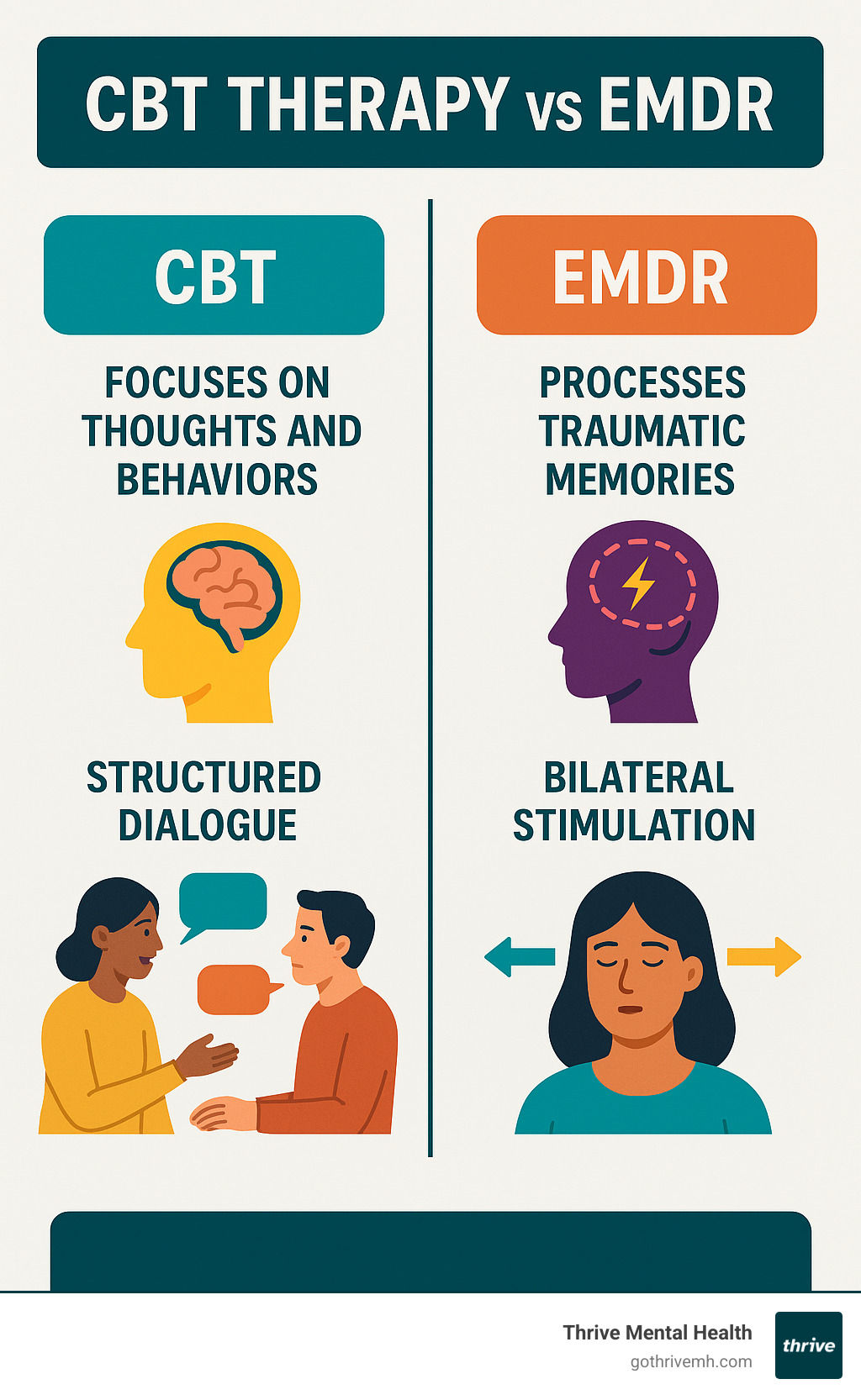
When comparing cbt therapy vs emdr, both approaches offer powerful evidence-based treatment for mental health conditions, but they work in fundamentally different ways:
| CBT (Cognitive Behavioral Therapy) | EMDR (Eye Movement Desensitization and Reprocessing) |
|---|---|
| Focuses on changing negative thought patterns and behaviors | Focuses on processing traumatic memories through bilateral stimulation |
| Involves structured talk therapy with homework | Requires minimal verbal discussion of trauma details |
| Typically 5-20 sessions | Often fewer sessions needed (6-12 sessions) |
| Best for anxiety, depression, OCD | Best for PTSD, trauma, and specific distressing memories |
| Active collaboration with therapist | Less emphasis on therapeutic relationship |
CBT therapy vs emdr effectiveness varies by condition. Research shows EMDR significantly outperforms CBT for reducing PTSD symptoms and anxiety in the short term, while both therapies show similar results for depression. However, CBT’s advantages may be more sustained over time.
The choice between these approaches often comes down to your specific needs, preferences, and the nature of your mental health challenges. Some people thrive with CBT’s structured, skill-building approach, while others prefer EMDR’s ability to process difficult memories without extensive discussion.
As someone who has led behavioral health innovation at Thrive Mental Health, I’ve seen how the right therapeutic approach can transform lives for individuals across Florida. My experience guiding evidence-based treatment programs has shown me that understanding cbt therapy vs emdr differences is crucial for making informed decisions about your mental wellness journey.
Common cbt therapy vs emdr vocab:
Understanding the Foundations: What Are CBT and EMDR?
When you’re ready to take that brave step toward healing, you’ll likely encounter two powerhouse therapies that have helped millions of people worldwide. CBT therapy vs EMDR represents two distinctly different yet equally valid paths to mental wellness. Think of it like choosing between two different routes to the same destination, both will get you there, but the journey looks quite different.
Both approaches are grounded in solid research and have earned their place as go-to treatments for various mental health conditions. They’re particularly effective for healing from trauma, though they work in completely different ways. Understanding these foundational differences will help you make the best choice for your unique situation.

What is Cognitive Behavioral Therapy (CBT)?
CBT operates on a beautifully simple yet profound idea: your thoughts, feelings, and behaviors are all connected. When one shifts, the others follow. It’s like a three-legged stool, if you strengthen one leg, the whole structure becomes more stable.
Developed by brilliant minds like Aaron Beck and Albert Ellis, CBT focuses on identifying those sneaky negative thought patterns that can trap us in cycles of distress. You know the ones, those automatic thoughts that pop up and make everything seem worse than it actually is. CBT helps you catch these thoughts in action and learn to challenge them.
The magic happens through something called cognitive restructuring. This is where you and your therapist work together like detectives, examining the evidence for and against your negative beliefs. It’s surprisingly empowering to realize that many of our most distressing thoughts simply aren’t based in reality.
CBT is wonderfully goal-oriented and structured. You’ll often get “homework” assignments, but don’t worry, they’re actually pretty interesting. Maybe you’ll track your mood patterns or practice a new coping skill. These exercises help you apply what you’re learning in real-world situations.
This approach shines brightest when treating anxiety disorders (including panic attacks and social anxiety), depression, obsessive-compulsive disorder, and even PTSD through specialized trauma-focused techniques. It’s also incredibly effective for eating disorders and substance abuse issues.
What makes CBT special is how it teaches you to become your own therapist over time. You’ll develop a toolkit of skills that you can use long after therapy ends. If you’re curious to learn more, check out our comprehensive guide on Cognitive Behavioral Therapy: What You Need to Know.
For Florida residents seeking this evidence-based approach, our programs offer flexible CBT Therapy in Florida that fits your schedule and lifestyle.
What is Eye Movement Desensitization and Reprocessing (EMDR)?
EMDR takes a completely different approach to healing. Created by Dr. Francine Shapiro in the late 1980s, this therapy is based on the Adaptive Information Processing model. Think of your brain as having a natural filing system for memories. Sometimes, traumatic experiences get “stuck” in the wrong file folder, causing them to feel as fresh and painful as the day they happened.
The core principle is fascinating: EMDR helps your brain reprocess these stuck memories so they can be properly filed away. This happens through something called bilateral stimulation, usually guided eye movements, though it can also involve sounds or gentle tapping.
Here’s what makes EMDR unique: you don’t have to talk extensively about your trauma. Instead, you’ll focus on the distressing memory while following your therapist’s finger with your eyes (or listening to alternating sounds). It might sound unusual, but there’s solid science behind why this works.
EMDR follows a structured eight-phase protocol that ensures you’re properly prepared and supported throughout the process. Your therapist will help you build coping skills first, then guide you through processing specific memories, and finally make sure you’re feeling stable before each session ends.
This approach is particularly powerful for post-traumatic stress disorder, in fact, the World Health Organization considers it one of the most effective PTSD treatments available. It’s also excellent for various types of trauma, panic disorders, anxiety, and depression that stems from difficult life experiences.
What’s remarkable about EMDR is how it can provide relief relatively quickly. Many people notice significant improvements in 6-12 sessions, though everyone’s journey is different. The memories don’t disappear, but they lose their emotional sting and stop interfering with daily life.
If you’re intrigued by this innovative approach, dive deeper into Exploring EMDR Therapy Techniques for Trauma Recovery. Our Florida-based programs provide expert EMDR Therapy in Florida delivered by specially trained therapists who understand the nuances of trauma recovery.
The beauty of understanding CBT therapy vs EMDR is recognizing that both paths can lead to profound healing. The question isn’t which one is “better”, it’s which one feels right for you and your specific needs.
CBT Therapy vs EMDR: A Head-to-Head Comparison
When you’re weighing cbt therapy vs emdr, understanding how these approaches actually work in practice can make all the difference. Both therapies are backed by solid research and can be incredibly effective, but they feel quite different when you’re actually in the room. Think of it like choosing between two different routes to the same destination, one might take you through busy city streets with lots of stops and conversations, while the other is more like a quiet, focused highway that gets you there faster.

The In-Session Experience: Talk vs. Sensation
The biggest difference you’ll notice in cbt therapy vs emdr is what actually happens when you’re sitting with your therapist.
CBT sessions feel like productive conversations with a purpose. You’ll spend most of your time talking through what’s going on in your life, exploring your thoughts, and working together to spot patterns that might be holding you back. Your therapist will be actively engaged, asking questions, offering new perspectives, and sometimes gently challenging thoughts that aren’t serving you well. It’s collaborative in the truest sense, you’re both working together to build your toolkit of coping skills.
Between sessions, you’ll often have homework assignments that help you practice what you’ve learned. This might mean keeping a thought journal, trying out a new behavior, or practicing relaxation techniques. These assignments aren’t busy work, they’re designed to help you apply your new skills in real-world situations.
EMDR sessions, on the other hand, are much quieter affairs. While you’ll certainly talk with your therapist, especially in the beginning, the heart of EMDR happens with less conversation. Instead of extensively discussing your trauma, you’ll focus on specific memories while engaging in bilateral stimulation, usually following your therapist’s finger movements with your eyes, though sometimes it might involve listening to alternating sounds or holding small devices that buzz gently back and forth.
During these processing moments, your therapist becomes more of a guide than a conversation partner. They’re watching carefully and occasionally checking in, but mostly they’re allowing your brain to do its natural healing work. You might also do a body scan at the end to release any physical tension that came up during the session.
This approach can be especially helpful if talking about your experiences feels too overwhelming or if you find yourself getting stuck when you try to put traumatic memories into words. For more insight into different therapeutic approaches, check out A Guide to Common Types of Therapy and Their Uses.
Treatment Duration and Intensity
Another key difference in cbt therapy vs emdr is how long you can expect to be in treatment and what that journey looks like.
CBT typically unfolds over 5 to 20 sessions, with most people seeing significant improvements around the 8-12 session mark. It’s designed as an ongoing skill-building process where you gradually develop and strengthen new ways of thinking and responding to life’s challenges. Each session builds on the last, and you’ll often spend time reviewing what you’ve practiced since your last meeting.
EMDR often works faster, with many people experiencing meaningful relief in 6-12 sessions. Some people even see significant changes after just a few sessions, though everyone’s timeline is different. The intensity can be higher during processing sessions, you’re directly working with difficult memories, but this intensity is usually contained within the session itself.
Several factors influence how long either therapy might take for you: the complexity of your symptoms, your specific mental health condition, how much you engage with any between-session practices, your comfort level with processing difficult emotions, and the strength of your therapeutic relationship. At Thrive Mental Health, our therapists in Florida work with you to create a personalized treatment plan that respects your timeline and goals.
What the Research Says About CBT Therapy vs EMDR
When researchers have studied cbt therapy vs emdr head-to-head, both therapies consistently show strong results, but with some interesting nuances.
A comprehensive meta-analysis of randomized trials looking at PTSD treatment found some compelling patterns. For PTSD symptoms, EMDR showed a significant advantage right after treatment ended, helping people feel better faster than CBT. However, when researchers checked back three months later, both therapies were performing equally well, suggesting that CBT’s benefits might build more steadily over time.
For anxiety reduction, EMDR came out ahead in the research, showing stronger immediate results. But for depression, both therapies performed equally well, both immediately after treatment and months later.
Here’s what the numbers looked like:
| Condition | Right After Treatment | Three Months Later |
|---|---|---|
| PTSD Symptoms | EMDR showed significantly better results | No difference between therapies |
| Anxiety | EMDR performed better | Similar results (implied) |
| Depression | No significant difference | No significant difference |
What’s reassuring is that both approaches are recognized by major health organizations, including the World Health Organization, as top-tier treatments for trauma and PTSD. The choice often comes down to what feels right for you and your specific situation.
Making Your Choice: Which Therapy is Right for You?
Deciding between cbt therapy vs emdr can feel like a significant decision, but remember, the goal is to find the path that best supports your healing journey. There’s no single “right” answer, as the most effective therapy is ultimately one that aligns with your personal preferences, treatment goals, and the specific nature of your mental health challenges. We understand that finding the right therapist and the right approach is paramount, especially when considering online therapy options accessible throughout Florida.
 Behavioral Health Boosters: Where to Find the Best Mental Health SupportMental Health

Practical Considerations for CBT Therapy vs EMDR
When weighing your options, several practical considerations come into play:
- Therapist Training: Both CBT and EMDR require specialized training and certification. A qualified CBT therapist might have certifications through institutions like the Beck Institute, while an EMDR therapist must complete basic training through EMDRIA-approved programs. When choosing, ensure your therapist is properly trained and certified in the modality they offer.
- Cost and Insurance: Generally, the cost of individual sessions for both therapies can be comparable. However, because EMDR often requires fewer sessions to achieve significant results, it can potentially be more cost-effective in the long run. Most insurance providers, including those in Florida, do cover both CBT and EMDR when deemed medically necessary, so it’s always wise to verify your coverage.
- In-Person vs. Virtual Therapy: Both CBT and EMDR can be effectively delivered through virtual platforms. For instance, virtual reality tools can even simulate the eye movements needed for EMDR, making it accessible remotely while maintaining effectiveness. Online therapy has been shown to be as effective as traditional in-person settings for conditions like PTSD, offering flexibility and convenience. At Thrive Mental Health, we pride ourselves on offering expert-led virtual programs, making quality mental healthcare accessible to all Florida residents, whether you’re in Tampa Bay, St. Petersburg, or anywhere else in Central Florida.
- Finding Qualified Therapists in Florida: We emphasize meeting with a mental health professional to discuss your needs and goals. Our dedicated team can help you steer these choices and match you with a specialized therapist. If you’re specifically looking for EMDR, our guide on Choosing the Right EMDR Therapist: Tips and Considerations can provide invaluable advice.
- Technology in Therapy: The leveraging of technology has made quality mental health care more accessible and adaptable. Digital platforms facilitate remote sessions, and as mentioned, even advanced tools like virtual reality are being integrated to improve therapeutic experiences, particularly for EMDR.
Who is a Good Candidate for CBT?
CBT might be an ideal choice for you if:
- You prefer a structured approach: CBT has a clear blueprint, with specific techniques and exercises. It’s often described as building a house, starting with foundational skills and progressing to more complex thought patterns.
- Your focus is on current problems: CBT excels at addressing “here-and-now” issues and solutions, helping you to identify and change negative thought patterns and behaviors that are impacting your daily life.
- You desire to learn coping skills: CBT is excellent for developing practical strategies for managing anxiety, depression, anger, and other challenging emotions. It teaches you to steer and reshape unhelpful feelings through actionable steps.
- You are comfortable with and willing to actively challenge your thoughts: CBT is a collaborative process where you and your therapist work together to identify and reframe negative beliefs. It often involves engaging in discussions and completing assignments between sessions.
- You are dealing with a broad range of issues: While effective for trauma, CBT’s versatility makes it suitable for anxiety disorders, depression, OCD, eating disorders, and general stress management.
For a deeper dive into the widespread benefits of this approach, explore The Benefits of CBT in Mental Health Treatment.
Who is a Good Candidate for EMDR?
EMDR might be a more suitable choice for you if:
- You have specific traumatic memories or PTSD: EMDR was specifically developed for and is highly effective in treating the distress associated with traumatic experiences, whether it’s a single event or complex trauma.
- You feel discomfort with extensive talking about trauma: If the idea of repeatedly recounting the details of your traumatic experiences feels overwhelming or re-traumatizing, EMDR may be appealing. It allows for processing without requiring detailed verbal disclosure.
- You are seeking to process past events without being overwhelmed: EMDR guides your brain to reprocess “stuck” memories in a way that lessens their emotional pain, allowing you to remember them without the intense emotional storm.
- You experience body-based symptoms of trauma: Since trauma can manifest as physical sensations (like chronic pain, tension, or hyperarousal), EMDR can help to release the emotional charge tied to these bodily sensations.
- You desire potentially quicker results for trauma: Studies suggest EMDR can lead to significant reductions in traumatic symptoms in a shorter timeframe compared to some other therapies, especially for PTSD.
If EMDR resonates with your needs, we encourage you to explore Find Top EMDR Therapist: Find Relief Today to find a qualified professional who can guide you.
Frequently Asked Questions about EMDR and CBT
When you’re weighing cbt therapy vs emdr, certain questions naturally come up. These are the ones we hear most often from people just like you who are trying to figure out which path might work best for their healing journey.
Do I have to talk about my trauma in detail with EMDR?
Here’s one of the most reassuring things about EMDR: you don’t have to relive your trauma by talking through every painful detail. This is actually what draws many people to EMDR over traditional talk therapy approaches.
While you’ll certainly work with your therapist to identify the distressing memory and notice what feelings and beliefs come up around it, the actual healing work happens differently. During the core processing phases, you’ll focus on the memory while your therapist guides you through bilateral stimulation, those gentle eye movements, alternating sounds, or tactile sensations.
Your brain does the heavy lifting of reprocessing internally. You might notice images, sensations, or thoughts shifting on their own, but you’re not required to narrate what happened to you over and over again. Many of our clients in Florida find this approach much less overwhelming, especially when talking about their experiences feels too difficult or retraumatizing.
Is CBT effective for trauma and PTSD?
Absolutely, CBT can be incredibly effective for trauma and PTSD. While EMDR often gets the spotlight for trauma work, there’s a specialized form of CBT called Trauma-Focused CBT (TF-CBT) that’s specifically designed for these experiences.
TF-CBT works by helping you understand how trauma has shaped your thoughts and beliefs about yourself and the world. Maybe you’ve developed thoughts like “I’m not safe anywhere” or “I should have been able to prevent what happened.” Through cognitive restructuring, you’ll learn to examine these beliefs and develop more balanced, helpful ways of thinking.
The approach also includes exposure techniques, where you’ll gradually and safely confront trauma-related memories and situations in a controlled way. This helps reduce the power these memories have over your daily life. It’s methodical, collaborative, and gives you concrete tools to manage symptoms as they come up.
Both approaches, EMDR and TF-CBT, are considered gold standards for PTSD treatment, so you really can’t go wrong with either one. Our Florida-based team is trained in both to provide the best possible care.
Can EMDR and CBT be used together?
This is one of our favorite questions because the answer is a resounding yes! Some of the most powerful healing happens when we combine the strengths of both approaches in what’s called an integrative treatment plan.
Think of it this way: CBT might help you build a strong foundation of coping skills and emotional regulation techniques. You’ll learn to manage daily stress, challenge unhelpful thought patterns, and develop practical tools for navigating life’s ups and downs.
EMDR can then target those specific traumatic memories that might be keeping you stuck, processing them in a way that reduces their emotional charge. Or we might flip it, use EMDR first to take the intensity out of core traumatic experiences, making it easier for you to then engage with CBT techniques.
At Thrive Mental Health, our therapists serving clients across Florida are skilled in recognizing when this kind of blended approach makes sense. We believe in meeting you where you are and using whatever combination of evidence-based tools will best support your unique healing journey. You can explore our flexible treatment programs to see how we create a personalized approach for each client. After all, your mental health deserves a personalized approach, not a one-size-fits-all solution.
What is EMDR therapy, in plain terms?
EMDR stands for eye movement desensitization and reprocessing. It’s a one-on-one therapy for PTSD and trauma. You briefly bring an upsetting memory to mind while following a back-and-forth movement or sound, like your therapist’s moving finger or a tone. Over time, the memory feels less distressing. The VA’s National Center for PTSD says treatment usually takes about 3 months of weekly 50- to 90-minute sessions. In most cases you won’t describe the trauma in detail, and there’s no homework.
Can EMDR and CBT be done over video?
Yes, in many cases. The 2023 VA/DoD guideline recommends secure video for recommended trauma therapies when the therapy has been validated for video. It also recommends video when other options aren’t available. Thrive’s virtual IOP delivers care over secure video. Ask your care team how EMDR sessions would work in your program.
Take the Next Step on Your Healing Journey
Choosing the right therapy approach is a deeply personal decision, and we understand that weighing cbt therapy vs emdr can feel overwhelming at times. Here’s what I want you to remember: both Cognitive Behavioral Therapy and Eye Movement Desensitization and Reprocessing are powerful, evidence-based tools that have helped countless people reclaim their lives. There’s no “wrong” choice here, only the path that feels right for you.
Maybe you’re drawn to CBT’s structured approach because you love having clear tools and strategies to work with. Or perhaps EMDR’s gentle processing method appeals to you because talking extensively about trauma feels too difficult right now. Both are completely valid preferences, and both can lead to profound healing.
The best therapy is simply the one that aligns with your unique needs, comfort level, and healing goals. Some people thrive with CBT’s collaborative, skill-building focus. Others find freedom in EMDR’s ability to process difficult memories without endless discussion. And remember, you’re not locked into one approach forever. Many people benefit from trying different therapies or even combining approaches as their needs evolve.
At Thrive Mental Health, we believe healing shouldn’t be complicated or inaccessible. That’s why our expert-led programs are designed to meet you wherever you are, literally and figuratively. Whether you’re in busy Miami, peaceful Gainesville, or anywhere else across Florida, our virtual intensive outpatient program (IOP) brings evidence-based care right to your living room.
Our team understands that life doesn’t pause for healing. That’s why we’ve created flexible treatment programs that work around your schedule, not against it. You deserve care that adapts to your life, not the other way around.
The journey to mental wellness isn’t always linear, and that’s perfectly okay. What matters is taking that first brave step forward. You’ve already started by educating yourself about your options, that’s something to be proud of.
Ready to explore how we can support your healing journey? Explore our flexible treatment programs and find the difference that personalized, expert-led care can make in your life.

This article is for informational purposes only and is not a substitute for individualized clinical advice or insurance verification.