


How does dialectical behavioral therapy work: Taming 4
Understanding How DBT Transforms Emotional Chaos into Life Skills
If you or someone you know is in crisis or struggling with thoughts of self-harm, please call or text 988 to reach the Suicide & Crisis Lifeline. You are not alone.
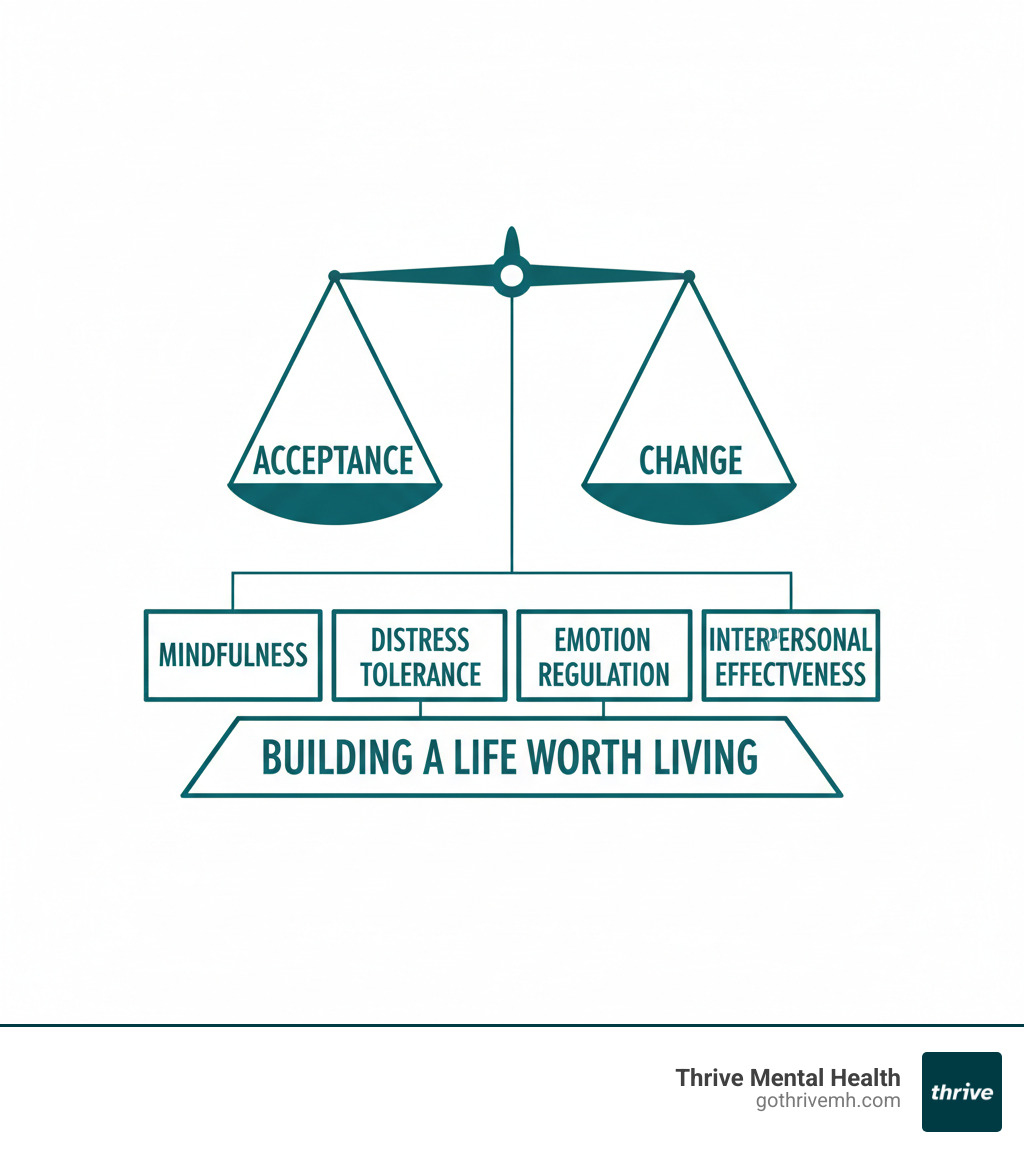
How does dialectical behavioral therapy work? DBT uses a structured approach combining four skill modules, mindfulness, distress tolerance, emotion regulation, and interpersonal effectiveness. These are delivered through individual therapy, group sessions, and phone coaching to help people build a “life worth living.”
Quick Answer: The DBT Process
- Individual Therapy, Weekly sessions using diary cards to track progress and apply skills to personal challenges.
- Group Skills Training, Learning four skill modules with peers over 6-12 months.
- Phone Coaching, Real-time support to practice skills during crisis moments.
- Four Core Skills, Mindfulness (present moment awareness), distress tolerance (crisis survival), emotion regulation (managing intense feelings), and interpersonal effectiveness (healthy relationships).
Feeling like your emotions are in control is a common struggle. Intense feelings can hijack thoughts and relationships, but there is a proven path forward. DBT was developed by Dr. Marsha Linehan for people who experience emotions more intensely. Originally for borderline personality disorder, it now helps with depression, anxiety, PTSD, eating disorders, and substance use.
DBT’s unique “dialectical” approach means two opposites can be true simultaneously. You can accept yourself as you are and work toward change. You can validate your pain and take steps to feel better.
I’m Anna Green, LMHC, LPC, Chief Clinical Officer at Thrive Mental Health. I’ve seen how does dialectical behavioral therapy work to transform lives in our virtual intensive outpatient programs. My experience confirms that DBT’s structured approach creates real, lasting change.
Quick look at:
What is DBT? The Core Philosophy of Acceptance and Change
When emotions feel like a tidal wave, some therapies suggest you “just think differently.” DBT takes another approach, saying, “Your feelings make sense, and we can help you manage them better.” That’s how dialectical behavioral therapy work transforms lives.
DBT is an evidence-based treatment developed by Dr. Marsha Linehan. She saw that traditional therapies weren’t fully helping people with intense emotional struggles, especially those with Borderline Personality Disorder (BPD) and chronic suicidal thoughts. From her own lived experience, she created a approach.
DBT blends cognitive-behavioral techniques with mindfulness, grounded in a core principle: you can accept yourself exactly as you are right now and work toward positive changes. You don’t have to choose.
The therapy’s foundation is the biosocial theory, the idea that some people are born with heightened emotional sensitivity. When this trait meets an invalidating environment, it can lead to emotional dysregulation. DBT provides the tools to manage this without judgment.

How DBT Differs from Traditional CBT
Cognitive Behavioral Therapy (CBT) is highly effective for changing unhelpful thought patterns, as shown by extensive scientific research on CBT’s principles. While CBT focuses primarily on change, DBT adds a crucial element: validation.
For someone with intense emotions, hearing “That thought is irrational” can feel invalidating. DBT offers a different path: “Your intense feelings make complete sense given your experiences, and we can learn skills to help you feel more in control.” This validation creates the safety needed for real change to happen.
Instead of rushing to change thoughts, DBT first acknowledges that two opposites can be true at once. Your pain is real, and you can learn to manage it. This approach follows the “middle path”, finding balance instead of swinging between extremes. For more on these differences, see our guide on CBT vs. DBT vs. MBT.
The ‘Dialectical’ Heart of DBT
The word “dialectical” means finding truth in the synthesis of opposites. Many people who benefit from DBT struggle with black-and-white thinking, where things are either all good or all bad. This all-or-nothing mindset is exhausting and rarely reflects reality.
DBT teaches you to find the “and” instead of getting stuck in “either/or.” You can be disappointed in someone and still care about them. You can feel anxious and take steps to address the situation. This flexible thinking is a practical skill that transforms how you steer complex emotions and relationships.
The 4 Pillars: Mastering the Core Skills of DBT
DBT provides a practical toolbox for life’s toughest moments. How does dialectical behavioral therapy work? By teaching specific, concrete skills to use when emotions feel overwhelming. These skills are organized into four core modules that work together to help you build the life you want.
The four skill modules are the foundation of DBT: Mindfulness grounds you in the present, Distress Tolerance helps you survive crises, Emotion Regulation gives you control over intense feelings, and Interpersonal Effectiveness builds healthier relationships. Learn more about these in our article on DBT’s Components.
Core Mindfulness: Staying Grounded in the Present
In DBT, mindfulness is a practical skill for paying attention to the present moment, not the stories your mind creates about the past or future. The “what” skills teach you to observe, describe, and participate, while the “how” skills guide you to do so non-judgmentally, one-mindfully, and effectively.
Practicing mindfulness creates space between you and your emotional reactions, giving you room to choose how to respond. Dr. Linehan calls this balanced state “Wise Mind,” where your emotional and logical sides work together. Living in the moment becomes about noticing what’s happening without getting swept away by it.
Distress Tolerance: Surviving Crisis Without Making It Worse
Callout Box: If you are in crisis, call or text 988 right now. Help is available.
When pain feels unbearable, crisis survival skills help you get through the moment without making things worse. The TIPP skill is an emergency toolkit: use Temperature (cold water on your face), Intense exercise, Paced breathing, or Paired muscle relaxation to change your body chemistry and lower emotional intensity.
Radical Acceptance is a life-changing skill that means fully accepting reality as it is, not because you like it, but because fighting it only adds suffering. It’s the shift from “This shouldn’t be happening” to “This is happening, and I can handle it.”
Self-soothing with your five senses offers gentle ways to comfort yourself: listen to calming music, take a warm bath, or use a soft blanket. These are smart strategies for self-care during difficult times.
How does dialectical behavioral therapy work to manage feelings?
Emotions aren’t the enemy. DBT teaches you to work with your emotions by first understanding them. Feelings always make sense, even if they aren’t helpful in the moment.
Reducing vulnerability to negative emotions often starts with basics like eating well, getting enough sleep, and moving your body. The Opposite Action technique is simple but powerful: when depression tells you to isolate, you gently do the opposite and engage in an activity. When anxiety says to avoid, you approach.
Gaining control over emotional responses means becoming skillful, not emotionless. You learn to feel your feelings fully while choosing how to act on them, changing your relationship with difficult emotions from one of fear to one of competence.
Interpersonal Effectiveness: Building Healthier Relationships
Since many emotional struggles occur in relationships, learning to steer them skillfully is essential. The DEAR MAN skill provides a roadmap for asking for what you need: Describe, Express, Assert, Reinforce, stay Mindful, Appear confident, and Negotiate. It turns difficult conversations into collaborative problem-solving.
The GIVE skill helps nurture relationships by being Gentle, showing Interest, Validating feelings, and using an Easy manner. The FAST skill helps you maintain self-respect by being Fair, avoiding unnecessary Apologies, Sticking to your values, and being Truthful. These skills help you balance getting your needs met, maintaining relationships, and keeping your self-respect.
How Does Dialectical Behavioral Therapy Work in Practice? The Structure of Treatment
Understanding how does dialectical behavioral therapy work means looking at its structure. A comprehensive DBT program is a support system designed to help you learn and apply new skills in your daily life. Mastering DBT is like learning an instrument; it requires lessons, practice, and expert guidance.

A complete program weaves together individual therapy, group skills training, phone coaching, and a therapist consultation team. Each part strengthens the others, creating a safety net as you build confidence.
Individual Therapy & Diary Cards
Weekly individual therapy sessions focus on applying DBT skills to your specific challenges. The diary card is a key tool for tracking emotions, urges, behaviors, and skill use. This data helps you and your therapist identify patterns and prioritize what to work on.
Sessions are structured to address life-threatening behaviors first, then therapy-interfering behaviors, and finally quality-of-life issues. This hierarchy keeps you safe while you build the life you want. Together, you’ll analyze triggers and practice applying skills to real-life situations.
 Obsessed with Solutions – Mastering Exposure and Response Prevention TherapyMental Health
Group Skills Training
Group skills training is more like a class than traditional group therapy. You learn concrete skills alongside peers who understand your struggles. A trained therapist leads the group through the four core modules: mindfulness, distress tolerance, emotion regulation, and interpersonal effectiveness.
The curriculum typically takes 24 weeks, and many programs repeat it to help skills become second nature. Homework assignments provide opportunities to practice skills in your daily life, and sharing experiences with the group enriches the learning process.
In-the-Moment Phone Coaching
Phone coaching is a unique feature of DBT. It provides real-time support for using skills during a crisis, not for full therapy sessions. For example, if you have a major conflict and feel an urge to react destructively, you can call your therapist for coaching on which skill to use right now.
This in-the-moment support builds confidence that you can handle difficult situations on your own. Clear boundaries keep the coaching focused and effective.
How long does a DBT program typically last?
DBT is a commitment. A standard comprehensive DBT program typically lasts 6-12 months, sometimes longer. The skills curriculum alone takes about six months, and many people benefit from repeating it.
For those needing more initial support, Intensive Outpatient Programs (IOP) and Partial Hospitalization Programs (PHP) offer more frequent sessions. At Thrive, our flexible DBT Virtual IOP provides comprehensive care that fits your life.
The time investment is significant, but the proven effectiveness of DBT is clear. It’s like learning a new language, it takes time, but fluency opens up a new world of possibilities.
Who Benefits from DBT and What’s the Outlook?
While originally for Borderline Personality Disorder (BPD), DBT’s skills-based approach helps anyone struggling with intense emotions. How does dialectical behavioral therapy work for so many? By targeting the core issue of emotional dysregulation.

DBT can benefit individuals with BPD, Post-Traumatic Stress Disorder (PTSD), eating disorders, substance use disorders, depression, and bipolar disorder. If you recognize yourself in these struggles, there is hope. Research shows that commitment to DBT leads to profound improvements. You can learn more about how DBT helps with trauma in our article on Research on DBT for PTSD.
Proven Effectiveness for Complex Conditions
The outlook for individuals in DBT is hopeful, with studies confirming real, measurable changes. Here’s a summary of the research:
- Suicide & Self-Harm: Landmark studies show DBT significantly reduces suicide attempts, self-harm behaviors, and hospitalizations for individuals with BPD. A 2019 study found these reductions were larger and longer-lasting in adolescents receiving DBT.
- BPD Remission: Recovery is possible. One study found that after a year of DBT, 77% of participants no longer met the criteria for BPD. You can read more about one study’s findings on BPD remission.
- PTSD: DBT shows great promise for trauma, especially related to childhood abuse. One study found that combining DBT with cognitive processing therapy led to better outcomes than CPT alone.
- Depression & Anxiety: DBT’s mindfulness and emotion regulation skills significantly reduce symptoms of depression and anxiety. For older adults, combining DBT with antidepressants was more effective than medication alone.
- Eating Disorders: DBT can be highly effective. One study found that 89% of women with binge eating disorder stopped bingeing after treatment, with over half maintaining progress six months later.
- Substance Use Disorders: DBT helps individuals manage urges and have shorter relapses. One study with American Indian/Alaska Native adolescents found 98% reported feeling “recovered” or “improved” after treatment.
The research is clear: DBT helps people build improved social functioning and create “a life worth living.”
Insurance Coverage for DBT in Florida
Navigating insurance can be overwhelming. At Thrive Mental Health, we’re committed to making treatment accessible.
We work with major insurance providers, including Cigna, Optum, Aetna, and Blue Cross Blue Shield. Our team is experienced in verifying benefits to help you understand your coverage for our virtual and hybrid intensive outpatient programs.
For our clients in Florida, we encourage you to reach out so we can verify your specific benefits. We’ve created guides, like our article on using Aetna for DBT, to help you steer the process. Don’t let insurance questions stop you from getting help.
Frequently Asked Questions about How DBT Works
Here are answers to some of the most common questions about DBT.
What is the main goal of DBT?
The primary goal is to help you build “a life worth living”, one that feels meaningful and manageable to you. How does dialectical behavioral therapy work toward this? By teaching concrete skills to manage painful emotions, improve relationships, and reduce behaviors that make life harder. It’s about becoming a more skilled version of yourself by balancing self-acceptance with change.
Can you do DBT on your own?
While you can learn skills from books, comprehensive DBT is designed to be delivered by trained professionals. The core components, individual therapy, group skills training, and phone coaching, work together to provide the support, accountability, and expert guidance needed for lasting change. Self-study is a great supplement, but it doesn’t replace a full program.
What is the hardest part of DBT?
Many find the consistent commitment to be the hardest part, especially showing up when you feel your worst. DBT asks you to face painful emotions rather than avoid them. The skill of Radical Acceptance, accepting reality without judgment, even when it’s painful, is often particularly challenging but also one of the most transformative parts of the therapy.
How do you know if DBT is working?
You’ll know DBT is working when you notice small but powerful changes. You might use a distress tolerance skill during a crisis instead of reacting impulsively. You might communicate your needs clearly in a conflict. Other signs include feeling emotions but manageably, bouncing back faster from setbacks, and feeling more hopeful about the future. Progress isn’t always linear, but you’ll feel more resilient.
Ready to Build a Life You Love? Take the Next Step
Your emotions don’t have to control you. How does dialectical behavioral therapy work? It provides concrete skills to work with your feelings, helping you steer through life’s storms with confidence.
Think of DBT as learning to captain your own ship. The waves of emotion will still come, but you’ll have the tools to steer them. You’ll learn to balance accepting yourself as you are and working toward the changes that matter most.
Change happens skill by skill, building your confidence that you can handle whatever life throws your way. Building a life worth living is about creating meaning, connection, and hope. Research shows that people who commit to DBT see real improvements in their emotional stability and quality of life.
At Thrive Mental Health, our virtual and hybrid intensive outpatient programs offer flexibility without sacrificing quality. You can access expert-led, evidence-based DBT care from anywhere, with evening options that fit your schedule.
Ready for support? Thrive offers virtual IOP with evening options. Verify your insurance in 2 minutes (no obligation) → Start your benefits check now or call 561-203-6085. If you’re in crisis, call/text 988.

This article is for informational purposes only and is not a substitute for individualized clinical advice or insurance verification.