


Therapist in Fort Wayne IN Who Uses CBT for Anxiety 2025
What is CBT? How Does It Stop Anxiety in Its Tracks?
Finding a therapist in Florida who uses cbt for anxiety can feel overwhelming when worry already fills your days. Here’s what you need to know right now:
Quick Guide to Finding a CBT Therapist in Florida:
- Search online directories to filter by specialty (CBT, anxiety)
- Call your insurance provider (Anthem, Cigna, UnitedHealthcare, Aetna) for in-network therapists
- Ask your primary care doctor for referrals to local CBT specialists
- Consider virtual therapy through platforms like Thrive Mental Health for flexible, evidence-based care
- Verify credentials: Look for LMHC, LCSW, or LMFT licenses in Florida
- Book a free consultation to ensure the therapist is the right fit
Constant worry. Racing thoughts. Avoiding social situations. Panic attacks that come out of nowhere. Anxiety’s grip can feel inescapable, but it doesn’t have to control your life.
Cognitive Behavioral Therapy (CBT) is one of the most effective, evidence-based treatments for anxiety. It’s not just talk therapy, it’s a structured, goal-focused approach that teaches you practical skills to break the cycle of anxious thoughts and behaviors. Whether you’re dealing with generalized anxiety, panic disorder, social anxiety, or specific phobias, CBT can help you regain control.
Florida has a strong healthcare network, but finding the right therapist who uses CBT for anxiety can still feel like searching for a needle in a haystack. That’s where this guide comes in. We’ll walk you through everything you need to know, from understanding how CBT works to finding local and virtual therapists who specialize in anxiety treatment.
I’m Anna Green, LMHC, LPC, Chief Clinical Officer and founder of Thrive Mental Health. I’ve spent my career developing evidence-based programs, including IOP and PHP, for people struggling with anxiety, and I’ve seen how finding the right therapist in Florida who uses cbt for anxiety can transform lives. Let’s get you the support you deserve.
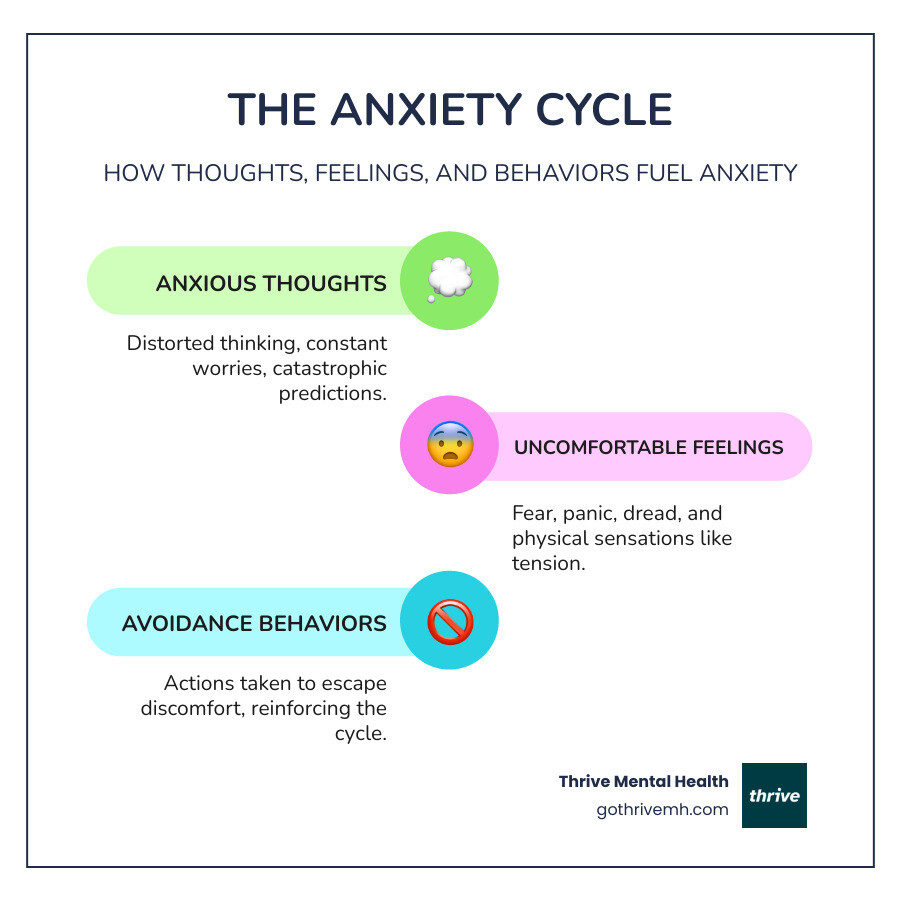
Cognitive Behavioral Therapy (CBT) is a highly effective, evidence-based psychotherapy focused on changing the negative thought patterns and behaviors that fuel anxiety. It operates on a simple principle: our thoughts, feelings, and actions are interconnected. By learning to identify and challenge distorted thoughts (like assuming the worst), we can change our emotional responses and behaviors, breaking the cycle of anxiety.
As the American Psychological Association notes, CBT is a structured, goal-oriented approach that provides lasting relief. It’s not just talk; it’s about learning practical skills to manage your mental health. To dive deeper into the science behind this powerful therapy, explore The Benefits of CBT in Mental Health Treatment.
Core CBT Techniques for Anxiety Relief
CBT equips you with practical, actionable strategies to manage and overcome anxiety. Here are some of the core techniques we use:
-
Cognitive Restructuring: This cornerstone of CBT involves identifying and challenging automatic negative thoughts and cognitive distortions (e.g., “all-or-nothing thinking” or “catastrophizing”). You’ll learn to replace them with more balanced and realistic thoughts, calming your anxious reactions. If you’re curious about how this works, check out How CBT Can Transform Negative Thought Patterns.
-
Behavioral Activation: This technique focuses on changing what you do to change how you feel. It involves gradually re-engaging in positive or meaningful activities you’ve been avoiding due to anxiety, which helps improve your mood and thinking.
-
Exposure Therapy: Especially effective for phobias and panic, this involves safely and gradually confronting feared situations or objects. This process, done in a controlled way, teaches you that your anxiety will decrease on its own and that feared outcomes are unlikely, breaking the cycle of avoidance.
-
Skills Training: CBT equips you with practical coping skills, such as relaxation techniques (deep breathing), mindfulness strategies to stay grounded in the present, and assertiveness training to handle social situations with more confidence.
-
Homework Assignments: Therapy continues between sessions. You’ll get assignments like journaling thoughts or practicing new skills in real-world situations. This is crucial for making lasting changes and ensuring the skills become a natural part of your life.
These techniques are custom to your unique needs, helping you gain mastery over your anxiety and build a more peaceful, fulfilling life.
How to Find a Therapist in Florida Who Uses CBT for Anxiety
Finding the right therapist in Florida who uses CBT for anxiety can feel overwhelming when you’re already struggling with worry. But here’s the truth: taking this step is often the hardest part, and you’re already doing it. We want to make the rest of your search as simple and straightforward as possible.

Start with your insurance provider. Call the number on your card or use their online portal to find in-network therapists in Florida who specialize in CBT for anxiety. Major Florida plans like Florida Blue, Cigna, UnitedHealthcare, Aetna, and Humana cover mental health services, and this is the best way to clarify your costs upfront.
Ask your primary care physician for a referral. Doctors often have trusted networks of mental health professionals in Florida and can recommend specialists in evidence-based care like CBT.
Online therapist directories allow you to filter by location, specialty (anxiety), and approach (CBT). Review profiles to find therapists who list CBT as a primary method and check their credentials and accepted insurance.
Don’t limit your search to your immediate area. Virtual therapy offers access to top CBT specialists from home, providing flexibility for busy schedules and ensuring privacy. Thrive Mental Health provides virtual therapy programs designed for anxiety, combining expert-led CBT with the convenience of telehealth. Learn more at Remote Therapy for Anxiety.
When evaluating potential therapists, check their credentials carefully. In Florida, look for licenses like LMHC (Licensed Mental Health Counselor), LCSW (Licensed Clinical Social Worker), or LMFT (Licensed Marriage and Family Therapist). These designations mean the therapist has completed rigorous education and training requirements.
The relationship you build with your therapist matters. That’s why we strongly recommend scheduling an initial consultation before committing to ongoing treatment. Many therapists offer a free 15-minute phone call to help you both determine if you’re a good fit.
Questions to Ask a CBT Therapist in Florida
An initial consultation is your chance to interview a potential therapist. Here are essential questions to ask:
What specific training and experience do you have in CBT? You want someone who has dedicated training in this approach, not just a passing familiarity. Ask about certifications, workshops, or specialized programs they’ve completed.
How do you apply CBT principles to treat anxiety? This helps you understand their practical approach. A skilled CBT therapist should be able to explain how they’ll help you identify thought patterns, challenge distortions, and practice new behaviors in clear, everyday language.
Have you worked with my specific type of anxiety before? Whether you’re dealing with generalized anxiety disorder, panic attacks, social anxiety, or phobias, experience matters. While CBT works across anxiety disorders, a therapist familiar with your particular struggle will understand the nuances.
What does a typical session look like? CBT is structured and goal-focused. Your therapist should describe how sessions are organized, how they assign homework, and how they track your progress. This gives you a realistic picture of what to expect.
How do we know if we’re a good fit? The therapeutic relationship is the foundation of successful treatment. A good therapist will acknowledge this and encourage open communication about how you’re feeling throughout the process.
What are your fees, and how does insurance work? Understanding the financial side upfront prevents stress later. Ask about co-pays, deductibles, out-of-pocket costs, and whether they offer sliding scale fees if needed. If you’re considering Thrive’s programs, you can verify your insurance in just two minutes with no obligation.
Trust your instincts during this conversation. You want someone who listens without judgment, explains things clearly, and makes you feel hopeful about the path ahead. Finding the right therapist in Florida who uses CBT for anxiety might take a few calls, but when you find that connection, you’ll know. And that’s when real healing can begin.
What to Expect: Your CBT Journey in Florida
Starting therapy for anxiety takes courage. If you’re reading this, you’ve likely already been carrying the weight of worry for too long. The good news? Recognizing you might benefit from help is the hardest part, and you’ve already done it.

So how do you know if it’s time to reach out to a therapist in Florida who uses cbt for anxiety? Here are the signs that suggest you could benefit from specialized support.
Overwhelming worry that feels constant, intrusive, and uncontrollable is a key sign. If anxiety is running your life, it’s time to seek support.
Physical symptoms like a racing heart, shortness of breath, dizziness, or chronic muscle tension are your body’s way of signaling distress. Frequent panic attacks are another strong indicator.
Avoidance behaviors are a common sign. If you find yourself making excuses to skip social events, work meetings, or other activities you used to enjoy, anxiety may be making decisions for you.
The clearest sign is when anxiety disrupts your daily life. If it interferes with your work, relationships, sleep, or joy, you deserve support. You don’t have to wait until it’s “bad enough.” For a deeper look, read Anxiety Symptoms and Their Impact on Daily Life.
Once you decide to pursue CBT, your first step will be a personalized assessment. Your therapist will take time to understand your history, specific anxiety symptoms, triggers, and goals. This leads to collaborative goal-setting, where you and your therapist partner to define what success looks like for you and create a custom treatment plan.
Inside a CBT Session for Anxiety
CBT sessions are structured, focused, and designed to give you practical tools you can use right away.
Each session typically starts with a check-in. You’ll review your week and any homework, like thought records or behavioral experiments. This connects therapy to your real life.
Next comes setting the agenda. You and your therapist will collaboratively decide what to focus on that day, keeping therapy focused on what matters most to you right now.
The core work happens when you learn and practice new CBT techniques. You’ll work on identifying cognitive distortions, challenging negative thoughts, and developing practical strategies for managing anxious moments.
Sometimes sessions include role-playing or problem-solving. This allows you to practice new skills for difficult situations in a safe, supportive environment, helping you build confidence.
Before you leave, you’ll typically receive new homework assignments. The real magic of CBT happens between sessions, when you’re actively practicing new skills and proving to yourself that change is possible.
CBT is generally a short-term therapy, typically lasting 12 to 20 weekly sessions. Most people start with weekly sessions to build momentum. As you progress, your therapist might adjust the frequency based on your needs.
The beauty of CBT is that it’s time-limited and goal-focused. You’re learning specific skills that you’ll carry with you long after therapy ends. To learn more about the overall process, check out A Beginner’s Guide to Cognitive Behavioral Therapy (CBT).
 Campus Calm: Creative Art Activities for Students’ Mental WellnessMental Health
Why CBT Works: Benefits for Anxiety in Florida
We’ve seen countless individuals in Florida transform their relationship with anxiety through Cognitive Behavioral Therapy. The reason CBT is so widely recommended is because it provides tangible, lasting benefits that empower you to take control of your mental health.

Working with a therapist in Florida who uses cbt for anxiety means building a practical toolkit for real change. A key benefit is measurable progress. CBT is goal-oriented, so you’ll set clear objectives and track concrete improvements in your anxiety symptoms, leading to lasting relief.
CBT focuses on long-term coping skills, not quick fixes. You learn to identify, challenge, and change anxious thought patterns, equipping you with strategies that reduce the likelihood of relapse and last a lifetime. You essentially become your own therapist.
This process fosters self-sufficiency and empowerment. By actively participating and practicing new skills, you gain control over your mental health, building resilience and confidence that positively impacts all areas of your life.
CBT is the gold standard for many anxiety-related conditions. It’s highly effective for Generalized Anxiety Disorder (GAD), Panic Disorder, Social Anxiety Disorder, specific phobias, and Obsessive-Compulsive Disorder (OCD), helping to manage everything from chronic worry and panic attacks to social fears and compulsive behaviors.
While CBT is incredibly powerful, it’s also important to understand how it fits within the broader landscape of therapy options. Some individuals might benefit from Dialectical Behavior Therapy, especially if they struggle with emotional regulation or interpersonal relationships alongside anxiety. You can learn more about these distinctions at CBT and DBT.
How CBT Compares to Other Approaches for Anxiety
| Feature | Cognitive Behavioral Therapy (CBT) | Other Talk Therapies (e.g., Psychodynamic, Humanistic) |
|---|---|---|
| Focus | Changing negative thought/behavior patterns | Exploring emotions, past experiences, self-findy, personal growth |
| Structure | Highly structured, goal-oriented, often involves homework | Less structured, more open-ended, client-led exploration |
| Duration | Short-term (typically 12-20 weekly sessions) | Often longer-term, can extend for many months or years |
| Best For | GAD, Panic Disorder, Social Anxiety, Phobias, OCD, specific behavioral issues | Broader mental health concerns, deep-seated emotional issues, personality exploration, relationship dynamics |
Understanding these differences can help you make an informed decision about what type of therapy might work best for you. CBT’s structured, time-limited approach often appeals to people who want concrete skills and measurable progress, while other therapies might be better suited for those seeking deeper exploration of long-standing patterns or personal growth.
Insurance & Costs: Getting CBT for Anxiety in Florida
Navigating the cost of therapy can be stressful, but getting help from a therapist in Florida who uses cbt for anxiety is often more affordable than you think. Here’s a breakdown of how to manage the financial side.
Verifying Your Insurance Coverage
Most insurance plans include mental health benefits, which means your CBT therapy for anxiety is likely covered. Before you start, it’s worth spending a few minutes to understand exactly what your plan offers. When you call your insurance company (or check their online portal), here are the key things to ask:
What’s your deductible, and have you met it this year? This is the amount you pay out-of-pocket before insurance kicks in. What’s your co-pay or co-insurance for outpatient mental health services? This is what you’ll pay per session. Do you need a referral from your primary care doctor? Some plans require this, though many don’t for mental health services. Are there any session limits? Some plans cap the number of therapy sessions per year, though this is becoming less common.
At Thrive Mental Health, we work with most major insurance providers across Florida. This includes Florida Blue, Cigna, Carelon Behavioral Health, UnitedHealthcare, Aetna, and Humana. We’ve made it easy for you to check your benefits, you can verify your insurance for CBT therapy in just about two minutes, with absolutely no obligation. No pressure, just clarity.
Understanding In-Network vs. Out-of-Network
If your therapist is in-network with your insurance plan, you’ll typically pay just your co-pay or co-insurance amount after meeting any deductible. This is usually the most affordable option. If a therapist is out-of-network, you might pay more upfront, but many plans still provide partial reimbursement. We can provide all the documentation you need to submit claims for out-of-network benefits if that’s your situation.
Self-Pay and Sliding Scale Options
Not everyone has insurance, and some people prefer not to use it for privacy reasons, and that’s completely okay. Self-pay rates for individual CBT sessions typically range from $135 to $240, depending on whether it’s an initial intake or a follow-up session. We understand that financial constraints are real, which is why some therapists offer sliding scale fees based on your income. It never hurts to ask what options might be available.
Using HSA and FSA Cards
If you have a Health Savings Account (HSA) or Flexible Spending Account (FSA), you can use those funds to pay for therapy. These accounts let you use pre-tax dollars for healthcare expenses, which can make therapy more affordable. Most therapy practices, including Thrive, accept HSA/FSA cards along with standard debit and credit cards.
The bottom line? We believe that financial concerns shouldn’t keep you from getting the support you deserve. Our team is here to help you understand your options and find a path that works for your budget. Whether you’re using insurance or paying out-of-pocket, there’s a way to make this work.
CALLOUT BOX: If you’re in crisis, call or text 988 right now. You are not alone.
Frequently Asked Questions: CBT for Anxiety in Florida
We know you probably have questions about finding a therapist in Florida who uses cbt for anxiety and what the whole process looks like. These are the questions we hear most often from people just like you who are taking that brave first step toward relief.
How effective is CBT for anxiety?
CBT is one of the most effective, research-backed treatments for anxiety. Studies show its benefits are often comparable to medication and tend to last longer because it teaches you lifelong skills. Success depends on active participation, but most people see significant, measurable improvement.
How long does CBT take to work for anxiety?
Many people feel some improvement within a few weeks. A typical course of CBT is 12 to 20 weekly sessions, which is when most experience lasting change. The exact timeline is unique to you and depends on your specific needs and how consistently you practice the skills.
Can a CBT therapist in Florida prescribe anxiety medication?
No. In Florida, therapists like LMHCs and LCSWs provide psychotherapy but cannot prescribe medication. Only medical doctors, psychiatrists, or psychiatric nurse practitioners can. However, your therapist can collaborate with you and refer you to a prescriber if medication seems like a helpful addition to your treatment.
Does insurance cover CBT for anxiety in Florida?
Yes, most major insurance plans in Florida cover CBT for anxiety, including Florida Blue, Cigna, UnitedHealthcare, Aetna, and Carelon Behavioral Health. Coverage details like deductibles and co-pays vary by plan, so verify your benefits first. Thrive Mental Health offers a quick online insurance verification tool to help you do this with no obligation.
Is virtual CBT therapy available in Florida?
Yes! Virtual CBT therapy is widely available in Florida. Thrive Mental Health offers virtual intensive outpatient (IOP) programs, plus individual virtual therapy. This provides flexible, expert-led care from any private location, fitting easily into a busy schedule. You get the same high-quality, evidence-based treatment as in-person therapy. To learn more, explore our virtual therapy options.
Take Back Your Life from Anxiety, Starting Now
You’ve made it this far, and that matters. Reading this guide, learning about CBT, and considering your options, these aren’t small steps. They’re the beginning of something different, something better.
Anxiety doesn’t have to be your constant companion. It doesn’t have to dictate which invitations you accept, which opportunities you pursue, or how you spend your quiet moments. CBT offers a proven, practical path forward, not just temporary relief, but real, lasting change. You’ll learn to recognize the thought patterns that fuel your worry, challenge the beliefs that keep you stuck, and build healthier responses that actually work in real life.
By understanding how CBT works and finding a qualified therapist in Florida who uses cbt for anxiety, you’re already taking back control. And here’s the thing: you don’t have to do this alone. Whether you’re looking for traditional weekly therapy or need something more intensive, support is available right now.
If you’re feeling like once-a-week sessions might not be enough, maybe your anxiety is severely impacting your daily life, or you’ve tried therapy before without enough progress, we invite you to learn more about Thrive’s IOP program. This structured, evidence-based program offers multiple sessions per week with expert clinicians, giving you the concentrated support you need to break through and move forward. For those who prefer flexibility or need care that fits around work and family, our virtual therapy options bring expert-led CBT right to your home, wherever you are in Florida.
You deserve to feel calm. You deserve to sleep through the night without racing thoughts. You deserve to say yes to life again.
Ready for support? Thrive offers virtual IOP with evening options. Verify your insurance in 2 minutes (no obligation) → Start benefits check or call 561-203-6085. If you’re in crisis, call/text 988.

This article is for informational purposes only and is not a substitute for individualized clinical advice or insurance verification.