





Virtual Wellness Programs: Crucial 2025 Necessity
The End of the 9-to-5 Grind: Why Your Team Is Burning Out (And What to Do About It)
Virtual wellness programs are digital health initiatives that support employee well-being through online fitness classes, mental health resources, financial coaching, and social connection activities, all accessible from anywhere, at any time.
Quick Overview: What Virtual Wellness Programs Include
- Physical Health: On-demand workouts, yoga, nutrition coaching, ergonomic assessments
- Mental Health: Teletherapy, guided meditation, stress management webinars, crisis support
- Financial Wellness: Budgeting workshops, debt management, retirement planning
- Social Connection: Virtual team activities, peer support groups, online community building
- Technology: Mobile apps, video platforms, wearable integrations, AI-driven personalization
Remote work promised freedom. Instead, it delivered isolation, burnout, and a workforce on the edge.
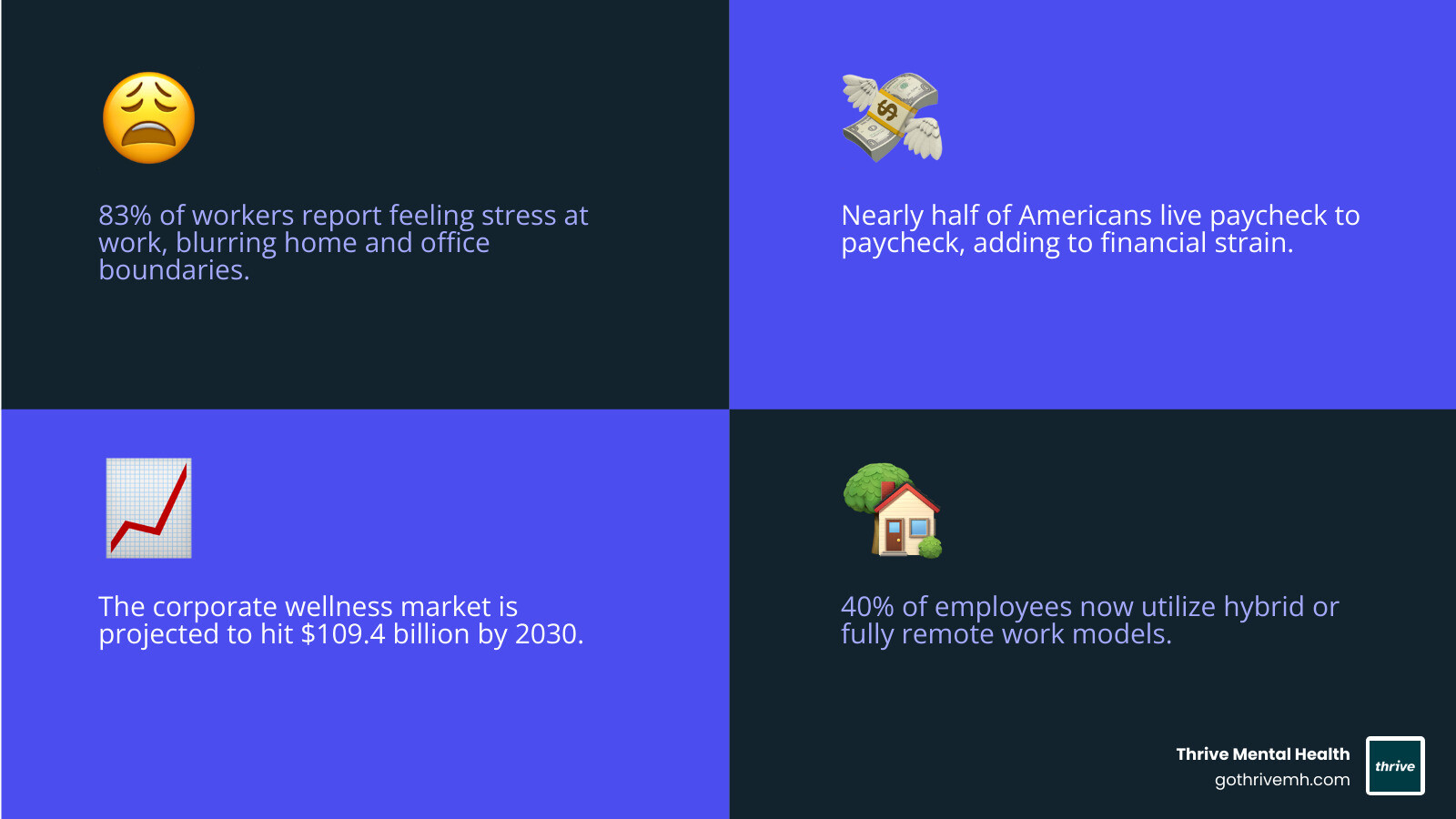
The stats don’t lie. 83% of workers report feeling stress at work. The line between “office” and “home” has vanished, leaving employees trapped in a digital pressure cooker.
Traditional wellness programs built for cubicles can’t solve this. Your team needs something that meets them where they are: at home, online, and overwhelmed.
That’s where virtual wellness programs come in. They’re not a trendy perk; they’re a strategic business necessity for companies that want to keep their best people healthy and productive. The corporate wellness market is projected to hit $109.4 billion by 2030, because smart organizations recognize what’s at stake.
This guide breaks down what virtual wellness programs are, what they should include, and how to build one that actually works. At Thrive, we’ve seen how these programs transform access to care for companies across Florida and beyond, whether through telehealth, structured IOP programming, or comprehensive wellness platforms.
Basic virtual wellness programs vocab:
What’s Actually Inside a Virtual Wellness Program? [A Breakdown]
So what exactly comes in a virtual wellness program? The best are built on four pillars: Physical Wellness, Mental & Emotional Support, Financial Wellness, and Social Connection. They work because they meet people where they are: at home, online, and accessible 24/7. For companies with employees across Florida, from Miami to Jacksonville, or even in other states, everyone gets the same access to resources like on-demand fitness classes, live-streamed yoga, guided meditation resources, telehealth access, nutrition coaching, and financial literacy workshops. The flexibility is key, an early bird can hit a 6 AM spin class while a night owl does yoga at 10 PM.
Supporting Physical Health from the Home Office

Remote work reduces natural movement. Virtual wellness programs tackle this with ergonomic assessments to fix your workspace and micro-workout challenges, five to ten-minute bursts of movement between meetings. They also offer hydration tracking, healthy cooking classes, meal planning services, and libraries of on-demand workouts. The goal is keeping your team moving, energized, and pain-free.
Prioritizing Mental Health in a Digital World
Remote work has strained mental health, with 83% of workers reporting stress. Virtual wellness programs provide the infrastructure to address this. Teletherapy connects your team with licensed therapists conveniently and confidentially. Stress management webinars give people practical tools, while mindfulness apps offer guided meditation to reset between calls. These programs also include digital detox challenges, peer support groups, and critical crisis support resources. This is about creating a psychologically safe environment where mental health is supported.
Tackling Financial Stress Head-On
Money stress follows you to work, and with nearly half of Americans living paycheck to paycheck, it’s a reality for many. Smart virtual wellness programs address this with financial literacy workshops, budgeting tools, and debt management resources. They also offer retirement planning seminars, access to financial advisors, and help with improving credit scores. Removing this massive source of stress directly impacts your team’s ability to perform.
The Bottom Line: How Virtual Wellness Programs Boost Your ROI
Virtual wellness programs aren’t just the right thing to do, they’re a smart investment for your bottom line. When employees feel supported, productivity climbs, turnover drops, and your culture transforms.

The numbers are staggering. Psychological safety, the foundation of effective wellness programs, drives a 27% reduction in turnover and 76% more engagement. Employees in these environments also experience 50% more productivity and 74% less stress. These aren’t abstract benefits; they translate to faster project completion and stronger team cohesion. At Thrive, we see this firsthand: comprehensive virtual wellness programs lead to measurable improved employee engagement, reduced turnover, and lower absenteeism. The market agrees, with corporate wellness projected to become a $109.4 billion industry by 2030. Employee well-being isn’t a cost center, it’s a competitive advantage.
Designing Effective Virtual Wellness Programs for Your Team
Building a program that works requires strategy. Start with needs assessment surveys to ask employees what they actually need. Choose the right technology platform that is intuitive, secure, and accessible. Ensure accessibility and inclusivity by accommodating multiple time zones and diverse backgrounds. At Thrive, we specialize in serving teams across Florida, with additional support for employees in California, Indiana, Arizona, and South Carolina. We work with insurers like Cigna and Optum to minimize barriers to care. Learn more about our accessible virtual programs. Promote the program effectively so employees know what’s available. Finally, measure success and gather feedback to continuously refine your program.
Making Your Virtual Wellness Programs Accessible and Inclusive
A wellness program that isn’t inclusive is a missed opportunity. True accessibility means multi-language support, accommodations for disabilities like screen readers, and varied activity levels. Offer flexible scheduling across time zones with on-demand content. Cultural sensitivity is also crucial, as wellness looks different across cultures. Your program should feel relevant to everyone, regardless of age or family situation. When you design with inclusivity, every employee feels valued, boosting loyalty and engagement.
Beyond Zoom Yoga: How to Fight Burnout and Isolation
Virtual wellness programs are about more than just checking boxes or offering trendy perks. They’re about tackling the hardest parts of remote work head-on: the crushing weight of isolation and the slow burn of chronic stress that leads to full-blown burnout.
Yes, Zoom yoga is nice. But if that’s all you’re offering, you’re missing the point entirely.

The real power of virtual wellness programs lies in their ability to create structured opportunities for genuine human connection and provide critical mental health infrastructure when employees need it most. These programs directly combat the core challenges of remote work by building psychological safety, that sense of being valued, heard, and supported that we know leads to 27% reduction in turnover and 76% more engagement.
Rebuilding Connection for Remote Teams
When your team went remote, they lost something vital: those unplanned moments of connection. The quick lunch invite. The hallway conversation. The shared frustration over the broken coffee maker. These weren’t just pleasant distractions, they were the social glue that held teams together.
Virtual wellness programs can intentionally rebuild what was lost. Virtual coffee breaks aren’t just scheduled meetings, they’re sacred time for non-work conversations, the digital equivalent of watercooler chats. Many companies provide gift cards to make these feel special, encouraging teams to truly disconnect from work mode.
Team-based wellness challenges tap into our natural competitive spirit while promoting healthy habits. Whether it’s a step challenge, a hydration goal, or a meditation streak, these activities give teams a shared mission outside of quarterly targets and project deadlines. There’s something powerful about knowing your coworkers are struggling through the same plank challenge you are.
Online social clubs create space for employees to connect over shared passions rather than shared projects. Book clubs that explore both beach reads and self-care literature. Gaming groups that build friendships through friendly competition. Virtual cooking clubs where team members share family recipes and cultural traditions. These aren’t mandatory team-building exercises, they’re genuine communities built around real interests.
Peer “buddy” systems pair employees for mutual support and accountability, creating one-on-one connections that can be especially valuable for new hires or anyone feeling adrift in the remote work sea. Sometimes you just need one person who checks in, who notices when you’re quiet in meetings, who remembers you mentioned a tough week.
The goal isn’t to recreate the office experience, it’s to foster a sense of community and belonging in a digital world. To ensure that no employee feels like just another face in a grid of tiny squares.
Providing Intensive Support When It’s Needed Most
Disclaimer: If you or someone you know is in crisis or considering self-harm, please call or text 988 to reach the Suicide & Crisis Lifeline. You are not alone.
 Virtual IOP in Phoenix, ArizonaIntensive Outpatient Program
Here’s the truth that most companies don’t want to acknowledge: standard EAPs are not always enough.
General wellness initiatives, meditation apps, fitness challenges, financial workshops, are crucial preventative measures. But for employees facing severe burnout, crippling anxiety, deep depression, substance use disorders, or eating disorders, these resources fall short. These employees need more than a hotline number and three free therapy sessions.
For employees in crisis, more structured support is critical. They need intensive care that meets them where they are, providing comprehensive treatment without requiring them to check into an inpatient facility and disappear from their lives entirely.
At Thrive Mental Health, we’ve built our programs specifically for this gap, for people who need more than once-a-week therapy but less than inpatient care. Our virtual Intensive Outpatient (IOP) programs provide this next level of care, combining group therapy that fosters shared healing, individual counseling that addresses personal challenges, and psychiatric support for comprehensive medical care when needed.
These programs aren’t one-size-fits-all wellness offerings. They’re evidence-based clinical treatment delivered in a flexible online format, making intensive care highly accessible for employees throughout Florida, from the Panhandle to the Keys, as well as in other states we serve, including California, Indiana, Arizona, and South Carolina. Our virtual format means employees can get the serious help they need while maintaining their jobs, their routines, and their privacy.
We offer evening sessions specifically designed for working professionals, so treatment doesn’t have to mean choosing between your mental health and your career. Because when an employee is drowning, throwing them a yoga mat isn’t going to cut it. Learn more about Virtual IOP programs and how we provide the level of support that actually makes a difference.
The Future of Work is Well: Trends Shaping Corporate Wellness
The world of corporate wellness isn’t standing still, it’s accelerating. The virtual wellness programs market is projected to explode from $57.3 billion in 2021 to an impressive $109.4 billion by 2030. That’s not just growth, it’s a revolution in how companies think about employee health.
What’s driving this change? Technology is finally catching up to what employees actually need.
Artificial intelligence and machine learning are moving wellness beyond the one-size-fits-all approach. Instead of everyone getting the same generic wellness email, AI will analyze patterns (with strict privacy protections, of course) to suggest your ideal workout time, your most effective stress management techniques, or your personalized nutrition plan. It’s like having a wellness coach who actually knows you.
Wearable technology is becoming the bridge between intention and action. Your smartwatch doesn’t just count steps anymore, it’s feeding data directly into virtual wellness programs, tracking sleep quality, detecting stress spikes, and even nudging you to take a break before burnout hits. This real-time feedback loop makes wellness measurable and, more importantly, achievable.
Then there’s Virtual Reality. Imagine strapping on a headset and finding yourself on a quiet beach for meditation, or in a safe, controlled environment for exposure therapy. VR isn’t just cool tech, it’s creating immersive experiences that make mental health interventions more effective and engaging. The technology that once felt like science fiction is becoming a legitimate therapeutic tool.
Perhaps the most important shift is toward preventative mental healthcare. We’re moving beyond crisis response to building resilience before things fall apart. This means teaching employees emotional regulation skills, stress management techniques, and digital mindfulness practices as part of their everyday routine, not just when they’re already drowning.
The future also means seamless integration. Virtual wellness programs won’t be that separate app you have to remember to open. They’ll be woven into your daily digital workspace, a meditation prompt in your calendar, a wellness check-in on your work dashboard, a stress management resource right where you need it. Wellness becomes as natural as checking your email.
At Thrive Mental Health, we’re already seeing how technology can break down barriers to care. Our virtual IOP program combines clinical expertise with flexible technology, making intensive support accessible across Florida, California, Indiana, Arizona, and South Carolina. We work with major insurance providers like Cigna, Optum, and Florida Blue to ensure cost isn’t a barrier to getting the care you need.
The future of work isn’t just remote or hybrid, it’s well. Companies that accept comprehensive virtual wellness programs now aren’t just ahead of the curve. They’re building workplaces where people actually want to stay, grow, and thrive.
Frequently Asked Questions about Virtual Wellness Programs
What is the main goal of a virtual wellness program?
The primary goal is to improve holistic well-being across physical, mental, financial, and social dimensions. For remote teams, these programs provide accessible digital resources that meet people where they are. The result is higher productivity, better engagement, and lower turnover. It’s about building a healthier, more resilient workforce.
How much do virtual wellness programs cost?
Costs vary widely, from a few dollars per employee per month for basic apps to more for comprehensive packages with live coaching and teletherapy. Many companies leverage their health insurance plans (Optum, Cigna, Aetna, and Florida Blue) to cover clinical services like teletherapy or virtual IOP/PHP programs, especially for employees in Florida, California, Indiana, Arizona, and South Carolina. Always verify your insurance coverage to understand what’s included in your benefits.
How do you measure the success of a virtual wellness program?
Success is measured by combining participation data, employee feedback, and business outcomes. Track which resources are being used. Gather qualitative feedback through regular surveys asking about stress levels and support. Finally, monitor key business metrics like employee retention rates, absenteeism, and productivity. A 27% reduction in turnover is measurable proof that your investment is working. Many platforms also offer analytics dashboards to help refine your offerings.
Your Team’s Health Is Your Company’s Future
Here’s the truth: virtual wellness programs aren’t a trendy perk anymore. They’re the foundation of every resilient, successful business in 2025 and beyond.
When you invest in accessible, comprehensive digital wellness, you’re not just checking a box on your benefits page. You’re telling your team: We see you. We value you. Your health matters. And that message, that genuine commitment, transforms everything.
It strengthens your company culture. It protects your bottom line. It builds teams that don’t just survive the modern workplace, they actually thrive in it.
The data backs this up. We’ve seen it in our own work at Thrive Mental Health, and the research confirms it: companies that prioritize employee well-being see measurable gains in productivity, engagement, and retention. They create workplaces where people want to stay, where they feel safe enough to bring their whole selves, where they can do their best work without burning out.
This isn’t soft science. It’s smart business.
Your employees are navigating remote isolation, financial stress, mental health challenges, and the constant pressure to do more with less. They need more than a yoga app. They need structured support, real resources, and access to care when they need it most, whether that’s a virtual fitness class on Tuesday morning or intensive outpatient therapy when life gets overwhelming.
By building a robust wellness program that addresses physical health, mental well-being, financial literacy, and genuine human connection, you’re investing in the people who make your company run. And when they’re healthy, engaged, and supported? Everyone wins.
The future of work isn’t about grinding harder. It’s about working smarter, with compassion, and with systems in place that actually support human beings, not just productivity metrics.
Ready to support your team? Thrive offers accessible virtual IOP programs with evening options for employees throughout Florida, as well as in California, Indiana, Arizona, and South Carolina. Verify your insurance in 2 minutes (no obligation) or call our Florida-based team at 561-203-6085. If you’re in crisis, call/text 988.

This article is for informational purposes only and is not a substitute for individualized clinical advice or insurance verification.