


Art therapy activity for teenager with depression: 10 Proven Help
Why Depressed Teens Need More Than Words to Heal
Art therapy activity for teenager with depression offers a lifeline when traditional talk therapy falls short. Here are the most effective activities:
| Activity | What It Does | Time Needed |
|---|---|---|
| Inside/Outside Mask | Externalizes hidden emotions | 30-45 min |
| Feelings Collage | Visualizes emotional complexity | 20-30 min |
| Sculpt Your Depression | Gives physical form to struggle | 30-60 min |
| Lighthouse Drawing | Creates symbol of hope | 15-20 min |
| Visual Journaling | Processes daily feelings | 10-15 min |
| Coping Skills Box | Builds tangible self-care tool | 45-60 min |
| Anxiety Monster | Personifies and controls fear | 20-30 min |
| Mandala Drawing | Reduces stress through focus | 15-30 min |
| Words to Live By | Reinforces core values | 20-30 min |
| Family Sculpture | Maps support system | 30-45 min |
If you’re in crisis, call or text 988 right now. You are not alone.
Depression in teenagers often hides behind silence. When a teen can’t find the words, or refuses to speak them, their pain gets buried deeper. Art therapy breaks through that wall. It lets teens express what they feel through color, shape, and texture instead of sentences they don’t have.
Research shows that creative expression can lower cortisol, reduce negative emotions, and improve mood regulation in adolescents struggling with depression. Unlike traditional therapy that demands verbal processing, art therapy activities for teenagers with depression access emotions through a different neural pathway, one that doesn’t require talking at all.
The activities in this guide are evidence-based, teen-tested, and designed to work whether your teenager is skeptical, shut down, or simply tired of talking. Some can be done at home. Others work best with a trained therapist who can help process what surfaces. Either way, they give depressed teens a way to be heard without saying a word.
I’m Nate Raine, CEO of Thrive Mental Health. We’ve integrated art therapy into our adolescent programs across Florida, helping hundreds of teens find their voice. My background is in driving innovation in behavioral health to connect clinical care with measurable outcomes.
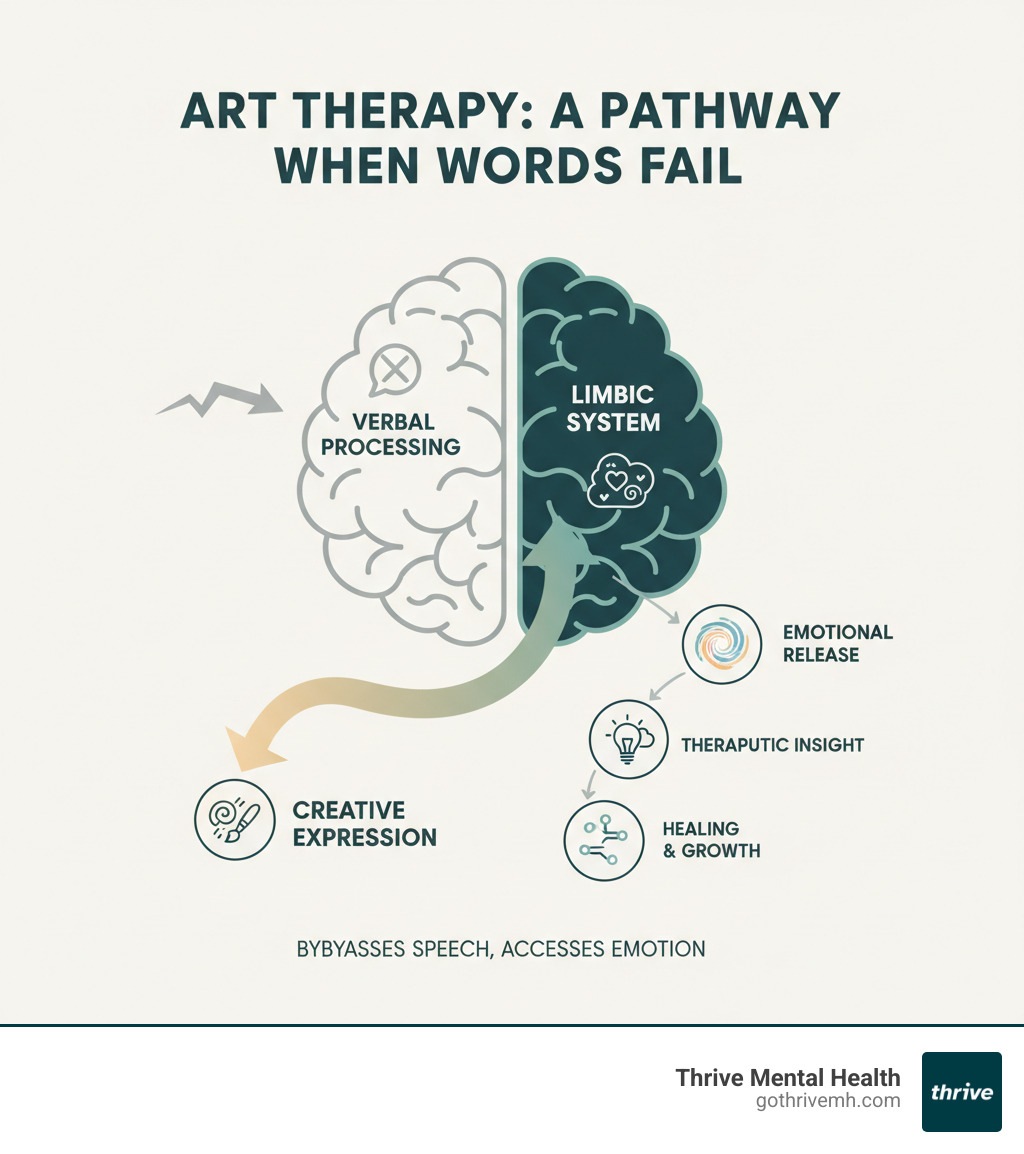
Why Art Therapy Works When Talk Therapy Fails for Depressed Teens
Getting a depressed teenager to talk about their feelings is often an uphill battle. They might feel ashamed, resistant, or simply not have the words to describe the heavy mix of sadness, hopelessness, and anger. When words fail, art speaks.
The American Art Therapy Association defines art therapy as a mental health profession using art-making and creative processes within a therapeutic relationship. Simply put, it’s therapy that uses creative expression instead of just talking. A trained art therapist provides materials and gentle prompts, helping teens work through emotions without forcing them to speak.
For teens battling depression, this approach is life-changing. Depression steals energy and clouds thinking, making conversation feel impossible. Art therapy provides a different language. Through colors, shapes, and textures, they can express what they can’t say. As the American Art Therapy Association notes, when words fail, art fills the gap.
The creative process itself becomes healing. When teens externalize their feelings onto paper or into clay, those emotions become something they can see, touch, and begin to understand. They’re no longer trapped inside. This is what makes art therapy activity for teenager with depression so powerful, it transforms invisible pain into something visible and manageable.
Unique Benefits for Adolescents
Adolescence is a complicated time of intense emotions and self-findy, and depression makes it exponentially harder. Art therapy meets teens where they are, offering unique benefits.
Building resilience through creation. Picking up a brush or shaping clay gives teens a sense of control in a chaotic world. This hands-on process teaches coping skills like mindful breathing and focused attention, creating a grounding anchor when life feels overwhelming.
Lowering defenses naturally. Talking to a therapist can be intimidating for a depressed teen. Art therapy bypasses these defenses by removing the pressure to find the “right” words. Teens can explore all aspects of themselves in a safe, non-judgmental space.
Rebuilding self-worth. Depression erodes self-esteem. Creating art in a nonjudgmental environment provides a sense of accomplishment. Research shows art therapy improves self-esteem and reduces anger, which is key since teen depression often manifests as irritability.
Gaining insight without interrogation. The creative process sparks natural self-reflection. As teens create, they may find connections between their art and feelings organically, without probing questions.
The science backs this up. Research supports the effectiveness of art therapy in treating depression, one comprehensive review found that 81% of studies showed significant stress reduction after participants engaged in painting and drawing therapy. Other studies demonstrate that art therapy interventions help adolescents process trauma and reduce both depression and anxiety symptoms.
These aren’t just feel-good activities. They’re evidence-based interventions that work when traditional approaches don’t. For more on how these techniques are applied with teenagers specifically, see our detailed guide on Art Therapy for Teenagers.
The bottom line? Art therapy works because it doesn’t ask teens to be verbal, articulate, or “ready to talk.” It meets them where they are and gives them tools to heal at their own pace.
10 Proven Art Therapy Activities for Teenagers with Depression
Here’s something that stops parents in their tracks: you don’t need to be good at art for art therapy to work. In fact, artistic skill has nothing to do with it. The magic happens in the process, not the product. It’s about what surfaces during creation, the feelings, the insights, the release, not whether it looks gallery-ready.
Before you start, gather some basic materials: paper, markers, colored pencils, paints, clay, old magazines, glue, scissors, and whatever else feels right. You don’t need everything at once. Start with what you have. The materials are just tools to open up what’s already inside.
These 10 art therapy activities for teenagers with depression are evidence-based, tested with real teens, and designed to work even when your teenager is skeptical, shut down, or tired of talking.
1. The “Inside/Outside” Mask: Show the World vs. How You Really Feel
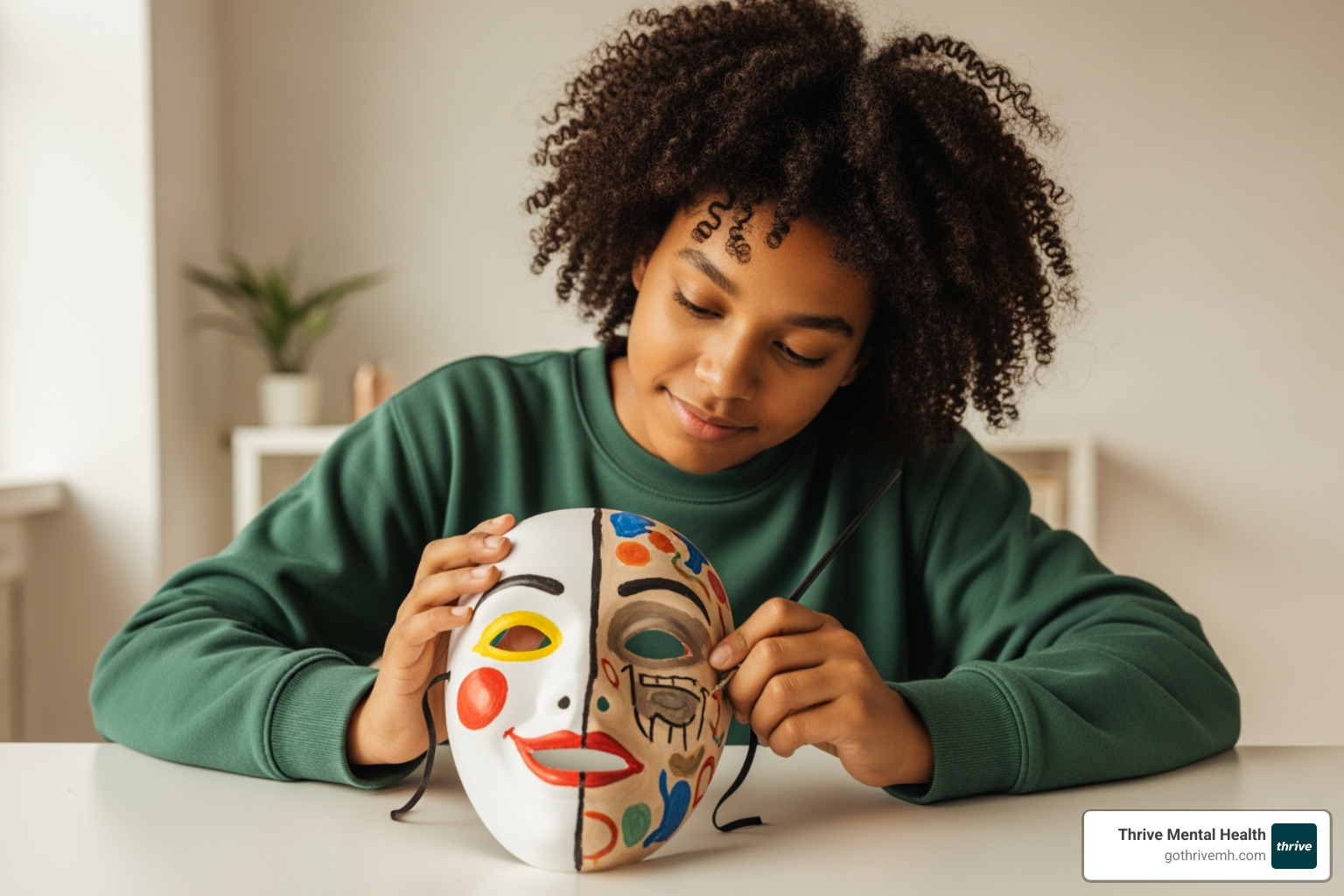
Depression forces teenagers to wear masks. They smile at school, say “I’m fine” at dinner, and save their real feelings for the dark. This activity makes that split visible.
Here’s how it works: Start with a plain craft mask or cut a paper plate into a face shape. On the outside, your teen decorates it to show how they present themselves to the world, the brave face, the “everything’s okay” persona. On the inside, they show how they really feel: the sadness, the hopelessness, the anger that nobody sees.
Why it helps: Depression thrives in secrecy. Externalizing hidden emotions into a tangible mask breaks the isolation and makes the pain visible. It opens a conversation about the weight of hiding and helps close the gap between the public face and private truth. This activity was created for people who struggle with the exhaustion of pretending.
2. Feelings Collage: Visualize Your Emotional Landscape
Sometimes emotions are too layered, too contradictory, too messy for sentences. A collage lets them exist all at once, without forcing them into order.
Here’s how it works: Give your teen old magazines, newspapers, fabric scraps, photos, glue, and a large piece of paper. Ask them to cut out images, words, textures, and colors that capture how they feel about their depression, their life, their future. No rules. No “right” way. Just arrange it however it wants to be arranged.
Why it helps: This art therapy activity for teenagers with depression uses symbolism to express complex feelings. A torn photo can represent broken relationships; dark colors can show sadness. When a teen explains their choices, it provides a window into their emotional world that direct questions can’t. For more ways to use creative expression, explore our guide on Mental Health Art Activities.
3. Sculpt Your Depression: Give Shape to Your Struggle
Clay is different. It’s tactile. It responds to pressure. It can be molded, transformed, or destroyed. That makes it perfect for depression that feels shapeless and unchangeable.
Here’s how it works: Hand your teen air-dry clay and ask them to sculpt their depression. What shape does it take? Is it heavy or light? Smooth or jagged? Big or small? Once it’s formed, they can choose what to do with it, reshape it, contain it, break it apart, or even throw it away.
Why it helps: Giving depression a physical form makes it tangible and manageable. The act of molding clay becomes a metaphor for control and personal growth, proving that change is possible. As Spotted Rabbit Studio on clay as a metaphor explains, this tactile process mirrors the journey of change.
4. The Lighthouse Drawing: An art therapy activity for a teenager with depression to find hope

When depression makes everything feel dark and directionless, finding a source of guidance, even an imagined one, can anchor a teenager to hope.
Here’s how it works: Ask your teen to draw a lighthouse. Then explore what it represents. Is it a person who supports them? A coping skill that helps? A future goal they’re working toward? An inner strength they forgot they had? What kind of light does it shine? What’s surrounding it, calm water or a storm?
Why it helps: This activity helps teens visualize their coping strategies and sources of safety. The activity involves imagining being lost at sea and creating a lighthouse to guide them home. It shifts focus from the darkness to the light, even when it’s hard to see.
5. Visual Journaling: A No-Pressure Way to Process Daily Feelings
Talk therapy happens once a week. Depression happens every day. Visual journaling bridges that gap with a private, ongoing space for reflection.
Here’s how it works: Encourage your teen to keep an art journal, just a blank notebook works fine. Whenever they feel moved to, they can draw, paint, collage, or write about their emotions and experiences. There are no rules. No one has to see it. It’s theirs alone.
Why it helps: Regular journaling helps teens track mood patterns, process emotions in the moment, and gain insight into triggers. As Mindful Art Studio on the forgiving nature of art journals notes, it’s a forgiving way to make art with no judgment, just honest self-expression.
6. Create a “Coping Skills” Box: Build Your Own Emotional First-Aid Kit
When depression hits hard, having a tangible resource to reach for can make all the difference. This activity creates exactly that.
Here’s how it works: Start with any box, a shoe box, a craft box, whatever. Your teen decorates the outside to reflect calm, resilience, or whatever feels right to them. Inside, they fill it with written affirmations, photos of happy memories, comforting scents, small meaningful objects, or reminders of their coping skills. Anything that brings comfort or strength.
Why it helps: This art therapy activity for teenagers with depression makes abstract concepts like “self-care” concrete. The self-care box is a comforting resource they can use during difficult moments, and its creation is therapeutic.
7. Draw Your Anxiety Monster: A powerful art therapy activity for a teenager with depression and anxiety
Depression and anxiety are often roommates in a teenager’s brain. Giving anxiety a physical form makes it feel less like an invisible force and more like something they can face.
Here’s how it works: Ask your teen to draw their anxiety or depression as a monster, creature, or abstract shape. What does it look like? What color is it? How big? What does it do to them? Then, they draw themselves in relation to it, standing up to it, shrinking it, caging it, or finding a way to coexist with it.
Why it helps: This activity externalizes and personifies overwhelming emotions, creating psychological distance and a sense of control. It helps teens recognize and manage these feelings. For more, see our resources on Anxiety Monster Drawing and how this activity allows participants to externalize anxiety in a manageable way.
8. Mandala Drawing: A Meditative Path to Calm
Sometimes the best thing for a depressed, anxious brain is to quiet it down. Mandalas do that through repetitive, focused creation.
 The Easiest Way to Use Bilateral Stimulation for Daily RegulationMental Health
Here’s how it works: Give your teen paper and drawing tools, markers, colored pencils, whatever they prefer. They draw a circle and then fill it with patterns, shapes, and colors from the center outward. No plan required. Just continuous creation within the circular boundary.
Why it helps: The repetitive nature of drawing patterns in a circle is deeply soothing. It quiets racing thoughts, reduces stress, and creates a meditative state. A study on mandala drawing reducing negative emotions shows this simple activity helps regulate emotions and find calm.
9. Words to Live By Collage: Visualize Your Core Values
Depression erodes a teenager’s sense of self and what matters to them. This activity helps them reconnect with their inner compass.
Here’s how it works: Similar to the feelings collage, but with a specific purpose. Provide magazines, newspapers, and art supplies. Ask your teen to create a collage that visually represents their core values, beliefs, positive affirmations, and the words or phrases they want to live by. What matters to them? What do they want to remember about themselves?
Why it helps: This activity clarifies values, reinforces positive self-talk, and visualizes future goals, building resilience against depression’s narrative of worthlessness. The Words to Live By activity helps teens visualize values in a tangible, motivating way.
10. Family Sculpture: Understand Your Support System
Family dynamics shape a teenager’s mental health, for better or worse. This activity makes those invisible dynamics visible.
Here’s how it works: Provide modeling clay, pipe cleaners, or small objects. Ask your teen to create a “sculpture” of their family, representing each member and how they relate to one another. They can show emotional distance or closeness, power dynamics, who supports whom, or who feels isolated.
Why it helps: This gives teens insight into their support system, revealing where support is strong or lacking. It highlights relationship dynamics that need attention. The family sculpture exercise is a popular art therapy activity because it makes abstract family dynamics concrete.
The Role of a Therapist: When to Seek Professional Help
There’s a world of difference between doodling in a notebook at home and working with a trained professional. While the art therapy activities for teenagers with depression we’ve shared can absolutely help your teen begin to express themselves, they’re most powerful when guided by someone who knows how to steer what surfaces.
Think of it this way: you can watch YouTube videos and learn to change your own oil, but when your engine light comes on and won’t turn off, you call a mechanic. Clinical depression isn’t something to DIY your way through alone.
What an Art Therapist Actually Does
An art therapist isn’t just handing out crayons and saying “draw your feelings.” They’re trained mental health professionals who understand both the therapeutic process and the language of visual expression. They create a safe, non-judgmental space where your teen can explore emotions that might be too scary or confusing to name out loud.
The magic happens in what comes after the creation. A skilled therapist asks the right open-ended questions, “What was it like to create this?” or “Tell me about the colors you chose”, that help your teen find insights they didn’t know they had. They’re trained to recognize patterns in the artwork that might signal deeper issues, and they know how to gently guide a teen through difficult emotions without pushing too hard.
The therapeutic relationship itself is often what makes healing possible. Research consistently shows that the bond between therapist and client is one of the strongest predictors of positive outcomes. When a teen feels truly seen and accepted by their therapist, they’re more willing to be vulnerable and do the hard work of healing.
Art therapists set concrete goals with your teen, like reducing symptoms, improving emotional regulation, or building coping skills. They track progress by noticing shifts in artwork themes and how your teen discusses their work. They are also trained to safely handle intense emotions that may arise during a session.
How Parents Can Support the Process
You don’t need to be a therapist to help your teen. In fact, some of the most powerful support comes from simply being present and curious. Keep art supplies accessible at home. Create a calm, judgment-free space where your teen can create. When they show you something they’ve made, resist the urge to interpret it or fix it. Instead, ask questions like “What does this mean to you?” or “How did you feel while you were making this?”
Validate whatever they share without trying to talk them out of their feelings. If they say their drawing represents anger or hopelessness, don’t rush to reassure them that everything’s fine. Just listen. Let them know their emotions are real and acceptable.
When It’s Time to Call in a Professional
If your teen is showing persistent signs of depression, withdrawal, changes in sleep or appetite, loss of interest in things they used to love, or talk of self-harm, it’s time to seek professional help. If they’ve tried talk therapy and it hasn’t worked, or if they flat-out refuse to talk about their feelings, art therapy might be the bridge they need.
At Thrive Mental Health, we integrate art therapy activities for teenagers with depression into our comprehensive treatment programs in Florida. Our Adolescent Intensive Outpatient Program combines evidence-based modalities, including art therapy, individual counseling, and group support, to give teens multiple pathways to healing. We serve families across Florida, with flexible virtual and hybrid options that work around school schedules.
Many insurance plans, including Cigna, Aetna, Optum, and Florida Blue, cover our programs. You can verify your benefits in about two minutes with no obligation.
The bottom line: creative expression at home is valuable. Professional guidance takes it to another level. If your teen is struggling, you don’t have to figure this out alone.
Frequently Asked Questions about Art Therapy for Depression
How does art therapy help a teenager who won’t talk about their depression?
When a teenager shuts down verbally, art therapy provides a side door into their emotional world. The creative process bypasses the need for articulate explanations and lowers the defenses that often keep feelings locked away. Through images, colors, and shapes, emotions like sadness, anger, and hopelessness can surface naturally, without the pressure of finding the “right” words.
What makes this particularly powerful is that once these emotions are externalized on paper or in clay, they become something a therapist can help the teen explore. The artwork becomes a bridge to conversation, making it easier to discuss difficult feelings that might have remained hidden otherwise. It’s not about avoiding talking forever, it’s about creating a gentler path toward it.
Does my teen need to be “good at art” to benefit?
Absolutely not. This is one of the most common misconceptions that keeps teens from trying art therapy activities for teenagers with depression. The entire focus is on the process of creation, not the artistic quality of what comes out.
Think of it this way: a scribbled mess of dark colors might reveal more about a teen’s inner turmoil than a technically perfect drawing ever could. The goal is self-expression and emotional exploration, not creating something Instagram-worthy. In fact, the freedom from judgment and performance is precisely what makes art therapy so effective. Your teen doesn’t need talent, they just need willingness.
Can these activities be done at home?
Yes, and many families find that creative activities at home become a valuable outlet for self-expression. The activities we’ve outlined can absolutely be done in your living room, at the kitchen table, or anywhere your teen feels comfortable.
However, there’s an important distinction to understand. While home-based creative expression is beneficial, it’s not the same as clinical art therapy for treating depression. The real therapeutic power comes when a trained art therapist helps the teen process the emotions and insights that arise during creation. They know which questions to ask, how to steer difficult revelations, and when to dig deeper or pull back.
For professional guidance that still offers the comfort of home, Thrive offers Virtual Counseling for Teens that brings expert support directly to your teen, no commute required.
What’s the difference between an art class and art therapy?
This is a crucial distinction. An art class teaches technique and skills, how to draw perspective, mix colors, or throw a pot on a wheel. The goal is creating a specific aesthetic outcome, and students are often evaluated on their technical proficiency.
Art therapy is a form of psychotherapy that happens to use the creative process as its vehicle. It’s facilitated by a mental health professional (an art therapist) who applies psychological theory to help individuals heal and gain insight. The artwork itself isn’t the goal, it’s the tool. The therapist isn’t critiquing composition or brushwork; they’re exploring what the colors, shapes, and symbols reveal about the teen’s inner world and helping them process those findies in a therapeutic context.
In other words: art class produces artists. Art therapy produces healing.
Your Teen’s Path to Healing Can Start Today
Depression doesn’t have to steal your teenager’s voice. Through art therapy activity for teenager with depression, they can express what they can’t say, process what they can’t name, and begin to heal without the pressure of perfect words.
These ten activities offer a starting point, a way for your teen to externalize their pain, visualize their struggles, and reconnect with hope. Whether it’s molding clay, drawing a lighthouse, or decorating a mask that shows their hidden self, each creative act is a step toward understanding and resilience.
But here’s the truth: while these activities can spark powerful self-findy at home, they reach their full potential when guided by a trained professional. An art therapist doesn’t just provide materials, they create a safe space where your teen can explore what surfaces in their art, process difficult emotions, and build lasting coping skills. They turn creative expression into clinical progress.
Thrive Mental Health integrates evidence-based modalities like art therapy into our programs for teens and young adults across Florida. Our virtual and hybrid Intensive Outpatient (IOP) and Partial Hospitalization (PHP) programs combine clinical expertise with flexible evening scheduling, because healing shouldn’t require your teen to miss school or you to miss work. And many of our programs are covered by insurance plans like Cigna, Aetna, Optum, and Florida Blue.
Your teen doesn’t have to carry this alone. And neither do you.
Ready for support? Thrive offers virtual IOP programs with evening options. Verify your insurance in 2 minutes (no obligation) → Start benefits check or call 561-203-6085. If you’re in crisis, call/text 988.

This article is for informational purposes only and is not a substitute for individualized clinical advice or insurance verification.