
Grief’s Canvas: Art Therapy Activities to Find Peace

Art Therapy Activities for Grief Counseling: 8 Gentle Peace
When Words Fail, Art Speaks
Art therapy activities for grief counseling offer a gentle, non-verbal path to healing when talk therapy feels overwhelming. These creative approaches help you process complex emotions, honor memories, and find meaning in loss—no artistic skill required.
Quick Answer: Top Art Therapy Activities for Grief
- Memory Box or Collage – Honor your connection through photos and mementos
- Clay Sculpting – Give physical form to emotions like anger or sadness
- Grief Mandala – Find calm through repetitive patterns and shapes
- Visual Journal – Track your non-linear healing journey
- Letter Writing – Express unsaid words and release regret
- Journey Mapping – Visualize your resilience and progress
- Scribble Drawings – Release raw emotion without thinking
- Emotion Wheel – Validate holding multiple feelings at once
Grief is a whole-body experience that lives in your chest, your shoulders, your stomach. When you’re grieving, words often fail. You might want to explain how you feel, but the language isn’t there, or you’re simply exhausted from talking about it.
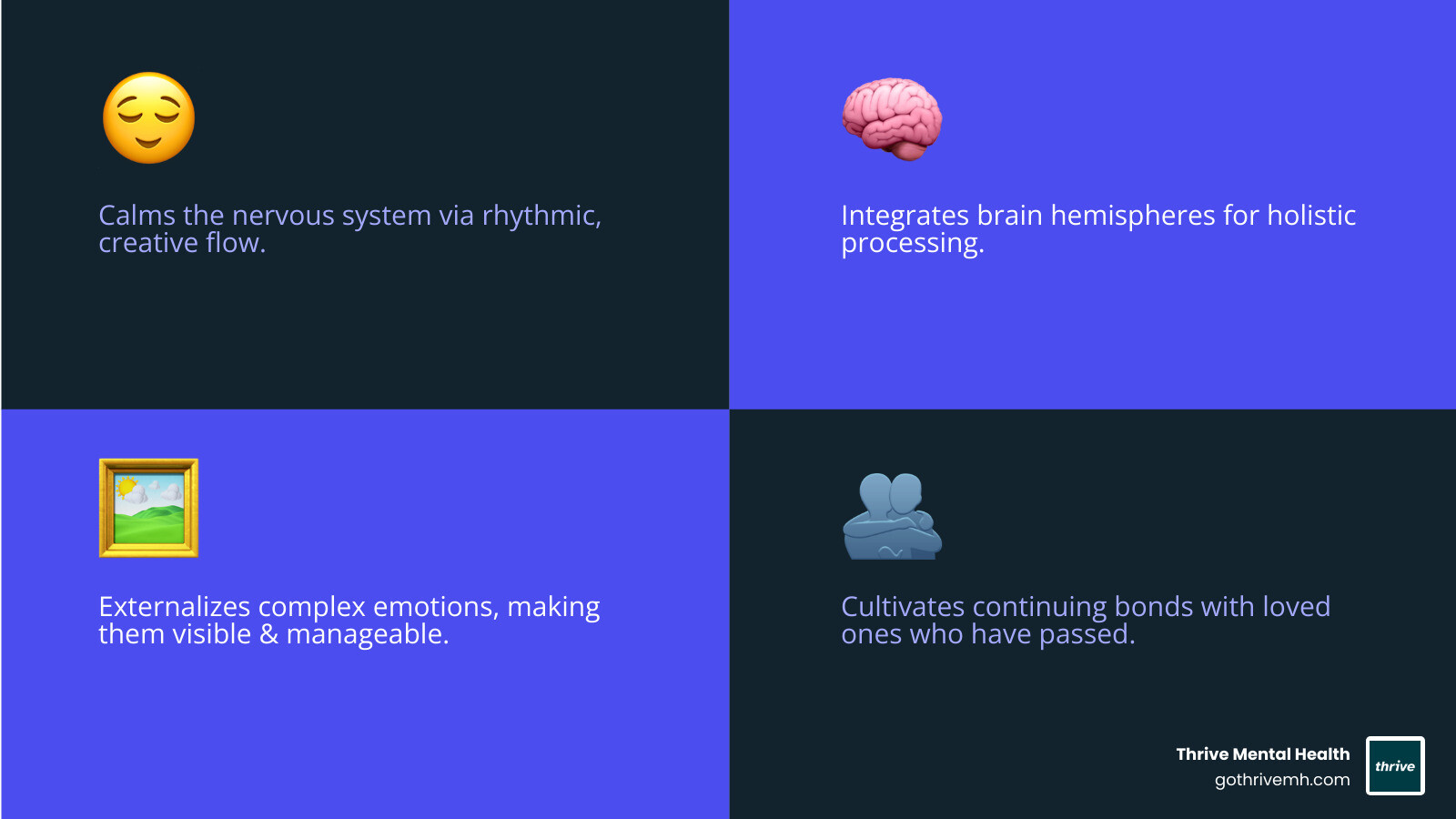
That’s where art therapy steps in. It’s not about creating a masterpiece; it’s about externalizing what’s stuck inside. The rhythmic motion of drawing or sculpting can calm a nervous system stuck in high alert, helping you find a middle ground between feeling numb and overwhelmed.
These activities are accessible and judgment-free. You don’t need expensive supplies or artistic training, just a willingness to create and heal at your own pace. At Thrive Mental Health, we’ve seen how art therapy provides breakthrough moments when traditional approaches feel stuck, helping individuals across Florida process loss and regain a sense of control.
Why Art Therapy Works for Grief [When Talk Therapy Isn’t Enough]
Grief is a whole-body phenomenon. When you can’t find the words to describe the tightness in your chest or the fog in your mind, art therapy activities for grief counseling offer a different path. The focus is on the process over the product—using the creative act as a bridge to your inner world.
Here’s why it’s so effective:
- It Bypasses Words: Language often fails when we grieve. Colors, shapes, and textures can express contradictory feelings like love and anger, or capture a sense of emptiness in ways words can’t. A jagged line can represent rage; a dark wash of blue can show sadness. Art gives form to feelings that resist explanation.
- It Calms the Nervous System: Grief often puts your body in a state of high alert. The rhythmic, repetitive motions of drawing, painting, or sculpting provide somatic relief, reducing stress hormones and helping you find a middle ground between feeling numb and being overwhelmed.
- It Externalizes Your Pain: Moving feelings from inside your head onto paper or into clay makes them tangible. This is where the healing power of art truly lies. What once felt unmanageable becomes visible and something you can work with.
- It Restores a Sense of Control: Loss can make you feel powerless. Art therapy gives you agency. You choose the colors, you shape the clay, you decide what goes on the page. These small choices are incredibly empowering when life feels chaotic.
- It Helps You Make Meaning and Maintain Bonds: Art helps you create a narrative for your loss, integrating it into your life story. A memory box or a visual journal becomes a tangible connection to your loved one, supporting a continuing bond that changes but doesn’t end.
While talk therapy is invaluable, art therapy offers a less draining way to explore emotions, reconcile conflicts, and foster self-awareness. To learn how we integrate art therapy into our virtual IOP/PHP programs, explore our approach to holistic healing for individuals throughout Florida.
8 Gentle Art Therapy Activities for Grief Counseling You Can Start Today
You don’t need to be an artist to benefit from art therapy activities for grief counseling. These exercises are about giving your grief an outlet, not creating a masterpiece. They are accessible, require simple materials like paper and colored pencils, and should be approached with self-compassion. There is no right or wrong way to do this—only permission to feel whatever comes up.

1. Create a Memory Box or Collage: Honoring Your Connection
Find a box—even a shoebox will do—and fill it with items that remind you of your loved one: photos, trinkets, fabric from a favorite shirt, letters, or ticket stubs. If a box feels too contained, create a collage on poster board with images and mementos.
Why it helps: This activity creates a tangible connection to your loved one. The act of gathering and arranging items is a ritual of remembrance that honors their memory and supports a “continuing bond,” reinforcing that the relationship changes but doesn’t end.
2. Sculpt Your Feelings with Clay: Giving Form to Grief
Grab a block of modeling clay or playdough. Without overthinking, let your hands mold, press, and shape the clay to reflect your emotions. You might create jagged shapes for anger, a heavy ball for sadness, or a tangled mess for confusion.
Why it helps: The tactile nature of clay provides a physical release for emotions stored in the body. This grounding activity offers somatic relief, releasing tension from your jaw, shoulders, and hands. It makes abstract feelings tangible.
3. Draw a Grief Mandala: Finding Center in the Chaos
Draw a large circle on a piece of paper. Fill it with patterns, shapes, and colors that reflect your current feelings about your grief. Start from the center or the edge—the patterns don’t need to be perfect, just expressive.
Why it helps: The circle represents wholeness and continuity, while the repetitive motion of drawing quiets a racing mind. It’s a meditative act that contains overwhelming emotions within a boundary, providing a sense of control and calm when life feels chaotic.
4. Start a Visual Grief Journal: Mapping Your Inner World
Dedicate a sketchbook to your grief journey. Instead of just writing, fill the pages with drawings, scribbles, paintings, or collages that express your daily emotions and memories. There are no rules—just let whatever needs to come out onto the page.
Why it helps: A visual journal is a safe container for your emotions and a record of your non-linear healing path. Looking back can reveal patterns, show you how far you’ve come, and validate your resilience, even on difficult days.
5. Write and Decorate a Letter You’ll Never Send
Write a letter to the person who died. Say everything you wish you’d said—express your regret, anger, love, and guilt. Don’t hold back. Afterward, decorate the letter with colors or symbols that feel meaningful. You can keep the letter, or burn it in a ritual of release.
Why it helps: This activity is a powerful ritual of communication that allows you to voice unsaid words and release trapped emotions. It is particularly effective for processing regret and guilt, as noted in studies on creative techniques for traumatic grief.
6. Map Your Grief Journey: Acknowledging Your Resilience
On a large sheet of paper, draw a path—a winding river, a mountain trail, or a road. Mark significant moments in your grief journey along this path: the initial shock, periods of deep sadness, unexpected moments of peace, and setbacks. Use colors and symbols to represent your emotions at each point.
Why it helps: This map normalizes the non-linear process of grief. It visually represents your resilience, showing you how far you’ve come and reminding you that setbacks are a natural part of the landscape, not a sign of failure.
7. Practice Expressive Scribble Drawings: Releasing Raw Emotion
When grief feels too intense for structured activities, grab a large piece of paper and a marker. Let your hand move freely across the paper, scribbling rapidly and pressing hard. Focus on releasing built-up energy and tension from your body, not on creating a specific image.
Why it helps: This technique is incredibly cathartic because it bypasses the thinking mind for direct emotional expression. It’s a judgment-free way to find immediate relief from overwhelming feelings.
8. Paint an Emotion Wheel: One of the most effective art therapy activities for grief counseling
Draw a large circle and divide it into pie slices. In each section, use color to represent a different emotion you’re feeling—sadness in blue, anger in red, confusion in gray, love in pink. Use whatever colors feel right to you.
Why it helps: This activity builds emotional literacy by helping you identify and name your feelings. It validates the experience of holding contradictory emotions at once (like love and anger, or hope and despair), normalizing the complexity of grief.
Adapting Art Therapy for Grief: Support for Children, Teens, and Adults
Grief is experienced differently at every age, so art therapy activities for grief counseling must be adapted to meet developmental needs. What works for a child may not resonate with a teen or adult, making a custom approach essential for effective support.

For Children: Play and Creation
For young children, art is a natural language. They can express feelings they don’t have words for through simple, tactile activities.
- Feelings Monsters: Using Play-Doh or clay to give a physical form to emotions like anger or sadness.
- Memory Boxes: Filling a special box with drawings, photos, and toys to maintain a connection with their loved one.
- Picture Stories: Drawing sequences to show what happened, how they felt, or memories they want to keep. The Draw It Out resource offers excellent guidance.
For Teens: Identity and Expression
Teens often feel caught between childhood and adulthood, and grief can complicate their search for identity. Art offers a private way to process complex feelings without judgment.
- Visual Journaling: A private sketchbook for honest expression through drawing, collage, and writing.
- Collage Work: Using magazine cutouts and song lyrics to explore their public persona versus their hidden pain.
- Mask-Making: Decorating a mask’s exterior to show the world, while the interior reveals their true feelings.
For Adults: A deeper look at art therapy activities for grief counseling
Adults often use art therapy to reflect, make meaning, and integrate loss into their life story. The focus shifts toward reconstructing identity and finding a way forward.
- Journey Mapping and Mandalas: These activities help adults reflect on their non-linear grief path and find a sense of wholeness and resilience.
- Legacy Projects: Creating a memory quilt, painting, or photo collection to honor the deceased and explore a continuing bond.
- Existential Exploration: Using art to process deeper questions about identity, worldview, and finding meaning in pain.
At Thrive Mental Health, our virtual IOP and PHP programs available in Florida integrate art therapy for all ages, adapting techniques to provide expert clinical support.
Frequently Asked Questions about Art Therapy for Grief
Do I need to be an “artist” to do art therapy?
Absolutely not. Art therapy activities for grief counseling are about the process of creation, not the final product. The goal is emotional expression, not a masterpiece. There is no judgment on skill, and you only need simple materials and a willingness to explore your feelings.

How does art therapy help with emotions I can’t put into words?
Grief often exists deeper than language. Art provides a non-verbal voice. Colors, shapes, and textures can express complex feelings like sadness, anger, or emptiness when words feel inadequate. By moving these feelings onto paper or into clay, you make them tangible and easier to process.
How do I know if art therapy for grief is actually working?
Progress is often subtle. Look for small shifts: a sense of relief after creating, a new insight into your feelings, or sleeping a little better. Your artwork may also change over time, moving from chaotic and dark to more integrated and balanced. Healing isn’t linear, but these are signs that it’s happening. For structured support in Florida, our virtual IOP/PHP programs provide expert guidance.
Conclusion: Create Your Path to Healing
The journey of grief is deeply personal. Art therapy activities for grief counseling offer a language beyond words, helping you transform pain into meaning and isolation into connection. These creative tools build lasting emotional resilience and provide coping skills you can use whenever grief resurfaces.
At Thrive Mental Health, we’ve seen this change in our communities across Florida. Our expert-led programs integrate art therapy with other evidence-based approaches to create comprehensive, personalized support. We offer flexible virtual and in-person options with evening scheduling, and our programs are covered by many insurance plans, including Cigna, Optum, and Florida Blue.
If you’re in crisis, call/text 988 right now. You are not alone.
Ready for support? Thrive offers virtual and hybrid IOP/PHP programs with evening options. Verify your insurance in 2 minutes (no obligation) → Start benefits check or call 561-203-6085. If you’re in crisis, call/text 988.