




Art therapy in an Intensive Outpatient Program (IOP) is structured clinical work, not an art class. A licensed therapist uses drawing, painting, or other visual media to help you express what’s difficult to put into words, then guides you through what comes up, feelings, memories, patterns, using the same evidence-based framework as the rest of your IOP care. At Thrive, art therapy runs alongside CBT, DBT, EMDR, and MBT in our virtual IOP programs. This piece walks through what that looks like in practice, who tends to benefit, and what the research says.
What art therapy actually is (and isn’t)
Art therapy is a clinical mental health treatment delivered by a credentialed therapist, typically someone with an LPC, LCSW, LMHC, or PsyD who has additional training in expressive arts, or a registered art therapist (ATR). The American Art Therapy Association defines it as the use of creative process, guided by a therapist, to improve cognitive, sensory, and emotional functioning. It’s not a craft hour. It’s not a relaxation tool with a marker. It’s the same kind of clinical work that happens in talk therapy, with a different entry point.
That entry point matters. For people with trauma, anxiety, or conditions where words run out, borderline personality, OCD, dissociation, visual expression can surface what verbal processing can’t reach. Then the therapist helps you understand what surfaced, exactly the way they’d in a CBT or EMDR session.
How it works inside a virtual IOP
Thrive’s IOP runs 9-12 hours of clinical care per week, delivered virtually. Most clients attend three group sessions of three hours each, plus individual therapy. Art therapy slots into the group hours as one of several modalities your clinician selects based on the week’s clinical goal.
A typical virtual art therapy group runs about 60-75 minutes. Your clinician prompts a directed exercise, for example, mapping a recent emotion as a color, drawing what your anxiety looks like, or sketching a “safe place” image. You work in your own space with your own supplies. The group then shares (only what you want to share), and the clinician helps each person process what came up.
This isn’t show-and-tell. It’s a clinical intervention, the therapist watches for themes, attachment patterns, defense mechanisms, and trauma responses the same way they would in any group therapy session, then names them, normalizes them, and ties them back to skills you’re building elsewhere in the program.
How art therapy integrates with CBT, DBT, EMDR, and MBT
Art therapy isn’t a replacement for evidence-based modalities. It’s a complementary tool that often makes those modalities work better.
- With CBT: drawing distorted thoughts can externalize them, making it easier to challenge them in the next CBT session. “I am unlovable” is harder to fight in your head than on a page.
- With DBT: art is a high-leverage distress tolerance skill (one of DBT’s four modules). Many clients keep using it after discharge as part of their crisis plan.
- With EMDR: visual processing can prepare a memory for trauma reprocessing, especially when verbal recall is fragmented or dissociative. A 2018 review in The Arts in Psychotherapy found art-based interventions plus EMDR improved trauma symptom reduction over EMDR alone in complex PTSD.
- With MBT (Mentalization-Based Treatment): drawing what someone else might be thinking helps build the perspective-taking skills MBT centers on, particularly for clients with borderline traits.
None of these are “art therapy as the main treatment.” They’re integrated approaches, your therapist coordinates which modality fits the moment.
Who benefits most from art therapy in IOP
Research and clinical experience converge on a few populations:
- Trauma and PTSD. When the trauma is preverbal, dissociative, or wrapped in shame that’s hard to speak, visual expression often opens what talk therapy can’t. A 2017 systematic review in Frontiers in Psychology found art therapy reduced PTSD symptoms across adult and adolescent populations.
- Anxiety disorders. The repetitive, sensory nature of mark-making down-regulates the sympathetic nervous system, clients with panic and GAD often report measurable reductions in baseline arousal after sessions.
- Eating disorders and body image distress. Body mapping and self-portrait work surface relationships with the body that verbal processing tends to skim over.
- Adolescents and young adults. Verbal therapy can feel performative or surveilled. Visual work side-steps that defense.
- Adults with alexithymia (difficulty identifying emotions). Visual cues give a language for feelings the person can’t yet name.
What a typical session looks like
A virtual art therapy session at Thrive typically follows a five-part arc:
- Check-in (5-10 min). Each member names their current state. Clinician notes the group’s emotional baseline.
- Prompt (5 min). Clinician introduces a directive, for example, “draw the part of your week you’ve been avoiding”, and explains the clinical rationale.
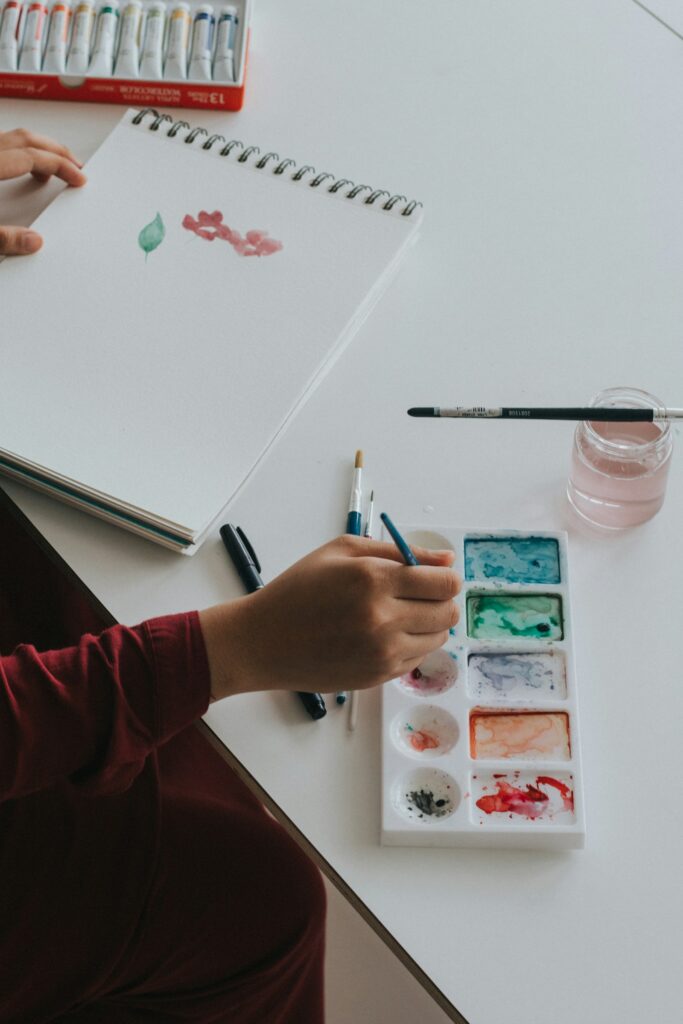
- Work (20-30 min). You work in your own space with whatever supplies you have. Most Thrive clients use a simple set: paper, pencils, markers, and one watercolor brush. No artistic skill required and not assessed.
- Share (15-20 min). Each member shows their work, or doesn’t, and describes what came up. The clinician guides the discussion using the modality the group is working in that week (CBT, DBT skills, etc.).
- Close (5-10 min). Each member names one thing they’re taking with them and one self-care step before the next session.
You keep your work. Many clients build a personal portfolio across treatment that becomes a relapse-prevention tool after discharge.
What the evidence shows
Art therapy in clinical mental health settings has a growing evidence base. A few of the strongest signals:
- A 2017 meta-analysis in BMC Psychiatry across 27 randomized trials found art therapy produced significant reductions in anxiety, depression, and trauma symptoms compared with treatment-as-usual.
- SAMHSA lists creative arts therapies as an evidence-informed practice in trauma-focused care.
- The Joint Commission, which accredits Thrive, recognizes expressive arts as a legitimate component of behavioral health treatment when delivered by credentialed staff.
The body of evidence is smaller than that for CBT or EMDR, which is why we use art therapy as a complement rather than a primary modality. But the research that exists is consistent, it works, especially for trauma, anxiety, and clients who struggle with purely verbal processing.
Is art therapy covered by insurance?
When art therapy is delivered inside a credentialed IOP, like Thrive’s, it’s covered as part of the program’s overall behavioral health benefit, not as a separate service line. Your insurance pays for the IOP per diem or per session, and the art therapy hour is one of the modalities that fills that time. We accept most major commercial plans and verify benefits free of charge before you start.
 IOP Classes 101: Intensive Help Without Intensive HassleIntensive Outpatient Program
Standalone art therapy, meeting a private-practice art therapist once a week, outside an IOP, is harder to bill insurance for in most states. That’s not what we offer; we offer art therapy as one of several integrated modalities inside a full clinical program.
Frequently asked questions
Do I need to be good at art to do art therapy?
No. The work is about expression and process, not the finished piece. Many clients use stick figures, color swatches, or simple marks. Your clinician is reading the process, not the product.
What supplies do I need for virtual art therapy?
The basic kit: a few sheets of paper, pencils, markers, and one set of watercolors with a brush. Thrive sends a recommended supply list during your intake, and most can be purchased for under $30. Anything you already have at home works.
Is art therapy the same as art class or a creativity workshop?
No. Art class teaches technique. Art therapy is clinical mental health treatment delivered by a licensed therapist using creative process as the medium. The goals are clinical, symptom reduction, insight, skill-building, not artistic.
Can art therapy replace medication?
No. Art therapy is psychotherapy, and like any psychotherapy it works alongside, not instead of, medication when medication is clinically indicated. Decisions about psychiatric medication belong with a prescribing clinician.
How many art therapy sessions are included in Thrive’s IOP?
It varies by week and by program. Your clinician structures the group hours based on what the week’s clinical goal calls for. Some weeks include art therapy; others may lean more heavily on DBT skills or process work. Across a typical 8-12 week IOP, most clients have 6-12 art therapy sessions.
Find out if Thrive’s virtual IOP, including art therapy, is right for you. Free, confidential insurance verification. Most members get a benefits summary within 24 hours.
Related from Thrive
While art therapy in IOP uses different tools than dialectical behavior therapy, both share the same underlying goal: giving you a way to work with intense emotion when words alone cannot reach it. Read DBT Therapy: What It Is, How It Works, and Who It Helps.

This article is for informational purposes only and is not a substitute for individualized clinical advice or insurance verification.