
Navigating Orlando Intensive Outpatient Programs for Youth

Top 1 Healing: Adolescent intensive outpatient programs near me orlando serve young adults
Adolescent Intensive Outpatient Programs in Orlando: A Parent’s Guide
Adolescent intensive outpatient programs near me orlando serve young adults who need more support than weekly therapy can offer but don’t require 24/7 residential treatment. If you’re an Orlando parent watching your teen struggle with anxiety, depression, or behavioral challenges, you’re facing a critical decision about the right level of care.
Quick Answer: Orlando Adolescent IOP
- What it is: Structured mental health treatment (9-12 hours/week) while teens live at home.
- Who it helps: Ages 12-17+ with depression, anxiety, trauma, and behavioral issues.
- When to consider: When weekly therapy isn’t enough, but inpatient care isn’t necessary.
- Available in Orlando: Thrive Mental Health offers flexible virtual and in-person programs.
- Insurance: Most major plans accepted (Florida Blue, Cigna, Optum, TRICARE, Medicaid).
The numbers tell a sobering story. Youth mental health challenges are rising, with parents across Central Florida reporting increased anxiety, school refusal, and social withdrawal in their teens. The good news? With the right intensive outpatient program (IOP), 90% of adolescent clients with severe depression see measurable improvements.
IOPs bridge a critical gap. Your teen gets evidence-based therapy and peer support multiple times per week while still sleeping in their own bed and maintaining connections to school and friends. Programs offer flexible after-school schedules, family therapy, and specialized tracks for LGBTQIA+ youth, neurodivergent teens, and trauma survivors.
At Thrive Mental Health, we’ve spent years developing intensive outpatient programs that deliver measurable outcomes for teens. We understand how adolescent intensive outpatient programs near me orlando serve young adults who need flexible, evidence-based care that fits into their life.
What Is an Intensive Outpatient Program (IOP) for Teens?
If you’re searching for adolescent intensive outpatient programs near me orlando serve young adults, you’re likely trying to find the right level of support for your teen. An IOP is the answer when weekly therapy isn’t enough, but residential treatment feels like too much.
An Intensive Outpatient Program is a structured mental health treatment that meets multiple times per week—typically 9 to 12 hours over 3 to 4 days—while your teen lives at home and attends school. It’s for adolescents who need more than a weekly session but don’t require 24/7 supervision.
Think of it this way: weekly therapy is like a vitamin for maintenance. Residential treatment is like a hospital stay for a crisis. An IOP is the focused, therapeutic middle ground. It doesn’t pull your teen out of their world; it gives them tools to use immediately at home and school.
Thrive Mental Health’s programs are built on this philosophy. Teens receive evidence-based therapy (like CBT and DBT) and group support with peers who understand their struggles. Because they apply what they learn in real-time, they create lasting change.
Virtual IOPs, like those available through Thrive’s intensive outpatient programs, make this care even more accessible by removing transportation barriers and offering a private, comfortable setting for anxious teens.
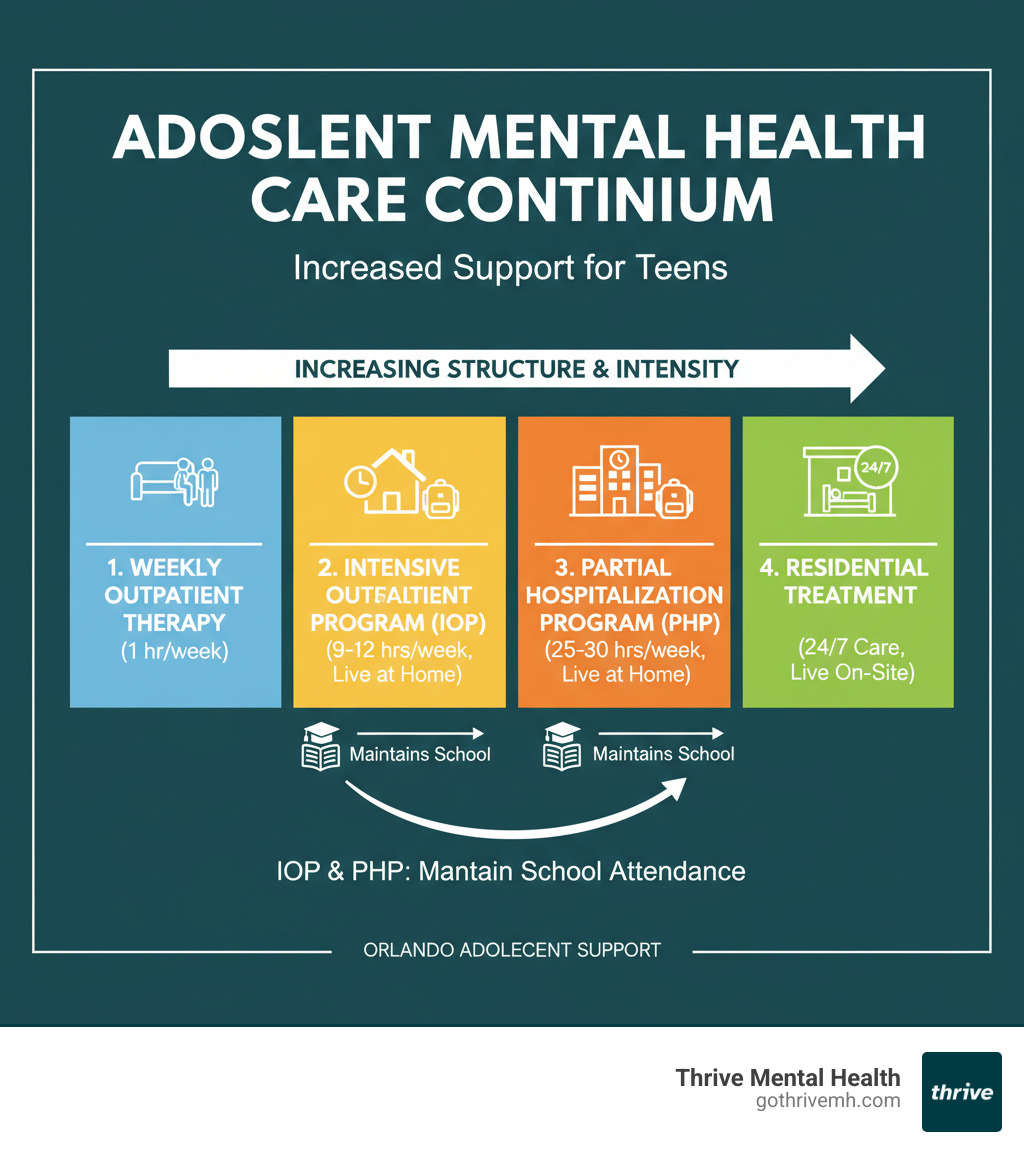
Here’s how IOPs compare to other levels of care:
| Treatment Level | Hours/Week | Living Situation | Ideal Candidate |
|---|---|---|---|
| Weekly Therapy | 1-2 hours | At home | Mild symptoms, seeking support for specific issues, or maintaining progress. |
| Intensive Outpatient Program (IOP) | 9-12 hours (3-4 days/week) | At home | Needs more structure than weekly therapy, has a supportive home environment, or is stepping down from higher care. |
| Partial Hospitalization Program (PHP) | 25-30 hours (5 days/week) | At home | Requires intensive daily treatment, significant symptoms impact daily functioning, or is stepping down from residential care. |
| Residential Treatment | 24/7 care | Facility on-site | Severe symptoms, safety concerns, needs removal from triggering environments, or has not succeeded in lower levels of care. |
The flexibility of an IOP is what makes it so effective. Teens learn to manage their mental health while still living their lives, and built-in family therapy ensures parents are part of the healing process.
If your teen is struggling but is safe at home and motivated to get better, an IOP provides intensive support that fits into the life they’re already living.
Who Benefits? Conditions Treated by Adolescent IOPs in Orlando
CALLOUT BOX: If you or your teen are in crisis or thinking about self-harm, call or text 988 now to connect with the 988 Suicide & Crisis Lifeline. You are not alone.

Adolescent intensive outpatient programs near me orlando serve young adults dealing with a wide range of mental health challenges that feel too big for weekly therapy alone. IOPs are designed to address the real issues teens face today, including:
- Depression and Anxiety: Persistent sadness, panic attacks, and overwhelming worry.
- Trauma and PTSD: A safe place to process difficult experiences without being retraumatized.
- Substance Use: Dual diagnosis treatment that addresses both addiction and underlying mental health struggles.
- School Refusal and Bullying: Developing skills to face social challenges and reconnect with education.
- Family Conflict and Self-Esteem Issues: Rebuilding relationships and self-worth through individual and family therapy.
Who’s a Good Fit for Adolescent IOP?
IOP works best when a few key things are in place. Your teen should be:
- Medically stable and not an immediate danger to themselves or others. For urgent safety concerns, a higher level of care is the right first step.
- Needing more than weekly therapy. If symptoms are worsening despite regular sessions, IOP can provide the needed intensity.
- Motivated to engage. While enthusiasm isn’t required, a willingness to participate is essential for progress.
- In a supportive home environment. Family involvement is a top predictor of success, as teens practice new skills at home.
- Able to function in daily life with support, such as attending school.
- Stepping down from higher care, like residential or PHP, and needing continued structure.
Specialized Support Tracks
Quality programs offer specialized tracks because cookie-cutter treatment doesn’t work. At Thrive, we tailor care to specific needs:
- LGBTQIA+ Affirming Care: A safe space for queer and trans youth to explore identity and address related mental health challenges.
- Neurodivergent Support: Custom approaches for teens with ADHD or autism, focusing on executive function, emotional regulation, and social skills.
- Trauma-Informed Therapy: Techniques that help teens process trauma without being retraumatized.
- Gender Dysphoria Support: Affirming care for transgender and gender non-conforming youth to steer transition-related stress and identity exploration.
- Eating Disorder Treatment: Using approaches like Health at Every Size to address the complex relationship between mental health, body image, and food.
At Thrive Mental Health’s IOP and PHP programs, we meet teens where they are. The right IOP provides the structure and support they need to heal while staying connected to their life.
What to Expect: A Day in Orlando’s Top Youth IOPs
When considering an IOP, you want to know what actually happens. Will it fit your schedule? What will your teen do? Will it help?

Adolescent intensive outpatient programs near me orlando serve young adults with schedules designed around real life. Most programs run during after-school or evening hours, 3-4 days per week, for about 3 hours per session. This adds up to 9-12 hours of therapy weekly, allowing your teen to attend school, do homework, and sleep in their own bed.
At Thrive Mental Health, our virtual and hybrid programs include evening options because we know families are juggling school, work, and other commitments.
A typical IOP includes several core components:
- Group Therapy: The heart of the program. Teens connect with peers who “get it,” reducing isolation and building social skills.
- Individual Therapy: One-on-one time with a primary therapist to explore personal challenges and set goals.
- Family Therapy: Built-in sessions to improve communication, resolve conflict, and teach the family how to support each other. Family involvement is the #1 predictor of success.
- Evidence-Based Therapies: Proven methods like Cognitive Behavioral Therapy (CBT) to change negative thought patterns and Dialectical Behavior Therapy (DBT) to teach emotion regulation and distress tolerance.
- Aftercare Planning: A plan for what comes next, including ongoing therapy, support groups, and relapse prevention strategies.
Family Involvement in IOP
Your teen’s mental health affects the entire family. That’s why quality IOPs make family involvement a priority. Through regular family therapy sessions, you’ll learn new communication patterns and build a more supportive home environment. Many programs also offer parent support groups and psychoeducation to equip you with the tools to help your teen thrive. At Thrive Mental Health, we see parents as essential partners in the healing process.
Balancing School and Treatment
One of parents’ biggest concerns is how their teen will keep up with school. IOPs are designed to integrate with academic life, not replace it. Sessions are held after school, so teens don’t miss class. In fact, the goal is to provide the mental health support needed for them to succeed academically.
Many IOPs, including Thrive, will coordinate with your teen’s school (with your permission) to arrange accommodations and ensure a smooth experience. Some programs also offer dedicated study time or virtual classroom options. A well-designed IOP recognizes that mental well-being and academic success are deeply connected.
Ready to learn more about how Thrive’s flexible IOP programs can fit into your teen’s life? Explore our virtual therapy options or verify your insurance today.
How to Choose the Right Orlando IOP for Your Teen
Finding the right adolescent intensive outpatient programs near me orlando serve young adults is a critical decision. Asking the right questions can help you find a program that fits your teen’s needs and your family’s values.

Key factors to consider:
- Accreditation: Look for programs accredited by The Joint Commission or CARF. This is your assurance that the program meets rigorous national standards for quality and safety.
- Staff Experience: Are the therapists licensed professionals with specific experience treating adolescents? You want clinicians who understand teen development and can connect with them authentically.
- Therapeutic Approach: Does the program use evidence-based therapies like CBT, DBT, or EMDR? A quality program should be able to explain its clinical methods clearly.
- Family Involvement: How does the program include parents? Look for regular family therapy, parent support groups, and psychoeducation.
- Location and Format: Consider the logistics of in-person programs. Virtual options, like those at Thrive, eliminate transportation barriers and offer greater flexibility and privacy.
- Program Philosophy: Does the program feel like the right fit? Look for a trauma-informed, holistic approach that resonates with your family.
Learn more about Thrive’s IOP and virtual therapy options
Insurance and Payment: What Parents Need to Know
Worrying about how to pay for treatment shouldn’t prevent your teen from getting help. Mental health parity laws require most insurance plans to cover IOP treatment similarly to medical care.
Thrive accepts most major insurance plans, including Florida Blue, Cigna, Optum, and Aetna. Being in-network means significantly lower out-of-pocket costs. Even if we’re not in-network with your plan, you may have out-of-network benefits that cover a substantial portion of the cost. Our team can help you steer your benefits.
For those without coverage or who prefer not to use it, we offer transparent self-pay rates and flexible payment plans. We believe in honest, upfront pricing with no surprise bills. Financial assistance may also be available for qualifying families.
The easiest way to understand your coverage is to verify your insurance. It takes just a few minutes and comes with no obligation. This will give you clear information on what your plan covers for adolescent intensive outpatient programs near me orlando serve young adults. You can verify your insurance in just two minutes or call us at 561-203-6085 to speak with our team. We’re here to advocate for you so you can focus on your teen’s recovery.
Frequently Asked Questions about Adolescent IOPs in Orlando
How long does an adolescent IOP usually last?
The duration of an adolescent IOP is highly individualized, depending on your teen’s specific needs, progress, and the severity of their condition. On average, programs typically last 8–12 weeks. However, some teens may benefit from a shorter period, while others might require a longer engagement to achieve their therapeutic goals. The length is determined through ongoing clinical assessments and collaboration with your family.
Are virtual IOPs as effective as in-person for teens?
Yes, for many teens, virtual IOPs can be just as effective as in-person programs, and sometimes even more so. Virtual programs offer significant flexibility, allowing teens across Florida to receive treatment from the comfort and privacy of their home, which can reduce anxiety, transportation barriers, and stigma. They also enable teens to practice new skills in their natural environment immediately. The best fit depends on your teen’s specific needs, their comfort with technology, and the nature of their challenges. At Thrive, we’ve seen over 91% of our clients experience improvements in their most severe mental health symptoms through our virtual IOP programs.
What’s the difference between IOP and PHP for adolescents?
The main difference lies in the intensity and time commitment. An Intensive Outpatient Program (IOP) for adolescents typically involves 9–12 hours of therapy per week, usually spread across 3-4 days in after-school or evening sessions. This allows teens to continue attending school and participate in daily activities. A Partial Hospitalization Program (PHP), on the other hand, is more intensive, requiring 25–30 hours of treatment per week, typically 5-6 hours a day, 5 days a week. PHP is a step below inpatient care and is often used for teens who need significant structure but can still return home at night. IOP is often a “step-down” from PHP or residential care.
Your Teen Can Heal—Get Help from Thrive Today
Seeking help takes courage, and it’s the most important first step. We want you to know that hope is real, and recovery is possible. We’ve walked alongside countless families and witnessed incredible change.
The teen years are hard enough without the weight of anxiety, depression, or trauma. When weekly therapy isn’t enough, adolescent intensive outpatient programs near me orlando serve young adults by providing the right balance of structure and flexibility.
At Thrive Mental Health, our virtual and hybrid Intensive Outpatient (IOP) and Partial Hospitalization (PHP) programs are designed for this exact moment. We use evidence-based approaches delivered by experienced clinicians who care about your teen’s progress. And because life doesn’t stop for treatment, we offer evening options that work around school and family commitments.
Whether you’re in Orlando, Miami, or anywhere else across Florida, our virtual programs bring expert care directly to your home. No long drives or waiting rooms—just consistent, compassionate support. We accept most major insurance plans, including Florida Blue, Cigna, Optum, and Aetna, and our team will help you understand your coverage with zero pressure.
Your teen’s story doesn’t end with their struggle. With the right support, they can build the resilience and confidence to thrive.
Ready for support? Thrive offers virtual and hybrid IOP/PHP with evening options. Verify your insurance in 2 minutes (no obligation) → Start benefits check or call 561-203-6085. If you’re in crisis, call/text 988.