
Beyond Inpatient: Unpacking the Partial Hospitalization Program

Your Bridge to Recovery: An Introduction to PHP
What is a partial hospitalization program? A Partial Hospitalization Program (PHP) is an intensive, structured mental health treatment option that provides several hours of clinical care each day—typically 4-6 hours, five days a week—while allowing you to return home each evening. It sits between inpatient hospitalization and traditional outpatient therapy, offering a critical middle ground for people who need more than weekly sessions but don’t require 24/7 supervision.
Quick Answer:
- Level of Care: More intensive than outpatient therapy or IOP, less restrictive than inpatient hospitalization
- Time Commitment: 4-6 hours per day, 5 days per week (20-30 hours total)
- Living Situation: You live at home and commute to treatment daily
- Clinical Team: Access to psychiatrists, therapists, nurses, and peer support
- Purpose: Crisis stabilization, medication management, skill-building, and relapse prevention
- Ideal For: Adults who need structured support but are stable enough to manage evenings and weekends independently
If you’ve hit a wall with weekly therapy, recently left inpatient care, or feel like your symptoms are spiraling but you’re not in immediate danger—PHP might be the most effective next step. It’s designed for people ready to do the work of recovery without putting their entire life on hold.
Why this matters now: According to recent data, more than one-third of metropolitan hospitals in the U.S. provide PHP services, yet many people still don’t know this option exists. PHPs have been shown to deliver outcomes equal to or better than inpatient care, with higher patient satisfaction and lower costs—all while letting you sleep in your own bed and stay connected to your support system.
As CEO of Thrive Mental Health, I’ve spent over a decade working at the intersection of mental health innovation and evidence-based care, helping thousands of people find the right level of support when traditional therapy isn’t enough. We are proud to bring this expertise to our communities across Florida, and understanding what is a partial hospitalization program is essential for anyone navigating the mental health continuum and seeking measurable, life-changing results.
What is a partial hospitalization program terms to know:
- are partial hospitalization programs effective
- how long is a partial hospitalization program
- iop vs php
What is a Partial Hospitalization Program (PHP) and How Does It Work?
A Partial Hospitalization Program (PHP) is a comprehensive, structured mental health treatment option that provides an intensive level of care without requiring an overnight stay. Think of it as a bridge between the 24/7 supervision of inpatient care and the less frequent sessions of traditional outpatient therapy. At Thrive Mental Health, we offer virtual and in-person PHPs across Florida, designed to deliver clinical expertise with flexible scheduling and measurable results.
The core purpose of a PHP is to offer intensive day treatment for individuals struggling with significant mental health challenges that interfere with their daily functioning. This could involve crisis stabilization, where immediate, focused intervention is needed to prevent further decline or inpatient admission. It’s about providing structured support and skill-building in a safe, therapeutic environment, allowing you to learn and grow while still having the comfort and familiarity of returning to your own home each evening.
The goal of a PHP is always goal-oriented care. We focus on helping you develop practical coping strategies, manage symptoms, and build resilience. This intensive approach allows for consistent application of learned skills in your real-world environment, which is crucial for sustainable recovery. The number of CMHC-based PHPs grew significantly from 1993 to 1997, and by 2016, a substantial portion of hospitals in the U.S. provided these services, highlighting their recognized value in the mental health landscape.
The Core Structure of a PHP
The structure of a PHP is designed to be highly intensive and immersive. Most PHPs for adult patients provide services during the day, 5 days per week, and average 5 to 6 hours of programming per day. This significant time commitment ensures that you receive consistent, high-quality care.
Our programs at Thrive Mental Health are led by a multidisciplinary team of experts. This team typically includes psychiatrists, licensed therapists, nurses, and other mental health professionals, all working collaboratively to provide a holistic approach to your care. The collective expertise of this team allows for comprehensive assessments, individualized treatment plans, and continuous support throughout your journey. For a deeper understanding of the services offered, explore A deep dive into PHP mental health services.
Defining what is a partial hospitalization program in the continuum of care
Understanding what is a partial hospitalization program means recognizing its unique position within the broader mental health continuum of care. It serves several critical functions:
- Step-down from inpatient care: For many, a PHP is the ideal next step after completing an inpatient or residential treatment program. It provides a structured transition, allowing you to gradually reintegrate into your daily life while still receiving intensive support, reducing the risk of relapse or re-hospitalization.
- Step-up from IOP: If traditional outpatient therapy or an Intensive Outpatient Program (IOP) isn’t providing enough support, a PHP can offer a more robust intervention. It’s a “step-up” for those who need more intensive care but don’t meet the criteria for inpatient admission.
- Alternative to hospitalization: In many cases, a PHP can serve as a direct alternative to inpatient hospitalization. If you’re experiencing acute symptoms but can maintain safety at home with significant daily support, a PHP can help stabilize your condition and prevent the need for a 24/7 hospital stay. This can be more efficient and cost-effective, offering superior or equivalent recovery-based care with greater patient satisfaction compared to inpatient treatment.
The role of PHPs in providing crisis-oriented and recovery-based treatment is well-documented. They empower individuals to gain stability and develop coping skills in a less restrictive environment. Learn more about their comprehensive approach in Providing Crisis-oriented and Recovery-based Treatment in Partial Hospitalization Programs. For a broader perspective on this level of care, consider A guide to partial hospitalization programs.
PHP vs. IOP vs. Inpatient: Which Level of Care is Right for You?
Choosing the right level of mental health care can feel overwhelming, but understanding the distinctions between Inpatient, PHP, and IOP is crucial. It’s not about finding the “best” program, but the “best fit” for your unique needs, based on a thorough clinical assessment and medical necessity.

Clinical Assessment and Medical Necessity
The journey begins with a comprehensive clinical assessment. This evaluation, often conducted by a mental health professional, helps determine the severity of your symptoms, your level of functioning, and whether you pose an immediate danger to yourself or others. Medical necessity is the guiding principle: what level of care is clinically required to stabilize your condition and promote recovery?
For instance, if you’re experiencing severe depressive episodes with active suicidal ideation or psychosis, inpatient treatment might be necessary for your safety. However, if you’re stable enough to be at home but still require significant daily structure and therapeutic intervention, a PHP could be the appropriate choice. If you’re managing symptoms well with some support but need more than weekly therapy, an IOP might be ideal.
Comparing Levels of Care
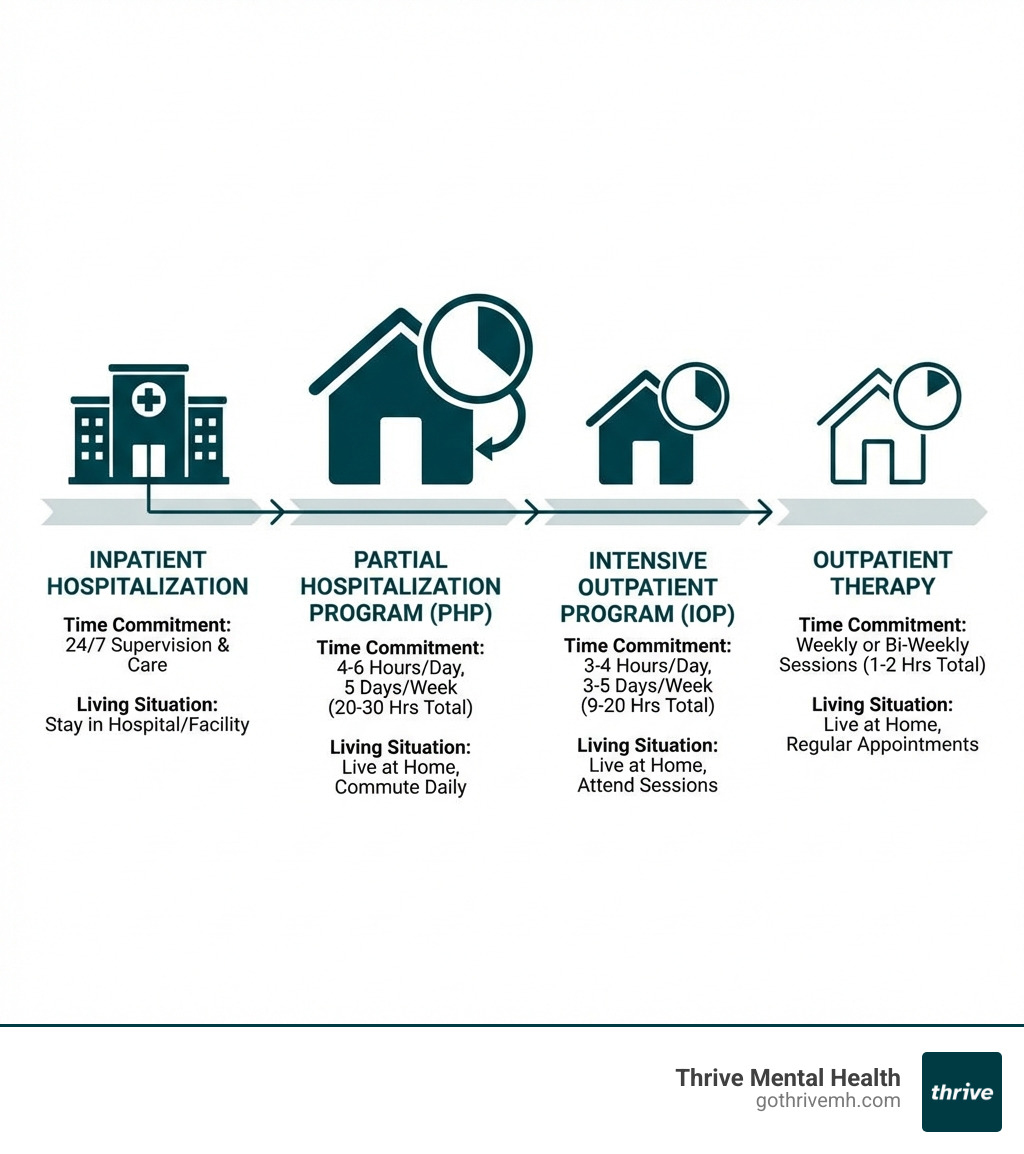
Here’s a table comparing Inpatient, PHP, and IOP to help clarify their differences:
| Criteria | Inpatient Treatment | Partial Hospitalization Program (PHP) | Intensive Outpatient Program (IOP) |
|---|---|---|---|
| Time Commitment | 24 hours/day, 7 days/week | 4-6 hours/day, 5 days/week (approx. 20-30 hours/week) | 2-4 hours/day, 3-5 days/week (approx. 9-15 hours/week) |
| Living Situation | Reside at facility (hospital, residential center) | Live at home, commute to treatment daily | Live at home, commute to treatment multiple times a week |
| Supervision Level | 24/7 medical and psychiatric supervision | Structured daily treatment, medical oversight available; return home evenings/weekends | Structured therapy sessions; manage daily life independently; less frequent medical oversight |
| Ideal Candidate | Acute crisis, immediate danger to self/others, severe symptoms requiring constant monitoring | Significant functional impairment, needing intensive daily support but stable enough to return home; step-down from inpatient; step-up from IOP | Moderate symptoms, needs more than weekly therapy but can maintain daily responsibilities; step-down from PHP; can integrate skills independently |
As you can see, each level serves a distinct purpose. PHPs typically involve more intensive treatment than an IOP but are less intensive than inpatient treatment. IOPs, in turn, are a step down from PHPs, offering structured support while allowing for greater flexibility in daily life. For a detailed comparison, read What is the Difference Between PHP and IOP?.
A Day in the Life: What to Expect During PHP Treatment
Stepping into a PHP can feel like a significant change, but understanding what a typical day involves can ease any apprehension. While specific schedules may vary slightly between programs, the core components are designed to provide consistent, structured therapeutic support.

A typical day in a PHP at Thrive Mental Health, whether virtual or in-person at our Florida locations, usually begins in the morning and continues for several hours, often with a dedicated lunch break. Patients typically attend 5 days per week, with sessions averaging 5 to 6 hours per day.
Here’s a general overview of what you can expect:
- Morning Check-in: The day often starts with a group check-in, allowing participants to share how they are feeling, discuss any challenges from the previous evening, and set intentions for the day. This fosters a sense of community and mutual support.
- Group Therapy Sessions: This is a cornerstone of PHP. You’ll participate in multiple group therapy sessions throughout the day. These sessions cover a wide range of topics, from coping skills and emotional regulation to communication strategies and relapse prevention. Group therapy can be just as effective as individual therapy for many mental health conditions and offers the unique benefit of peer support and shared experiences.
- Individual Counseling: Most PHPs include regular individual therapy sessions, typically at least once a week. This is your opportunity to work one-on-one with a licensed therapist to address personal issues, process emotions, and develop individualized coping mechanisms.
- Medication Management: For many participants, medication plays a vital role in managing symptoms. PHPs often include access to a psychiatrist for medication management, including assessments, adjustments, and education about your prescriptions.
- Psycho-educational Groups: These sessions are designed to educate you about mental health conditions, treatment options, and practical strategies for well-being. Topics might include understanding anxiety, depression, trauma, addiction, stress management, or developing healthy lifestyle habits.
- Lunch Break: A structured break for lunch allows for informal social interaction with peers and staff, promoting a sense of normalcy and connection.
Therapeutic Modalities That Drive Results
The intensive nature of a PHP allows for the consistent application of evidence-based therapeutic modalities, which are critical for driving real, measurable results. Our programs integrate a variety of approaches custom to individual needs:
- Dialectical Behavior Therapy (DBT): This therapy focuses on teaching skills in four key areas: mindfulness, distress tolerance, emotion regulation, and interpersonal effectiveness. It’s particularly effective for individuals struggling with intense emotions, impulsivity, and relationship difficulties.
- Cognitive Behavioral Therapy (CBT): CBT helps you identify and challenge negative thought patterns and behaviors that contribute to mental health issues. By reframing thoughts and developing healthier responses, you can improve your emotional well-being.
- Acceptance and Commitment Therapy (ACT): ACT encourages you to accept difficult thoughts and feelings rather than fighting them, while committing to actions aligned with your values. This approach fosters psychological flexibility and resilience.
- Family Therapy: Mental health challenges often impact the entire family system. Family therapy sessions, when appropriate, help improve communication, foster understanding, and build a supportive home environment.
- Experiential Therapy: These therapies involve active participation and hands-on experiences, such as art therapy, mindfulness exercises, or role-playing, to help process emotions and develop new skills in a dynamic way.
These modalities work together to equip you with essential coping skills, improve emotional regulation, and improve interpersonal effectiveness, preparing you for a more fulfilling and stable life.
Is a PHP Right for You? [Benefits, Candidates, and Conditions Treated]
Deciding if a Partial Hospitalization Program is the right choice means evaluating its benefits against your personal circumstances and needs. For many, a PHP offers a unique blend of intensive support and personal autonomy, proving to be a powerful catalyst for recovery.
Benefits of PHP
The advantages of attending a PHP are significant, especially for those seeking a robust treatment option that integrates with their daily life:
- Cost-effectiveness: PHPs can be more cost-effective than inpatient care because they don’t involve overnight stays, yet they offer a comparable level of clinical intensity. This makes high-quality treatment more accessible.
- Real-world skill application: By returning home each day, you get immediate opportunities to practice the coping skills and strategies learned in therapy within your own environment. This immediate application is invaluable for solidifying new behaviors and thought patterns.
- Maintaining independence: A PHP allows you to maintain connections with your family, friends, and community, fostering a sense of normalcy and reducing the disruption that inpatient care can cause. You sleep in your own bed, maintain some daily routines, and continue to engage with your support system.
- Reduced rehospitalization risk: PHPs provide intensive support during a critical period, often after an acute crisis or inpatient stay. This structured transition significantly reduces the likelihood of needing to return to inpatient care, offering a smoother path to long-term stability. In fact, PHPs can provide superior or equivalent recovery-based care with greater patient satisfaction as compared to inpatient treatment, and patients and families were found to be more satisfied with the care one year after discharge.
Who is a good candidate for what is a partial hospitalization program?
While highly effective, PHPs are not suitable for everyone. The ideal candidate typically meets certain criteria:
- Stable living environment: You must have a safe and supportive home environment to return to each day.
- Motivated for change: A PHP requires active participation and a genuine desire to engage in the therapeutic process.
- Not an immediate danger to self or others: If you are actively suicidal, homicidal, or experiencing severe psychosis that compromises your safety, inpatient care would be the more appropriate initial step.
- Needs more than weekly therapy: If traditional outpatient therapy isn’t enough to manage your symptoms or prevent decline, but you don’t require 24/7 supervision, a PHP fills this gap.
- Can manage evenings/weekends: While days are structured, you’ll be responsible for managing your time and applying learned skills during evenings and weekends.
Common Conditions Treated in PHP
PHPs are versatile and can effectively treat a wide range of mental health and substance use disorders. Some of the most common conditions addressed include:
- Depression: Including severe or treatment-resistant depression.
- Anxiety disorders: Such as generalized anxiety disorder, panic disorder, and social anxiety disorder.
- Bipolar disorder: Especially during episodes of depression or mania where stabilization is needed.
- PTSD and trauma: Providing a safe space to process trauma and develop coping mechanisms.
- Substance Use Disorder (SUD): PHPs are a crucial level of care for addiction recovery, offering intensive support without requiring full residential stay. For more on this, see More on PHP for rehab.
- Eating disorders: Providing structured support for individuals working towards recovery from anorexia, bulimia, or binge eating disorder.
If you or someone you know is in crisis or thinking of suicide, call or text 988 to reach the Suicide & Crisis Lifeline. You are not alone.
Navigating Logistics: Insurance Coverage and Life After PHP
Starting on a Partial Hospitalization Program is a significant step toward healing. Understanding the practical aspects, such as insurance coverage and what happens after you complete the program, can help you focus on your recovery with confidence.
Navigating the Transition: Discharge Planning and Aftercare
A key component of any effective PHP is robust discharge planning. From day one, your clinical team will work with you to develop a personalized aftercare plan. This plan is crucial for maintaining the progress you’ve made and preventing relapse. It typically involves:
- Stepping down to IOP: Many individuals transition from a PHP to an Intensive Outpatient Program (IOP). This allows for a gradual reduction in treatment intensity while still providing structured support and therapy multiple times a week.
- Transition to outpatient therapy: Once you’ve achieved significant stability and developed strong coping skills, the next step is often traditional outpatient therapy. This might include individual therapy, group therapy, and continued medication management with a psychiatrist.
- Relapse prevention: Your aftercare plan will also include strategies for identifying triggers, managing cravings or difficult emotions, and accessing support if you feel your symptoms returning. This empowers you to take an active role in your long-term well-being.
The typical duration of PHP treatment is 4 to 6 weeks, followed by an additional 2 to 4 weeks of IOP. This structured step-down approach ensures a smooth transition and sustained recovery.
Does Insurance Cover PHP?
Understanding insurance coverage is a common concern for those considering a PHP. We are committed to making evidence-based treatment accessible, and that includes helping you steer your insurance benefits.
Most major insurance plans do cover PHPs, as they are recognized as a medically necessary level of care. However, coverage can vary depending on your specific plan and provider. At Thrive Mental Health, we accept many insurance providers, including national carriers like Cigna and Optum, as well as regional plans like Florida Blue, which is crucial for our clients in Florida.
It’s important to verify your in-network benefits and understand any potential out-of-pocket costs, such as co-pays or deductibles. Our team can assist you with this process, ensuring you have a clear picture of your financial responsibility before beginning treatment. An insurance company may authorize coverage for more PHP days than inpatient days, recognizing its value as a less restrictive, yet intensive, option. To get a clear understanding of your benefits, Check your insurance benefits for PHP now.
How Thrive Mental Health Supports Your Journey
At Thrive Mental Health, we are dedicated to providing exceptional care that fits your life. We deliver virtual and in-person PHPs for adults and young professionals, combining clinical expertise with flexible scheduling and measurable results. Our mission is to make evidence-based treatment accessible anywhere, anytime, through expert-led virtual programs and trusted in-person centers across our Florida service areas. Whether you’re in Tampa Bay or another community we serve in Florida, we strive to offer programs that are convenient and effective. Our virtual PHP options, for example, provide the same high-quality, structured care from the comfort of your home, removing geographical barriers and offering unparalleled flexibility. Learn more about how our approach can support your recovery by exploring our Virtual Partial Hospitalization Program.
Frequently Asked Questions about Partial Hospitalization Programs
How long does a PHP typically last?
The duration of a PHP is based on individual progress and medical necessity, but programs typically last from two to six weeks. The goal is to stabilize symptoms and provide you with the skills to transition to a lower level of care, like an Intensive Outpatient Program (IOP).
Can I still work or go to school during a PHP?
Due to the significant time commitment of 4-6 hours per day, 5 days a week, it is very challenging to maintain a full-time work or school schedule. Some programs may offer evening or virtual options that provide more flexibility.
What is the main difference between PHP and IOP?
The main difference is intensity and time commitment. A PHP is more intensive, requiring about 20-30 hours of treatment per week, and serves as a direct alternative to or step-down from inpatient care. An IOP is less intensive, typically requiring 9-15 hours per week, and is designed for those who need more than weekly therapy but have more stability.
Take the Next Step Toward Healing
A Partial Hospitalization Program (PHP) offers a vital, structured path to recovery, providing intensive support while allowing you to stay connected to your life. It’s an effective bridge between the 24/7 supervision of inpatient care and the autonomy of traditional therapy. If you’re in Florida and ready for a higher level of support to manage your mental health, a PHP could be the right choice.
Ready for support? Thrive offers virtual and hybrid IOP/PHP programs with evening options for Florida residents. Verify your insurance in 2 minutes (no obligation) or call 561-203-6085. If you’re in crisis, call/text 988.