
Healing Trauma Without EMDR—Top Alternatives to Explore

When EMDR Doesn’t Work—What to Try Instead
EMDR alternatives include Accelerated Resolution Therapy (ART), Cognitive Processing Therapy (CPT), Trauma-Focused CBT, Somatic Therapy, and Internal Family Systems (IFS). Each offers evidence-based trauma healing without the bilateral stimulation or intensity that makes EMDR challenging for some people.
Quick comparison of top alternatives:
| Therapy | Best For | Session Length | Evidence Level |
|---|---|---|---|
| ART | Fast results, less talking | 1–5 sessions | Growing research |
| CPT | Changing stuck beliefs | 12–14 sessions | Strong research |
| Trauma-Focused CBT | Structured, practical tools | 12–16 sessions | Strong research |
| Somatic Therapy | Body-focused healing | Varies | Emerging research |
| IFS | Complex/childhood trauma | Varies | Emerging research |
EMDR helped 77% of trauma survivors in one study—but that means 23% didn’t improve. Some felt worse, couldn’t tolerate the distress, or just needed a different approach.
If EMDR didn’t work for you, you’re not broken. The therapy might not fit your trauma type or healing style. The good news? Multiple evidence-based alternatives exist—and some work faster or with less distress than EMDR.
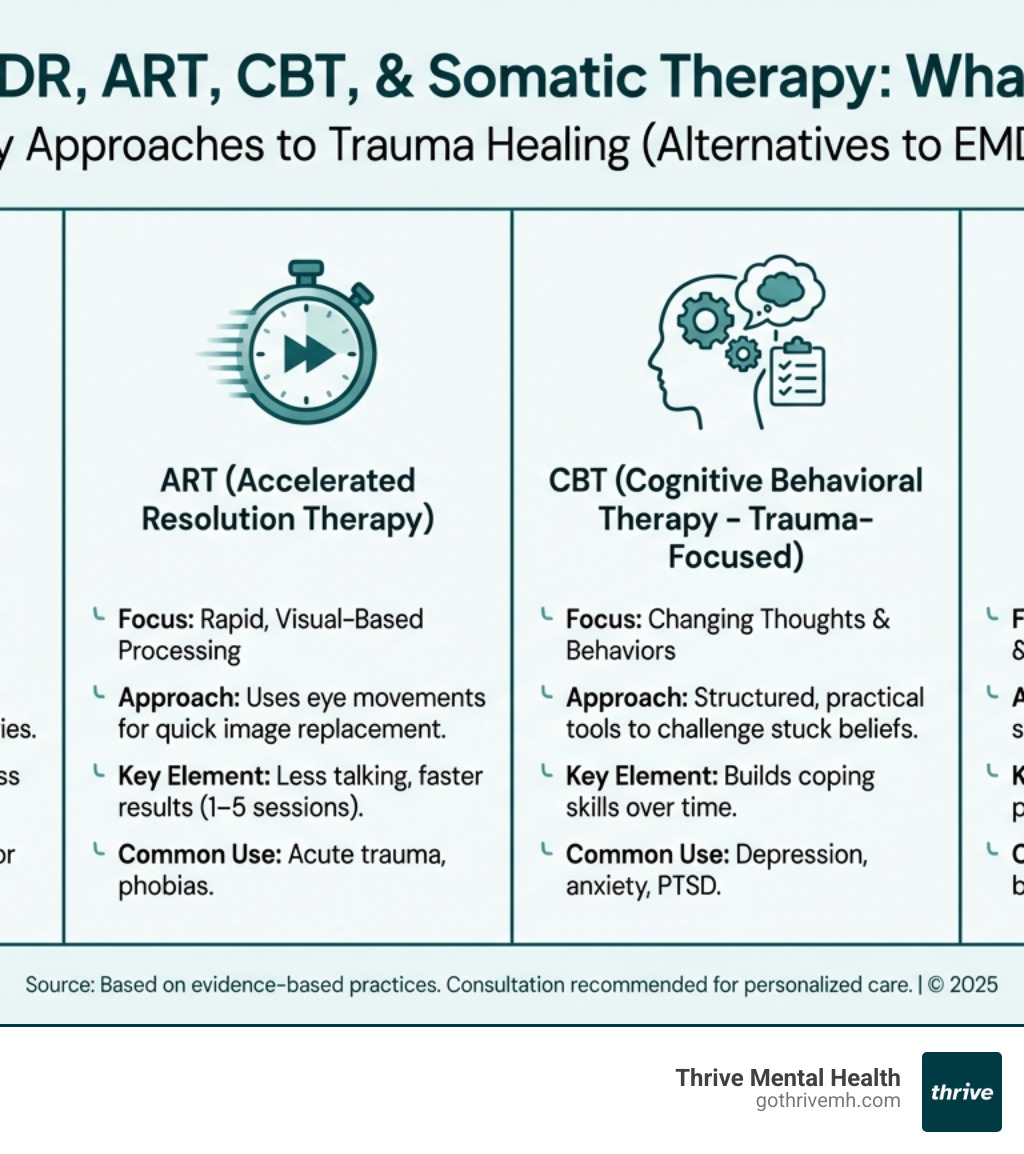
Quick look at emdr alternatives:
Why EMDR Isn’t Always the Best Fit

EMDR (Eye Movement Desensitization and Reprocessing) uses bilateral stimulationlike guided eye movementsto help the brain reprocess traumatic memories. It has a strong evidence base and can be highly effective, especially for single-incident trauma. The American Psychological Association (APA) recognizes it as a primary treatment for PTSD.
But it doesn’t work for everyone. Studies show that about 23% of people don’t improve with EMDR. If it didn’t work for you, you’re not brokenthe therapy just wasn’t the right fit. That’s why EMDR alternatives are so important.
Heres why EMDR can be a poor fit for some:
- It can be too intense. Directly engaging with traumatic memories can trigger abreactionsintense emotional or physical reactions that leave you feeling more dysregulated. For those with complex trauma or who struggle with emotional regulation, this intensity can backfire.
- It requires stability. EMDR assumes you have a baseline of coping skills. If you’re in crisis or experiencing severe dissociation, jumping into reprocessing can be destabilizing.
- It requires memory recall. While you don’t have to talk in detail, you do have to consciously revisit the trauma. For some, this is re-traumatizing. Alternatives like somatic therapy or ART may be better if you need a less memory-focused approach.
- Therapist skill is critical. EMDR’s effectiveness depends heavily on the practitioner. Rushing into reprocessing, failing to prepare you adequately, or sticking too rigidly to the protocol can derail progress.
If you feel stuck, persistently distressed, or are simply not seeing improvement after several sessions, its time to pivot. Exploring EMDR alternatives isn’t failureit’s smart, personalized care. At Thrive, we match you to the therapy that fits your trauma type, nervous system, and goals. Verify your insurance to see what’s covered, or call 561-203-6085 to talk through your options.
Top EMDR Alternatives for Trauma Recovery

If EMDR isn’t the right fit, you have powerful, evidence-based options. Trauma healing isn’t one-size-fits-all, and finding the right approach for your nervous system and history is key. At Thrive Mental Health, we’ve seen thousands recover using EMDR alternatives that matched their unique needs.
Here are some of the most effective alternatives:
Somatic Therapy: Heal Trauma Through Your Body
As Bessel van der Kolk’s work shows, “The body keeps the score.” Trauma isn’t just in your mind; it’s stored in your nervous system as chronic tension, numbness, or that constant feeling of being on edge. Somatic therapy helps release this stored trauma directly from the body.
Instead of focusing on thoughts and memories, approaches like Somatic Experiencing (SE) and Trauma Release Exercises (TREs) help you tune into bodily sensations. The goal is to complete the survival responses (fight, flight, freeze) that got trapped in your nervous system during the traumatic event. This is done gently, by tracking sensations and allowing your body to release stored energy through natural mechanisms like shaking or tremoring. You learn to regulate your nervous system, moving from a state of high alert or shutdown back to calm.
Somatic therapy is best for you if: You feel disconnected from your body, you’re “stuck” despite talk therapy, or you experience chronic physical symptoms of stress. It’s a powerful non-verbal path to healing.
Bessel van der Kolk: Why the body keeps the score
Cognitive Therapies: Rewire Traumatic Thoughts
Trauma changes how you think, creating “stuck points” or negative beliefs like “I’m not safe” or “It was my fault.” Cognitive Behavioral Therapy (CBT) and Cognitive Processing Therapy (CPT) are EMDR alternatives that directly target these thought patterns.
- Trauma-Focused CBT helps you identify and challenge cognitive distortions (like catastrophic thinking) and build practical coping skills like relaxation and distress tolerance techniques.
- Cognitive Processing Therapy (CPT) is a specialized 12-session therapy for PTSD that focuses on modifying the meaning you’ve made of the trauma. You’ll work with your therapist to challenge unhelpful beliefs about safety, trust, and self-esteem without having to re-live the event in detail.
Cognitive therapies are best for you if: You want a structured, skills-based approach with practical tools. If you’re trapped in shame, guilt, or fear, these therapies help you reframe your narrative and reclaim your life. At Thrive Mental Health, our IOP and PHP programs in Florida integrate CBT and CPT to give you the tools to transform the cognitive impact of trauma.
Accelerated Resolution Therapy (ART): Fast, Focused Healing
What if you could neutralize the pain of a traumatic memory in just 1-5 sessions? That’s the promise of Accelerated Resolution Therapy (ART), a powerful and fast-acting EMDR alternative.
ART is a highly structured therapy that uses guided eye movements, similar to EMDR, but combines them with a technique called voluntary image replacement. Your therapist guides you to replace distressing images and sensations with positive or neutral ones. You’re not erasing the memory, but changing how it’s stored so it no longer triggers a negative emotional and physical reaction.
One of ART’s biggest advantages is that it requires minimal verbal processing. This is a huge relief if talking about your trauma is overwhelming. The process is rapid, highly structured, and often involves less distress than other modalities. While it’s a newer therapy with a growing research base, its effectiveness for PTSD, depression, and anxiety is making it a go-to choice for many.
ART is best for you if: You want rapid results, can’t commit to months of therapy, or find talking about your trauma to be re-traumatizing.
ART vs. EMDR: What’s the Difference?
| Feature | EMDR (Eye Movement Desensitization and Reprocessing) | ART (Accelerated Resolution Therapy) |
|---|---|---|
| Avg. Sessions | 6-12+ sessions | 1-5 sessions |
| Structure | Flexible eight-phase protocol | Highly procedural and scripted |
| Distress Level | Can be high during reprocessing | Often lower, with more client control |
| Talking Required | Moderate | Minimal |
| Core Mechanism | Brain’s natural reprocessing | Voluntary image replacement/rescripting |
| Research Base | Extensive | Growing |
How to Choose the Right Trauma Therapy
Navigating trauma therapies can be overwhelming. The “best” therapy is the one that aligns with your unique history, symptoms, and goals. The crucial first step is a comprehensive professional assessment with a trauma specialist to understand:
- The nature of your trauma (single-incident vs. complex).
- Your primary symptoms (e.g., flashbacks, dissociation, anxiety).
- Your personal preferences (structured vs. flexible, verbal vs. body-based).
- Any co-occurring conditions.
At Thrive Mental Health, we make this process accessible. We work with many major insurance providers, including Cigna, Optum, and Florida Blue, across our locations in Florida. Our team can help you understand your benefits for our Intensive Outpatient (IOP) and Partial Hospitalization (PHP) programs.
We also offer flexible virtual and hybrid programs, so you can get expert-led trauma care from home, on your schedule.
Verify your insurance for a free assessment
When Are EMDR Alternatives a Better Choice?
While EMDR is highly effective for many, EMDR alternatives are often a better choice in specific situations:
- For complex or childhood trauma: Therapies like Internal Family Systems (IFS) or somatic approaches can better address the layered nature of developmental trauma.
- If you prefer a less verbal approach: If talking is re-traumatizing or you have significant physical symptoms, body-based therapies like Somatic Therapy are ideal.
- When you need fast, structured results: Accelerated Resolution Therapy (ART) can provide relief in just 1-5 sessions with minimal talking.
- To build coping skills first: CBT or CPT are perfect for building a foundation of practical tools to manage thoughts and emotions before (or instead of) deeper memory work.
- If EMDR was too intense or didn’t work: This is a clear sign that a different modality will better fit your nervous system and healing style.
FAQs: EMDR Alternatives—What People Ask
What’s the best alternative to EMDR?
There’s no single “best” one. The right choice depends on your needs. Accelerated Resolution Therapy (ART) is fastest. Cognitive therapies (CBT/CPT) provide structured tools to change thought patterns. Somatic therapies are ideal for releasing trauma stored in the body. A professional assessment will help you find the best fit for you.
Can I heal trauma without talking about it?
Yes. EMDR alternatives like ART and somatic therapies allow you to process trauma with minimal verbal recounting. They focus on guided imagery, body sensations, and movement rather than forcing you to tell the story, which can be a relief if talking feels re-traumatizing.
How do I pick the right trauma therapy?
Start with a comprehensive assessment from a trauma specialist. They will evaluate your specific trauma history, symptoms, and personal preferences to recommend the most effective approach. At Thrive Mental Health, we specialize in matching clients to the right therapy, whether it’s an EMDR alternative or an integrated plan.
Does insurance cover EMDR alternatives?
Yes, most major insurance plans, including Cigna, Optum, and Florida Blue, cover evidence-based EMDR alternatives like CBT, CPT, and ART. Our team at Thrive Mental Health can quickly verify your benefits for our programs in Florida. Check your coverage now.
Can I do trauma therapy virtually?
Absolutely. Thrive Mental Health offers expert-led virtual and hybrid Intensive Outpatient (IOP) and Partial Hospitalization (PHP) programs. You get the same high-quality, comprehensive trauma care, including group and individual sessions, from the comfort of your home. We offer flexible scheduling, including evening options, to fit your life.
Summary: EMDR Alternatives Can Help You Heal—Faster
If EMDR didn’t work for you, you are not out of options. EMDR alternatives like Accelerated Resolution Therapy (ART), Cognitive Processing Therapy (CPT), and Somatic Therapy offer proven, effective pathways to recovery. These therapies can help you heal faster, with less distress, and in a way that feels right for you—whether that’s through rapid memory rescripting, structured thought work, or gentle, body-based release. The goal isn’t to find the most popular therapy; it’s to find the one that helps you move forward. At Thrive Mental Health, we create personalized treatment plans that match the therapy to your needs, not the other way around.
Find Your Path to Healing at Thrive
Ready for support? Thrive offers virtual and hybrid IOP/PHP programs in Florida with evening options. Verify your insurance in 2 minutes (no obligation) Start benefits check or call 561-203-6085. If you’re in crisis, call/text 988.