
Buyer’s Guide: Best Evidence-Based IOP Treatment Centers in Orlando

7 Best Evidence-based IOP Treatment Orlando
Evidence-Based IOP Treatment Centers in Orlando [2025]: Costs, Insurance, and 9–12 Week Results
Stuck between weekly therapy that isn’t working and inpatient you can’t afford? Evidence-based IOP treatment centers in Orlando deliver 9+ hours/week of proven care—without pausing your life, job, or family.
What you get:
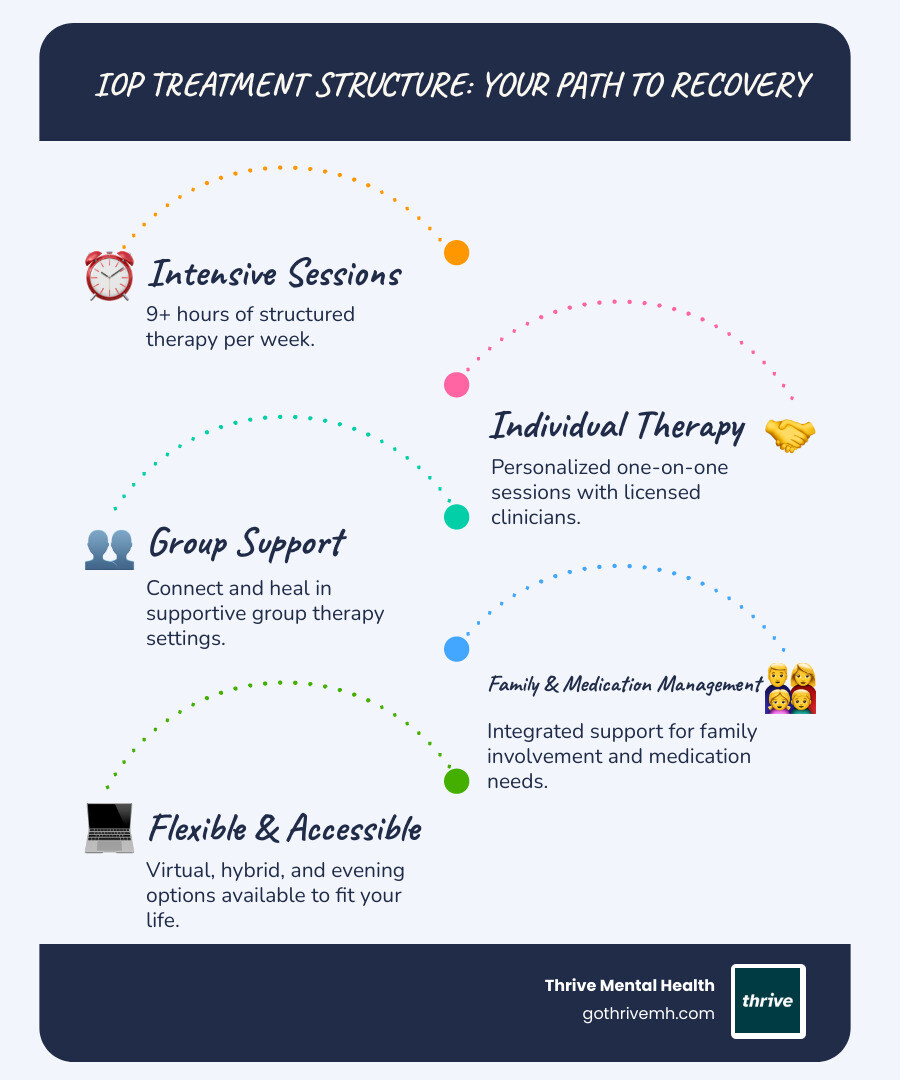
- 9–12 weeks of structured therapy (group + individual + family)
- Evidence-based care: CBT, DBT, EMDR, trauma-informed treatment
- Medication management and dual-diagnosis support
- Flexible scheduling: virtual, hybrid, evenings
- Lower costs with insurance (Florida Blue, Cigna, Aetna, UnitedHealthcare, Optum)
What it costs: $250–$600 per session before insurance. Most major plans cover IOP.
Act now vs. wait later:
- Act: Faster symptom relief, fewer crises, lower total cost of care
- Wait: Worsening symptoms, ER visits, lost work, higher costs
I’m Nate Raine, CEO of Thrive Mental Health. We build outcome-driven IOPs across Florida so you can recover faster—without stepping out of your life.
Quick Evidence-based IOP treatment centers in Orlando. definitions:
What Is an Evidence-Based IOP? [9+ Hours/Week Without Pausing Your Life]
An Intensive Outpatient Program (IOP) is structured therapy—without a 24/7 stay. You live at home, keep your job/school, and get 9+ hours of targeted care weekly for 9–12 weeks.
Why choose IOP?
- Keep your life moving: work, school, family
- More support than weekly therapy, less disruption than inpatient
- Lower cost vs. residential care
Who it helps:
- Step-down from inpatient or PHP
- Weekly therapy not enough
- Moderate–severe anxiety, depression, PTSD/trauma, bipolar, substance use (dual-diagnosis)
IOP vs weekly therapy—what’s the real difference?
| Factor | IOP (Intensive Outpatient) | Weekly Therapy |
|---|---|---|
| Hours/Week | 9+ hours (3–5 days) | ~1 hour |
| Structure | Group + individual + family + skills + med mgmt | Mostly individual |
| Flexibility | High (virtual/hybrid, evenings) | High |
| Supervision | Moderate | Low |
| Best For | Moderate–severe symptoms, step-down care | Mild issues/maintenance |
The intensive structure of IOP creates momentum that weekly therapy can’t match. Research shows that concentrated treatment hours lead to faster symptom reduction and better long-term outcomes. According to the National Institute of Mental Health, intensive treatment formats can accelerate recovery for conditions like depression, anxiety, and PTSD by providing consistent therapeutic engagement and peer support.
What makes IOP particularly effective is the combination of modalities. While weekly therapy typically focuses on individual sessions, IOP integrates multiple evidence-based approaches simultaneously. You’re not just talking about change—you’re practicing it daily with peers who understand your struggles. Group sessions provide real-time feedback and accountability, while individual therapy addresses your specific triggers and trauma. Family involvement, when appropriate, creates a support system that extends beyond treatment hours.
The flexibility of modern IOP programs has revolutionized access to care. Virtual and hybrid options mean you can attend from Orlando, Tampa, Miami, or anywhere in Florida—no commute required. Evening and weekend sessions accommodate work schedules. This accessibility removes the biggest barrier to intensive treatment: the fear of losing your job or falling behind in school.
Want the full IOP/PHP pathway? See Thrive’s programs: IOP and PHP.
The Science: What Makes an IOP “Evidence-Based” (and Why It Works Faster)
CALLOUT BOX: If you’re in crisis, call/text 988 right now. You are not alone.
Evidence-based means the therapies are proven in studies—not guesswork. You get what works, monitored by licensed clinicians.
Core elements:
- Individual therapy: personalized goals and coping skills
- Group therapy: practice skills, peer accountability
- Family involvement: top predictor of success
- Medication management: when needed for mood, anxiety, cravings (MAT for alcohol/opioids)
Proven methods we use at Thrive:
- CBT: change thoughts/behaviors that fuel symptoms
- DBT: regulate emotions, tolerate distress, prevent relapse
- EMDR: process trauma and reduce triggers
The evidence behind these approaches is compelling. Cognitive Behavioral Therapy (CBT) has decades of research showing 50-75% improvement rates for depression and anxiety disorders. DBT specifically reduces self-harm behaviors by up to 50% and significantly decreases hospitalizations. EMDR, recognized by the World Health Organization as a first-line treatment for PTSD, can reduce trauma symptoms in as few as 6-12 sessions.
What sets evidence-based IOPs apart is the systematic application of these therapies. Rather than trying one approach and hoping it works, you receive multiple interventions simultaneously. This multi-modal approach addresses different aspects of mental health: CBT tackles negative thought patterns, DBT builds emotional regulation skills, and EMDR processes underlying trauma. The synergy between these methods accelerates healing in ways that single-modality treatment cannot achieve.
Dual diagnosis done right: Treat mental health and substance use together to cut relapse risk and speed stability. Conditions treated include anxiety, depression, PTSD, bipolar, and SUDs. Research consistently shows that integrated treatment for co-occurring disorders leads to better outcomes than treating conditions separately. When substance use and mental health issues are addressed simultaneously, relapse rates drop by 30-40% compared to sequential treatment.
The measurement component is crucial. Evidence-based IOPs use validated assessment tools like the PHQ-9 for depression and GAD-7 for anxiety to track your progress weekly. This isn’t about feelings or hunches—it’s about measurable improvement. You’ll see your scores change, providing concrete proof that the treatment is working. This data-driven approach allows clinicians to adjust treatment in real-time, ensuring you’re always receiving the most effective interventions for your current symptoms.
See how our IOP works step-by-step.
7-Point Checklist [2025]: Choose the Best Evidence-Based IOP in Orlando (No Regrets)
Use this to avoid the wrong fit and wasted weeks:
1) Accreditation
- Joint Commission or CARF only. Verify current status.
2) Licensed Staff
- Therapists, psychiatrists, medical director. Multidisciplinary team.
3) Personalized Plans
- No one-size-fits-all tracks. Goals, diagnoses, and schedule custom to you.
4) Virtual/Hybrid Access
- Orlando-based care with virtual/evening options. Thrive offers virtual IOP services across Florida.
5) Measurable Outcomes
- Ask for outcomes and how progress is tracked (PHQ-9/GAD-7, attendance, relapse).
6) Aftercare & Relapse Prevention
- Ongoing therapy, peer groups, relapse plans, community resources.
7) Insurance & Cost
- In-network lowers out-of-pocket. Check Florida Blue, Cigna, Aetna, UnitedHealthcare, Optum.
Questions to ask:
- Which evidence-based therapies will I get (CBT/DBT/EMDR)? How often?
- Do you treat co-occurring disorders in the same program?
- Can I attend virtually/evenings? What’s the attendance policy?
- How do you measure results? Can I see sample outcomes?
Red flags to watch for:
- Programs that promise “quick fixes” or guarantee results
- Unlicensed or uncredentialed staff leading groups
- No clear discharge planning or aftercare support
- Refusal to provide outcome data or success rates
- One-size-fits-all curriculum without individualization
The accreditation piece cannot be overstated. Joint Commission and CARF accreditation require rigorous standards for clinical care, safety protocols, and outcome measurement. These organizations conduct surprise audits and require continuous quality improvement. According to SAMHSA’s treatment locator, accredited facilities have significantly better patient outcomes and lower readmission rates than non-accredited programs.
When evaluating staff credentials, look beyond basic licensure. The best IOPs employ specialists in trauma, addiction, mood disorders, and family systems. A true multidisciplinary team includes not just therapists but also psychiatric providers, case managers, and peer support specialists. This diversity of expertise ensures that all aspects of your mental health receive appropriate attention.
Explore Thrive’s levels of care: IOP and PHP. Verify coverage in 2 minutes → Check insurance.
Costs, Insurance, and Day One: What to Expect (Without Sticker Shock)
Typical Orlando IOP costs: $250–$600 per session before insurance. Most plans cover IOP.
Insurance we often accept: Florida Blue, Cigna, Aetna, UnitedHealthcare, Optum. Many centers also work with Medicaid, Medicare, state-financed, and Tricare/federal military insurance.
In-network vs out-of-network:
- In-network (like Thrive) = negotiated rates + lower out-of-pocket
- Out-of-network = higher deductibles/coinsurance
Parity protection (MHPAEA): Your plan must cover mental health at the same level as medical/surgical care. Know your rights: https://www.healthcare.gov/coverage/mental-health-substance-abuse-coverage/
Check coverage in 2 minutes (no calls needed): Verify insurance.
Day one, step-by-step:
- Confidential assessment (phone or virtual)
- Meet your Recovery Advocate
- Personalized plan (modalities, schedule, goals)
- Fast admissions—often same-day virtual start
- Have ready: ID, insurance card, current medications
Serving all of Florida with virtual and hybrid access. Prefer a higher level first? See our PHP program.
FAQs: Evidence-Based IOP in Orlando—Fast Answers
Q: How long does IOP take to work?
A: Most programs run 9–12 weeks at 9+ hours/week. Many clients report measurable gains within 2–4 weeks.
Q: Can I keep my job or attend school?
A: Yes. Thrive offers virtual and evening options so treatment fits around work, school, and family.
Q: Is virtual IOP as effective?
A: For most, yes. Outcomes are comparable when programs use the same evidence-based therapies and tracking. See Thrive’s Virtual Therapy.
Q: Does insurance cover IOP in Florida?
A: Usually. Thrive is in-network with Florida Blue, Cigna, Aetna, UnitedHealthcare, and Optum. Verify insurance in 2 minutes.
Q: What if I have mental health and substance use together?
A: Choose a dual-diagnosis IOP. Thrive treats both at once to cut relapse risk and speed stability.
Summary: Evidence-Based IOP Treatment Centers in Orlando—Faster Results, Lower Disruption
Bottom line: If weekly therapy isn’t enough and inpatient is too much, evidence-based IOP treatment centers in Orlando deliver proven results in 9–12 weeks—without pausing your life. Flexible scheduling, virtual access, and in-network insurance (Florida Blue, Cigna, Aetna, UnitedHealthcare, Optum) make it doable now, not “someday.”
Ready for support? Thrive offers virtual and hybrid IOP/PHP programs with evening options. Verify your insurance in 2 minutes (no obligation) → Start benefits check or call 561-203-6085. If you’re in crisis, call/text 988.