
Practical Ways to Find In-Network PHP in California for BS of CA

Find partial hospitalization programs in California that are in-network with BS of CA: 2025 Healing Guide
Why Finding the Right PHP Matters When You’re Ready for Real Change
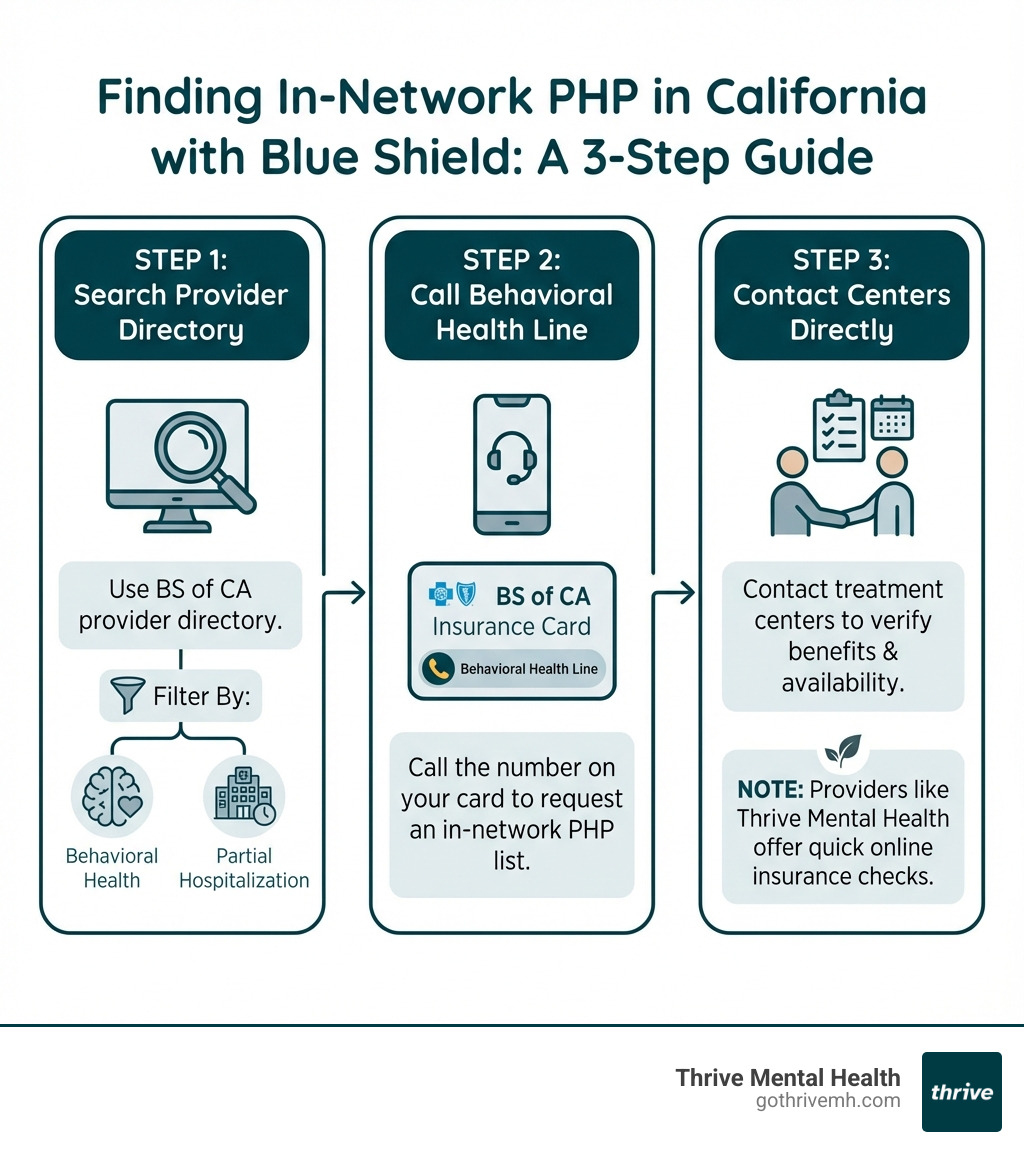
Find partial hospitalization programs in Florida that are in-network with BCBS of FL by following these three core steps:
- Search the Florida Blue provider directory at provider.bcbs.com and filter by “Behavioral Health” and “Partial Hospitalization”
- Call the Florida Blue behavioral health line on the back of your insurance card to request an in-network PHP list specific to your plan
- Contact treatment centers directly (like Thrive Mental Health) to verify your benefits and check real-time availability
If weekly therapy isn’t enough, you’re in the right place. Whether you’re stepping down from inpatient care or just need more structure, a Partial Hospitalization Program (PHP) offers the intensive support you’re looking for. You’re not broken—you’re ready for real change.
Partial Hospitalization Programs (PHPs) offer 5–6 hours of daily treatment while you sleep at home. They bridge the gap between living in a facility and managing on your own. And yes, Florida Blue covers them—but only if you know how to steer the system.
The problem is that insurance directories are confusing, and when you’re already struggling, the last thing you need is to chase dead ends or face surprise bills.
This guide gives you a clear, step-by-step process to find an in-network PHP in Florida, understand your Florida Blue benefits, and get admitted without the runaround. We’ll cover what PHPs involve, how to verify coverage, and how to avoid common insurance pitfalls.
I’m Nate Raine, CEO of Thrive Mental Health, and I’ve spent over a decade building systems that help people find partial hospitalization programs in Florida that are in-network with BCBS of FL and other major insurers. I’ve seen how the right program—at the right time—can completely change someone’s trajectory.
Learn more about Find partial hospitalization programs in Florida that are in-network with BCBS of FL.:
Your First Step: Understanding PHP and If It’s Your Path to Recovery
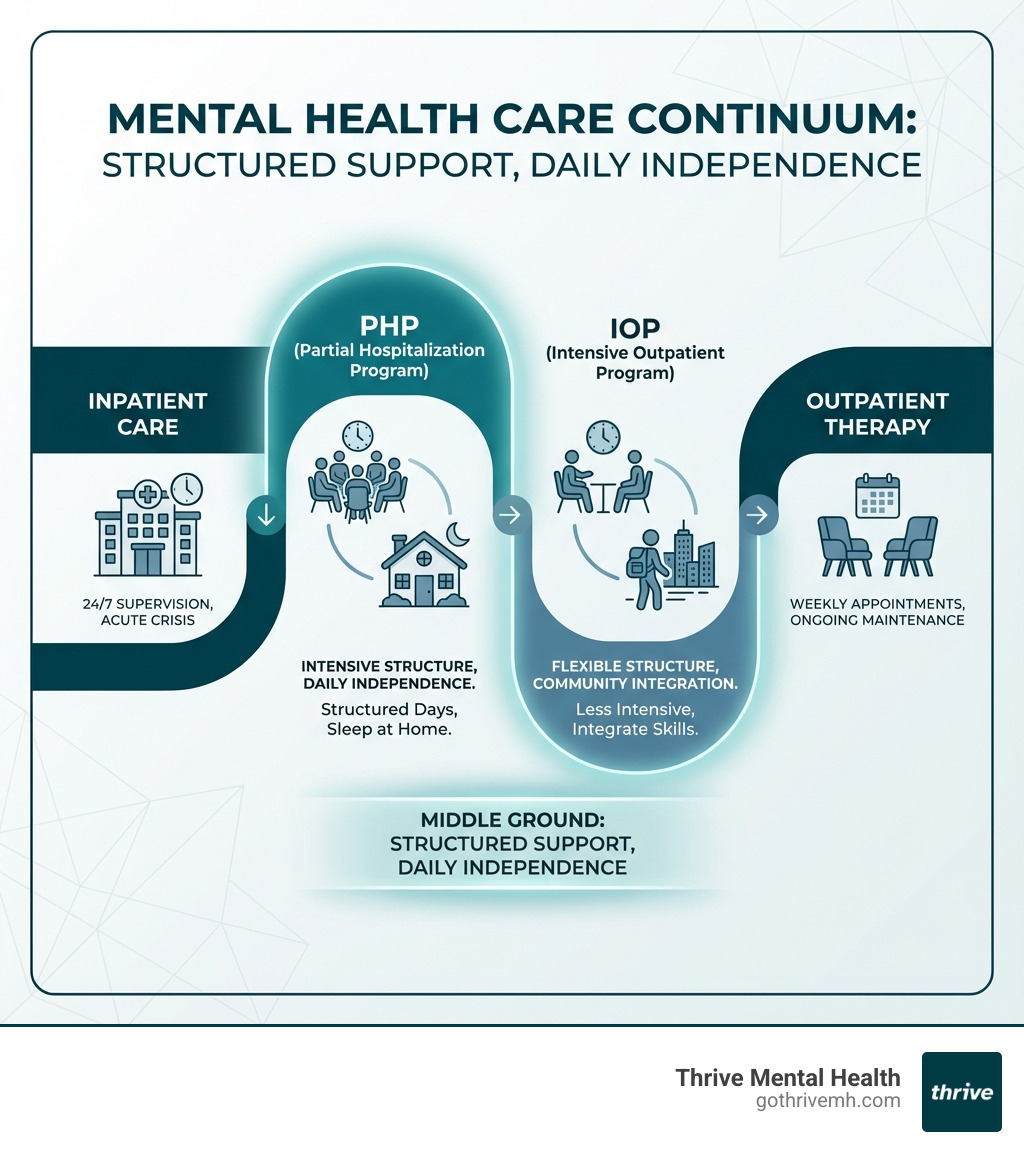
When you’re facing significant mental health challenges, the idea of intensive treatment can feel daunting. That’s where a Partial Hospitalization Program (PHP) comes in. PHPs are a crucial level of care designed to provide comprehensive support without requiring an overnight stay, offering a unique balance of structured treatment and daily independence.
What is a Partial Hospitalization Program (PHP)?
A PHP is an intensive mental health treatment program that offers structured clinical services for several hours a day, typically five days a week. It’s considered a step below inpatient care but a significant step up from traditional weekly therapy or even an Intensive Outpatient Program (IOP). The core benefit? You receive robust, evidence-based treatment during the day and return home in the evenings, allowing you to maintain connection to your daily life.
This level of care is perfect for individuals who:
- Are transitioning from inpatient hospitalization and need continued support.
- Require more structure and therapeutic intensity than outpatient therapy can provide.
- Are experiencing symptoms that interfere with daily functioning but don’t require 24/7 supervision.
Structured Support, Daily Independence
A PHP offers intensive, multi-faceted treatment while allowing you to sleep in your own bed. This daily independence is empowering, letting you practice new coping skills in your real-world environment immediately. Many programs highlight this balance of structured care and personal freedom as a key benefit.
What Conditions Do PHPs in Florida Treat?
PHPs in Florida treat a wide range of conditions with specialized tracks. Our Thrive Mental Health programs across Florida, from Miami to Orlando, address many of these issues.
Common conditions treated include:
- Depression: For persistent sadness, loss of interest, and fatigue.
- Anxiety Disorders: For generalized anxiety, panic attacks, and social anxiety.
- Substance Use Disorders: For alcohol, drug, or polysubstance abuse requiring intensive recovery support.
- Dual Diagnosis: For co-occurring mental health and substance use disorders that require integrated treatment.
- Trauma: Post-Traumatic Stress Disorder (PTSD) or complex trauma.
- Mood Disorders: Bipolar disorder, cyclothymic disorder, and other mood dysregulation issues.
- Eating Disorders: Structured support for disordered eating patterns and body image issues.
- Behavioral Challenges: Adolescent behavioral issues, self-harm, and other disruptive behaviors.
- Chronic Stress & Burnout: For individuals facing overwhelming stress from high-pressure environments.
Admission Criteria for a PHP
Admission is based on a clinical assessment to determine medical necessity. You are likely a good candidate if:
- You require a higher level of care than traditional outpatient therapy.
- Your symptoms are severe enough to disrupt daily functioning (work, school, relationships).
- You are medically stable and do not require 24-hour medical or psychiatric supervision.
- You can participate in and benefit from group therapy and other structured activities.
- You have a safe home environment to return to each evening.
Many providers, including Thrive Mental Health, offer free, confidential assessments to determine if a PHP is the right fit.
What a PHP Actually Involves
A PHP is a comprehensive, structured program designed to immerse you in a therapeutic environment. While specifics vary, a typical week in a PHP will involve a combination of individual, group, and family therapies.
Typical Day and Weekly Schedule:
Most PHPs run 5-6 hours a day, five days a week. The average length of stay is typically 2 to 4 weeks, depending on individual needs and progress.
A typical day might look something like this:
- Morning: Check-in, process group, skill-building group (e.g., CBT or DBT skills).
- Mid-day: Individual therapy session, medication management with a psychiatrist (if needed), lunch break.
- Afternoon: Process group, psychoeducation group, or experiential therapy (e.g., art therapy, yoga).
- End of Day: Wrap-up and planning for integrating skills at home.
Core Components of a PHP:
- Group Therapy: The cornerstone of PHP, providing a supportive environment to share experiences, practice new skills, and receive feedback.
- Individual Counseling: Regular one-on-one sessions with a primary therapist to address your specific treatment goals and track progress.
- Family Sessions: Many PHPs recognize the vital role of family in recovery and offer dedicated sessions to improve communication and build a stronger support system.
- Medication Management: Access to psychiatrists for evaluation, prescription, and ongoing management of medications is a key component for many participants.
The Key Differences Between PHP and IOP
While both Partial Hospitalization Programs (PHPs) and Intensive Outpatient Programs (IOPs) offer more intensive care than traditional weekly therapy, they differ in intensity and time commitment. Understanding these distinctions is key to choosing the right level of care. We at Thrive Mental Health offer both IOP and PHP programs, tailoring the level of support to what you need most.
| Feature | Partial Hospitalization Program (PHP) | Intensive Outpatient Program (IOP) |
|---|---|---|
| Time Commitment | 5-6 hours per day, 5 days per week (25-30 hours/week). | 3-5 hours per day, 3-5 days per week (9-20 hours/week). |
| Level of Structure | Highest level of outpatient care; highly structured, almost full-day programming. | Significant structure, but allows more flexibility than PHP. |
| Ideal Candidate | Stepping down from inpatient/residential care; needing to avoid inpatient admission; symptoms significantly impairing daily function. | Stepping down from PHP; needing more support than weekly therapy but able to manage daily life; maintaining work/school/family commitments. |
| Typical Duration | 2-4 weeks, with extension options. | Several weeks to a few months. |
| Focus | Stabilization, intensive skill-building, crisis prevention, comprehensive treatment for acute symptoms. | Continued skill-building, relapse prevention, integration into daily life, maintenance of progress. |
| Supervision | More direct and continuous clinical oversight during program hours. | Less direct supervision, greater emphasis on independent application of skills. |
As you can see, PHPs provide a more immersive and intensive treatment experience, often suited for those with more acute symptoms or those transitioning from a higher level of care. IOPs, while still highly structured, offer greater flexibility, allowing individuals to balance treatment with work, school, or family responsibilities.
Your Guide to Find Partial Hospitalization Programs in Florida That Are In-Network with BCBS of FL
Finding the right PHP is one thing; making sure it’s in-network with your Florida Blue plan is another. This is crucial for managing costs. Here’s a clear strategy to find partial hospitalization programs in Florida that are in-network with BCBS of FL.

Here are the practical steps you should take:
Step 1: Use the Official Florida Blue Provider Directory
Your first and most reliable resource is Florida Blue’s own “Find a Doctor” tool on their website.
- Visit the Florida Blue website: Go to provider.bcbs.com.
- Steer to the “Find a Doctor” tool: This tool allows you to search for providers and facilities within your network.
- Filter by specialty:
- Select “Behavioral Health” as the general category.
- Look for sub-categories like “Partial Hospitalization” or “Mental Health Day Programs.”
- Specify your location: Enter your zip code or city in Florida. Thrive Mental Health has in-person locations in major Florida areas like Miami, Orlando, Tampa, Jacksonville, and St. Petersburg.
- Verify network status: While the directory is a great starting point, always double-check by contacting the facility directly (Step 3). Provider networks can change.
Step 2: Call the Florida Blue Behavioral Health Line Directly
Don’t underestimate the power of a direct phone call to your insurance provider. The information on their website might not be as up-to-date as what a representative can tell you.
- Locate your member services number: This is on the back of your Florida Blue insurance card.
- Ask for the behavioral health department: They specialize in mental health and substance use benefits.
- Request a list of in-network PHP providers: Be specific. Ask for a list of partial hospitalization programs in Florida that are in-network with your specific Florida Blue plan. Whether you have a PPO, HMO, or other plan, the network of providers can differ.
- Confirm coverage details: While on the phone, inquire about your specific benefits for PHP, including deductibles, copays, coinsurance, and any prior authorization requirements.
Step 3: Contact Florida Treatment Centers and Verify Your Benefits
Once you have a list of potential PHPs, the next crucial step is to contact those centers directly. This is where you confirm real-time availability and verify your insurance benefits with their admissions team.
- Direct Outreach: Call the admissions or intake department of the PHP facilities you’re considering.
- Insurance Verification Form: Most reputable treatment centers, including Thrive Mental Health, offer a quick and confidential insurance verification process. We offer online insurance checks that can give you an immediate understanding of your benefits.
- Discuss Your Plan: Provide your Florida Blue member ID and group number. The admissions team will contact Florida Blue directly on your behalf to confirm your specific coverage for their PHP.
- Inquire About Single Case Agreements (SCAs): If a preferred PHP is out-of-network, ask if they can negotiate a Single Case Agreement (SCA) with Florida Blue. An SCA allows an out-of-network provider to treat you at an in-network rate, which is sometimes possible if there are no suitable in-network alternatives for your specific needs.
Many quality PHPs across Florida, including our programs at Thrive Mental Health, work with Florida Blue and can help you steer this process.
Decoding Your Florida Blue Benefits for PHP [2025 Guide]
Understanding your Florida Blue benefits is key to affordable PHP care. Here are the terms you need to know:
Key Terms to Understand for Your Florida Blue Plan:
- In-network vs. Out-of-network: An in-network provider is contracted with Florida Blue, which means lower costs for you. An out-of-network provider is not, leading to higher costs. HMO plans usually only cover in-network care, while PPO plans may offer some out-of-network coverage at a higher cost.
- Prior Authorization: This is Florida Blue’s approval for a service before you receive it. For PHPs, prior authorization is almost always required to confirm medical necessity. The facility’s admissions team will typically handle this process for you.
- Deductible: The amount you must pay out of pocket for covered healthcare services before your insurance plan starts to pay.
- Copay: A fixed amount you pay for a covered healthcare service after you’ve paid your deductible.
- Coinsurance: Your share of the cost for a covered healthcare service, calculated as a percentage (e.g., 20%) of the allowed amount for the service, after you’ve met your deductible.
Good news: The Affordable Care Act (ACA) and the Mental Health Parity and Addiction Equity Act (MHPAEA) mandate that insurers like Florida Blue cover mental health services like PHP no more restrictively than physical health services, provided they are medically necessary.
How to Handle Out-of-Network PHPs
Even with a strong desire to find an in-network program, sometimes the best fit for your needs might be out-of-network. Here’s how to steer that situation:
- Superbills and Reimbursement: If you attend an out-of-network PHP, you’ll likely pay for services upfront. The facility can provide a “superbill” (a detailed receipt) for you to submit to Florida Blue for partial reimbursement. PPO plans are more likely to offer these benefits.
- Single Case Agreements (SCAs): As mentioned earlier, an SCA is a contract between your insurance company and an out-of-network provider, allowing you to receive care at an in-network rate. This is often pursued when a specific, medically necessary service is not available through an in-network provider in your area.
- Negotiating Coverage: Don’t hesitate to advocate for yourself. If you believe an out-of-network PHP is your best option, discuss your case with Florida Blue. They may agree to cover a larger portion of the cost, especially if in-network alternatives are geographically distant or lack the specialized care you require.
- Out-of-Pocket Costs: Be prepared for higher out-of-pocket expenses with out-of-network care. Understand your deductible and coinsurance for these services, and ask the facility about payment plans.
Understanding Blue Distinction Centers for Quality Care
When seeking treatment, you might encounter the term “Blue Distinction Centers.” These are facilities recognized by the Blue Cross and Blue Shield Association for high-quality specialty care.
- What is a Blue Distinction Center?: These centers are identified as providing quality care based on rigorous, evidence-based criteria. Studies indicate these centers often have better overall outcomes.
- Quality Criteria: For Substance Use Treatment and Recovery, facilities are evaluated on measures related to structure, process, and outcomes of care, including the availability of medication-assisted treatment (MAT).
- Finding Designated Centers: You can use Florida Blue’s “Find a Doctor” tool to search for Blue Distinction Centers. While this is a national designation, it serves as a valuable indicator of quality for Florida Blue members. You can learn more about the Blue Distinction program to understand its criteria. Always verify your specific plan’s coverage with any designated center.
What Happens During and After a Florida PHP?
A PHP immerses you in a therapeutic environment to build coping skills. After the program, the focus shifts to maintaining your progress for sustainable recovery.
Building Your Toolkit: Therapies Used in PHPs
PHPs in Florida, including our Thrive Mental Health programs, use evidence-based therapies to build your mental health toolkit. These are delivered in both individual and group settings:
- Cognitive Behavioral Therapy (CBT): A widely used therapy that helps you identify and change negative thought patterns and behaviors. You’ll learn to challenge distorted thinking and develop healthier coping mechanisms.
- Dialectical Behavior Therapy (DBT): Often used for individuals with intense emotional dysregulation. DBT focuses on four key skill areas: mindfulness, distress tolerance, emotion regulation, and interpersonal effectiveness. Many PHPs incorporate DBT into their programs.
- Group Processing: The group dynamic itself is powerful. Sharing experiences, receiving peer support, and practicing new communication skills in a safe environment fosters connection and reduces isolation.
- Skill-Building: PHPs are highly focused on practical skills you can apply in your daily life, such as stress management, relapse prevention, and healthy boundary setting.
- Trauma-Informed Care: For those with a history of trauma, many PHPs integrate trauma-informed approaches, ensuring treatment is delivered in a way that recognizes the impact of trauma and avoids re-traumatization.
Beyond these core therapies, some PHPs may also offer:
- EMDR (Eye Movement Desensitization and Reprocessing): A specialized therapy for processing traumatic memories.
- Experiential Therapies: Such as art therapy, yoga, or mindfulness, which can provide alternative ways to express emotions and manage stress.
Life After PHP: Your Plan for Lasting Recovery
Completing a PHP is a huge step, but the journey isn’t over. A strong aftercare plan is crucial to maintain your progress.
- Discharge Planning: From day one, your treatment team will work with you to develop a personalized aftercare plan, connecting you with ongoing support resources.
- Step-Down to IOP: Many individuals transition from a PHP to a less intensive Intensive Outpatient Program (IOP). This provides continued structure as you gradually reintegrate into your daily routines. Our Thrive Mental Health programs also offer IOP as a natural step-down.
- Finding a Therapist: Continuing with individual therapy is a key component of aftercare. Your PHP therapist can provide referrals to trusted providers.
- Support Groups: Participating in peer-led support groups (e.g., 12-step programs, NAMI support groups) can provide ongoing community and accountability.
- Alumni Programs: Many treatment centers offer alumni programs, providing a network of support and opportunities for continued engagement with the recovery community.
Frequently Asked Questions about PHPs and Florida Blue
How much does a PHP cost with Florida Blue?
The cost of a PHP with Florida Blue varies based on your specific plan (PPO, HMO, etc.), whether the program is in-network, and if you’ve met your deductible.
- Deductible: You’ll need to pay this amount first before Florida Blue starts covering services.
- Copay: Once your deductible is met, you may have a fixed copay per day.
- Coinsurance: Alternatively, you might pay a percentage of the program’s cost after your deductible is met.
For example, while PHP treatment without insurance can be costly, using an in-network provider with Florida Blue can significantly reduce your out-of-pocket expenses to just your deductible, copays, or coinsurance.
Actionable step: The best way to determine your exact costs is to call the member services number on your Florida Blue card. The admissions team at your chosen PHP can also perform a benefits check for you.
Does Florida Blue require a referral for a PHP?
While a referral from a primary care physician (PCP) is often not required to access a PHP, prior authorization from Florida Blue is almost always necessary. This means the insurance company must approve the medical necessity of the treatment before you begin to ensure coverage.
The good news is that the admissions team at the PHP facility you choose will typically handle the prior authorization process on your behalf, coordinating directly with Florida Blue.
Can I attend a PHP virtually in Florida?
Yes, absolutely! Many providers now offer virtual Partial Hospitalization Programs (PHPs) in Florida. This allows you to receive intensive, structured care from the comfort and privacy of your home, which is particularly beneficial for those in our service areas like Miami, Orlando, Tampa, and Jacksonville.
Virtual PHPs, like those offered by Thrive Mental Health, follow a similar structure to in-person programs, including group therapy, individual counseling, and medication management, all delivered via secure telehealth platforms.
Actionable step: When considering a virtual PHP, check with both the provider and Florida Blue to confirm that telehealth services for PHP are covered under your specific plan. Most insurers have continued to cover telehealth, but it’s always best to verify.
Your Path to Healing Starts Now
Finding the right support is an act of strength. This guide is designed to empower you to find an in-network PHP in Florida with confidence. Lasting recovery is within reach, and you deserve accessible, comprehensive care.
Ready for support? Thrive offers virtual and hybrid IOP/PHP programs with evening options. Verify your insurance in 2 minutes (no obligation) → gothrivemh.com/verify-insurance or call 561-203-6085. If you’re in crisis, call/text 988.