
Detailed Reviews of Top 10 Ways to Find ERP Therapists

Find ERP Therapists Near Me: 10 Proven Ways to Relief!
Find Therapists in My Area Who Use Exposure and Response Prevention Therapy [2025]: 10 Fast Ways to Start (Covered by Cigna, Optum, Florida Blue)
Sick of “CBT” generalists who don’t move the needle? If OCD is running your day, you need ERP—and a real specialist—now. Here’s exactly how to find one fast, use your insurance, and start getting results.
Quick Wins: 10 fast ways to find ERP therapists near you
- Use Online Directories – Filter by “ERP” or “OCD specialist” on Psychology Today or IOCDF.
- Ask Your Doctor/Psychiatrist – Request a direct ERP referral.
- Check Insurance Networks – Search your plan for ERP/OCD; confirm in-network status.
- University Clinics – Expert-supervised ERP, often lower cost.
- OCD/Anxiety Clinics – Specialized centers in your state.
- Try Virtual ERP – Telehealth ERP from home via trusted platforms.
- OCD Organizations – Use IOCDF/ADAA directories and resources.
- Consider IOP/PHP – When weekly therapy isn’t enough.
- Google Smart – “ERP therapist [your city]” + “OCD specialist.”
- Ask Support Groups – Get real-world recommendations.
Exposure and Response Prevention (ERP) is the gold standard for OCD—50–60% achieve significant, lasting improvement. Don’t waste months on the wrong fit. If you’re in Florida, California, Indiana, Arizona, or South Carolina, virtual and hybrid options make it easy to start now.
I’m Nate Raine, CEO of Thrive Mental Health. We connect people to evidence-based care like ERP because the right treatment changes lives.
Find therapists in my area who use exposure and response prevention therapy terms explained:
What Is Exposure and Response Prevention (ERP) and Why Does It Work?
If you’re dealing with obsessive-compulsive disorder (OCD), you’ve likely heard of ERP therapy. But what is it, and why is it considered the most effective treatment?
ERP Explained in Plain English
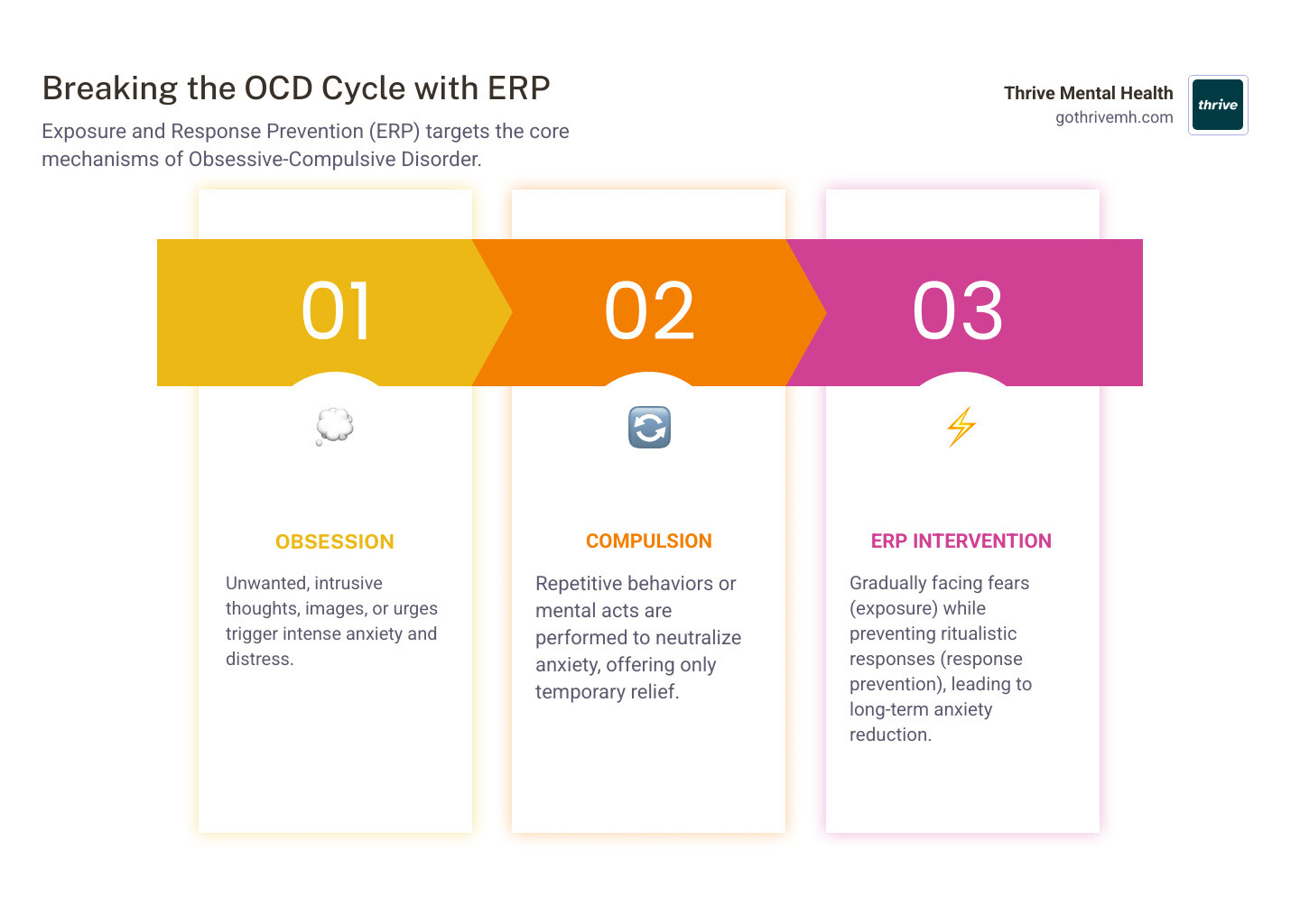
Exposure and Response Prevention (ERP) is a specialized therapy where you gradually and safely confront the thoughts, images, and situations that trigger your anxiety (exposure). The key is to then resist performing the compulsive behaviors or rituals you normally use to reduce that anxiety (response prevention). This process retrains your brain to understand that your fears are manageable and the compulsions are unnecessary.
How ERP Breaks the OCD Cycle for Good
OCD thrives on a vicious cycle: an obsession creates anxiety, and a compulsion temporarily relieves it, reinforcing the obsession’s power. ERP breaks this cycle. By facing the fear without performing the compulsion, you learn to tolerate the anxiety until it naturally fades—a process called habituation. This systematically weakens the link between obsessions and compulsions, giving you back control.
Why ERP Beats Talk Therapy or General CBT for OCD
While traditional talk therapy can provide insight, it rarely breaks the behavioral patterns of OCD. Even general Cognitive Behavioral Therapy (CBT) often isn’t enough. ERP is the gold standard because it is a specific, action-based form of CBT that directly targets the core mechanism of OCD. For OCD, phobias, and other anxiety disorders, this behavioral component is essential for lasting change.
How Long ERP Takes to Show Results
While results vary, many people see significant improvement in 12-20 sessions. Studies show that 50-60% of individuals who complete ERP experience long-term relief from their symptoms. It’s a commitment, but the outcome is a life no longer dictated by OCD. We’ve seen ERP help countless individuals manage their OCD Symptoms: What to Watch For and overcome debilitating Anxiety Symptoms.
10 Proven Ways to Find Therapists in My Area Who Use Exposure and Response Prevention Therapy
Finding a qualified ERP therapist can feel overwhelming. This proven strategy will help you connect with a professional who can guide you toward lasting relief.
1. Use Trusted Online Directories with ERP Filters
Online directories are your best starting point. Use their filters to narrow your search by location and specialty.
- Psychology Today: Search by your city or state (e.g., Florida, California) and use the “Types of Therapy” filter to select “Exposure and Response Prevention (ERP).”
- International OCD Foundation (IOCDF) Resource Directory: This directory lists professionals who specialize in OCD and are often trained in ERP through programs like the Behavioral Therapy Training Institute (BTTI). This is a top resource for finding true specialists. You can access their resources via this link for support.
- University of Pennsylvania’s CTSA Directory: The Center for the Treatment and Study of Anxiety (CTSA) maintains a list of certified Ex/RP therapists, ensuring a high level of expertise. Find it here: Find a Certified Ex/RP Therapist | Center for the Treatment and Study of Anxiety.
2. Ask Your Doctor or Psychiatrist for a Referral
Your primary care physician or psychiatrist likely has a network of trusted mental health specialists. Ask them for a direct referral to a local ERP therapist. They can also help coordinate care if you are considering Medication Management Online.
3. Check Your Insurance Provider’s List for ERP Specialists
Many insurance plans, including Cigna, Aetna, Florida Blue, UnitedHealthcare, and Optum, cover OCD treatment. Use your insurer’s “find a provider” tool and search for specialists in “OCD” or “Exposure and Response Prevention.” Always call to confirm they are accepting new patients and are truly specialized in ERP. For more help, see our guide on Insurance Covered Online Therapy.
How to Vet an ERP Therapist: 7 Questions You Must Ask Before Booking
Once you have a list of potential therapists, you need to vet them. Not all therapists who list “CBT” are qualified to provide ERP for OCD. Here’s how to tell the difference and find a true specialist.
ERP vs. Talk Therapy vs. General CBT for OCD—What Actually Works?
Understanding the differences is key to choosing the right treatment.
| Therapy Type | Primary Focus | Effectiveness for OCD |
|---|---|---|
| Talk Therapy | Exploring feelings and past experiences. | Limited impact on compulsive behaviors; often insufficient for OCD. |
| General CBT | Challenging unhelpful thought patterns. | A good foundation, but may not directly address the behavioral compulsions of OCD. |
| Exposure and Response Prevention (ERP) | Directly confronting triggers and preventing rituals. | Gold Standard. Directly breaks the OCD cycle by teaching the brain to tolerate distress without compulsions. |
What Is Exposure and Response Prevention (ERP) and Why Does It Work?
If you’re dealing with obsessive-compulsive disorder (OCD) or severe anxiety, you’ve likely heard the term “ERP therapy.” But what exactly is it, and why is it so effective? At Thrive Mental Health, we believe understanding your treatment options is the first step towards reclaiming your life.
ERP Explained in Plain English
Exposure and Response Prevention (ERP) Therapy is a specialized type of cognitive-behavioral therapy (CBT) primarily focused on addressing OCD and related anxiety disorders. Think of it as confronting your fears head-on, but in a safe, controlled, and gradual way, with a trained professional by your side.
Instead of avoiding situations or thoughts that trigger your anxiety, ERP involves intentionally exposing yourself to them. The “response prevention” part means you consciously choose not to engage in your usual compulsions or avoidance behaviors that temporarily relieve anxiety. This process teaches your brain that the feared outcome won’t happen, or that you can tolerate the discomfort without resorting to rituals.
How ERP Breaks the OCD Cycle for Good
OCD operates in a vicious cycle: an intrusive thought (obsession) triggers intense anxiety, leading you to perform a ritual or compulsion to neutralize the anxiety. This compulsion provides temporary relief, but it reinforces the idea that the obsession was dangerous and the compulsion was necessary. Over time, this cycle strengthens, making your OCD worse.
ERP directly targets this cycle. By preventing the compulsive response, ERP teaches you to tolerate the anxiety until it naturally decreases. This process, called habituation, gradually diminishes the power of obsessive thoughts and the urgency of compulsive behaviors. It helps you regain control over your actions and responses, rather than being dictated by your OCD.
Why ERP Beats Talk Therapy or General CBT for OCD
While general Cognitive Behavioral Therapy (CBT) is a powerful tool for many mental health challenges, ERP is considered the “gold standard” for OCD treatment for a reason. Why? Because ERP is a specific form of CBT that focuses on behavioral change in response to triggering stimuli.
Traditional talk therapy might help you understand why you have OCD, but it often doesn’t break the behavioral cycle. General CBT helps challenge distorted thought patterns, but for OCD, the direct behavioral component of ERP—facing fears without ritualizing—is crucial for lasting change. ERP directly confronts the mechanisms of OCD, making it uniquely effective. It’s also highly effective for phobias and other anxiety disorders characterized by avoidance behaviors.
How Long ERP Takes to Show Results
The duration and effectiveness of ERP therapy can vary depending on the severity of your condition and your commitment to the process. However, studies show promising results. For obsessive-compulsive disorder, 50-60 percent of clients who completed ERP treatment saw a significant improvement in symptoms over the long term. While every patient is different, ERP therapy typically lasts around 12 sessions, though some treatments can take longer. It’s a commitment, but the payoff is a life no longer controlled by OCD.
We’ve seen how ERP can transform lives, helping individuals manage OCD Symptoms: What to Watch For and overcome debilitating Anxiety Symptoms.
10 Proven Ways to Find Therapists in My Area Who Use Exposure and Response Prevention Therapy
Finding the right ERP therapist can feel like searching for a needle in a haystack. But with the right strategy, you can connect with a qualified professional who can guide you to lasting relief. Here are our top 10 proven ways to find therapists in my area who use exposure and response prevention therapy.
1. Use Trusted Online Directories with ERP Filters
Online directories like Psychology Today and the IOCDF Resource Directory allow you to filter for therapists who specialize in ERP. The University of Pennsylvania’s CTSA also lists certified Ex/RP therapists: Find a Certified Ex/RP Therapist.
2. Ask Your Doctor or Psychiatrist for a Referral
Your primary care physician or psychiatrist can be an excellent source for referrals to trusted local ERP specialists. They can also help coordinate care with Medication Management Online.
3. Check Your Insurance Provider’s List for ERP Specialists
Log into your insurance portal (e.g., Cigna, Aetna, UnitedHealthcare) and search their provider directory for therapists specializing in OCD or ERP. Always call to confirm their expertise. Learn more with our guide to Insurance Covered Online Therapy.
4. Contact University or Teaching Clinics
University psychology departments often have clinics that offer evidence-based treatments like ERP at a reduced cost. Therapists are typically supervised by leading experts in the field.
5. Search for Local OCD & Anxiety Clinics
Look for specialized clinics in your area dedicated to treating OCD and anxiety. These centers, like those in Florida, California, Indiana, Arizona, and South Carolina, have staff expertly trained in ERP. For severe symptoms, they may offer Intensive Outpatient Programs (IOP).
6. Get ERP Therapy Online with Thrive
Virtual ERP is as effective as in-person treatment and far more accessible. Thrive Mental Health offers expert-led virtual ERP programs in Florida, California, Indiana, Arizona, and South Carolina, allowing you to do exposure work in your own environment. Explore Virtual Therapy: A Convenient and Effective Approach to Counseling with us.
7. Connect with OCD and Anxiety Support Organizations
Organizations like the International OCD Foundation (IOCDF) and the Anxiety & Depression Association of America (ADAA) provide directories and resources for finding qualified therapists. Support groups can be effective at treating obsessive compulsive disorder and can also be a helpful addition to your treatment.
8. Consider Higher Levels of Care When Needed
If weekly therapy isn’t enough, consider an Intensive Outpatient Program (IOP) or Partial Hospitalization Program (PHP). These programs offer more structured, frequent therapy to accelerate progress.
9. Master Google Searches for Local ERP Therapists
Use specific search terms like “ERP therapist Miami, Florida” or “OCD treatment Los Angeles.” Look for websites that explicitly mention ERP and specialized training, not just general CBT.
10. Ask in Peer Support Groups and Forums
Online communities like the r/OCD subreddit can be a source of real-world recommendations. Members often share their experiences with local therapists, but always verify their credentials yourself.
How to Vet an ERP Therapist: 7 Questions You Must Ask Before Booking
Once you’ve compiled a list of potential ERP therapists, the next crucial step is to vet them thoroughly. You wouldn’t trust just anyone with your physical health, and your mental health deserves the same scrutiny. Here’s how to ensure you’re choosing a true ERP specialist.
ERP vs. Talk Therapy vs. General CBT for OCD—What Actually Works?
To truly understand what you need, let’s break down the differences:
| Therapy Type | Primary Focus | Effectiveness for OCD |
|---|---|---|
| Talk Therapy | Exploring feelings, past experiences, and insights | Limited direct impact on compulsive behaviors; often insufficient for breaking OCD cycle. |
| General CBT | Identifying and challenging unhelpful thought patterns | Good for anxiety/depression; for OCD, it’s a foundation, but without ERP, it may not address behavioral compulsions directly. |
| Exposure and Response Prevention (ERP) | Directly confronting triggers and preventing rituals | Gold Standard. 50-60% achieve significant long-term improvement. Directly breaks the OCD cycle by teaching habituation and distress tolerance. |
7 Must-Ask Questions:
- What’s your training in ERP for OCD?
Look for specific, advanced training, such as the IOCDF’s Behavioral Therapy Training Institute (BTTI) or similar intensive workshops. A therapist should be able to clearly articulate their ERP training and background. This shows they are truly specialized, not just generally familiar. - How much of your practice is focused on OCD/anxiety?
A therapist dedicating over 25% of their practice to OCD is a good indicator of specialization. This suggests they have deep experience with various OCD subtypes and presentations, enhancing their ability to effectively treat your unique challenges. - How would you approach my specific symptoms?
A qualified ERP therapist will explain how they’d tailor the ERP process to your unique obsessions and compulsions. They should discuss gradual exposure hierarchies and specific response prevention strategies, demonstrating a clear, personalized treatment plan. - Will you do exposures outside the office or via telehealth?
Effective ERP often requires “in-vivo” (real-life) exposures. A therapist willing to conduct sessions outside their office (e.g., at a grocery store for contamination fears) or guide you through exposures via telehealth (e.g., in your home environment) is a strong candidate. If they say no, understand their limitations. - How do you involve family/support people?
Family members can play a crucial role in supporting the ERP process. A good therapist will discuss how they can involve your family, whether it’s through psychoeducation, coaching, or occasional joint sessions, to foster a supportive environment. - What’s your view on medication with ERP?
The most effective treatment for OCD often combines ERP with medication, such as SSRIs. A therapist should have a positive, collaborative attitude towards medication, recognizing it as a potential complement to therapy, and be willing to coordinate care with a psychiatrist. A negative attitude towards medication can be a red flag. - How do you track progress and results?
ERP is an evidence-based therapy, and a good therapist will track your progress using measurable tools, such as symptom severity scales (e.g., Yale-Brown Obsessive Compulsive Scale – Y-BOCS). They should be transparent about how they assess your improvement and adjust the treatment plan accordingly.
Paying for ERP: Insurance, Online Options, and What to Expect
The cost of specialized therapy can be a barrier, but options are available to make ERP more accessible. Understanding your insurance and exploring virtual care can significantly reduce the financial burden.
How to Find ERP Therapists Who Take My Insurance
- In-network vs. Out-of-network: In-network providers have a contract with your insurance, meaning lower out-of-pocket costs. Out-of-network providers may offer more specialized care; you can often get partial reimbursement from your insurance by submitting a “superbill.”
- Major Insurers: Plans from Cigna, Aetna, Florida Blue, UnitedHealthcare, and Optum often cover ERP. Always call your insurance company to confirm your specific benefits. Our guides can help you understand Health Insurance with Mental Health Coverage and How to Read Mental Health Insurance Benefits.
Are Online or Teletherapy Options Available for ERP?
Absolutely. Online ERP is highly effective, convenient, and often more accessible than in-person options. Research shows virtual treatment for OCD is just as successful.
- Effectiveness & Convenience: Virtual therapy allows your therapist to guide you through exposures in your actual environment (e.g., your kitchen or car), which can improve treatment. It also eliminates travel time and offers flexible scheduling.
- Thrive’s Virtual Programs: We offer expert-led virtual ERP in Florida, California, Indiana, Arizona, and South Carolina. Explore our Virtual Therapy: A Convenient and Effective Approach to Counseling and state-specific services like Telehealth Counseling Florida and Arizona Virtual Therapy.
FAQs: Finding ERP Therapists Near Me
How do I quickly find ERP therapists near me?
Use the IOCDF directory, Psychology Today (filter by “Exposure and Response Prevention”), and your insurance portal. If you’re in Florida, California, Indiana, Arizona, or South Carolina, you can start with Thrive’s virtual care to get moving fast.
Is online ERP as effective as in-person?
Yes. Research shows virtual ERP works just as well—and it lets your therapist coach exposures in your real environment. Explore our Virtual Therapy.
How long until ERP starts working?
Many see solid progress in 12–20 sessions; 50–60% achieve long-term relief. Need speed or structure? Consider an IOP.
Will my insurance cover ERP?
Often, yes. Plans like Cigna, Aetna, Florida Blue, UnitedHealthcare, and Optum commonly cover ERP. Verify your benefits here → Start benefits check.
Do you serve Florida, California, Indiana, Arizona, and South Carolina?
Yes. We offer virtual and hybrid options, plus higher levels of care when needed: IOP and PHP.
Summary: Find Therapists in My Area Who Use Exposure and Response Prevention Therapy—Start Now, Save Months
Don’t let OCD stall your life another week. Use the steps above to find therapists in your area who use exposure and response prevention therapy, confirm insurance coverage, and get treatment that actually works. If weekly sessions aren’t enough, step up to a structured IOP/PHP to accelerate results.
Related: How Virtual IOPs Cut Recovery Time by 50%
Ready for support? Thrive offers virtual and hybrid IOP/PHP programs with evening options. Verify your insurance in 2 minutes (no obligation) → Start benefits check or call 561-203-6085. If you’re in crisis, call/text 988.