
From Trauma to Triumph: Understanding EMDR’s Eight Steps

Why Understanding the Stages of EMDR Could Change Your Life
The stages of EMDR provide a structured roadmap for healing trauma and reclaiming your life. EMDR (Eye Movement Desensitization and Reprocessing) therapy follows eight distinct phases that guide you from identifying traumatic memories to fully processing them—often in fewer sessions than traditional talk therapy.
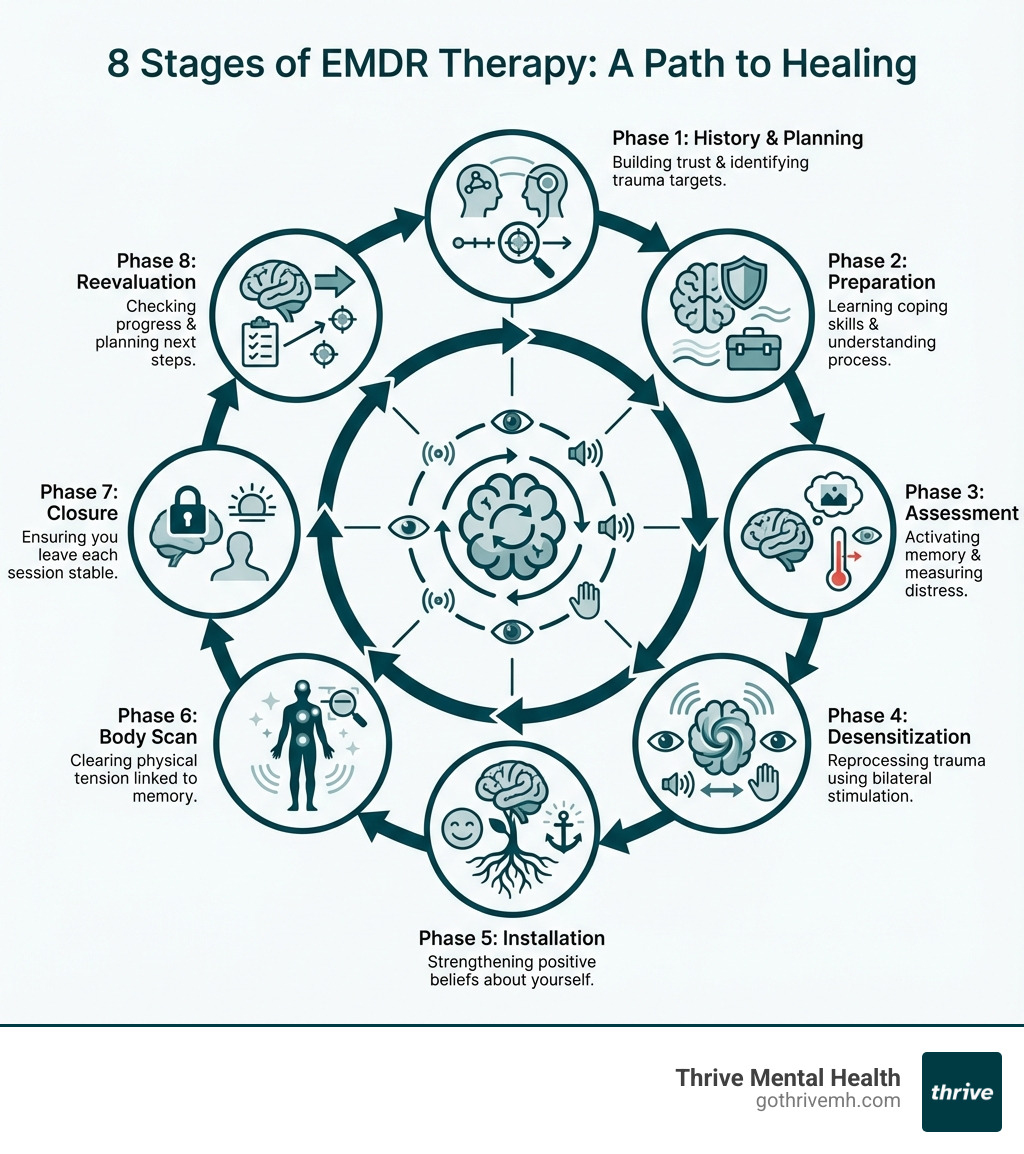
Here are the 8 stages of EMDR therapy:
- History-Taking and Treatment Planning – Building trust and identifying trauma targets
- Preparation – Learning coping skills and understanding the process
- Assessment – Activating the memory and measuring distress levels
- Desensitization – Reprocessing the trauma using bilateral stimulation
- Installation – Strengthening positive beliefs about yourself
- Body Scan – Clearing physical tension linked to the memory
- Closure – Ensuring you leave each session feeling stable
- Reevaluation – Checking progress and planning next steps
If you’re reading this, chances are you’ve tried traditional therapy without the breakthrough you need. Maybe you’re a driven professional managing anxiety or depression, or someone living with trauma that weekly talk therapy hasn’t resolved. You want results faster—and EMDR offers exactly that.
EMDR was developed in 1987 by psychologist Francine Shapiro and is now recognized by the American Psychological Association and World Health Organization as one of the most effective treatments for PTSD. Unlike traditional therapy that requires you to talk through every painful detail, EMDR uses bilateral stimulation (like guided eye movements) to help your brain reprocess traumatic memories so they lose their emotional charge.
The difference? Your brain does the healing. The therapist just guides the process through the eight stages of EMDR, helping you move from “that terrible thing happened to me” to “that’s something that happened in my past.”
As Nate Raine, CEO of Thrive Mental Health, I’ve seen how understanding the stages of EMDR empowers clients across Florida to approach their healing journey with confidence and clarity. With over a decade of leadership in mental health innovation and evidence-based care, I’ve built Thrive’s Florida-based programs around proven modalities like EMDR that deliver measurable outcomes for people ready to move forward. In this guide, I’ll break down each phase so you know exactly what to expect.
Essential stages of emdr terms:
What is EMDR and How Does It Reprogram Your Brain’s Response to Trauma?
At its core, EMDR therapy is a powerful form of interactive psychotherapy designed to alleviate psychological stress stemming from traumatic events. Its primary goal is to facilitate accelerated information processing, helping your brain digest and appropriately store problematic experiences that might be causing distress in your present life. We aim to identify and process negative thoughts and emotions tied to traumatic memories, ultimately reducing their emotional impact and vividness.
EMDR therapy emerged from the groundbreaking work of psychologist Francine Shapiro in the early 1980s. Dr. Shapiro observed that certain eye movements seemed to reduce the distress associated with her own disturbing thoughts. This led to the development of EMDR, a therapy now recognized by leading organizations like the American Psychological Association and the World Health Organization as a highly effective treatment for Post-Traumatic Stress Disorder (PTSD) and other mental health conditions.
The underlying theory behind EMDR is the Adaptive Information Processing (AIP) model. This model suggests that when a traumatic or highly distressing event occurs, the brain may not process the memory completely. Instead, it gets “stuck” in a raw, unprocessed state, retaining the original emotions, thoughts, and physical sensations. This maladaptive storage means that current perceptions are automatically linked to these unprocessed memories, leading to symptoms like flashbacks, anxiety, and depression. EMDR aims to reprocess these memories, allowing your brain to integrate them in a healthier way.
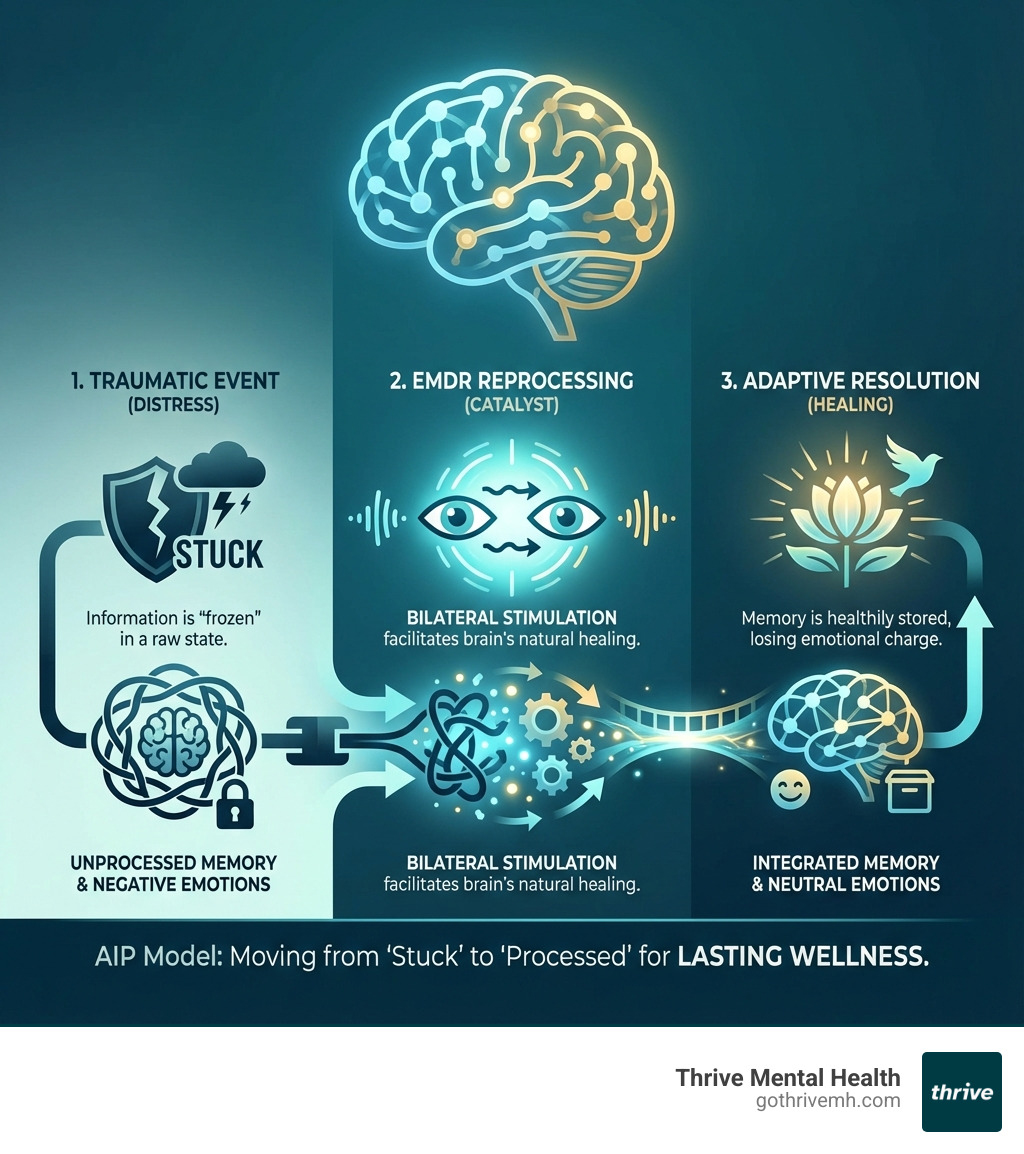
So, how does EMDR achieve this? Through bilateral stimulation (BLS). This involves stimulating both sides of your brain, typically through guided eye movements, but it can also include alternating taps or auditory tones. This bilateral stimulation is believed to mimic the natural processing that occurs during REM (rapid eye movement) sleep, where your brain actively processes memories and experiences. By engaging in BLS while focusing on a traumatic memory, your brain can reprocess the event, reducing its emotional charge and vividness. It’s like your brain is finally able to “file away” the memory correctly, so it no longer triggers an intense fight-or-flight response.
EMDR therapy differs significantly from traditional talk therapy. Unlike approaches that might require you to extensively detail the traumatic event, directly challenge dysfunctional beliefs, or complete homework assignments, EMDR focuses on changing how the memory is stored in your brain. We don’t spend sessions re-living every painful detail; instead, we guide your brain to reprocess the memory, allowing you to observe it from a more detached, less distressing perspective. This means you can gain relief without the need for prolonged exposure or lengthy discussions that can sometimes feel overwhelming. To learn more about how this powerful technique works, explore The Science Behind Bilateral Stimulation and Memory Processing.
The 8 Stages of EMDR Therapy [Your Step-by-Step Roadmap to Healing]
EMDR therapy is not a one-size-fits-all solution, but a structured process that adapts to your unique needs. This structured, eight-phase approach is recognized by the American Psychological Association as an effective PTSD treatment, providing a clear map for reprocessing trauma. Each phase has a specific function in your healing journey, guiding you systematically from distress to resolution.
Phase 1: History-Taking and Treatment Planning

This initial phase is all about building a strong foundation for your therapy. We’ll spend time getting to know you, understanding your history, and establishing a trusting and supportive relationship. This is similar to many other types of therapy, as establishing trust and rapport is crucial for effective treatment.
During this phase, we’ll collaboratively identify the specific targets for your EMDR therapy. These targets can include past traumatic memories, current triggers that cause distress, and even future situations where you’d like to feel more capable or confident. We’ll also assess your internal and external resources, ensuring you have the necessary support systems in place. This phase typically spans one to two sessions, each lasting between 50 and 120 minutes, allowing us ample time to develop a comprehensive treatment plan custom just for you. For more insights into finding the right match, consider our guide on choosing the right EMDR therapist in Florida.
Phase 2: Preparation
The Preparation phase is crucial for setting you up for success and ensuring you feel safe and in control throughout the EMDR process. We’ll thoroughly explain the eight stages of EMDR therapy, detailing what happens in each step and what you can expect emotionally and physically. We address any concerns or questions you might have, building a secure alliance between you and your therapist.
A key component of this phase is teaching you self-soothing and relaxation techniques, such as deep breathing, imagery, or mindfulness exercises. We might guide you through a “calm/safe place” exercise, helping you identify and visualize a peaceful mental retreat you can access if you ever feel overwhelmed during reprocessing. These techniques act as vital coping mechanisms, giving you tools to manage any emotional distress that might arise during later phases. This phase typically takes one to four sessions, though it can be longer for individuals who need more time to develop solid coping skills.
Phase 3: Assessment
In the Assessment phase, we pinpoint the specific memory or target that we will work on. This involves activating the target memory by asking you to identify a specific image or mental picture from the event, a negative self-belief associated with it (e.g., “I am helpless” or “I am worthless”), and a desired positive self-statement (e.g., “I am capable” or “I am safe now”). You’ll also identify the emotions and physical sensations linked to that memory.
To establish a baseline for your progress, we’ll use two scales:
- Subjective Units of Disturbance (SUD) scale: You’ll rate the level of distress or disturbance you feel when thinking about the memory, on a scale from 0 (no disturbance) to 10 (worst possible disturbance). Our goal is to reduce this to 0 or 1.
- Validity of Cognition (VOC) scale: You’ll rate how true your desired positive self-statement feels, on a scale from 1 (completely false) to 7 (completely true). Our goal is to increase this to a 7.
This phase can be surprisingly quick, sometimes taking as little as 30 seconds to activate the memory and establish these baselines.
Phase 4: Desensitization
This is often what people think of when they hear “EMDR.” During the Desensitization phase, we’ll guide you to focus on the traumatic memory while simultaneously engaging in bilateral stimulation (BLS). This might involve following our finger with your eyes, listening to alternating tones through headphones, or holding pulsars that vibrate in your hands.
The BLS helps to activate both sides of your brain, facilitating the reprocessing of the memory. You’ll simply allow your mind to go where it needs to go, noticing any thoughts, feelings, images, or sensations that arise without judgment. We’ll continue with sets of BLS until your Subjective Units of Disturbance (SUD) score for that memory reduces significantly, ideally reaching a 0 or 1. This process helps to reduce the vividness and emotional impact of the memory, effectively “desensitizing” you to it.
Phase 5: Installation
The Installation phase is where we actively strengthen the positive cognition you identified in Phase 3. Once the distress associated with the memory has been significantly reduced (SUD is low), we’ll guide you to focus on your preferred positive belief (e.g., “I am safe now,” “I am strong”) while continuing with bilateral stimulation.
The goal here is to link this positive belief directly to the reprocessed memory, making it feel completely true and deeply integrated. We’ll use BLS to “install” this positive cognition until your Validity of Cognition (VOC) score reaches a 7, indicating that the positive belief feels entirely true to you. This helps to replace the old, negative self-talk with a new, empowering perspective. For more on how our Florida EMDR programs help with trauma-related conditions, visit our page on How EMDR Therapy Reduces PTSD Symptoms and Boosts Mental Health.
Phase 6: Body Scan
Even after the emotional distress has lessened and positive beliefs are installed, trauma can sometimes manifest as residual physical sensations in the body. The Body Scan phase addresses this critical mind-body connection. While holding the now-reprocessed memory and your newly installed positive belief in mind, we’ll ask you to mentally scan your body from head to toe, noticing any lingering tension, discomfort, or unusual sensations.
If any negative sensations arise, we’ll target them with further bilateral stimulation until they are cleared. This ensures that the reprocessing is complete on a somatic level, leaving you feeling entirely clear of disturbance related to the memory. It’s a crucial step to ensure that your body, not just your mind, is free from the grip of past trauma.
Phase 7: Closure
The Closure phase is essential for ensuring you leave each session feeling stable and grounded, regardless of whether the reprocessing of a specific memory is fully complete. We understand that EMDR can bring up intense emotions, and your safety and well-being are our top priority.
If the reprocessing of a memory is not finished within a session, we’ll use specific self-calming techniques and containment strategies to help you manage any remaining emotional charge. We’ll debrief the session, discuss what you experienced, and provide instructions on what to expect between sessions. We might suggest journaling or practicing the relaxation techniques you learned in Phase 2. Our aim is for you to leave feeling better than or at least not worse than when you began, equipped to manage any residual feelings until your next appointment.
Phase 8: Reevaluation (The Start of Your Next Session)
Every EMDR session, subsequent to the first, begins with the Reevaluation phase. This is where we check in on the progress made in previous sessions. We’ll revisit the memories we’ve worked on, assessing their Subjective Units of Disturbance (SUD) and Validity of Cognition (VOC) scores to ensure that the distress remains low and the positive cognitions are strong.
If any residual disturbance is noted, we’ll address it. This phase also helps us identify any new targets or aspects of the trauma that may have emerged, guiding the direction of future sessions. It completes the cycle of the stages of EMDR for one target, allowing us to build on your progress and continue your journey towards healing.
Is EMDR Right for You? [Benefits, Timelines, and What to Expect]
EMDR therapy is a versatile and effective treatment for a wide range of mental health challenges, not just PTSD. We’ve seen it help countless individuals move from surviving to thriving.
Here are some conditions EMDR can effectively treat:
- PTSD (Post-Traumatic Stress Disorder): EMDR is considered one of the most effective treatments for PTSD, with the official EMDR Institute reporting a 92% success rate in patients experiencing PTSD. The U.S. Department of Veterans Affairs, for example, encourages and recommends EMDR to treat PTSD in combat veterans.
- Anxiety and Panic Attacks: By reprocessing the root causes of anxiety, EMDR can significantly reduce panic attacks and general anxiety symptoms.
- Depression: EMDR can help address underlying traumatic experiences or negative self-beliefs contributing to depressive episodes.
- Phobias: It can desensitize individuals to the specific triggers of their phobias.
- Low Self-Esteem: By installing positive cognitions, EMDR helps rebuild self-worth.
- Chronic Pain: EMDR can address the psychological component of chronic pain, reducing its impact.
- Substance Use Disorder: Often used in conjunction with other treatments, EMDR can help address the trauma that frequently underlies addiction.
- Unresolved Grief: EMDR can help individuals process the emotional pain of loss, allowing for healthy grieving.
- Performance Anxiety: By reprocessing past negative experiences, EMDR can improve confidence and performance.
How long does EMDR therapy typically last, and how long are sessions?
EMDR therapy is typically delivered one to two times per week. A structured treatment plan often spans 6 to 12 sessions, though some individuals may benefit from fewer, especially for a single-incident trauma which might be reprocessed within one to three sessions. Each EMDR session usually lasts approximately 60-90 minutes. The total duration can vary based on the complexity of your trauma history and individual needs.
What should someone expect in terms of emotional experience during EMDR sessions?
It’s important to know that EMDR can evoke a range of emotions. As you focus on distressing memories during reprocessing, you might experience strong emotions, vivid memories, or physical sensations. This can include crying, sadness, anger, or even physical discomfort. This emotional release is a natural and necessary part of the healing process. However, you are always in control. Your therapist is there to guide you, help you stay grounded, and use the coping techniques you learned in Phase 2 to manage any overwhelming feelings. We ensure you process these feelings without being consumed by them.
Are there any specific populations or conditions for whom EMDR may not be suitable?
While EMDR is highly effective for many, it may not be suitable for everyone. Individuals with severe dissociative disorders or psychosis might find the intensity of EMDR overwhelming. Similarly, if you are actively using substances or experiencing hallucinations, these can interfere with the reprocessing process. In such cases, a more gradual or alternative approach may be recommended. It’s crucial to have a thorough assessment with a licensed mental health professional to determine if EMDR is the right fit for your specific needs. For a deeper dive into considerations, explore More info about the dangers and side effects of EMDR.
Can EMDR therapy be adapted or customized for individual needs?
Absolutely. EMDR therapy is highly flexible and can be adapted to suit your individual needs and goals within its eight-phase framework. Your therapist will work closely with you to tailor the treatment plan, selecting targets and pacing the sessions in a way that feels comfortable and effective for you.
We understand that accessing quality mental healthcare is paramount for Floridians. Thrive Mental Health is proud to offer EMDR therapy in our virtual and in-person programs across Florida. We work with many major insurance providers, including Florida Blue, Cigna, and Optum, to make this life-changing therapy accessible right here in the Sunshine State.
Frequently Asked Questions about the Stages of EMDR
How long does EMDR therapy take to work?
EMDR is designed for accelerated processing. While a full course is typically 6-12 sessions (60-90 minutes each), many people report feeling some relief after just a few sessions. The total time depends on the complexity of the trauma and individual response.
What does EMDR feel like?
During reprocessing, you might experience strong emotions, vivid memories, or physical sensations. However, you are always in control, and your therapist guides you to stay grounded in the present. The goal is to process the feelings, not to be overwhelmed by them.
Does EMDR erase bad memories?
No, EMDR does not erase memories. It helps your brain reprocess them so they are no longer emotionally charged. The memory becomes just a memory, like a story from the past, rather than a distressing event that feels like it’s happening now.
Your Path to Healing Starts Here
The stages of EMDR offer a proven, structured path from trauma to recovery, helping your brain’s natural healing process get unstuck. At Thrive Mental Health, our certified Florida-based therapists are trained to guide you through each phase with expertise and compassion. We offer flexible virtual and in-person programs in Florida designed for your life, covered by most major insurance plans, including Florida Blue.
Ready for support in Florida? Thrive offers virtual and hybrid IOP/PHP programs with evening options. Verify your insurance in 2 minutes (no obligation) → Start benefits check or call 561-203-6085. If you’re in crisis, call/text 988.