
Cheat Sheet to Thrive vs. Local Clinic Mental Health Access

Why Mental Health Access Matters More Than Ever—and Why Most People Can’t Get It
How accessible are Thrive’s mental health programs compared to local clinics? Thrive offers care in 1–7 days with flexible evening scheduling and virtual access across Florida, while most local clinics have 4–12+ week waitlists and rigid 9–5 hours that force you to miss work or school.
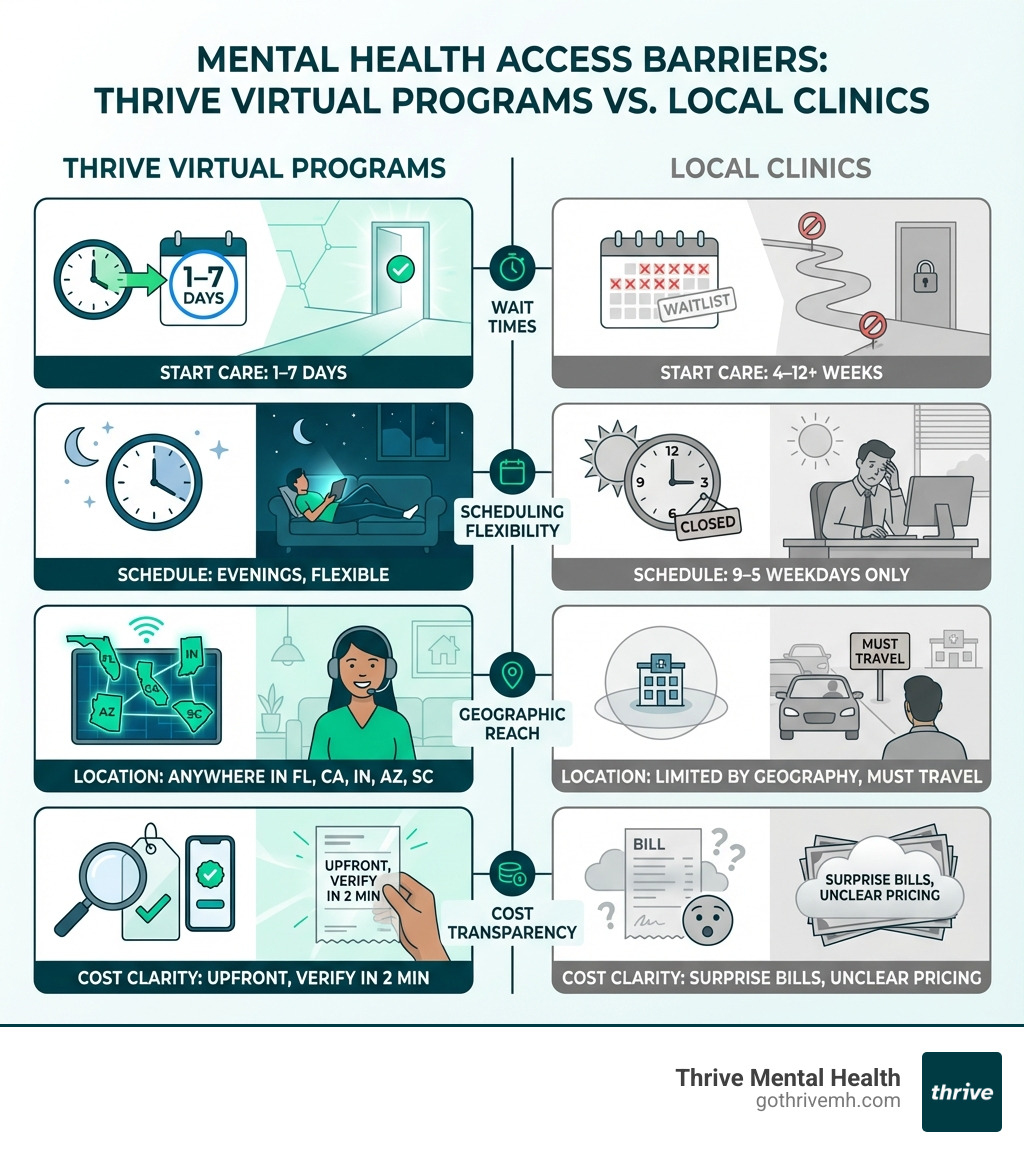
Quick Answer: Thrive vs. Local Clinics
| What You Need | Thrive Virtual IOP/PHP | Typical Local Clinic |
|---|---|---|
| Start Care | 1–7 days | 4–12+ weeks |
| Schedule | Evenings, flexible | 9–5 weekdays only |
| Location | Anywhere in Florida | Must travel, limited by geography |
| Cost Clarity | Upfront, verify in 2 min | Surprise bills, unclear pricing |
| Insurance | In-network: Cigna, Optum, FL Blue, more | Varies, often out-of-network |
Nearly 50 million American adults experienced mental illness in 2022. More than half got no treatment at all.
Why? The mental health system is broken.
37% of Americans live in mental health provider shortage areas—that’s 149 million people fighting for care in “therapy deserts.” Even if you find a provider, you’re looking at month-long waitlists, 9-to-5 schedules that clash with work, and surprise bills that can cost hundreds per session.
High costs stopped 44% of Americans from getting mental health care in 2019. For those with serious mental illness, that number jumped to 52%.
And it’s getting worse. Global rates of anxiety and depression jumped 25% in the first year of the pandemic. Youth mental health is now a national emergency—yet only 20% of teens with mental health needs receive care.
The old model isn’t working. Traditional local clinics are overwhelmed, understaffed, and out of reach for millions. Community-based, virtual care models like Thrive are changing the game by removing barriers, cutting wait times, and bringing treatment to you—wherever you are.
I’m Nate Raine, CEO of Thrive Mental Health, and I’ve spent over a decade building systems that make behavioral health care accessible, measurable, and effective. Understanding how accessible are Thrive’s mental health programs compared to local clinics isn’t just about logistics—it’s about whether you can get help this week or wait until your symptoms spiral.
Let’s break down exactly how Thrive’s approach compares to traditional local clinics—so you can make an informed decision about your care.
Why Traditional Mental Health Care Leaves People Waiting—and Hurting
The numbers are brutal: millions can’t get help when they need it. The stark reality is that our current mental health infrastructure often fails to meet the overwhelming demand for care. This isn’t just about individual providers; it’s a systemic issue rooted in provider shortages, inconvenient scheduling, and opaque costs that create significant barriers.
Consider this:
- 37% of Americans live in mental health provider shortage areas, which means 149 million people reside in regions with one or fewer mental health professionals per 30,000 residents. These are often dubbed “therapy deserts,” leaving vast swaths of our communities underserved.
- These “therapy deserts” aren’t exclusive to rural areas; they exist in both rural and urban environments, making access a postcode lottery rather than a right.
- Rigid 9-to-5 schedules are the norm for many traditional clinics. If you work a standard job, have childcare responsibilities, or are a student, finding time for an appointment can feel impossible. This forces many to choose between their mental health and their daily responsibilities.
- High out-of-pocket costs and insurance headaches are a major deterrent. High costs prevented nearly 44% of Americans with any mental health issues and up to 52% of adults with serious mental illness from receiving treatment in 2019. Even with insurance, confusing billing practices, high deductibles, and limited in-network options turn seeking care into a financial labyrinth.
- The lingering stigma of walking into a clinic can also prevent individuals from seeking help. Despite growing awareness, the fear of judgment or being seen as “weak” keeps many from taking that crucial first step.

The Real Cost of Delayed Care: What Waiting Does to Your Life
When you need mental health support, every day counts. Delaying care isn’t just an inconvenience; it can have devastating, cascading effects on every aspect of your life. The statistics paint a grim picture of untreated mental illness impact: nearly 50 million adults in the United States experienced some form of mental illness in 2022, and more than half of them received no treatment. This leads to:
- Worsening symptoms: What might start as manageable anxiety or sadness can escalate into severe conditions, requiring more intensive and prolonged treatment down the line.
- Lost workdays and strained relationships: Mental health struggles can significantly impair your ability to function at work or school, leading to decreased productivity, absenteeism, and even job loss. Relationships with family and friends can suffer as communication breaks down and emotional withdrawal increases.
- Financial stress from untreated illness: The economic cost of untreated mental illness is enormous, impacting individual earning potential and contributing to broader societal burdens. For every US$1 invested in scaled-up treatment for depression and anxiety, there is a US$4 return in better health and productivity, highlighting the immense value of timely intervention.
- Frustration and hopelessness: Constantly battling symptoms without professional support, coupled with the struggle to access care, can lead to profound feelings of frustration, isolation, and hopelessness, further exacerbating mental health challenges.
Are You in a “Therapy Desert”?
The term “therapy desert” isn’t an exaggeration; it’s a harsh reality for far too many Americans. We’re talking about regions where access to mental health providers is severely limited.
- 1 in 3 Americans can’t find a local provider, largely due to these geographical disparities. This means even if you’re ready to seek help, the physical infrastructure simply isn’t there to support you.
- Rural areas are hit hardest, where the scarcity of mental health professionals is most acute. This leaves residents with limited options, often requiring long-distance travel for appointments, if they can even find one.
- This scarcity also means a lack of specialized care. If you need specific interventions for complex conditions, finding a local expert becomes an even greater challenge.
- Beyond just the absence of providers, physical access creates transportation and time-off barriers. How do you get to an appointment an hour away when you don’t have reliable transportation or can’t afford to take hours off work? These logistical problems can be impossible, effectively shutting people out of the care system.
The THRIVE Model: Community-Integrated, Virtual Care That Breaks Barriers
At Thrive, we believe mental health care should be as accessible and integrated into your life as your physical health. Our approach isn’t just about treating symptoms; it’s about empowering you with tools and support that fit seamlessly into your daily routine, breaking down the traditional barriers that leave so many behind.
Our model is fundamentally different from the institutional, one-size-fits-all approach of many local clinics:
- Community-based, not institutional: We integrate care into your life, not pull you away from it. This means services are designed to be part of your community, whether that community is your home, your workplace, or your social network. We focus on enhancing access and supporting recovery in everyday environments, rather than isolated clinical settings.
- Integrated mental + physical health: We understand that your mind and body are connected. Our programs consider the holistic picture of your well-being, recognizing that mental health is influenced by and influences physical health.
- Addressing social factors that impact recovery: We acknowledge that mental health is shaped by a complex interplay of individual factors, social connections, and environmental conditions. Our programs take into account the “community determinants” of health, such as access to resources, supportive environments, and social inclusion. This broader perspective helps us provide more comprehensive and sustainable support.
- Empowering you to take charge: We believe in your inherent strength and ability to heal. Our programs are designed to give you the tools, knowledge, and support to actively participate in your recovery journey, building resilience and fostering long-term well-being.
- Technology that brings care to your door: We leverage cutting-edge technology to deliver high-quality, evidence-based care directly to you. Our virtual Intensive Outpatient (IOP) and Partial Hospitalization (PHP) programs are designed for people who need more than once-a-week therapy but less than inpatient care, offering the flexibility and convenience that traditional clinics often lack. This virtual component is a game-changer for individuals in therapy deserts or with demanding schedules.
This community-integrated, virtual care model aligns with best practices for expanding mental health access globally. It moves beyond simply providing services to fostering environments where mental well-being can truly flourish.
Thrive Accessibility Breakdown: How Fast, Flexible, and Transparent Is It?

When you’re struggling, every obstacle to care feels magnified. That’s why we’ve designed Thrive’s programs to eliminate as many barriers as possible. Let’s look at a head-to-head comparison of Thrive’s virtual IOP/PHP programs versus typical local clinics:
| Feature | Thrive Virtual IOP/PHP | In-Person Clinic |
|---|---|---|
| Wait Time | 1–7 days | 4–12+ weeks |
| Scheduling | Evenings, flexible | 9–5 only |
| Location | Anywhere in Florida | Must travel, limited reach |
| Cost Transparency | Upfront, verify in 2 min | Surprise bills, unclear |
| Insurance | Cigna, Optum, FL Blue, more | Varies, often out-of-network |
| Care Intensity | IOP/PHP, group & individual | Mostly weekly therapy only |
Speed to Care: Get Help This Week, Not Next Season
The biggest differentiator for how accessible are Thrive’s mental health programs compared to local clinics is often speed. When you’re in crisis or experiencing significant distress, waiting weeks or months for an appointment can feel like an eternity.
- Thrive: Start in days, not months. We understand the urgency of mental health needs. Our streamlined intake process allows most individuals to begin their Intensive Outpatient (IOP) or Partial Hospitalization (PHP) programs within 1 to 7 days. This rapid access means you can get the support you need when you need it most, preventing symptoms from escalating.
- No referral bottlenecks. Unlike many traditional clinics that require lengthy referral processes, our direct access model removes unnecessary problems, getting you to care faster.
- Immediate access to IOP/PHP. Our programs provide a higher level of care than typical weekly therapy, offering comprehensive support for those who need it. This means you don’t have to wait to “prove” you need more intensive treatment; if our assessment indicates IOP or PHP is appropriate, you can start right away. Learn more about Thrive’s IOP/PHP programs.
Cost & Insurance: No More Surprise Bills
High costs are consistently cited as the #1 barrier to mental health care. For many, the financial burden of therapy is simply too much to bear, even when they desperately need help. We believe financial transparency is key to accessibility.
- Thrive: Upfront pricing, instant insurance check. We provide clear, upfront information about costs, so you know what to expect. You can quickly and easily verify your insurance in 2 minutes to understand your coverage without any obligation.
- In-network with Cigna, Optum, Florida Blue, and more. We actively work with major insurance providers to ensure our programs are accessible and affordable for a wider range of individuals. In Florida, telehealth parity laws require insurance companies to cover online mental health services just as they would in-person visits, further expanding your options.
- The average out-of-pocket cost for an in-person therapy session is around $174. With Thrive, online therapy subscription plans can break down to as little as $65-$100 per week, making consistent, intensive care significantly more affordable. With insurance, copays for online therapy can be as low as $0-$53 per session.
Location & Schedule: Care That Fits Your Life
Traditional mental health care often demands that you adapt your life to its schedule and location. At Thrive, we flip that script, bringing care to you, on your terms.
- Access from Anywhere in Florida. Our virtual Intensive Outpatient (IOP) and Partial Hospitalization (PHP) programs mean that geographical limitations no longer dictate your access to high-quality care. Whether you’re in Miami, Orlando, Tampa, or Jacksonville, you can receive treatment without leaving your home. This is a crucial advantage for residents across Florida, a state with significant mental health provider shortages in many areas.
- No commute, no time off work. Think about the time and energy saved by eliminating travel to and from appointments. This is especially beneficial for individuals in areas like Tampa Bay, South Florida, or the Panhandle, where traffic and distance can be considerable barriers.
- Evening and flexible options for busy lives. Our programs are designed with your schedule in mind. We offer evening sessions, making it possible for you to commit to intensive treatment without sacrificing your job, education, or family responsibilities. This flexibility is ideal for parents, working professionals, and anyone facing mobility or transportation challenges.
Beyond Access: Quality, Results, and Real Support
Accessibility is paramount, but it’s only one piece of the puzzle. At Thrive, we’re equally committed to providing high-quality, effective treatment that delivers tangible results and fosters genuine, lasting well-being. Our approach extends beyond simply opening the door to care; we walk alongside you on your journey to recovery.
- Evidence-based, measurable results. Our programs are rooted in clinical expertise and data-driven methods. We constantly assess and refine our interventions to ensure they are effective, helping you achieve meaningful, accelerated healing.
- Integrated care for mind and body. We recognize that mental health doesn’t exist in a vacuum. Our holistic approach considers the interplay between your mental and physical well-being, providing comprehensive support for your whole self.
- Community support, not just “patients.” We foster a sense of belonging and connection within our programs. You’re not just a number; you’re part of a supportive community where shared experiences and mutual encouragement are central to the healing process. Explore Thrive’s Virtual Therapy options.
Stigma-Free, Inclusive Care: Feel Safe, Not Judged
For many, the fear of judgment is a significant barrier to seeking mental health care. We’ve built an environment where you can feel safe, respected, and understood.
- Anonymity and privacy of virtual care. Virtual programs offer a level of privacy that can significantly reduce the perceived stigma. You can engage in therapy from the comfort and discretion of your own space, eliminating the anxiety of being seen entering a mental health clinic.
- Culturally competent, inclusive support. We are committed to providing care that respects and understands diverse backgrounds and experiences. Our therapists are trained to offer inclusive support, ensuring everyone feels heard and valued.
- Peer support and real community. Connecting with others who share similar experiences can be incredibly validating and empowering. Our group therapy sessions foster a strong sense of community, allowing you to build connections and receive support from peers who truly understand what you’re going through. Read: The Power of Community in Mental Health Recovery.
You’re a Partner, Not a Number
Your recovery journey is unique, and we treat it as such. We see you as an active participant, not a passive recipient of care.
- Active role in your recovery. We believe the most effective treatment happens when you’re fully engaged. Our programs encourage you to take an active role, setting goals, providing feedback, and building skills that serve you long after your program ends.
- Collaborative treatment planning. Your treatment plan is developed with you, not just for you. We integrate your insights, preferences, and goals into a personalized roadmap for your well-being.
- Build resilience with community and expert support. We combine the wisdom of our expert clinicians with the strength of peer connections to help you build lasting resilience, equipping you to steer life’s challenges with greater confidence and coping skills.
FAQs: Fast Answers About Thrive’s Accessibility
Is virtual IOP or PHP as effective as in-person?
Yes—studies consistently show that virtual Intensive Outpatient Programs (IOP) and Partial Hospitalization Programs (PHP) are just as effective as their in-person counterparts, with the added benefits of convenience, privacy, and reduced logistical barriers.
How do I know if I need more than weekly therapy?
If your mental health symptoms are significantly disrupting your daily life, work, school, or relationships, or if you find that weekly therapy isn’t providing the level of support or progress you need, an IOP or PHP program might be a more suitable option. These programs offer more intensive, structured support to help you stabilize and build coping skills more rapidly.
What if I don’t have good insurance?
Thrive is committed to making care accessible. We work with a wide range of insurance providers, including Cigna, Optum, and Florida Blue, and our team can help you understand your benefits. We also offer transparent self-pay options and can explore various payment solutions to ensure you get the care you need. Check your benefits in 2 minutes.
Can I join from anywhere in my state?
Yes—Thrive’s virtual programs are available across the entire state of Florida. This means whether you’re in a major city like Miami, Orlando, or Tampa, or a more rural area, you can access our high-quality Intensive Outpatient and Partial Hospitalization programs.
How fast can I start?
We prioritize rapid access to care. Most individuals can begin their Thrive program within 1–7 days of their initial inquiry. We don’t believe in long waitlists when your mental health is on the line.
Summary: Don’t Wait—Thrive Makes Mental Health Care Accessible Now
If you’re tired of waiting, paying too much, or feeling stuck in a system that doesn’t prioritize your needs, Thrive’s virtual IOP/PHP programs are built for you. We bridge the gap between urgent need and effective treatment, making mental health care a reality in days, not months. Access our comprehensive, evidence-based programs from anywhere in Florida, with transparent costs and no surprise bills.
Ready for support? Thrive offers virtual and hybrid IOP/PHP programs with evening options. Verify your insurance in 2 minutes (no obligation) → Start benefits check or call 561-203-6085. If you’re in crisis, call/text 988.