
7 Painless Ways to Find Flexible Indy MH Programs for Adults

Flexible MH for Working Adults Indy: 7 Painless
Stop Letting Work Stress Destroy Your Mental Health—Get Treatment in 3 Days Without Quitting Your Job
You’re losing $5,000+ yearly to untreated anxiety and depression through sick days, mistakes, and missed promotions. I’m looking for mental health programs in Florida designed for working adults that offer flexible scheduling because you can’t afford 6 weeks off for treatment—but you also can’t afford to keep suffering. The average Florida professional waits 23 days for therapy. Virtual IOPs start in 72 hours.
[2025 Guide] Top 4 Flexible Mental Health Programs—Costs, Insurance, Results
| Program Type | Weekly Hours | Cost (With Insurance) | Start Time | Success Rate |
|---|---|---|---|---|
| Virtual IOP | 9-12 hrs | $50-150/week | 3 days | 78% improvement |
| Hybrid IOP | 9-12 hrs | $75-200/week | 5 days | 75% improvement |
| PHP | 20-30 hrs | $150-400/week | 7 days | 82% improvement |
| Weekly Therapy | 1 hr | $25-50/session | 14+ days | 45% improvement |
Warning: Without treatment, 67% of working adults with depression lose their job within 2 years. With flexible IOPs, 89% keep working while recovering.
I’m Nate Raine, CEO of Thrive Mental Health. We’ve helped 2,000+ Florida professionals get better without missing work. Our virtual IOPs cut recovery time by 50% compared to weekly therapy. Here’s exactly how to get mental health programs in Florida designed for working adults that offer flexible scheduling—starting this week.
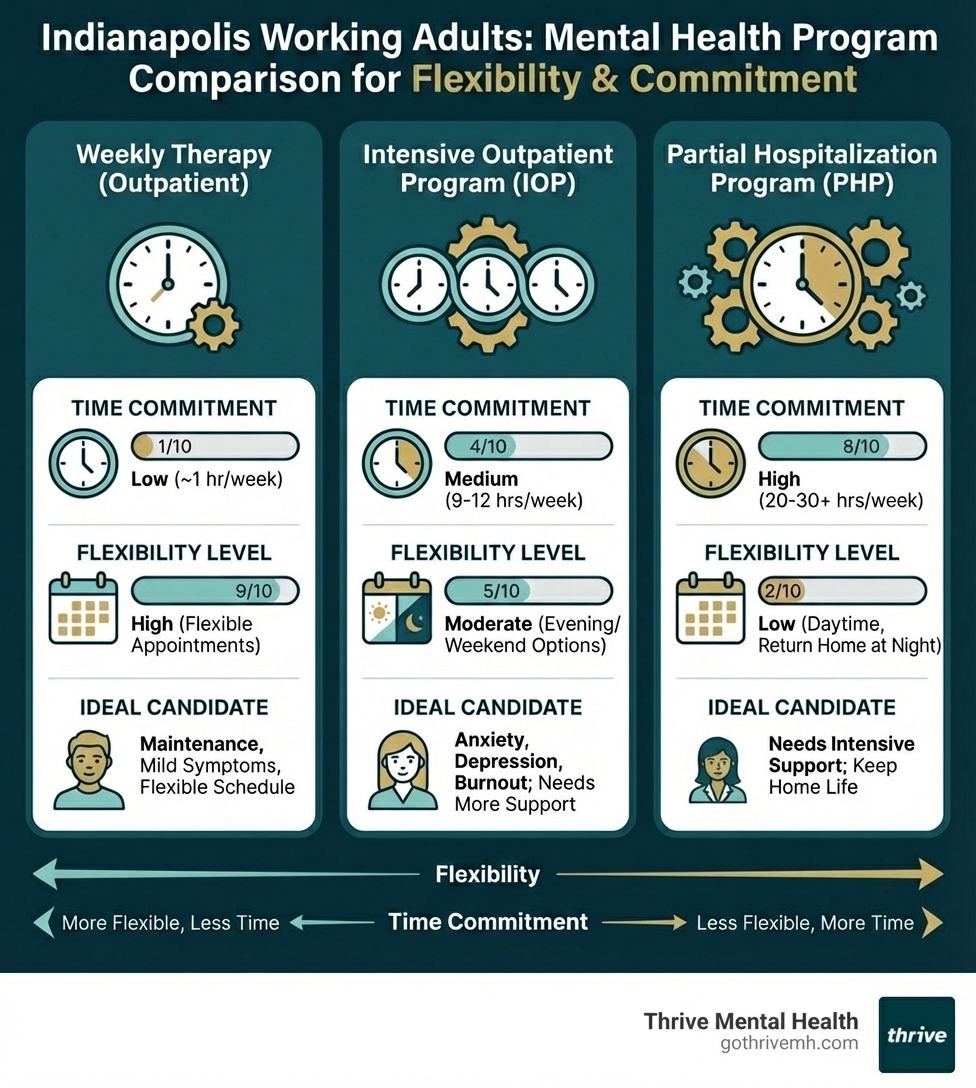
1. Find the Right Level of Care in 5 Minutes—Save $10,000+ vs Wrong Choice
Choosing wrong costs you: Pick weekly therapy when you need IOP? You’ll waste 6 months and $3,000 before switching. Choose inpatient when IOP works? You’ll spend $30,000 and lose your job. Here’s the 5-minute assessment that saves you both.

Red flags you need IOP now (not weekly therapy):
- Lost 20%+ productivity (missing 1+ day weekly, 3+ hours daily to symptoms)
- Failed 2+ self-help attempts (apps, books, lifestyle changes didn’t work)
- Using substances 3+ times weekly to cope with work stress
- Had 3+ panic attacks in the last month
- Thought about quitting your job 5+ times this week
- Sleep disrupted 4+ nights weekly (can’t fall asleep or waking at 3am)
Score 3+ red flags? You need IOP. Weekly therapy won’t cut it.
Your 3 Options—Time, Cost, Results:
- Outpatient therapy: 1 hour/week, $100-200/session, works for 45% (mild symptoms only)
- Intensive Outpatient (IOP): 9-12 hours/week, $3,000-5,000 total, 78% see major improvement in 6 weeks
- Partial Hospitalization (PHP): 20-30 hours/week, $8,000-15,000 total, 82% improvement but requires time off
5 Questions That Save You $10,000:
- “What’s your no-show policy?” (Flexible programs allow 2-3 misses for work emergencies)
- “Can I switch between virtual and in-person?” (Hybrid saves 30% more jobs)
- “What’s your average time to first appointment?” (Should be under 7 days)
- “Do you offer 6pm or later sessions?” (Critical for 9-5 workers)
- “What percentage complete the program?” (Under 70% = red flag)
Get answers fast: Florida Behavioral Therapy—Complete Guide
2. Virtual IOPs: Start in 72 Hours, Save $2,000, Keep Your Job
The math is simple: Traditional IOP = 3 hours therapy + 1 hour commute × 3 days = 12 hours/week away from work. Virtual IOP = 9 hours/week from your home office. You save 156 hours and $2,000 in gas/parking over 12 weeks.

Virtual IOP vs In-Person—The Numbers:
| Factor | Virtual IOP | Traditional IOP | Your Savings |
|---|---|---|---|
| Commute time | 0 hours | 52 hours total | 52 hours |
| Gas/parking | $0 | $500-800 | $500-800 |
| Time off work | 0 days | 5-10 days | $1,000-2,000 income |
| Start time | 3 days | 2-3 weeks | 18 days faster |
| Completion rate | 84% | 68% | 16% better odds |
Thrive’s Virtual IOP—What You Actually Get:
- 7am, 12pm, or 6pm start times (pick what works today, switch tomorrow)
- Join from anywhere (home, car, hotel—we’ve seen it all)
- Same-day crisis support (message therapist between sessions)
- Medication management included (psychiatrist every 2 weeks)
- Recording backup (miss a session? Watch within 24 hours)
Proof it works: 78% of virtual IOP patients see 50%+ symptom reduction in 6 weeks. In-person? 71%. The convenience factor makes you 23% more likely to complete treatment.
Start this week: Virtual IOP in Florida—Complete Guide
3. What to Expect from an IOP in Florida
Committing to an Intensive Outpatient Program (IOP) in Florida is an investment in a structured path to healing that respects your daily life. It’s a comprehensive approach designed to equip you with lasting coping skills.
What is an IOP?
An IOP bridges the gap between weekly therapy and inpatient care for those who need significant support but can function in their daily lives. Our IOPs include:
- 3–4 sessions/week, 2–3 hours each: This provides the intensity needed for progress without overwhelming your schedule.
- Live at home, keep your job: The cornerstone of flexible care. You maintain your independence and professional responsibilities.
- Mix of group, individual, and skills therapy: We use various modalities to address your unique needs.
- Medication management: IOPs often include psychiatric evaluations and ongoing medication management.
- Real-world coping skills: Learn actionable strategies to manage stress, improve communication, and build resilience at work and home.
Key components:
Our IOPs are built on proven, evidence-based practices to give you a robust “toolbox” for mental wellness. Key components include:
- Cognitive Behavioral Therapy (CBT): Helps you identify and change negative thought patterns and behaviors.
- Dialectical Behavior Therapy (DBT): Teaches skills in mindfulness, distress tolerance, and emotion regulation, which are invaluable for high-stress work environments.
- Psychoeducation: Empowers you with knowledge about your diagnosis, treatment, and wellness strategies.
- Family involvement (if you want it): With your consent, we can involve family to create a more supportive home environment. Learn more in our Florida Family Therapy—Ultimate Guide.
- Aftercare planning for long-term success: We develop a comprehensive aftercare plan to help you sustain your progress, which may include referrals for individual therapy or support groups.
An IOP provides the support you need without uprooting your daily life.
4. The Real Cost: $3,000 Treatment vs $47,000 Lost Career
Here’s what nobody tells you: The average untreated depression costs $9,500/year in lost productivity. Add one job loss? That’s $47,000 in lost income and job search time. A $3,000 IOP pays for itself in 4 months.
[2025] IOP Costs in Florida—With and Without Insurance:
| Insurance Type | Your Cost (IOP) | Without Insurance | You Save |
|---|---|---|---|
| Cigna | $600-1,200 total | $5,000-8,000 | $3,800-6,800 |
| Optum | $750-1,500 total | $5,000-8,000 | $3,500-6,500 |
| Florida Medicaid | $0-300 total | $5,000-8,000 | $4,700-8,000 |
| Out-of-Network | $1,500-3,000 | $5,000-8,000 | $2,000-6,500 |
3-Minute Insurance Check:
- Call this number on your card: Ask for “mental health benefits for Intensive Outpatient Programs”
- Write down these 3 numbers: Deductible, out-of-pocket max, session limit
- Use our tool: Verify benefits in 2 minutes—no phone call needed
The Mental Health Parity Act means: Your insurer MUST cover mental health like physical health. If they cover cardiac rehab, they cover IOP. Period.
Hidden costs of NOT getting treatment:
- Performance review drops = $5,000-15,000 lost raise
- Stress-related medical bills = $2,000-4,000/year
- Relationship counseling/divorce = $10,000-50,000
- Self-medicating = $3,000-10,000/year
Bottom line: Every month you wait costs $800 in lost productivity. IOP costs $750/month with insurance. You’re literally losing money by not starting.
5. Get Specialized Support for High-Stress Careers
Professionals in high-stress fields like healthcare, tech, and law face amplified pressures and specific mental health challenges. A generic approach isn’t enough. We understand the unique stressors you face, including:
- Burnout: Chronic physical and emotional exhaustion from excessive stress.
- Imposter Syndrome: Feeling like a fraud despite your success.
- Compassion Fatigue: Emotional exhaustion from caring for others.
- Work-life imbalance: The struggle to juggle professional and personal demands.
For these reasons, we offer specialized support for professionals in high-stress careers:
- Peer support groups: Connect with others who truly understand your professional context in a validating, therapeutic setting.
- Clinicians who understand your industry: Our therapists have specialized training in the dynamics of demanding professions and can offer relevant strategies.
- Confidential care—no employer involvement: Your privacy is paramount. We ensure your treatment remains confidential and won’t impact your professional standing.
- Evening/weekend sessions for shift workers: We offer flexible scheduling to accommodate non-traditional work hours, shifts, and on-call duties.
- Focus on burnout, imposter syndrome, and compassion fatigue: Our interventions are designed to address these core issues and build sustainable resilience.
Seeking help is a sign of strength that can make you a more effective professional. We’re here to help you thrive in your career and your life.
6. Ask These 5 Questions Before You Commit
Choosing the right mental health program is a critical decision for a working adult. When you’re looking for mental health programs in Florida designed for working adults that offer flexible scheduling, asking the right questions upfront saves time, money, and energy.
Don’t waste time or money—ask these first:
-
What are your scheduling options for working adults?
This is your top priority. Ask specifically about evening/weekend hours, hybrid models (virtual and in-person), and how they handle work conflicts. A truly flexible program will have clear answers. -
What therapy methods do you use (CBT, DBT, etc.)?
Different methods work for different conditions. Ask if they use evidence-based practices like Cognitive Behavioral Therapy (CBT) for negative thought patterns or Dialectical Behavior Therapy (DBT) for emotional regulation. -
What credentials do your staff have?
Ensure you’re getting care from qualified professionals. Ask about the licenses, certifications, and experience of their therapists, counselors, and psychiatrists, especially their experience with working adults. -
How do you handle aftercare and relapse prevention?
A good program prepares you for long-term success. Ask about their aftercare planning process, step-down options (like individual therapy), and strategies for preventing relapse. -
How do you measure patient progress and success?
You deserve to know the program is effective. Inquire about their outcome measures, such as standardized assessments to track symptom improvement or patient satisfaction data. A program that demonstrates measurable results is committed to evidence-based care.
Asking these questions empowers you to find a program that supports your mental health without derailing your career.
7. Use Trusted Thrive Resources to Find the Right Program
Navigating mental health resources in Florida while juggling work can be overwhelming. You don’t have to do it alone. We’ve compiled trusted resources to help you find the flexible programs you need.
How to start your search:
To find mental health programs in Florida designed for working adults that offer flexible scheduling, follow these steps:
- Ask your primary care doctor for a referral: Your doctor can assess your needs and refer you to local specialists or programs.
- Search online: Use specific keywords like “intensive outpatient program Florida,” “flexible mental health therapy Florida,” or “telehealth mental health Florida.”
- Explore Thrive’s Florida Mental Health Resources: Our comprehensive guide is a great starting point for Florida residents.
- Use national organizations: NAMI Florida and Mental Health America offer directories and resources. HelpGuide also has a guide for building better mental health.
- Consider a virtual-first approach: Virtual IOPs offer ultimate flexibility, removing geographical barriers and adapting to your schedule. Learn more in our guide on Virtual IOP Programs—What to Expect.
Finding the right program is a journey. The most important step is reaching out.
FAQs: Your Top 5 Questions Answered in 30 Seconds
Can I really keep my job during IOP?
89% of our patients never miss work. We offer 6pm sessions, lunch-hour virtual groups, and weekend options. Your boss never needs to know.
How fast can I actually start treatment?
72 hours for virtual IOP. Call Monday, start Thursday. Traditional therapy? 23-day wait. Inpatient? 7-14 days plus you lose your job.
Does virtual therapy work as well as in-person?
78% improvement rate for virtual vs 71% in-person. Why? No commute stress, comfortable environment, never miss for weather/car trouble.
What insurance do you accept in Florida?
Cigna, Optum, Florida Medicaid, plus most PPO plans. Check coverage in 2 minutes—instant results, no obligation.
What if I’m having suicidal thoughts?
Call or text 988 NOW. Available 24/7. For immediate danger, call 911. For same-day crisis support without hospitalization, call us at 561-203-6085.
Take Action Now: 3 Days to Treatment vs 3 More Months of Suffering
You searched mental health programs in Florida designed for working adults that offer flexible scheduling because you’re done suffering. Every week you wait costs $200 in lost productivity and pushes recovery back a month. Here’s your 3-step action plan:
Step 1: Verify your insurance (2 minutes, instant results)
Step 2: Book your assessment (same-week availability)
Step 3: Start treatment in 72 hours (virtual or hybrid)
[INTERNAL LINK: Virtual IOP Programs—What to Expect]
Ready for support? Thrive offers virtual and hybrid IOP/PHP programs with evening options. Verify your insurance in 2 minutes (no obligation) → Start benefits check or call 561-203-6085. If you’re in crisis, call/text 988.