
Strengthen Your Bonds with Family Therapy in Indiana

Indiana Family Therapy: Top 5 Benefits for Stronger Bonds
Why Families in Indiana Are Turning to Therapy for Stronger Relationships
Indiana family therapy helps families work through challenges, improve communication, and build stronger bonds. Whether you’re dealing with conflict, life transitions, or simply want better family dynamics, professional therapy provides the tools and support your family needs to thrive.
Quick Guide to Indiana Family Therapy:
- What it is: Professional counseling that treats the family as a connected system.
- Who can benefit: Families facing communication issues, conflict, grief, or major changes.
- Average cost: Often covered by insurance (Cigna, Optum, BlueCross BlueShield), with an average course of 12 sessions.
- Where to find it: Licensed therapists (LMFT, LCSW, LMHC) available in-person and virtually.
- Success rate: Studies show nearly 90% improvement in family functioning.
Think of your family as an ecosystem. When one person struggles, it affects everyone. Family therapy recognizes this interconnection and helps restore balance. Research shows that families who attend therapy together are significantly more likely to see lasting positive changes.
From Indianapolis to Fort Wayne, Hoosier families are finding that therapy isn’t just about fixing problems—it’s about building resilience and creating the supportive home environment everyone deserves.
I’m Anna Green, LMHC, LPC, and as someone licensed to provide Indiana family therapy, I’ve seen how transformative this work can be when families commit to healing together using evidence-based approaches like family systems therapy.
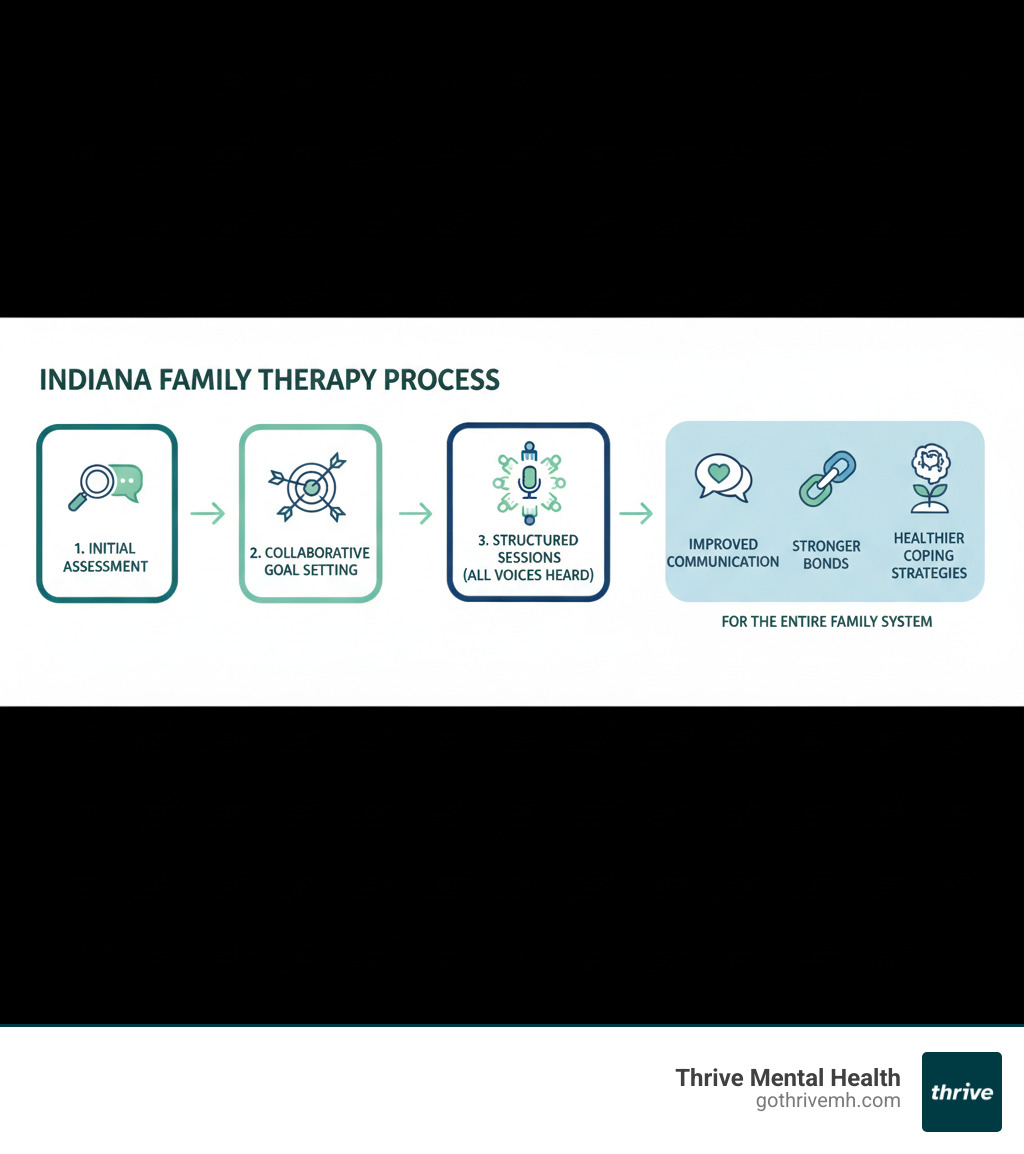
Indiana family therapy terms at a glance:
What is Family Therapy and How Does It Work?
Indiana family therapy is a specialized form of psychotherapy that treats your family as a complete unit rather than focusing on individual problems in isolation. The core idea is that every family member’s thoughts, feelings, and behaviors create ripples throughout the entire household. When your teenager struggles, it affects everyone. When parents are stressed, kids feel it too. Family therapy acknowledges these connections and works with them, not against them.
As your therapist, I become your family’s neutral guide—not taking sides or judging, but creating a safe space where everyone can speak honestly. My job is to help you hear each other in new ways and find healthier patterns of relating.
Here’s how it typically unfolds: We start with an initial assessment to understand your family’s unique story, challenges, and strengths. Then, we work together to set realistic goals. The key is making sure every voice gets heard, from the quietest family member to the loudest. Sessions focus on understanding how your family system currently works and identifying small changes that can create big improvements.
Learn more about Thrive’s family therapy and coaching options.
The Core Idea: Viewing the Family as a System
Picture your family as a mobile hanging above a crib. When one piece moves, everything else shifts to find balance. This is family systems theory in action—the understanding that families are interconnected webs where change in one person naturally affects everyone else.
Every family develops its own unspoken rules and behavioral patterns. These patterns aren’t necessarily good or bad; they’re just how your family has learned to function. But sometimes they stop working, especially during stressful periods or major life changes.
When we view your family as a system, we can spot these patterns and understand how they’re either helping or hindering your relationships. More importantly, we can identify your family’s natural strengths and build on them. The beautiful thing about family systems work is that when one person makes positive changes, everyone benefits.
What Challenges Can Family Therapy Address?
Indiana family therapy can help with virtually any challenge creating tension in your home. Some families come to us in crisis, while others want to strengthen already good relationships.
Common issues we address include:
- Communication breakdowns: When conversations always turn into arguments.
- Parent-child conflicts: Especially during teenage years, to help steer new boundaries.
- Sibling rivalry: When squabbles create lasting tension.
- Major life changes: Adjusting to blended families, divorce, or job loss.
- Grief and loss: Processing pain as a unit and moving forward together.
- Behavioral problems in children: Looking at what drives behaviors and how the family can respond effectively.
- Financial stress: Coping with financial pressures that threaten relationships.
- Mental health challenges: When a family member’s anxiety or depression affects everyone.
- Impact of substance use: Supporting both recovery and family healing.
The Top 5 Benefits of Seeking Therapy as a Family
When Indiana families try therapy together, they often find the journey of healing becomes a shared adventure that brings them closer. The magic of Indiana family therapy isn’t just in solving today’s problems—it’s in building a stronger foundation for the future.
-
Better communication skills often emerge as the first game-changer. We help families learn the art of truly listening and expressing feelings without blame, leading to more productive conversations.
-
As communication improves, deeper empathy and understanding naturally follow. When family members feel safe sharing their true feelings, they start seeing each other as whole people rather than just sources of stress.
-
Effective conflict resolution techniques become your family’s new toolkit. Disagreements will happen, but therapy teaches families how to work through them in ways that actually strengthen relationships, not break them.
-
Perhaps most importantly, families find stronger bonds and connections that feel authentic and lasting. Facing challenges together with professional guidance creates a powerful sense of \”we’re in this together.\”
-
Finally, healthier coping mechanisms for stress become part of your family’s routine. Families who’ve been through therapy learn to support each other, communicate openly about stress, and tackle problems as a team.
The beautiful thing about investing in family therapy is that you’re not just fixing what’s broken—you’re building something stronger, more resilient, and more connected for all the years ahead.
Guide: How to choose the right therapy options for your family.
Your Guide to Finding Indiana Family Therapy [With Local Resources]
Finding the right support for your family is a crucial step. The good news? Hoosier families have more options than ever for accessing quality Indiana family therapy, whether you prefer meeting face-to-face or connecting from home.

Navigating local therapy options is about finding what works for your family’s unique situation. Accessibility and convenience have become game-changers in how families access mental health support.
Traditional in-person sessions offer a dedicated therapeutic space away from home, which some families find essential. However, virtual therapy is revolutionizing how families get help. With platforms like Thrive Mental Health, you can connect with a qualified therapist from anywhere in Indiana. No more rushing through traffic or finding childcare. Virtual sessions fit into real life, making it easier to maintain consistency.
Explore Indiana Virtual Therapy with Thrive.
What Credentials to Look for in an Indiana Family Therapist
When you’re entrusting your family’s wellbeing to a professional, credentials matter. They represent years of rigorous training, supervised practice, and a commitment to ethical standards.
- Licensed Marriage and Family Therapist (LMFT): This is the gold standard for family work. These therapists have specialized graduate education focused on family systems and relationship dynamics. The American Association for Marriage and Family Therapy (AAMFT) is the primary professional organization for these specialists.
- Licensed Clinical Social Worker (LCSW): LCSWs bring a unique perspective, emphasizing how social and environmental factors impact family health.
- Licensed Mental Health Counselor (LMHC): LMHCs with family therapy training are equipped to address both individual and relational concerns within the family unit.
The key is ensuring your therapist has professional training in family systems theory. Always verify credentials through the Indiana Professional Licensing Agency—it takes just a few minutes and provides peace of mind.
Where to Find Qualified Therapists in Indiana
Finding the right family therapist doesn’t have to be a challenge. Several reliable paths can lead you to the perfect match.
- Thrive Mental Health’s provider network offers a streamlined approach to finding licensed therapists who understand family dynamics, with flexible virtual and in-person options.
- Online directories like Psychology Today allow you to filter by location, specialization, and insurance.
- Your insurance provider’s website can provide a targeted list of in-network family therapists, helping you find financially accessible options.
- Physician referrals from your family doctor or pediatrician can lead to trusted mental health professionals in your community.
Indiana is also home to specialized resources, such as university-affiliated training clinics and community centers that offer evidence-based treatment and holistic, systems-based approaches to family healing.
Find family therapy options in Indiana with Thrive.
What is the Typical Cost and Insurance Coverage for Indiana Family Therapy?
The cost of Indiana family therapy varies based on the therapist’s experience, your location, and session length. Many therapists offer sliding scale fees based on income, so don’t hesitate to ask.
Encouragingly, family therapy is often short-term and solution-focused. Many families see significant improvement in about 12 weekly sessions. You and your therapist will regularly check in on progress and adjust the plan as needed.
Insurance coverage for family therapy has improved dramatically. Most major insurance plans provide coverage when therapy is deemed medically necessary. Common providers offering mental health coverage in Indiana include Cigna and Evernorth, Optum, Aetna, BlueCross BlueShield (including Anthem), UnitedHealthcare, Humana, Medicaid, and Medicare. Always verify your specific benefits with your insurance company to understand your out-of-pocket costs.
If you don’t have insurance or prefer not to use it, self-pay options are always available. At Thrive Mental Health, we are committed to making mental health care both accessible and affordable.
Mental Health Care Online with Thrive.
Common Approaches & Overcoming Problems in Therapy
Just as every family is unique, so are the therapeutic approaches in Indiana family therapy. A skilled therapist will tailor their methods to your family’s needs. At Thrive Mental Health, our commitment is to provide custom treatment plans rooted in evidence-based care.

Sometimes, families are stuck in a \”fight or flight\” state due to underlying trauma, making progress difficult. Our expert-led approach focuses on addressing these deeper issues to achieve true balance and healing.
Popular Family Therapy Modalities
Think of these approaches as tools in a toolbox. A skilled therapist knows which one to use and when.
- Structural Family Therapy (SFT) focuses on your family’s organizational structure—rules, boundaries, and hierarchies—to create healthier interactions.
- Strategic Family Therapy is a direct, problem-focused approach that uses specific interventions to resolve immediate issues and change troublesome patterns.
- Cognitive Behavioral Therapy (CBT) for families helps identify and change negative thought patterns and behaviors that fuel conflict, teaching new coping skills.
- Emotionally Focused Therapy (EFT) digs into the emotional cycles that create distance, helping family members express deeper emotions and form secure attachments.
- Solution-Focused Brief Therapy (SFBT) emphasizes what’s already working, helping families envision their desired future and take small, concrete steps to achieve it.
These modalities are often combined to provide a comprehensive toolkit for your family’s specific situation.
How to Encourage a Reluctant Family Member to Participate
It’s normal for some family members to be hesitant about therapy. Here are gentle ways to encourage participation:
- Express concern with love and empathy. Try, \”I miss our closeness and think talking to someone together could help us get back on track,\” instead of placing blame.
- Use \”we\” language instead of \”you\” language. Frame therapy as a team effort: \”We could all benefit from learning new ways to support each other.\”
- Explain the benefits for everyone. Emphasize that it’s about strengthening the entire family, not singling anyone out.
- Highlight the therapist as a neutral helper. Reassure them that the therapist isn’t there to take sides or assign blame.
- Suggest starting with one trial session. A lower commitment can ease anxiety and let them experience the process firsthand.
- Emphasize confidentiality. Therapists follow strict confidentiality guidelines, which helps build trust and openness.
Patience and understanding are key. The goal is to open the door to healing, not force anyone through it.
Frequently Asked Questions about Family Therapy in Indiana
We hear these questions all the time from Indiana families considering therapy. Here are straightforward answers to your real concerns.
How do I know if my family needs therapy?
If you’re asking this question, you’re already paying attention to the right signals. Indiana family therapy is helpful when you notice unhealthy patterns that feel stuck.
Key signs include:
- Constant arguing that goes in circles without resolution.
- Emotional distance, where family members feel like strangers.
- Communication breakdowns that turn into shouting or silent treatments.
- Acting out behaviors in children, which often signal deeper family stress.
- A shared traumatic experience like a death, divorce, or major illness.
Trust your instincts. If family life feels harder than it should, therapy can help restore connection.
What is the success rate of family therapy?
The research is very encouraging. Studies consistently show significant improvements in family functioning, communication, and problem-solving. Some research indicates success rates of nearly 90% for improving emotional and mental health, with many families reporting that the skills they learn last long after therapy ends.
Success looks different for every family, but those who engage actively in the process almost always see meaningful improvements.
Is family therapy covered by insurance in Indiana?
Yes, most major insurance plans in Indiana cover family therapy when it’s considered medically necessary. We work with many providers, including Cigna, Optum, Aetna, BlueCross BlueShield, and UnitedHealthcare. We always recommend calling the number on your insurance card to verify your specific mental health benefits, co-pays, and deductibles.
How long does a typical family therapy session last?
Indiana family therapy sessions typically run 50-60 minutes. The frequency and overall duration depend on your family’s goals. Many families find significant progress in around 12 weekly sessions, though this is flexible. We work with you to find a rhythm that fits your family’s life.
Can I access family therapy virtually in Indiana?
Absolutely! Virtual family therapy has become a popular and effective option. Thrive offers secure virtual therapy that lets you connect with expert therapists from anywhere in Indiana. Virtual sessions eliminate travel time and make it easier to fit therapy into busy schedules, often in the more relaxed environment of your own home.
Learn more about virtual therapy.
{
  \"@context\": \"https://schema.org\",
  \"@type\": \"FAQPage\",
  \"mainEntity\": [
    {
      \"@type\": \"Question\",
      \"name\": \"How do I know if my family needs therapy?\",
      \"acceptedAnswer\": {
        \"@type\": \"Answer\",
        \"text\": \"Common signs that your family may benefit from therapy include constant arguing, emotional distance, communication breakdowns, behavioral issues in children, or difficulty coping with a major life event or trauma. If family life feels harder than it should, therapy can help.\"
      }
    },
    {
      \"@type\": \"Question\",
      \"name\": \"What is the success rate of family therapy?\",
      \"acceptedAnswer\": {
        \"@type\": \"Answer\",
        \"text\": \"Family therapy has a high success rate. Studies show that nearly 90% of families experience improvement in emotional and mental health. It is effective because it addresses root patterns and teaches skills that last long after sessions end.\"
      }
    },
    {
      \"@type\": \"Question\",
      \"name\": \"Is family therapy covered by insurance in Indiana?\",
      \"acceptedAnswer\": {
        \"@type\": \"Answer\",
        \"text\": \"Yes, most major insurance plans in Indiana cover family therapy when it is deemed medically necessary. Providers like Cigna, Optum, Aetna, and BlueCross BlueShield often offer coverage. It is best to verify your specific plan's mental health benefits.\"
      }
    },
    {
      \"@type": "Question",
      "name": "How long does a typical family therapy session last?",
      "acceptedAnswer": {
        "@type": "Answer",
        "text": "A typical family therapy session lasts between 50 and 60 minutes. While many families see significant progress in about 12 sessions, the total duration of therapy is custom to your family's specific needs and goals.\"
      }
    },
    {
      \"@type\": \"Question\",
      \"name\": \"Can I access family therapy virtually in Indiana?\",
      \"acceptedAnswer\": {
        \"@type\": \"Answer\",
        \"text\": \"Yes, virtual family therapy is widely available in Indiana. Thrive Mental Health offers secure online sessions, making it convenient for families across the state to access expert care from the comfort of their homes.\"
      }
    }
  ]
}
Start Your Family’s Healing Journey Today
Your family’s story doesn’t have to be defined by current challenges. Indiana family therapy offers a path to strengthening bonds, building resilience, and creating the connected future your family deserves. We’ve explored how therapy views your family as a system, the challenges it can address, and the benefits it brings—from improved communication to stronger relationships.
We’ve also walked you through finding qualified therapists, understanding costs, and choosing between in-person and virtual options. Seeking help is a sign of strength and commitment to your family’s wellbeing.
Taking that first step is an act of love. At Thrive Mental Health, we provide flexible, expert-led, evidence-based care customized to your family’s needs. Our virtual and hybrid IOP/PHP options, including convenient evening sessions, ensure quality mental health support is accessible no matter where you are in Indiana.
You’re not just fixing problems; you’re building skills and creating new patterns that will serve your family for years to come. The best time to begin is right now.
Navigating Local Therapy Options for Better Mental Health – Thrive Blog

Ready for support? Thrive offers virtual and hybrid IOP/PHP with evening options. Verify your insurance in 2 minutes (no obligation) → Start benefits check or call 561-203-6085.
If you’re in crisis, call/text 988 right now. You are not alone.