
Why Individualized Mental Health Care is the Future of Therapy

Your Mental Health Isn’t One-Size-Fits-All. Your Treatment Shouldn’t Be Either.
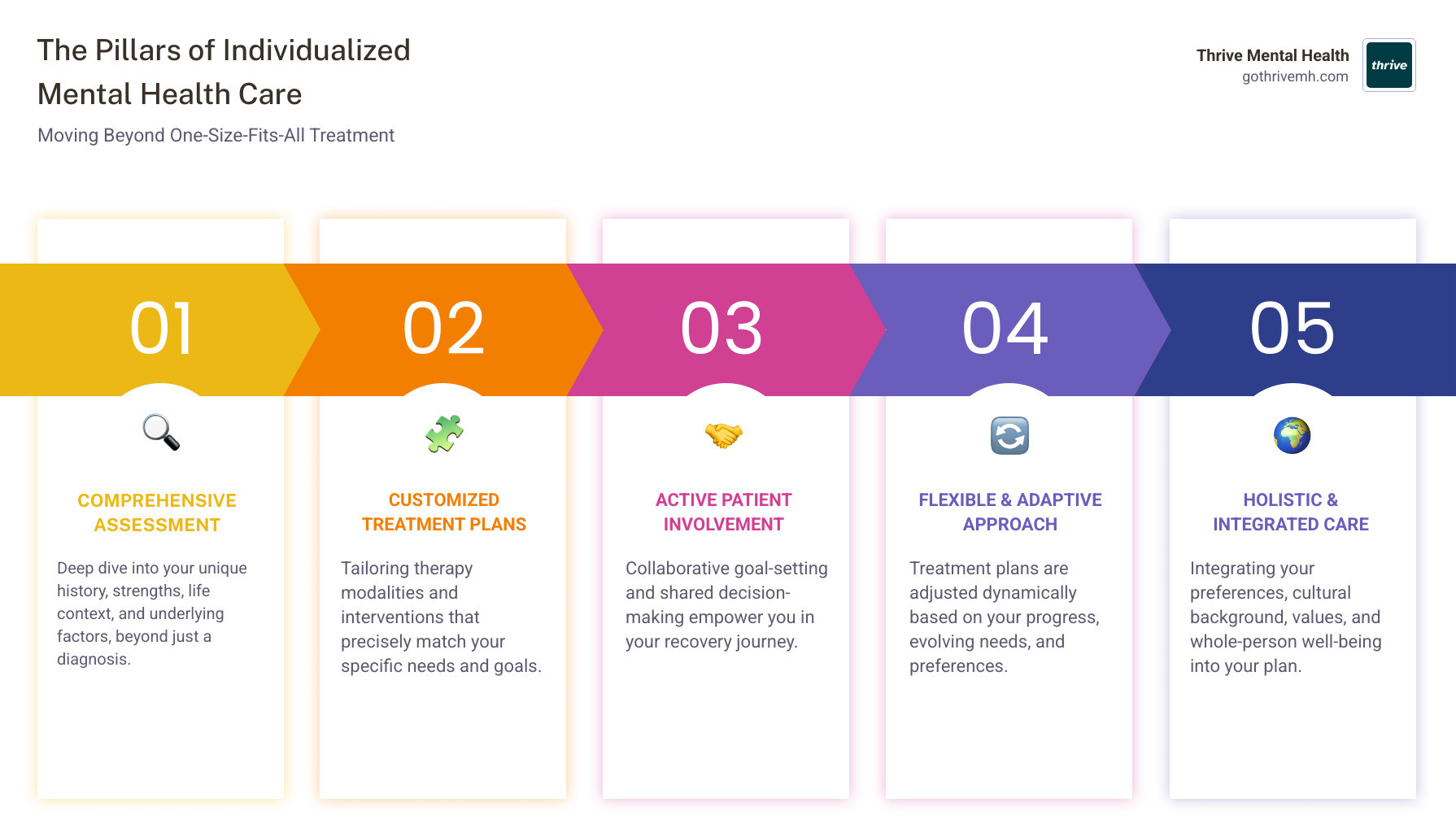
Individualized mental health care is an approach that tailors treatment plans to your unique needs, experiences, and goals—rather than applying the same protocol to everyone with a similar diagnosis. Here’s what makes it different:
What Individualized Mental Health Care Includes:
- Comprehensive assessment of your history, symptoms, strengths, and life circumstances
- Customized treatment plans combining therapy modalities that match your specific needs
- Active patient involvement in goal-setting and decision-making
- Flexible adjustments as you progress through treatment
- Integration of your preferences, cultural background, and personal values
Nearly one-third of adults with major depression don’t respond to standard treatments. Half of those treated for generalized anxiety disorder see no improvement from first-line approaches. The reason? Mental health isn’t uniform. Your brain chemistry, trauma history, support system, and personal goals are different from everyone else’s—so your treatment should be too.
Traditional therapy often follows a diagnosis-driven playbook: if you have depression, you get antidepressants and weekly CBT. But research increasingly shows that what works for one person may fail for another, even with identical diagnoses. Factors like your age, cultural background, co-occurring conditions, and even your brain’s unique wiring all influence how you’ll respond to treatment.
That’s why the future of mental health care is personalized. It starts with understanding you—not just your symptoms—and builds a plan around your whole life, not a textbook protocol.
I’m Nate Raine, CEO of Thrive Mental Health, where we’ve spent over a decade building evidence-based, tech-enabled programs that deliver individualized mental health care across Florida. Our work integrates clinical excellence with real-world data to create treatment plans that are as unique as the people we serve.
What “Individualized Mental Health Care” Actually Means (And Why It Gets Results)
Here’s the truth: when most people hear “personalized care,” they picture something vague—maybe a therapist who remembers your name or asks how your week went. But individualized mental health care is far more specific and powerful than that.
At its core, it means your treatment is built around you—not around a textbook diagnosis. It’s about selecting therapy approaches, adjusting medications, and modifying your entire plan based on your specific needs, preferences, life circumstances, and how you’re actually responding to treatment. This stands in stark contrast to the traditional model, where everyone with the same diagnosis gets handed the same protocol, regardless of who they are or what they need.
Think of it this way: two people can both have major depression. One might be a 24-year-old dealing with work stress and social isolation. The other might be a 45-year-old navigating a divorce and childhood trauma. Should they get identical treatment? Of course not. But that’s exactly what happens in a one-size-fits-all system.
| Feature | One-Size-Fits-All Approach | Individualized Approach |
|---|---|---|
| Assessment | Standardized, symptom-focused checklist | Comprehensive, holistic, considering biology, psychology, social context |
| Treatment Goals | Generic, symptom reduction | Collaborative, specific, meaningful to patient’s life |
| Therapy Modalities | Limited, often one or two prescribed methods | Diverse, integrated, chosen to match patient’s profile |
| Patient Role | Passive recipient of treatment | Active participant, empowered in decision-making |
| Treatment Plan | Static, follows a predetermined path | Dynamic, adaptable, evolves with patient progress and feedback |
Individualized mental health care is rooted in what clinicians call person-centered care. That’s a fancy way of saying we see you as a whole person, not just a collection of symptoms. We recognize your cultural background, your values, your relationships, and your dreams. We involve you in every decision, because you know your life better than anyone else. And we work with you to set goals that actually matter to you—not generic benchmarks that look good on a chart but feel meaningless in real life.
This approach also accepts the biopsychosocial model. Translation: we look at three interconnected layers of your health. There’s the biological side—your genetics, brain chemistry, and physical health. There’s the psychological side—your thoughts, emotions, coping patterns, and past experiences. And there’s the social side—your relationships, environment, culture, and community. When we understand how all three layers interact in your unique life, we can create a treatment plan that addresses the root causes, not just surface symptoms.
The result? Better outcomes. When treatment fits you, you’re more likely to stick with it, engage fully, and see real progress. That’s not marketing talk—it’s what the research consistently shows.
How Your Unique Story Shapes Your Recovery
Your life story isn’t just background information. It’s the map we use to guide your treatment.
Your individual experiences shape how you see the world and respond to stress. Trauma, loss, major life transitions—these aren’t just events to check off on an intake form. They’re experiences that have literally changed your brain and nervous system, and they need to be honored and addressed in treatment.
Your personal goals matter just as much as clinical outcomes. Maybe you want to feel confident at work again. Maybe you want to repair a relationship. Maybe you just want to wake up without dread. Whatever success looks like to you, that’s what we’re working toward together.
Your cultural background influences everything from how you express emotions to what kinds of support feel natural and safe. An effective treatment plan respects your values, integrates your beliefs, and connects with your community and identity. We don’t ask you to fit into a Western therapy model if that’s not who you are.
Your specific needs might include flexible scheduling because you work nights, or virtual sessions because you’re a caregiver, or a therapist who understands your industry’s unique stressors. At Thrive Mental Health, we’ve built our programs around these real-world needs, offering both virtual and in-person options across Florida.
Co-occurring disorders are incredibly common—anxiety and depression often travel together, and substance use frequently overlaps with trauma or mood disorders. A generic approach might treat these separately, or worse, ignore one entirely. But individualized mental health care recognizes these complex interactions and addresses them as interconnected parts of your whole health picture.
Here’s something fascinating: recent research on children with mood and anxiety disorders found three distinct patterns of brain maturation—accelerated, delayed, and atypical. Kids with the same diagnosis showed completely different neurobiological profiles, which means they need completely different interventions. One group might benefit from cognitive support, while another needs a different approach entirely. Your brain’s unique wiring, shaped by your genes, experiences, and environment, affects how you’ll respond to treatment. That’s why we can’t just follow a script.
The Non-Negotiable Role of Trust and Rapport
Let’s be direct: therapy doesn’t work if you don’t trust your therapist.
The relationship between you and your care team—what clinicians call the therapeutic alliance—isn’t a nice-to-have. It’s the foundation everything else is built on. Research backs this up: the quality of that relationship is one of the strongest predictors of treatment success, often more important than the specific techniques used.
When you feel safe and understood, something shifts. You’re more willing to be honest about what’s really going on. You’re more open to trying new coping strategies, even when they feel uncomfortable. You’re more likely to show up consistently, even on the hard days. That’s not weakness—that’s human nature. We all need to feel seen and respected before we can do the vulnerable work of healing.
Open communication flows both ways. You need to feel comfortable saying when something isn’t working, when a goal needs adjusting, or when you’re struggling more than you’re letting on. And we need to create an environment where that honesty is welcomed, not judged. Our expert-led virtual programs are specifically designed to create this kind of safe, confidential space where real connection can happen—even through a screen.
A collaborative relationship means you’re not just a passive recipient of treatment. You’re an active partner. You help set the goals, voice your preferences, and make decisions about your care. This sense of ownership and empowerment isn’t just emotionally satisfying—it directly improves outcomes and helps those gains last long after treatment ends.
At Thrive, we know that individualized care starts with this human connection. Before we talk about treatment modalities or medication options, we focus on building trust. Because without that foundation, even the most sophisticated treatment plan won’t get you where you want to go.
The Key Components: How a Personalized Plan is Built

Building an individualized mental health care plan isn’t about plugging your symptoms into a formula. It’s about sitting down together and mapping out a path that actually makes sense for your life. Think of it as designing a custom suit versus grabbing something off the rack—one fits perfectly, the other just sort of works.
At Thrive Mental Health, we’ve built our entire approach around six core elements: comprehensive assessments that dig deeper than a standard intake form, customized treatment plans that reflect your specific situation, patient empowerment that puts you in the driver’s seat, shared decision-making where your voice matters as much as clinical expertise, flexible scheduling that works around your life (not the other way around), and measurable results so you can actually see your progress.
Step 1: A Deeper, More Comprehensive Assessment
We start by really getting to know you. Not just your diagnosis, but you. This means going way beyond the DSM checklist that many traditional practices rely on.
Our assessment process includes psychological testing to understand how you think, feel, and cope with stress. We spend time understanding your life context—your relationships, your work situation, your daily stressors, and the environment you’re navigating every day. We’re also actively looking for your strengths—the resilience, resources, and coping skills you already have that we can build on.
We also consider biological factors that shape your mental health. New research using fMRI brain scans is identifying different “biotypes” of depression, linking specific brain circuit dysfunctions to targeted treatments. While we may not run brain scans for everyone, we do acknowledge that genetic factors and brain maturation patterns play a real role in how you experience mental health challenges and how you’ll respond to different interventions.
This 360-degree view helps us understand not just what you’re struggling with, but why—and more importantly, what’s most likely to help.
Step 2: Collaborative Goal Setting and Patient Empowerment
Once we understand your full picture, we don’t hand you a pre-written treatment plan. Instead, we sit down and figure out what success actually looks like to you.
Maybe you want to get back to work without panic attacks. Maybe you need to repair relationships that have been damaged by depression. Maybe you just want to feel like yourself again. Whatever matters most to you becomes the target we aim for together.
This collaborative approach means defining success together, setting meaningful, achievable goals that resonate with your values, and involving you directly in planning every step of your treatment. When you have real ownership over your recovery, something shifts. You’re not just following orders—you’re actively building the life you want.
Research consistently shows that active participation improves outcomes in individualized mental health care. When you’re invested in the plan because you helped create it, you’re more likely to stick with it, engage fully in therapy, and see lasting results. That’s not just theory—we see it every day in our Intensive Outpatient Programs and Partial Hospitalization Programs available to residents throughout Florida.
This empowerment isn’t a nice-to-have. It’s the foundation that makes everything else work.
The Future is Here: Technology and Integrated Care

Mental health treatment is changing fast. What seemed like science fiction just a few years ago—using artificial intelligence to predict treatment outcomes, tracking your mood through your smartphone, or combining brain scans with therapy—is now becoming standard practice. This is the reality of precision mental health: data-driven approaches that make individualized mental health care more accurate, more accessible, and more effective than ever before.
We’re moving from guesswork to precision. Just as medicine evolved from “take two aspirin and call me in the morning” to targeted treatments based on your specific biology, mental health care is making the same leap. The future of precision mental health is about matching the right treatment to the right person at the right time, using every tool at our disposal.
The technologies reshaping mental health care aren’t replacing therapists—they’re making therapists better. AI and machine learning analyze patterns across thousands of patients to predict which treatments will work best for you. Wearable sensors track your heart rate, sleep, and stress levels in real time, giving your care team objective data about how you’re doing between sessions. Digital phenotyping uses your smartphone activity—how much you move, how often you communicate, even your typing patterns—to detect early warning signs of declining mental health. And telehealth platforms bring expert care directly to your home, breaking down barriers of distance and scheduling that once kept people from getting help.
How Technology is Revolutionizing Treatment
Here’s what technology is actually doing for individualized mental health care: it’s making invisible patterns visible. Machine learning algorithms can now predict suicide risk months before a crisis occurs by analyzing hundreds of variables—from your treatment history and family background to personality factors and co-occurring conditions. This isn’t about replacing clinical judgment; it’s about giving clinicians better information to make life-saving decisions.
Digital phenotyping transforms your phone into a passive mental health monitor. Changes in your sleep patterns, social interactions, or physical activity can signal a depressive episode before you even recognize it yourself. This allows for smartphone-based interventions that respond to your needs in real time, not just during your weekly appointment.
AI-powered feedback systems are helping therapists track your progress more accurately and adjust treatment faster. These systems analyze your responses, identify patterns, and suggest evidence-based interventions—but the final decision always stays with your clinical team. It’s human expertise improved by data, not replaced by it.
At Thrive, our Intensive Outpatient Programs (IOP) integrate these technological advances into every aspect of care. We use data to inform treatment decisions while keeping the human connection at the center of everything we do. Technology opens doors; relationships create healing.
Integrating Conventional and Holistic Therapies
The most effective individualized mental health care doesn’t pick sides between conventional and holistic approaches—it combines them. Your brain and body aren’t separate systems, and your treatment shouldn’t pretend they are.
We’ve seen powerful results from combining CBT or DBT with mindfulness practices. When you learn to challenge negative thoughts and develop present-moment awareness, you build stronger, more flexible coping skills. The cognitive work gives you tools; the mindfulness gives you the space to use them.
Nutrition plays a bigger role in mental health than most people realize. Your gut produces more serotonin than your brain does, and what you eat directly affects your mood, energy, and ability to manage stress. We don’t just talk about symptoms; we look at how you’re fueling your recovery.
Art and movement therapies offer pathways to healing that talk therapy can’t always reach. Sometimes you need to express what you can’t put into words, or release trauma that’s stored in your body. Dance, yoga, painting, music—these aren’t just nice extras. For many people, they’re essential components of a truly holistic treatment plan.
Creating this kind of comprehensive care requires flexibility and creativity. Every person’s plan looks different because every person’s needs are different. That’s the whole point of individualized mental health care.
Challenges and Ethical Lines We Can’t Cross
With all this promise comes serious responsibility. As we accept technology and data-driven care, we have to be crystal clear about the ethical boundaries we won’t cross.
Data privacy isn’t negotiable. When you share your most vulnerable thoughts and experiences, you deserve absolute confidence that your information is protected. We maintain the highest HIPAA security standards across all our virtual and in-person programs. Your data belongs to you, period.
Access can’t become another divider. Advanced technology shouldn’t only be available to people with the best insurance or who live in major cities. We work with Cigna, Aetna, Optum, Florida Blue, and other major insurers to make our evidence-based programs accessible across Florida. Innovation should expand access, not limit it.
Algorithmic bias is a real threat. If the data used to train AI systems doesn’t represent diverse populations, the recommendations will perpetuate existing inequities. We continuously evaluate our data sources and treatment algorithms to ensure they serve everyone fairly, regardless of race, gender, socioeconomic status, or background.
Finally, there’s what researchers call the paradox of personalization: treatment should be custom to you, but it can’t be imposed on you. Your autonomy matters. Individualized mental health care means building a plan with you, not for you. We bring clinical expertise and data-driven insights, but you bring the most important piece: your own lived experience and personal goals. The decisions are always yours.
Technology is powerful. Data is valuable. But at the end of the day, healing happens in relationship—between you and your care team, between your past and your future, between who you are now and who you’re becoming. That’s what we protect above everything else.
Frequently Asked Questions about Individualized Mental Health Care
How is individualized care different from regular therapy?
Think of traditional therapy like buying clothes off the rack—it might fit okay, but it’s not made for your specific measurements. Individualized mental health care is more like having something custom just for you.
The difference starts the moment you walk in. Instead of a quick symptom checklist that leads to a standard protocol, we spend time getting to know you—your biology, your psychology, your life circumstances, your goals, even your cultural background. We’re not just treating a diagnosis; we’re treating a whole person.
From there, we build a treatment plan with you, not just for you. You’re actively involved in setting goals that matter to your life, choosing approaches that feel right, and adjusting as you progress. It’s collaborative, flexible, and focused on what you need—not what a textbook says someone with your diagnosis should receive.
Can I get personalized mental health care in Florida?
Absolutely. At Thrive Mental Health, we offer individualized mental health care through our Intensive Outpatient (IOP) and Partial Hospitalization (PHP) programs across Florida.
You can access our programs in person at our trusted centers or virtually from wherever you are. Our virtual programs are designed to deliver the same high-quality, evidence-based care with flexible scheduling that fits your life—whether you’re balancing work, school, or family responsibilities. We’ve built our approach to make personalized treatment accessible, no matter where you live in Florida.
Does insurance like Cigna or Florida Blue cover individualized programs?
This is one of the most common questions we hear, and the answer is encouraging. Many major insurance providers—including Cigna, Aetna, Optum, and Florida Blue—often cover higher levels of care like our Intensive Outpatient (IOP) and Partial Hospitalization (PHP) programs.
Coverage varies based on your specific plan, so the best way to know exactly what you’re eligible for is to verify your insurance benefits. It takes about two minutes, there’s no obligation, and it gives you a clear picture of your coverage. We’re here to help make individualized mental health care accessible and affordable.
How does technology help personalize my treatment?
Technology has fundamentally changed what’s possible in mental health care. Instead of relying on trial-and-error, we can now use AI, machine learning, and digital tools to gather and analyze data about your unique profile—from your brain patterns to your daily behaviors.
This means we can predict which treatments are most likely to work for you specifically, not just what works on average. We can tailor interventions in real-time based on your progress, adjust your plan when something isn’t working, and catch early warning signs before they become crises.
For example, wearable sensors can track your sleep and stress levels, giving us continuous insights into your well-being. Digital phenotyping uses data from your smartphone to understand patterns in your activity and mood. These tools don’t replace the human connection—they improve it, giving your care team more information to support you better. It’s precision care that adapts to you, not the other way around.
Stop Settling for Generic. Start Your Personalized Healing Journey.
The days of trying the same treatment plan over and over, hoping it will finally stick, are over. You deserve more than a cookie-cutter approach that ignores who you actually are. Individualized mental health care recognizes what research has confirmed: your brain, your history, your goals, and your life circumstances all matter—and they should shape every aspect of your treatment.
When you’re empowered to participate in your own recovery, when your care team takes time to understand your unique story, and when technology helps pinpoint exactly what will work for you, something shifts. Treatment stops feeling like something being done to you and starts feeling like something you’re building for yourself. That’s the difference between spinning your wheels and actually moving forward.
At Thrive Mental Health, we’ve built our entire approach around this principle. Our Partial Hospitalization Programs (PHP) and Intensive Outpatient Programs provide the structure and intensity you need, while our flexible virtual options meet you where you are—geographically and in your daily life. We combine clinical excellence with real-world practicality, offering evening sessions for working adults and young professionals who can’t put life on hold to heal.
This isn’t just about feeling better for a few weeks. It’s about measurable, lasting change. It’s about finally having a treatment plan that makes sense for your life, your schedule, and your goals. It’s about precision mental health care that treats you like the individual you are, not a diagnosis on a chart.
You don’t have to settle for generic anymore. You don’t have to wonder if there’s something better out there. There is—and it starts with understanding that your healing journey should be as unique as you are.
Ready for support in Florida? Thrive offers virtual and hybrid IOP/PHP programs with evening options. Verify your insurance in 2 minutes (no obligation) → Start benefits check or call 561-203-6085. If you’re in crisis, call/text 988.