
Your Neighborhood Guide to Intensive Outpatient Psychiatric Programs

Finding the Right Level of Care When Weekly Therapy Isn’t Enough
When weekly therapy no longer manages depression or anxiety, an Intensive Outpatient Program (IOP) bridges the gap between standard outpatient care and residential treatment. In 9-12 hours per week, you receive structured, evidence-based support while living at home and maintaining work, school, or family responsibilities.
At Thrive Mental Health, our in-person and virtual IOPs for adults across Florida combine individual therapy, skills-focused groups, and medication management. Research shows this level of care reduces symptoms as effectively as inpatient treatment—without putting life on hold.
Learn more about our programs:
What Is an Intensive Outpatient Program?

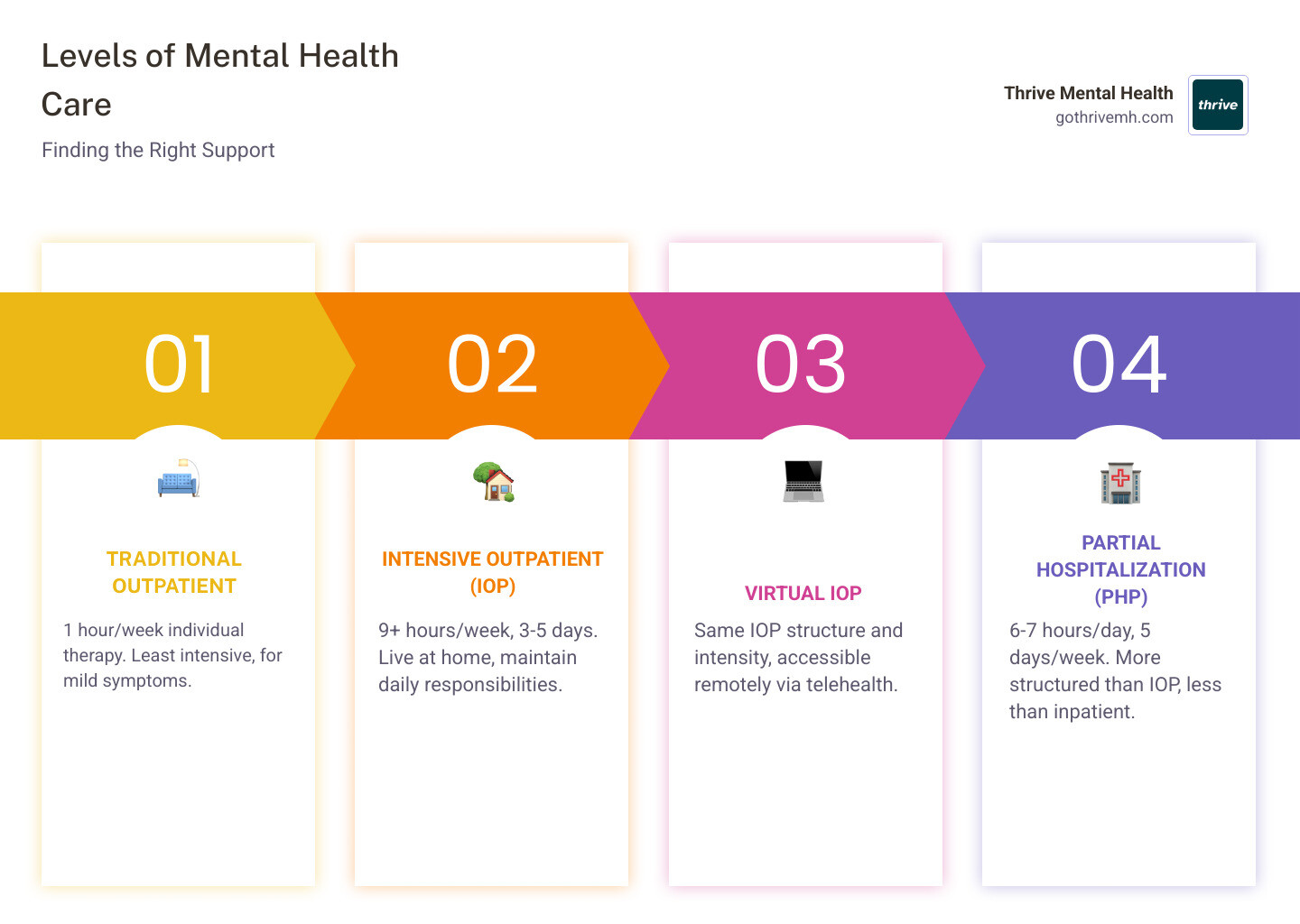
An IOP is a structured treatment plan—usually three to five half-days weekly—for people whose symptoms are too disruptive for standard weekly therapy but who don’t need 24/7 care. It serves as step-up care when depression or anxiety worsens, or step-down care after hospitalization.
Conditions Treated
IOPs at Thrive Mental Health address:
- Major depressive disorder and persistent depressive disorder
- Generalized, social, and panic anxiety disorders
- OCD, trauma, PTSD, and other mood disorders
- Co-occurring substance use
Explore specifics on depression and anxiety.
IOP vs. Weekly Therapy
| Feature | Weekly Therapy | Intensive Outpatient |
|---|---|---|
| Hours per week | ~1 | 9-12 |
| Format | Individual only | Groups + Individual + Psychiatry |
| Duration | Open-ended | 3-12 weeks |
| Best for | Mild symptoms | Moderate-severe symptoms needing rapid change |
Understanding the IOP Model of Care
An IOP lets you practice new coping skills in real life daily and process successes or challenges with your treatment team the same week. At Thrive Mental Health, each client receives a comprehensive intake and personalized plan managed by psychiatrists, licensed therapists, and case managers.
| Traditional OP | Thrive IOP | |
|---|---|---|
| Living at home | ✓ | ✓ |
| Work/school friendly | Sometimes | Yes – morning & evening tracks |
| Evidence-based therapies | Varies | CBT, DBT, ACT, mindfulness |
| Medication management | External prescriber | On-site or virtual psychiatrist |
| Typical length | Months-years | 3-12 weeks |
ARTICLE SPECIFICATIONS
- Topic: intensive outpatient programs for depression and anxiety near me
- Format: Extensive Guide
KEY QUESTIONS TO ANSWER
- What is an Intensive Outpatient Program (IOP) and how does it differ from other levels of mental health care?
- What specific mental health conditions, including depression and anxiety, can be treated in an IOP?
- What types of therapies and activities are typically included in an IOP?
- What is the typical schedule and duration of an Intensive Outpatient Program?
- What are the key benefits of choosing an IOP for mental health treatment?
- How effective are IOPs in treating depression and anxiety, and what outcomes can be expected?
- How can I find an Intensive Outpatient Program near me, and what is the admission or referral process?
- Does insurance typically cover IOPs, and what are the potential costs?
- Are virtual or online Intensive Outpatient Programs available, and how do they work?
- What role does family involvement play in IOP treatment?
- What kind of support or aftercare is provided after completing an IOP?
RELEVANT STATISTICS
- Intensive outpatient programs (IOPs) have been shown to be just as effective as residential treatment.
- Intensive Outpatient Programs (IOPs) are just as effective as inpatient programs in treating depression.
- One research study found that participants’ depression scores decreased significantly over the course of Dialectical Behavioral Therapy (DBT) implemented in an IOP.
- 93% of clients in Charlie Health’s virtual Intensive Outpatient Program reported improvements in symptoms associated with depression.
- 90% of clients in Charlie Health’s virtual Intensive Outpatient Program reported improvements in symptoms associated with anxiety.
- Intensive Outpatient Programs (IOPs) typically require individuals to attend at least nine hours of group and/or individual therapy per week.
- The duration of Intensive Outpatient Programs (IOPs) typically ranges from 3 to 12 weeks, with some programs lasting 4-6 weeks, 8 weeks, or 9-12 weeks depending on individual needs and program structure.
KEY SOURCES AND SEO INSIGHTS
Source Type: Information Page
SEO Insights:
Key Headings:
H2: Intensive Outpatient Program, Understanding Intensive Outpatient Treatment, What to Expect in an IOP, Conditions Intensive Outpatient Care Can Treat, Accessible Intensive Outpatient Treatment Centers, Begin Your Healing Journey, Support from compassionate, experienced care teams
H3: Our Therapeutic Approach
What Why:
The main point is to explain what Intensive Outpatient Programs (IOPs) are, what they entail, and what conditions they can treat. The purpose is to inform potential patients about this level of care and encourage them to seek treatment through Rogers Behavioral Health, emphasizing its flexibility and comprehensive nature.
Questions Answers:
Q: What is an Intensive Outpatient Program (IOP)?
A: An IOP is an effective and flexible option for mental health or substance use challenges, offering a structured and intensive level of care while allowing individuals to live at home and attend work or school.
Q: What can I expect in an IOP?
A: In an IOP, you can expect a combination of individual work, group therapy, and medication management, utilizing proven treatment approaches such as cognitive behavioral therapy (CBT) and dialectical behavior therapy (DBT).
Q: What conditions can Intensive Outpatient Care treat?
A: IOPs can treat conditions such as alcohol or drug addiction, anxiety, OCD, co-occurring conditions, trauma and PTSD, depression or other mood disorders, serious persistent mental illnesses (SPMIs), eating disorders, and complex medical and mental health conditions.
Industry Facts:
- Intensive outpatient programs are an effective and flexible option for mental health or substance use challenges.
- IOPs offer a structured and intensive level of care.
- IOPs typically combine individual work, group therapy, and medication management.
Tone:
Informative, compassionate, professional, supportive.
Title:
Intensive Outpatient Program
Topic Gaps:
- Detailed information on program duration and frequency (e.g., hours per week, number of weeks).
- Cost of IOPs and insurance coverage details.
- Specific criteria for admission or suitability for IOP vs. other levels of care.
- More in-depth comparison of IOP with PHP or traditional outpatient.
- Success rates or outcomes data for IOPs.
Bias:
The content is provided by a treatment center, so it naturally promotes their services and highlights the benefits of IOPs. It is not overtly biased in a negative way, but it is a service provider’s perspective on the treatment.
All Questions:
- What is an Intensive Outpatient Program?
- What can I expect in an IOP?
- What conditions can Intensive Outpatient Care treat?
- Where are accessible Intensive Outpatient Treatment Centers located?
- How can I begin my healing journey?
Unique Angle:
The emphasis on flexibility and accessibility, allowing patients to receive intensive care without completely disrupting their daily lives (work, school, home).
Unique Insights:
- IOPs allow individuals to continue living at home and attend work or school while receiving intensive care.
- IOPs offer a structured and intensive level of care without putting life on pause.
Cta:
Contact us today at 833.308.5887 or reach out online to learn more about our IOPs for behavioral health.
Article Type:
Information Page
Subtitle:
Understanding Intensive Outpatient Treatment
Best Practices:
- Uses proven treatment approaches such as cognitive behavioral therapy (CBT) and dialectical behavior therapy (DBT).
- Includes medication management as part of the treatment plan.
- Offers individualized care plans.
Hook:
Help is available and more approachable than you might think. Rogers Behavioral Health’s intensive outpatient programs (IOPs) can help you access compassionate, comprehensive care without putting your life on pause.
Topics Covered:
Therapeutic approaches:
- Cognitive Behavioral Therapy (CBT)
- Dialectical Behavior Therapy (DBT)
- Medication Management
Conditions treated by iop: - Alcohol or drug addiction
- Anxiety
- Obsessive-compulsive disorder (OCD)
- Co-occurring conditions
- Trauma and PTSD
- Depression or other mood disorders
- Serious persistent mental illnesses (SPMIs)
- Eating disorders
- Complex medical and mental health conditions
- Veterans, military service members, and first responders (Fire Watch program)
Intensive outpatient program (iop): - Definition of IOP
- Benefits of IOP (flexibility, structured care)
- What to expect in an IOP (individual work, group therapy, medication management)
Accessibility and locations: - National presence with locations across the country
- States where IOP services are available (California, Colorado, Florida, Georgia, Illinois, Minnesota, Pennsylvania, Tennessee, Wisconsin)
- Virtual options available in some states
Actionable Steps:
- Contact Rogers Behavioral Health to learn more about their IOPs.
- Call 833.308.5887.
- Reach out online.
Source Type: information page
SEO Insights:
Key Headings:
H3: Consultation Services, Behavioral Therapy Focus, Intensive Outpatient Treatment, Lodging
What Why:
The article describes The Emory Adult OCD & Anxiety Intensive Program, outlining its structure, treatment modalities, and access procedures, to inform potential patients and their families about the specialized care available for OCD and anxiety.
Questions Answers:
Q: How do I start the process to join the program?
A: The first step is to schedule a 20-30 minute phone intake with a team member.
Q: What does the Intensive Outpatient Program (IOP) involve?
A: Participants attend four days per week for two hours each day, typically for 2-3 weeks. Each day includes one hour of individual therapy and one hour of individual exposure coaching, focusing on ERP, and may include medication management, group therapy, and family therapy.
Q: Do I need an outpatient therapist before starting the program?
A: Yes, you must have an outpatient therapist in place before beginning this program to ensure maintenance of gains.
Q: Does the program offer regular outpatient therapy or medication management?
A: No, the intensive outpatient program is their full-time focus, and they do not have availability for regular outpatient therapy or medication management services.
Q: How do I check my insurance coverage?
A: You can call (404) 778-5526 to confirm whether your insurance provider covers mental health services at Emory Clinic, providing specific billing codes if possible.
Q: Where is the program located?
A: The program is located at Emory Clinic’s Brain Health Center, at 12 Executive Park Drive NE, Atlanta, GA 30329. All services are currently provided via a HIPAA-compliant telehealth platform.
Industry Facts:
- Intensive Outpatient Programs (IOPs) are a recognized level of care in mental health.
- Exposure and Response Prevention (ERP) is an evidence-based treatment for OCD and anxiety.
- HIPAA-compliant telehealth platforms are used for mental health services.
- Common billing codes for therapy services include 90791 (consultation), 90837 (individual therapy), and 90853 (group therapy).
Tone:
formal, informational, professional
Title:
The Emory Adult OCD & Anxiety Intensive Program
Topic Gaps:
- General definition and benefits of IOPs beyond this specific program.
- Comparison of IOPs to Partial Hospitalization Programs (PHPs) or traditional outpatient therapy.
- Information on IOPs for depression specifically.
- Success rates or long-term outcomes of the program.
- Patient testimonials or case studies.
- Broader discussion of mental health conditions beyond OCD and anxiety.
Bias:
The content is biased towards promoting Emory’s specific intensive outpatient program for OCD and anxiety.
Real World Use Cases:
- Individuals with OCD and anxiety disorders seeking intensive, short-term treatment.
- Patients who require a structured program focused on behavioral therapy and exposure coaching.
- People who need to transition from an intensive program back to regular outpatient care with their existing therapist.
All Questions:
- What is The Emory Adult OCD & Anxiety Intensive Program?
- What services does the program offer?
- How long does the intensive outpatient program last?
- What is the daily schedule for the IOP?
- What types of therapy are included in the IOP?
- Do I need an outpatient therapist before starting the program?
- Does the program offer regular outpatient therapy or medication management?
- How do I start the process to join the program?
- What is involved in the initial consultation?
- Where is the program located?
- Is telehealth available?
- How do I check if my insurance covers the program?
- Are there lodging options for patients from outside Atlanta?
Unique Angle:
The program’s unique angle is its specific focus on OCD and anxiety with a strong emphasis on individual exposure coaching, and the prerequisite of having an existing outpatient therapist for continuity of care.
Unique Insights:
- The program requires participants to have an outpatient therapist in place before beginning the IOP.
- The IOP structure is very specific: 4 days per week for two hours each day, lasting 2-3 weeks.
- Each day includes one hour of individual therapy and one hour of individual exposure coaching.
- The program does not offer regular outpatient therapy or medication management services outside of the IOP.
Cta:
Schedule a phone intake
Stats And Data:
- Program duration: 2-3 weeks.
- Program frequency: 4 days per week.
- Daily session length: 2 hours (1 hour individual therapy, 1 hour individual exposure coaching).
- Phone intake duration: 20-30 minutes.
- Billing codes: 90791, 90837, 90853.
Article Type:
service description
Best Practices:
- Utilizing evidence-based treatment options like Exposure and Response Prevention (ERP).
- Providing individualized care custom to patient goals.
- Collaborating with a patient’s existing outpatient therapist for smooth transition and maintenance of gains.
- Offering consultation services to help individuals understand symptoms and treatment options.
Hook:
The Emory Adult OCD & Anxiety Intensive Program offers a range of evidence-based treatment options, provided by psychologists, psychiatrists, and social workers who are dedicated to improving quality of life for our patients and their families.
Topics Covered:
Consultation services:
- Purpose of consultation
- Diagnostic clarification
- Treatment recommendations
Logistics and access: - Location (Atlanta, GA; currently telehealth)
- Insurance and billing information
- Lodging options for out-of-town patients
- Scheduling phone intake
Ocd and anxiety treatment: - Evidence-based approaches
- Specialized directories for finding therapists
Intensive outpatient program (iop): - Program structure and duration
- Treatment modalities (ERP, medication management, group therapy, family therapy, mindfulness)
- Prerequisites for admission (existing outpatient therapist)
- Transitioning from the program
Behavioral therapy focus: - Review of history and symptoms
- Learning strategies for family members
Actionable Steps:
- Schedule a phone intake to begin the process.
- Review Frequently Asked Questions about the program and services.
- Call the provided number to confirm insurance coverage for mental health services at Emory Clinic.
- Provide specific billing codes (90791, 90837, 90853) to insurance for cost estimation.
Source Type: Information page
SEO Insights:
Key Headings:
H1: What is Intensive Outpatient Treatment?
H2: Intensive Outpatient Treatment at Mood & Anxiety Program, What Can I Expect in Intensive Outpatient Treatment?, What Level of Care is Right for You?, Preferred In-Network Provider for All Major Health Insurance, Preferred In-Network Provider for All Major Health Insurance
H3: Find a Center Near You, Request Your Confidential Consultation714.828.0808
What Why:
The main point of the article is to define Intensive Outpatient Treatment (IOP) and explain what individuals can expect from such a program. Its purpose is to inform potential patients about IOP as a treatment option and guide them towards Findy Mood & Anxiety Program’s services.
Questions Answers:
Q: What is Intensive Outpatient Treatment?
A: An Intensive Outpatient Program (IOP) is a lower level of care that provides more support than an individual outpatient provider but does not require hospitalization or 24-hour supervision. It typically involves at least nine hours of group and/or individual therapy per week, divided into three-hour sessions, ranging three-to-five evenings a week, typically for 4-6 weeks.
Q: What Can I Expect in Intensive Outpatient Treatment?
A: Patients in IOP have the autonomy to continue their everyday life while receiving support from group and individual therapy. The goal is to help individuals shift their time back to their life outside treatment, using the program for continued therapy or skills practice. Medication management is handled by the patient’s external psychiatrist.
Q: What Level of Care is Right for You?
A: Individuals should call the provided number to speak with an admissions team member who will help identify the appropriate level of care and location.
Industry Facts:
- IOP is a lower level of care than residential treatment (RTC) or partial hospitalization (PHP).
- IOP provides more support than individual outpatient therapy.
- IOP typically involves 9+ hours of group and/or individual therapy per week.
- IOP sessions are often 3 hours long, 3-5 evenings a week, for 4-6 weeks.
Tone:
Informative, professional, supportive, slightly promotional.
Title:
What is Intensive Outpatient Treatment?
Topic Gaps:
- Specific therapeutic modalities used in IOP (e.g., CBT, DBT, trauma-informed care).
- Benefits of IOP for depression and anxiety specifically.
- Success rates or outcomes of IOP.
- How IOP differs from traditional outpatient therapy in terms of effectiveness or intensity for specific conditions.
- Patient testimonials or case studies.
- What happens after IOP (aftercare planning).
- Cost of IOP (beyond insurance acceptance).
- Virtual/telehealth IOP options.
Bias:
The content is biased towards promoting Findy Mood & Anxiety Program’s services, as it is their official program page. It focuses on their specific offerings and encourages users to contact them for treatment.
All Questions:
- What is Intensive Outpatient Treatment?
- What Can I Expect in Intensive Outpatient Treatment?
- What Level of Care is Right for You?
Unique Angle:
The article emphasizes the balance between intensive support and maintaining daily life, highlighting the autonomy patients retain in IOP.
Unique Insights:
- IOP requires 9+ hours of therapy per week, typically 3-hour sessions, 3-5 evenings/week, for 4-6 weeks.
- IOP is a step up from individual outpatient care or a step down from residential/PHP.
- In IOP, patients maintain autonomy and continue their everyday life.
- Medication management is typically handled by the patient’s external psychiatrist, not the IOP provider.
Cta:
Call us today at 714-828-0808 so we can learn about you and help you start your recovery journey.
Article Type:
Informational page / Program description
Hook:
An Intensive Outpatient Program (IOP) is a lower level of care. That means an individual in this level of care does not require hospitalization, or 24-hour supervision, but they need more support than an individual outpatient provider can give.
Topics Covered:
Expectations in iop:
- Patient Autonomy
- Therapy Modalities (group/individual)
- Goal of Treatment
- Medication Management
Intensive outpatient program (iop): - Definition
- Level of Care
- Time Commitment
- Patient Progression (stepping up/down)
Specific programs: - Mood & Anxiety Program
Accessing iop: - Admissions Process
- Location Finding
- Insurance Coverage
Actionable Steps:
- Call the provided phone number for assessment.
- Use the ‘Find a Center’ tool to locate a facility.
- Verify insurance coverage.
Source Type: information page
SEO Insights:
Key Headings:
H1: Transitions OutpatientBehavioral Health Programs
H2: Welcome
H3: Seniors Partial Hospitalization Program, Adult Intensive Outpatient Program, Young Adult Intensive Outpatient Program
What Why:
The main point of the article is to describe the various intensive outpatient and partial hospitalization programs offered by Emory Healthcare’s Transitions Outpatient Behavioral Health. The purpose is to inform potential patients and their families about these services, their structure, benefits, and how to access them, particularly for those needing care between inpatient and traditional outpatient levels.
Questions Answers:
Q: What is the Seniors Partial Hospitalization Program?
A: It is a comprehensive, short-term, outpatient program for ages 65 and over, providing support and treatment for emotional or behavioral health difficulties, with a structured format including medical monitoring, therapeutic groups, and activities.
Q: What are the benefits of the Adult/Young Adult Intensive Outpatient Program?
A: It can act as a step-down program for hospitalized patients, is an effective way to shorten inpatient stays, offers an immediate alternative to traditional outpatient care when urgent, and has a flexible schedule that can benefit working adults.
Q: What topics are covered in the Adult/Young Adult IOP?
A: Topics include managing depression and anxiety, guilt and shame, crisis management, family dynamics, healthy relationships, community resources, healthy boundaries, and coping with change.
Q: How is insurance handled for the Seniors PHP?
A: Medicare Part B generally covers 80% of the program fees. Medicare supplemental plans and Medicaid typically reimburse secondary costs, and most other insurance carriers also provide coverage. Patients are advised of their coverage upon admission.
Industry Facts:
- Medicare Part B generally covers 80 percent of partial hospitalization program fees.
- Medicare supplemental plans and Medicaid typically reimburse secondary costs.
Tone:
formal, informational, professional, clinical
Title:
Transitions Outpatient Behavioral Health Programs
Topic Gaps:
- Specific success rates or outcome data for the programs.
- Patient testimonials or case studies (without company names).
- Information on virtual or telehealth options for the programs.
- More detailed explanation of the evidence-based modalities used beyond just ‘cognitive therapy’ or ‘coping skills training’.
- Information on how to determine if an IOP/PHP is the right fit for an individual’s specific needs beyond a general assessment.
Bias:
The content is biased towards promoting Emory Healthcare’s own programs, which is expected for a service description page.
Real World Use Cases:
- Can act as a step-down program for hospitalized patients.
- An effective way to shorten inpatient stays.
- Offers patients an immediate alternative to traditional outpatient care when the need is urgent.
- The program’s flexible schedule can benefit working adults.
All Questions:
- What are the Transitions Outpatient Behavioral Health Programs?
- Who are these programs for?
- What is the Seniors Partial Hospitalization Program?
- What is the Adult Intensive Outpatient Program?
- What is the Young Adult Intensive Outpatient Program?
- What are the timings for each program?
- What does the assessment process involve?
- What are the benefits of participating in these programs?
- Who makes up the treatment team?
- What activities or topics are covered in the programs?
- How is insurance coverage handled?
- How can one make an appointment or get more information?
Unique Angle:
The detailed segmentation of outpatient programs by specific age demographics (seniors, young adults, adults) with distinct program timings and benefits.
Unique Insights:
- Segmentation of intensive outpatient programs by age group (Seniors, Young Adult, Adult) with custom timings.
- Specific program benefits such as acting as a step-down from inpatient care, shortening inpatient stays, and offering an immediate alternative to traditional outpatient care.
- Inclusion of free transportation inside the Perimeter for the Seniors Partial Hospitalization Program.
- Detailed breakdown of team members for the Seniors PHP (Geriatric psychiatrist, Advance practice nurse, Licensed social worker, Licensed professional counselors).
Cta:
Make an Appointment
Stats And Data:
- Medicare Part B generally covers 80 percent of the program fees.
Article Type:
program information page
Subtitle:
Welcome
Best Practices:
- Utilizing a multidisciplinary clinical team for individualized treatment.
- Offering flexible schedules to accommodate working adults.
- Providing comprehensive assessments to tailor treatment plans.
Hook:
Patients with needs somewhere in between inpatient admission and true outpatient care may find the help they need in one of our below.
Topics Covered:
Program details:
- Timing (daily schedules)
- Assessment process
- Personalized treatment plan development
- Program Benefits (case management, neuropsychological testing, medication management, group therapy, individual/family therapy, meals, transportation)
- Team composition
- Program Activities (cognitive therapy, assertiveness training, grief management, anger management, problem-solving, coping skills, relaxation techniques, relapse prevention, stress management)
- Insurance Information (Medicare, Medicaid, other carriers)
Intensive outpatient programs (iop): - Adult Intensive Outpatient Program
- Young Adult Intensive Outpatient Program
- Coping and preventive awareness skills
- Group therapy
- Medication management
- Case management
- Processing real-life situations
- Practicing healthy behavioral skills
- Multidisciplinary clinical team
- Managing depression and anxiety
- Guilt and shame
- Crisis management
- Family dynamics
- Healthy relationships
- Community resources
- Healthy boundaries
- Coping with change
Partial hospitalization programs (php): - Seniors Partial Hospitalization Program
- Ages 65 and over
- Comprehensive, short-term, outpatient program
- Medical monitoring
- Therapeutic groups and activities
- Step-down from inpatient treatment
- Intensive level of care without hospitalization
- Remaining in homes or communities
Actionable Steps:
- Make an Appointment by calling the provided phone numbers or emailing.
- Call 911 or visit the nearest emergency room for medical emergencies.
Source Type: information page
SEO Insights:
Key Headings:
H1: Intensive Outpatient Program (IOP)
H2: Questions?
H3: A Guide to South County Psychiatry’s Intensive Outpatient Program (IOP), What We Treat, Treatment Plan, Duration of Program, Comprehensive Evaluation, First Day of Treatment, Program Hours, Treatment Model, Individual Treatment Team, Individual Therapy, Group Therapy, Medication Management, Coordination of Care, Discharge Planning, Insurance Requirements and Coverage, Enrollment and Referral Process
What Why:
The main point of the article is to comprehensively describe South County Psychiatry’s Intensive Outpatient Program (IOP). Its purpose is to inform potential patients about the program’s structure, therapeutic approach, conditions treated, and logistical details, encouraging enrollment.
Questions Answers:
Q: What We Treat
A: Our program is a generalist IOP, designed to be broadly applicable to a range of mental health concerns including ongoing symptoms of low mood, sadness, or depression; intense and persistent anxiety and/or panic; difficulty interacting with friends, family, and co-workers; struggling to complete daily tasks; decline in function; stressful life events; trauma, abuse, or PTSD symptoms; and rapid and unmanageable mood symptoms.
Q: Duration of Program
A: Length of stay varies depending on individual needs. On average, most people are in the program for 3-6 weeks.
Q: Program Hours
A: The program runs 9:00 AM-12:30 PM daily, Monday through Friday.
Q: Insurance Requirements and Coverage
A: SCP accepts Blue Cross, Cigna, NHP-RI, Harvard Pilgrim, United, and Self-Pay. Insurance criteria for covering an IOP may include experiencing significant functional impairment not responding to outpatient care, risk of needing inpatient care without IOP, belief that symptoms will improve in the short term with IOP, dedication to the program, stable living conditions, and supporting documentation from the provider.
Industry Facts:
- Intensive Outpatient Programs (IOPs) are designed for those experiencing acute psychiatric issues hindering their daily functioning.
- Mid-level care settings like IOPs can significantly improve symptoms such as anxiety and depression, as well as ability to engage fully in work, hobbies, and time with family.
- Optimal treatment for mental health is often a combination of psychotherapy and medication.
Examples Anecdotes:
- Reasons why people choose to attend our program vary, but commonly include: Ongoing symptoms of low mood, sadness, or depression; Intense and persistent anxiety and/or panic; Difficulty interacting with friends, family, and co-workers in an appropriate manner; Struggling to complete daily tasks at home or work; A decline in function in everyday life; Stressful life events that are experienced as overwhelming, such as loss of a loved one, sudden change to medical symptoms, divorce, or work stress; Trauma, abuse, or PTSD symptoms; Rapid and unmanageable mood symptoms that seem to change daily.
Tone:
Formal, professional, informative, and reassuring.
Title:
Intensive Outpatient Program (IOP)
Topic Gaps:
- Specific details on the types of ‘third wave behavior therapies’ used (e.g., DBT, ACT, CBT).
- Detailed cost information beyond accepted insurance providers.
- Patient testimonials or success stories.
- Specific outcome data or success rates of the program.
- More in-depth comparison to other levels of care like Partial Hospitalization Programs (PHP) or traditional outpatient therapy.
- Information on long-term follow-up or alumni support after discharge.
Unique Opinions:
- We emphasize client-focused, evidence-based, and personalized care that provides support while minimally disrupting your life.
- We place a high value in understanding how and why effective treatment works so we can provide you with the best possible care in our programs.
- We at SCP are committed to setting the standard for excellent and coordinated care for everyone in our programs.
Bias:
The content is inherently biased towards promoting South County Psychiatry’s own IOP, highlighting its benefits and unique features without discussing potential drawbacks or comparing it critically to other programs or treatment options.
Real World Use Cases:
- Individuals experiencing acute psychiatric issues hindering their daily functioning.
- People with ongoing symptoms of low mood, sadness, or depression.
- Those with intense and persistent anxiety and/or panic.
- Individuals struggling to complete daily tasks at home or work, or experiencing a decline in function.
- People dealing with stressful life events such as loss of a loved one, sudden change to medical symptoms, divorce, or work stress.
- Patients with trauma, abuse, or PTSD symptoms.
- Individuals with rapid and unmanageable mood symptoms.
All Questions:
- What is an Intensive Outpatient Program (IOP)?
- Who is the IOP designed for?
- What are the primary objectives of the IOP?
- What types of therapy and treatment are included in the IOP?
- What is the daily schedule and duration of the program?
- Is the program virtual or in-person?
- What mental health conditions does the program treat?
- What is the typical length of stay in the program?
- What does the comprehensive evaluation entail?
- What should I expect on the first day of treatment?
- What is the treatment model or theoretical basis of the program?
- Who comprises the individual treatment team?
- How does medication management work within the program?
- How is care coordinated with my existing healthcare providers?
- What is discharge planning and what support is offered post-program?
- What insurance plans are accepted, and what are the criteria for coverage?
- How do I enroll or make a referral to the program?
Unique Angle:
The program’s virtual format, strong emphasis on doctoral-level providers (psychologist and psychiatrist) as the primary treatment team, and active engagement in research to improve treatment and diagnosis.
Unique Insights:
- The program’s primary objective is to lessen symptom severity and frequency, enabling participants to return to their normal activities.
- The IOP at SCP provides intensive, short-term treatment for people struggling with a wide variety of mental health concerns, emphasizing significant change in a relatively short time.
- The SCP IOP treatment group is actively engaged in both reviewing and generating research improving treatment and diagnosis.
- The individual treatment team primarily includes providers at the doctoral level, such as a psychologist and a psychiatrist.
- All sessions take place in a virtual format, allowing treatment from the comfort of home.
Cta:
Questions? We can answer your questions about our program, determine your insurance coverage, and help you move forward with strength and confidence. Contact us at 401-500-0424 or iop@scp-ri.com, or use the IOP Referral link.
Stats And Data:
- The IOP runs five days a week, from 9 AM to 12:30 PM.
- The program offers two group sessions and additional individual treatments daily.
- On average, most people are in the program for 3-6 weeks.
Article Type:
program information page
Subtitle:
A Guide to South County Psychiatry’s Intensive Outpatient Program (IOP)
Best Practices:
- Incorporating both individual and group therapy, along with private sessions with psychiatrists.
- Utilizing evidence-based interventions with a strong research base.
- Combining psychotherapy and medication for optimal treatment.
- Coordinating care with a patient’s existing outpatient team.
- Providing discharge planning to ensure a smooth transition back to daily life and establish ongoing care.
Hook:
The South County Psychiatry Intensive Outpatient Program (IOP) is designed for those experiencing acute psychiatric issues hindering their daily functioning and potentially requiring more intensive care. The program’s primary objective is to lessen symptom severity and frequency, enabling participants to return to their normal activities.
Topics Covered:
Logistics & access:
- Insurance Requirements and Accepted Providers (Blue Cross, Cigna, NHP-RI, Harvard Pilgrim, United, Self-Pay)
- Enrollment and Referral Process (Provider & Self-referrals)
Intensive outpatient program (iop) overview: - Definition and Purpose
- Program Structure (Individual & Group Therapy, Psychiatry Sessions)
- Daily Schedule and Hours
- Virtual Format
- Short-term Treatment Focus
Treatment process: - Comprehensive Evaluation
- First Day Experience
- Individual Treatment Team (Psychologist, Psychiatrist)
- Individual Therapy
- Group Therapy (Skills & Process Groups)
- Medication Management
- Coordination of Care with Outpatient Providers
- Discharge Planning
Program details: - Duration of Program
- Treatment Model (Evidence-based, Third Wave Behavior Therapies)
- Research Engagement
Conditions treated: - Generalist Approach
- Depression
- Anxiety and Panic
- Functional Impairment (Social, Daily Tasks)
- Stressful Life Events
- Trauma and PTSD
- Mood Symptoms
Actionable Steps:
- Respond to a daily check-in email or call the front desk to check in manually prior to 8:45 AM each morning.
- Provide a release of information for SCP to speak with your outpatient mental health team (individual therapist, psychiatric prescriber, primary care doctor).
- Complete the secure online referral form to enroll or make a referral.
- Contact the facility to inquire about insurance coverage if your method of payment is not listed.
Source Type: Information page
SEO Insights:
Key Headings:
H1: Intensive Outpatient
H2: Atlanta Intensive Outpatient Program, What is an Intensive Outpatient Program in Atlanta?, The Costs, What to Expect from Our IOP in Atlanta?, A Typical Day at Our Intensive Outpatient Program in Atlanta, Georgia, The Berman Center IOP Program Atlanta, Request a 100% Confidential Callback, Don’t Wait Any Longer, Let Us Help You, GO FROMAPART TO BELONGING,
LONELY TO CONNECTED,
DEPRESSED TO JOYFUL,
WITHDRAWN TO ENGAGED, Begin the Journey to Long-Term Healing
H3: Adults 18+, PHP Program, Adults 18+, IOP Program, Ages 14-18, Ignite IOP, We Work With Most Insurance Carriers -Please Contact Us For More Information., Paying for Treatment, Stories of Hope, Ross, Michelle, Nashon
What Why:
The main point is to inform potential clients about The Berman Center’s Intensive Outpatient Program (IOP) for mental health and substance use disorders. The purpose is to attract individuals seeking structured, flexible, and evidence-based treatment in the Atlanta area.
Questions Answers:
Q: What is an Intensive Outpatient Program in Atlanta?
A: An intensive outpatient program, IOP, is a form of outpatient treatment that has been shown to be just as effective as residential treatment but gives you much more flexibility in terms of continuing with other responsibilities. You visit the program during the day for services but return home in the afternoon.
Q: How to pay for our IOP program in Atlanta?
A: Many people believe treatment is outside their budget, but health insurance can make the cost much more affordable. IOPs are more affordable than residential programs. The admissions team can help review costs, insurance coverage, and alternative payment methods, including scholarships.
Q: What to Expect from Our IOP in Atlanta?
A: IOP programs last eight weeks, with one individual counseling session and nine to twenty-five hours of group therapy per week. Meetings are held Monday, Wednesday, and Friday, starting at 10 AM, including process groups, skills, experiential sessions, and electives.
Q: What is a Typical Day at Our Intensive Outpatient Program in Atlanta, Georgia?
A: A typical day includes process group sessions, followed by skills, experiential group sessions, and electives. Patients have control over the electives they participate in for the final session.
Q: How can The Berman Center help you?
A: The Berman Center offers an IOP founded on Jewish values, emphasizing a soul-to-soul connection. They provide confidential treatment, integrate family therapy, offer a welcoming and structured environment, and provide specialty treatment for various groups, including LGBTQ individuals, along with unique activities and outings.
Industry Facts:
- IOPs are a form of outpatient treatment.
- IOPs can be as effective as residential treatment.
- IOPs are generally more affordable than residential programs.
- Cognitive Behavioral Therapy (CBT) can help remove negative thoughts and identify triggers.
Examples Anecdotes:
- I’ve been to multiple IOPs in my life and The Berman Center is by far the best. It’s been an enormous help to my recovery and my mental health. The staff are amazing and you can tell that they truly care for their clients.
- The Berman Center was, is, and has been a place of refuge during the most challenging times of my life thus far… Because of my time at The Berman Center, I know what it means to have peace of mind.
- With the help of the center, I was able to regain control of my life and find purpose. I learned to not allow my addiction or mental illness to define me. The staff makes you feel like you are part of a loving family.
Tone:
Informative, professional, compassionate, promotional.
Title:
Intensive Outpatient
Topic Gaps:
- Detailed information on specific therapeutic approaches for depression and anxiety (e.g., how CBT/DBT specifically address these conditions in their IOP).
- More general information about choosing an IOP, not just promoting their own.
- Information on virtual IOP options (relevant for client’s USP).
- Information on partial hospitalization programs (PHP) beyond just mentioning they offer it, as the client also offers PHP.
- Geographic relevance for ‘near me’ for the client’s target audience (Florida/US).
- Success rates or outcomes data beyond testimonials.
- Specific qualifications or experience of the therapists beyond their credentials.
Unique Opinions:
- The Berman Center is by far the best.
- The Berman Center was, is, and has been a place of refuge…
- I learned to not allow my addiction or mental illness to define me.
Bias:
The content is heavily biased towards promoting The Berman Center’s specific IOP services, using phrases like ‘top-rated’ and focusing entirely on their offerings.
Real World Use Cases:
- Individuals struggling with addiction or mental health disorders seeking structured help without 24-hour supervision.
- People who need flexibility to continue with other responsibilities while receiving treatment.
- Families seeking integrated support in the treatment process.
- Individuals from specific communities (e.g., LGBTQ) looking for custom support.
All Questions:
- What is an Intensive Outpatient Program in Atlanta?
- How to pay for our IOP program in Atlanta?
- What to Expect from Our IOP in Atlanta?
- What is a typical day like?
- How can The Berman Center help you?
Unique Angle:
The emphasis on Jewish values and a ‘soul-to-soul connection,’ as well as specific programs for LGBTQ individuals.
Unique Insights:
- IOPs can be ‘just as effective as residential treatment’ while offering more flexibility.
- IOPs allow patients to practice learned skills in real-world settings (family/friends) and get actionable feedback.
- Scholarships are available for families in need.
- The program integrates family therapy bi-weekly and offers two virtual family groups.
- The center is founded on Jewish values, emphasizing a ‘soul-to-soul connection.’
- Specific considerations for LGBTQ groups due to historical discrimination and social stigmas.
Cta:
Get started; Don’t wait to get help. Reach out to our outpatient mental health treatment center in Atlanta; Request a 100% Confidential Callback; Begin Your Journey; Get in touch.
Stats And Data:
- IOP programs last eight weeks.
- Patients receive one individual counseling session per week.
- Patients receive between nine and twenty-five hours of group therapy per week.
- Meetings are held three days per week (Monday, Wednesday, Friday).
- Meetings begin at ten in the morning.
Article Type:
Informational service page
Subtitle:
Atlanta Outpatient Programs for Mental Health & Substance Use
Best Practices:
- Integrating family into treatment.
- Providing structured schedules.
- Offering specialty treatment for specific populations (e.g., LGBTQ).
- Maintaining client confidentiality.
- Offering financial assistance (scholarships).
Hook:
Explore our top-rated intensive outpatient program in Atlanta for adults over 18 years of age. If you are struggling with addiction or mental health disorders, finding the right level of care can make all the difference in your recovery.
Topics Covered:
Program features:
- Confidentiality
- Family Therapy
- Safe Locations
- Structured Schedules
- Specialty Treatment (LGBTQ, smoke-free)
- Activities & Outings
Substance use disorders: - Alcohol addiction
- Benzodiazepine addiction
- Co-occurring disorders
- Cocaine addiction
- Heroin addiction
- LSD addiction
- Marijuana addiction
- Methamphetamine addiction
- Opioid addiction
- Prescription drug addiction
- Synthetic drug addiction
Mental health conditions: - Anxiety disorders
- Bipolar disorder
- Depression
- Grief
- Obsessive compulsive disorder
- Personality disorders
- PTSD
- Schizophrenia
- Trauma
Admissions: - Contact Information
- Insurance Verification
- Financial Assistance
Intensive outpatient programs (iop): - Definition
- Effectiveness
- Flexibility
- Structure
- Duration
- Daily Schedule
- Cost
- Insurance
- Payment Options
Therapies: - Individual therapy
- Group therapy
- ACT
- CBT
- DBT
- Yoga
- Family counseling
- Art therapy
- Nutritional counseling
- Narrative therapy
- Twelve step programs
Actionable Steps:
- Reach out to their outpatient mental health treatment center.
- Verify insurance.
- Call their admissions team to review costs and policy details.
- Fill out a form for a confidential callback.
- Contact their caring team to learn more.
Source Type: Service Page
SEO Insights:
Key Headings:
H2: Real healing starts with connection., When traditional therapy may not be enough, What isIOP?, One model. Many paths., How personalization works, What it looks like week to week, We specialize in treatinghigh-acuity mental healthconditions with hyper-personalized, comprehensive care, The core mental health conditions we treat, FAQs about Virtual Intensive Outpatient Program (IOP) at Charlie Health
H3: Mental Health, Substance Use Disorders, Eating Disorders, What you’re struggling with most, Your age, The therapeutic approaches backed by research to best treat your symptoms, Your lived experience – whether you’re part of the LGBTQIA+ community, a veteran, a new parent, or anything else that matters
What Why:
The article defines Intensive Outpatient Programs (IOPs) as a crucial level of care for serious mental health challenges, explaining why they are needed when traditional therapy is insufficient. It details how Charlie Health’s virtual IOP provides personalized, comprehensive, and flexible treatment, aiming to help clients achieve lasting recovery while maintaining their daily lives.
Questions Answers:
Q: What is IOP?
A: Intensive outpatient programming (IOP) is a level of behavioral healthcare that is typically more structured and intensive than traditional weekly therapy. It is designed for individuals who need more treatment and support than can be provided through traditional outpatient services, but who do not require the level of care provided through residential or inpatient treatment.
Q: Why would someone enroll in an IOP?
A: Someone may enroll in an IOP if they had a recent discharge from a residential treatment program (behavioral health or substance use), partial hospitalization program, or an emergency department, or if they are already attending weekly therapy but are continuing to struggle with their mental health.
Q: What does a Charlie Health IOP treatment plan include?
A: Each treatment plan consists of up to 9-12 hours per week of curated groups, individual therapy, family therapy, and psychiatry as needed. Clients also have access to 24/7 crisis care, 20+ free family support groups, peer mentors, and Alumni Programming.
Q: How long does the program typically last?
A: The program typically lasts 9-12 weeks; the exact discharge date will depend on overall treatment progress.
Industry Facts:
- Intensive Outpatient Programming (IOP) is a level of behavioral healthcare that is typically more structured and intensive than traditional weekly therapy but less intensive than residential or inpatient treatment.
- The goal of IOP is to provide support and treatment for mental health issues and lasting recovery while allowing individuals to maintain daily routines and responsibilities.
- Family involvement is a leading predictor of success in IOP.
- IOPs typically include multiple group, individual, and family sessions per week.
Examples Anecdotes:
- Examples of individuals who can benefit: those for whom traditional therapy isn’t enough, those discharged from higher levels of care, or those struggling despite weekly therapy.
- Examples of individuals who can fit the flexible schedule: full-time parents, working professionals, student athletes.
Tone:
Informative, supportive, professional, empathetic, and slightly promotional.
Title:
Real healing starts with connection.
Topic Gaps:
- Detailed information on specific therapeutic modalities used (e.g., CBT, DBT, ACT).
- Specific qualifications or credentials of the clinical staff.
- More in-depth explanation of the virtual platform’s functionality.
- Detailed cost structure or specific insurance plans accepted beyond ‘many major insurance providers’.
- Comparison of IOP with Partial Hospitalization Programs (PHP) or other levels of care.
- Information on geographical restrictions for virtual care (e.g., specific states where services are available).
Unique Opinions:
- “Real healing starts with connection.”
- “We don’t believe in generic treatment.”
- “This is not a one-size-fits-all system. This is treatment that moves with you.”
- “We specialize in treating high-acuity mental health conditions with hyper-personalized, comprehensive care.”
Bias:
The source is a promotional page for Charlie Health’s virtual IOP, presenting its program as an optimal solution. It focuses solely on its own offerings and benefits without comparing to competitors or discussing potential drawbacks of virtual care.
Real World Use Cases:
- Individuals who find traditional weekly therapy insufficient but do not require inpatient or residential care.
- Patients recently discharged from higher levels of care (e.g., residential treatment, partial hospitalization, emergency room) needing continued support.
- People with busy schedules, such as full-time parents, working professionals, or student athletes, who require flexible treatment options.
All Questions:
- What kind of care makes a difference when facing serious mental health challenges, substance use, or eating disorders?
- What is IOP?
- How does Charlie Health’s IOP work?
- What conditions does Charlie Health treat?
- How does personalization work in the program?
- What does a week in the IOP look like?
- What are the core mental health conditions treated?
- What are the FAQs about Virtual Intensive Outpatient Program (IOP) at Charlie Health?
- Why would someone enroll in an IOP?
- What does a Charlie Health IOP treatment plan include?
- How long does the program typically last?
Unique Angle:
The strong emphasis on ‘connection’ as a foundational element of healing, combined with a highly personalized, virtual, and flexible treatment model that integrates diverse lived experiences.
Unique Insights:
- IOP serves as a bridge between traditional weekly therapy and higher levels of care like inpatient treatment.
- The importance of ‘connection’ (group, individual, family therapy) as a core component of healing in IOP.
- Hyper-personalization of treatment plans based on age, specific struggles, research-backed approaches, and diverse lived experiences (e.g., LGBTQIA+, veteran, new parent).
- Flexible virtual scheduling across time zones, including nights and weekends, to accommodate real-life commitments.
- Comprehensive support beyond core therapy, including 24/7 crisis support, free family support groups, peer mentors, and Alumni Programming.
- Typical program duration is 9-12 weeks.
Cta:
If you think you or a loved one could benefit from Charlie Health, please contact our Admissions Team to get started in as little as 24 hours. To get started with your personalized treatment plan, reach out today.
Stats And Data:
- 93% of clients reported improvements in symptoms associated with depression.
- 90% of clients reported improvements in symptoms associated with anxiety.
- 89% of clients reported improvements in self-harm.
- IOP schedule includes 9 hours of group each week, one individual therapy session, and one family therapy session (when needed).
- Treatment plans consist of up to 9-12 hours per week.
- The program typically lasts 9-12 weeks.
Article Type:
Service Page
Subtitle:
When traditional therapy may not be enough
Best Practices:
- Incorporate a multi-modal approach including group, individual, and family therapy for comprehensive care.
- Tailor treatment plans to individual needs, considering age, specific struggles, and lived experiences.
- Offer flexible scheduling to accommodate clients’ daily routines and responsibilities.
- Emphasize family involvement as a leading predictor of success in IOP.
Hook:
When someone is facing serious mental health challenges, substance use, or an eating disorder, it can be difficult to know what kind of care will actually make a difference. Traditional therapy may not be enough. Inpatient treatment may not be the right fit. That gap is where intensive outpatient care can help.
Topics Covered:
Substance use disorders:
- alcohol
- cannabis
- opioid
- other substances
Eating disorders: - disordered eating
- body image challenges
Treatment outcomes: - client improvement statistics for depression, anxiety, and self-harm
Program features: - virtual delivery
- flexible scheduling
- 24/7 crisis support
- family support groups
- peer mentors
- alumni programming
- insurance partnerships
Mental health conditions treated: - depression
- anxiety
- trauma
- OCD
- bipolar disorder
- suicidal thoughts
Intensive outpatient program (iop): - definition
- purpose
- structure (group, individual, family therapy)
- benefits
- personalization process
- weekly schedule
- duration
Actionable Steps:
- Contact Admissions Team to get started.
- Reach out today.
Source Type: Information page
SEO Insights:
Key Headings:
H1: Intensive Outpatient Program in Minnesota
H2: We accept all major insurances, We take the following insurances, Find an IOP Program near you, Wondering if IOP could be right for you?, Adult IOP programs, Our intake process, Let Ellie guide you, Meet our IOP team, Frequently Asked Questions, Get more insights about your mental health
H3: What is Intensive Outpatient Programming (IOP)?, Depression Track, DBT Track, Get started, Initial assessment, Begin programming
What Why:
The main point is to inform potential clients about Ellie Mental Health’s Intensive Outpatient Programs, detailing their structure, benefits, and how to access them. The purpose is to attract individuals seeking intensive mental health support for conditions like depression and anxiety.
Questions Answers:
Q: How long is IOP (Intensive Outpatient Program)?
A: IOP is a group-based program 3-5 days per week, usually lasting 9-12 weeks, depending on your individual needs and treatment plan. Times of the different IOP programs vary but are either held in the morning (9-noon) or in the afternoon (1-4).
Q: What is IOP?
A: IOP is like “boot camp” for therapy, it’s an intensive level of outpatient group-based therapy providing a multi-disciplinary treatment approach which may include a psychiatrist, licensed therapist, and a mental health counselor/social worker who work with you to individualize a treatment plan based on your symptoms. The services are provided for 3 hours a day, 3-5 days per week (depending on the program). Group therapy with your peers involves traditional talk therapy, and skills and psychoeducation groups to learn new ways to approach your mental health needs. There is weekly or bi-weekly individual counseling, and family therapy or psychiatric medication management may also occur.
Q: How much does IOP cost? Does insurance cover IOP?
A: We accept all major commercial health insurance plans of BC/BS, Health Partners, Cigna, UCare, Preferred One, Tricare, America’s PPO, and Optum for the DBT Track. Our Depression and Psychosis IOP tracks only accept Commercial Payers and Health Partners PMAP.
Q: Is IOP worth it?
A: Intensive Outpatient Programs are helpful in many ways. They provide tremendous support in a safe environment to help manage and treat mental health symptoms without going to the hospital. IOP’s can serve as a step-down for individuals coming out of the hospital or residential treatment or can serve as a step-up from 1-2 days a week outpatient care when that isn’t quite meeting your needs. IOP provides structure and support for a longer period of time than hospitalization. This allows you to learn and practice skills daily. Longer treatment, with live practice in this way, has been shown to be more effective in preventing the return of symptoms.
Q: How do I know if IOP is right for me?
A: If you are experiencing moderate to severe symptoms and are having difficulties functioning in one or more of these areas: work, school, your social life/relationships, home, or self-care, IOP could be the right level of care for you. If you are unsure if IOP is right for you, you can always schedule an intake to understand it in more detail.
Q: Do I need to be referred to an IOP?
A: No. While many individuals come to one of our IOPs through a referral from another provider, it is not a requirement to be admitted to an IOP. We have an initial assessment process (it’s really just a conversation!) in which we will work with you to determine whether IOP is right for you.
Industry Facts:
- Intensive Outpatient Programming (IOP) is a structured form of mental health treatment.
- IOP provides a higher level of care than traditional outpatient therapy.
- IOP typically involves Group Therapy, Individual Therapy, and Medication Management.
- Dialectical Behavior Therapy (DBT) is an evidence-based treatment modality developed by Marsha Linehan.
Examples Anecdotes:
- If you are experiencing moderate to severe symptoms and are having difficulties functioning in one or more of these areas: work, school, your social life/relationships, home, or self-care, IOP could be the right level of care for you.
Tone:
Informative, supportive, professional, and slightly promotional.
Title:
Intensive Outpatient Program in Minnesota
Topic Gaps:
- More specific details on anxiety-focused IOPs beyond the DBT track.
- Information on specific outcomes or success rates of their programs.
- Details about programs custom specifically for young professionals, as mentioned in the client’s USP.
- Broader geographic information or how virtual options serve a wider ‘near me’ audience beyond Minnesota.
- Specifics on the virtual platform used and any technical requirements for participation.
Unique Opinions:
- IOP is like ‘boot camp’ for therapy.
- Ellie Intensives – Your fast track to a healthy mind!
- Longer treatment, with live practice in this way, has been shown to be more effective in preventing the return of symptoms.
Bias:
The content is biased towards promoting Ellie Mental Health’s specific IOP services and their benefits.
Real World Use Cases:
- Individuals experiencing moderate to severe mental health issues.
- Individuals who need more support than regular outpatient therapy but do not require residential or inpatient treatment.
- Individuals transitioning out of hospital or residential treatment.
- Individuals whose current 1-2 days a week outpatient care is not sufficiently meeting their needs.
- Individuals having difficulties functioning in areas such as work, school, social life, relationships, home, or self-care.
All Questions:
- Wondering if IOP could be right for you?
- What is Intensive Outpatient Programming (IOP)?
- How long is IOP (Intensive Outpatient Program)?
- How much does IOP cost? Does insurance cover IOP?
- Is IOP worth it?
- How do I know if IOP is right for me?
- Do I need to be referred to an IOP?
- Have questions about how IOP works and how it could impact your life?
Unique Angle:
The content emphasizes a ‘fast track to a healthy mind’ approach, balancing intensive support with the encouragement for clients to remain engaged in their daily lives. It also provides a clear distinction and detailed breakdown of specific Depression and DBT program tracks, including their unique schedules and insurance acceptance.
Unique Insights:
- IOP can serve as a ‘step-down’ from higher levels of care (hospital/residential) or a ‘step-up’ from traditional outpatient therapy.
- Specific program durations are 9 weeks for the Depression track and approximately 12 weeks for the DBT track.
- Detailed daily schedules are provided, such as 4 days per week from 1:00 pm-4:00 pm for the Depression track.
- There is a distinction in accepted insurance payers between the Depression/Psychosis IOP tracks and the DBT track.
Cta:
Let’s Get Started
Stats And Data:
- Depression Track meets 4 days per week from 1:00 pm-4:00 pm (Tuesday-Friday) and takes 9 weeks to complete.
- DBT Track meets virtually 3 days per week from 1:00 pm-4:00 pm (Monday, Tuesday, and Thursday) for approximately 12 weeks.
- IOP is typically 3-5 days per week, usually lasting 9-12 weeks, with sessions lasting 3 hours a day.
- Initial assessment appointments are 60 minutes long.
- The team contacts individuals within 1-2 days for scheduling after a referral form is submitted.
Article Type:
Service page
Subtitle:
Ellie Intensives – Your fast track to a healthy mind!
Best Practices:
- Utilizing evidence-based treatment modalities such as CBT, DBT, ACT, and behavioral activation.
- Encouraging clients to remain engaged in ‘real life’ activities (school, work, family, friends) while participating in IOP.
- Providing a multi-disciplinary treatment approach involving psychiatrists, licensed therapists, and mental health counselors/social workers.
- Individualizing treatment plans based on the client’s specific symptoms and needs.
Hook:
Ellie Intensives – Your fast track to a healthy mind!
Topics Covered:
Mental health conditions:
- Depression
- Anxiety
- Addictive behaviors
- Relational distress
- Emotion regulation difficulties
- Psychosis
Program specifics: - Virtual IOP options
- In-person IOP locations (Maple Grove, MN)
- Accepted insurance providers
- Contact information for inquiries
Intensive outpatient programs (iop): - Definition and purpose of IOP
- Components of IOP (Group Therapy, Individual Therapy, Medication Management)
- Benefits and effectiveness of IOP
- Duration and scheduling of IOP programs
- Cost and insurance coverage for IOP
- Intake and assessment process for IOP
- Eligibility criteria for IOP
- Referral requirements for IOP
Treatment modalities: - Cognitive Behavioral Therapy (CBT)
- Dialectical Behavior Therapy (DBT)
- Acceptance and Commitment Therapy (ACT)
- Behavioral activation
Actionable Steps:
- Contact (651) 313-8080 (option 4) for questions about IOP programs.
- Fill out a short referral form or call to get started with the intake process.
- Schedule an initial assessment to determine if IOP is the right fit for your needs.
Source Type: blog post
SEO Insights:
Key Headings:
H1: How Intensive Outpatient Therapy Helps with Depression
H3: GET STARTED TODAY!424-302-2598
What Why:
The article defines Intensive Outpatient Programs (IOPs) and explains why they are an effective and flexible treatment option for individuals experiencing persistent depression symptoms, highlighting their structure, therapeutic modalities, and benefits.
Questions Answers:
Q: What is an IOP?
A: An intensive outpatient program provides mental health treatment for depression and other mental health conditions, offering a high level of support for individuals who need more care than weekly therapy but do not require an overnight stay.
Q: What are the benefits of IOPs?
A: Benefits include not requiring overnight stays, flexibility for employment and home duties, individual and group therapy, enhancing communication skills, providing catharsis, offering honest feedback, reducing feelings of isolation, teaching new coping skills, and enriching perspectives through discussions.
Industry Facts:
- Intensive Outpatient Programs (IOPs) provide a higher level of care than weekly therapy but do not require overnight stays like Partial Hospitalization Programs (PHPs).
- IOPs typically involve multiple days per week of treatment, including individual and group therapy.
- Group therapy can improve communication skills, provide catharsis, offer honest feedback, reduce feelings of isolation, teach coping skills, and enrich perspectives.
Tone:
Informative, supportive, professional
Title:
How Intensive Outpatient Therapy Helps with Depression
Topic Gaps:
- Specifics on how IOPs help with anxiety (beyond a brief mention that CAST’s IOP treats it).
- Information on cost, insurance coverage, or financial aid for IOPs.
- Guidance on how to choose an IOP or what to look for in a program.
- Detailed daily or weekly schedule of an IOP.
- Potential challenges or downsides of IOPs.
- Geographic relevance or how to find ‘near me’ programs.
Unique Opinions:
- Symptoms of depression are often so persistent that seeing a therapist only once a week may not feel like enough to overcome the intensity of your depression symptoms.
- The most important thing to know is that your depression symptoms will not last forever.
Bias:
The article is written by a treatment center (CAST Treatment Centers) and naturally promotes the benefits and effectiveness of IOPs, specifically their own program. It serves as a marketing tool for their services.
All Questions:
- What is an IOP?
- What are the benefits of IOPs?
- Did you know that research shows that IOPs are just as effective as inpatient programs in treating depression?
Unique Angle:
The article emphasizes the comparable effectiveness of IOPs to inpatient programs while highlighting the added benefit of flexibility and maintaining daily life.
Unique Insights:
- IOPs are just as effective as inpatient programs in treating depression when the individual is not a danger to themselves or others.
- IOPs offer flexibility, allowing individuals to maintain employment and home duties while receiving intensive treatment.
Cta:
GET STARTED TODAY! 424-302-2598; Contact Us
Stats And Data:
- Research shows that IOPs are just as effective as inpatient programs in treating depression (cited PubMed study).
- One research study implementing DBT for depression in an IOP found that participants’ depression scores decreased significantly and patients had an increase in hope (cited Wiley study).
Article Type:
informational blog post
Best Practices:
- IOPs use evidence-based therapy modalities such as Dialectical Behavioral Therapy (DBT) and Cognitive Behavioral Therapy (CBT).
- IOPs combine individual and group therapy for effective treatment.
Hook:
Symptoms of depression are often so persistent that seeing a therapist only once a week may not feel like enough to overcome the intensity of your depression symptoms. An Intensive Outpatient Program (IOP) may be a great solution for you if you are seeking treatment for depression.
Topics Covered:
Intensive outpatient programs (iops):
- Definition of IOP
- Structure of IOP (e.g., 3 days/week, individual and group therapy)
- Flexibility and advantages over inpatient care
- Effectiveness for depression
- Therapy modalities used (DBT, CBT)
Depression: - Symptoms of depression
- When to consider higher levels of care for depression
Mental health treatment: - Levels of care (weekly therapy, IOP, PHP, inpatient)
Group therapy: - Benefits of group therapy in IOPs
Actionable Steps:
- Recognize the symptoms of depression (changes in sleeping/eating, hopelessness, worthlessness, low energy, lack of interest, excessive crying, thoughts of suicide).
- Consider an IOP if weekly therapy is not sufficient for persistent depression symptoms.
Source Type: Information page
SEO Insights:
Key Headings:
H1: Depression Recovery PHP/IOP
H2: PHP/IOP offers two levels of specialized treatment for depression and other mood disorders, Types of therapy, Depression Recovery, Mental Health Recovery, DBT Mental Health Recovery, Serious Persistent Mental Illness, We want to help., Next Steps, Share your Rogers experience, Related Content
H3: Focus Depression Recovery PHP/IOP for adults and teens, Mental Health Recovery partial hospitalization care for adults, Mental Health Recovery Early Adolescent partial hospitalization care, DBT Mental Health Recovery PHP/IOP care for adults, pre-adolescents, and adolescents, Serious Persistent Mental Illness, Mood disorder PHP/IOP services are available in:, Have you or a loved one spent time at Rogers? We’d like to hear about your experience with us.Share your story., Call 800-767-4411 or go to rogersbh.org to request a free screening.
What Why:
The main point is to describe Rogers Behavioral Health’s comprehensive PHP/IOP services for various mental health conditions, particularly depression and anxiety, highlighting their evidence-based approach and individualized care. The purpose is to attract potential patients seeking these levels of care.
Questions Answers:
Q: Not sure what type of treatment or level of care is right for you?
A: Don’t worry, we are here to help guide you in what option fits you best during your free screening.
Industry Facts:
- PHP typically involves 6-7 hours/day, 5 days/week.
- IOP typically involves 3 hours/day, 5 days/week.
- Common evidence-based therapies include Cognitive Behavioral Therapy (CBT), Behavioral Activation (BA), Dialectical Behavior Therapy (DBT), Medication Management, Individual, Group, and Family Therapy, and Experiential Therapy.
- DBT core components: mindfulness, emotion regulation, distress tolerance, interpersonal effectiveness.
Examples Anecdotes:
- A personal story of an individual named Stephanie who struggled with mental health and found recovery through the program.
Tone:
Informative, professional, compassionate, reassuring.
Title:
Depression Recovery PHP/IOP
Topic Gaps:
- Specific success rates or detailed outcome statistics (beyond a general statement).
- Information on insurance coverage or cost.
- More detailed daily schedules or typical patient experience.
- Specific criteria for admission to different programs.
- Virtual/telehealth options.
Bias:
The content is biased towards promoting Rogers Behavioral Health’s own services and programs.
Real World Use Cases:
- A patient struggling with mental health throughout life found recovery through the program.
All Questions:
- Not sure what type of treatment or level of care is right for you?
Unique Angle:
The detailed breakdown of different PHP/IOP program types custom to specific conditions (e.g., Depression Recovery, DBT for emotional dysregulation, SPMI) and age groups (children, adolescents, adults).
Unique Insights:
- PHP (6-7 hours/day, 5 days/week) vs. IOP (3 hours/day, 5 days/week) distinction.
- Ability to continue work/school while undergoing IOP.
- Specific program focuses: Focus Depression Recovery, Mental Health Recovery, DBT Mental Health Recovery, Serious Persistent Mental Illness.
- Integration of nutritional health and wellness education in some programs.
- Stabilization of acute schizophrenia symptoms while treating other disorders like depression.
Cta:
Call 800-767-4411 to request a screening.
Stats And Data:
- Data collected before and after treatment shows Rogers’ treatment works.
Article Type:
Service Information Page
Subtitle:
Whether you need additional support in maintaining the progress you’ve made in inpatient or residential care, or you need more help than traditional outpatient counseling can provide in managing your depression, other mood disorders, anxiety or related general mental health conditions, we can help.
Best Practices:
- Evidence-based approach to treatment.
- Individualized treatment plans.
- Multidisciplinary team led by board-certified psychiatrists and psychologists.
- Patient, family, and treatment team collaboration on program length.
- Focus on gaining tools, insight into behaviors/feelings, setting realistic goals, and developing new skills.
Hook:
Whether you need additional support in maintaining the progress you’ve made in inpatient or residential care, or you need more help than traditional outpatient counseling can provide in managing your depression, other mood disorders, anxiety or related general mental health conditions, we can help.
Topics Covered:
Patient demographics:
- Children
- Adolescents
- Adults
Intensive outpatient programs (iop): - Definition and hours (3 hours/day, 5 days/week)
- Benefits (continue work/school)
- Target conditions (depression, mood disorders, anxiety, general mental health)
Partial hospitalization programs (php): - Definition and hours (6-7 hours/day, 5 days/week)
- Target conditions (depression, mood disorders, anxiety, general mental health)
Locations: - Appleton, WI
- Atlanta, GA
- Brown Deer, WI
- Denver, CO
- Hinsdale, IL
- Kenosha, WI
- Los Angeles, CA
- Madison, WI
- Miami, FL
- Minneapolis, MN
- Nashville, TN
- Oconomowoc, WI
- Philadelphia, PA
- San Diego, CA
- San Francisco, CA
- Seattle, WA
- Sheboygan, WI
- Skokie, IL
- St. Paul, MN
- Tampa, FL
- West Allis, WI
Therapeutic approaches: - Cognitive Behavioral Therapy (CBT)
- Behavioral Activation (BA)
- Dialectical Behavior Therapy (DBT)-informed skills
- Medication Management
- Individual therapy
- Group therapy
- Family therapy
- Experiential therapy
Related conditions: - Bipolar disorder
- Schizophrenia
- Emotional dysregulation
- Suicidal ideation
- Risky behaviors
Program structure: - Individualized plans
- Multidisciplinary team
- Length of programs based on individual progress
- Free screening
Specific programs: - Focus Depression Recovery PHP/IOP (adults and teens)
- Mental Health Recovery partial hospitalization (adults, early adolescent)
- DBT Mental Health Recovery PHP/IOP (adults, pre-adolescents, adolescents)
- Serious Persistent Mental Illness (SPMI) IOP
Actionable Steps:
- Call to request a free screening.
- Contact to learn more.
- View successful outcomes data.
- Share your story/experience.
Source Type: Information page
SEO Insights:
Key Headings:
H1: What is Intensive Outpatient Treatment?
H2: Intensive Outpatient Treatment at Mood & Anxiety Program, What Can I Expect in Intensive Outpatient Treatment?, What Level of Care is Right for You?, Preferred In-Network Provider for All Major Health Insurance, Preferred In-Network Provider for All Major Health Insurance
H3: Find a Center Near You, Request Your Confidential Consultation714.828.0808
What Why:
The main point of the article is to define Intensive Outpatient Treatment (IOP) and explain what individuals can expect from such a program. Its purpose is to inform potential patients about IOP as a treatment option and guide them towards Findy Mood & Anxiety Program’s services.
Questions Answers:
Q: What is Intensive Outpatient Treatment?
A: An Intensive Outpatient Program (IOP) is a lower level of care that provides more support than an individual outpatient provider but does not require hospitalization or 24-hour supervision. It typically involves at least nine hours of group and/or individual therapy per week, divided into three-hour sessions, ranging three-to-five evenings a week, typically for 4-6 weeks.
Q: What Can I Expect in Intensive Outpatient Treatment?
A: Patients in IOP have the autonomy to continue their everyday life while receiving support from group and individual therapy. The goal is to help individuals shift their time back to their life outside treatment, using the program for continued therapy or skills practice. Medication management is handled by the patient’s external psychiatrist.
Q: What Level of Care is Right for You?
A: Individuals should call the provided number to speak with an admissions team member who will help identify the appropriate level of care and location.
Industry Facts:
- IOP is a lower level of care than residential treatment (RTC) or partial hospitalization (PHP).
- IOP provides more support than individual outpatient therapy.
- IOP typically involves 9+ hours of group and/or individual therapy per week.
- IOP sessions are often 3 hours long, 3-5 evenings a week, for 4-6 weeks.
Tone:
Informative, professional, supportive, slightly promotional.
Title:
What is Intensive Outpatient Treatment?
Topic Gaps:
- Specific therapeutic modalities used in IOP (e.g., CBT, DBT, trauma-informed care).
- Benefits of IOP for depression and anxiety specifically.
- Success rates or outcomes of IOP.
- How IOP differs from traditional outpatient therapy in terms of effectiveness or intensity for specific conditions.
- Patient testimonials or case studies.
- What happens after IOP (aftercare planning).
- Cost of IOP (beyond insurance acceptance).
- Virtual/telehealth IOP options.
Bias:
The content is biased towards promoting Findy Mood & Anxiety Program’s services, as it is their official program page. It focuses on their specific offerings and encourages users to contact them for treatment.
All Questions:
- What is Intensive Outpatient Treatment?
- What Can I Expect in Intensive Outpatient Treatment?
- What Level of Care is Right for You?
Unique Angle:
The article emphasizes the balance between intensive support and maintaining daily life, highlighting the autonomy patients retain in IOP.
Unique Insights:
- IOP requires 9+ hours of therapy per week, typically 3-hour sessions, 3-5 evenings/week, for 4-6 weeks.
- IOP is a step up from individual outpatient care or a step down from residential/PHP.
- In IOP, patients maintain autonomy and continue their everyday life.
- Medication management is typically handled by the patient’s external psychiatrist, not the IOP provider.
Cta:
Call us today at 714-828-0808 so we can learn about you and help you start your recovery journey.
Article Type:
Informational page / Program description
Hook:
An Intensive Outpatient Program (IOP) is a lower level of care. That means an individual in this level of care does not require hospitalization, or 24-hour supervision, but they need more support than an individual outpatient provider can give.
Topics Covered:
Expectations in iop:
- Patient Autonomy
- Therapy Modalities (group/individual)
- Goal of Treatment
- Medication Management
Intensive outpatient program (iop): - Definition
- Level of Care
- Time Commitment
- Patient Progression (stepping up/down)
Specific programs: - Mood & Anxiety Program
Accessing iop: - Admissions Process
- Location Finding
- Insurance Coverage
Actionable Steps:
- Call the provided phone number for assessment.
- Use the ‘Find a Center’ tool to locate a facility.
- Verify insurance coverage.
Source Type: Information page
SEO Insights:
Key Headings:
H1: Intensive Outpatient Program
What Why:
The main point is to describe the structure, benefits, and logistical details of an Intensive Outpatient Program offered by the provider. Its purpose is to inform potential participants about what to expect from their IOP.
Questions Answers:
Q: What is an Intensive Outpatient Program (IOP)?
A: An IOP begins with a psychiatric evaluation and personal assessment to develop an individualized treatment plan, comprised of ongoing individual and group therapy, and medication management.
Q: What are the benefits of an IOP?
A: IOP emphasizes flexibility and continuity of daily life, allowing participants to maintain regular routines, stability, and enables a smoother transition towards improved mental health by gradually implementing learned skills.
Q: What is the average treatment duration for this IOP?
A: Six weeks.
Q: What ages are served by this IOP?
A: 12 years old and up.
Q: What mental health conditions are treated?
A: Mental health conditions.
Q: What is the time commitment for this IOP?
A: 9+ hours per week, 3+ hours per day for 3 days each week.
Industry Facts:
- Intensive Outpatient Programs (IOPs) typically involve a combination of individual and group therapy.
- IOPs often include psychiatric evaluation and medication management.
- IOPs are designed to allow participants to continue daily routines and responsibilities.
Tone:
Informative, professional, supportive, and slightly promotional.
Title:
Intensive Outpatient Program
Topic Gaps:
- Specific mention of depression and anxiety as primary conditions treated.
- Information on how to enroll or next steps for interested individuals.
- Cost or insurance information.
- Specific therapeutic modalities used (e.g., CBT, DBT).
- Outcomes or success rates of the program.
- Geographic information relevant to ‘near me’.
- Distinction or relation to Partial Hospitalization Programs (PHP).
- Details on virtual vs. in-person options.
- What happens after IOP completion.
Bias:
The content is inherently biased towards promoting its own Intensive Outpatient Program, highlighting only its benefits and positive aspects without discussing potential drawbacks or alternatives.
All Questions:
- What is an Intensive Outpatient Program (IOP)?
- What does an IOP involve?
- What are the benefits of an IOP?
- How long does an IOP last?
- Who can participate in an IOP?
- What conditions are treated in an IOP?
- What is the time commitment for an IOP?
Unique Angle:
The program’s emphasis on flexibility and continuity of daily life, allowing participants to maintain a sense of normalcy and stability while receiving intensive treatment.
Unique Insights:
- IOP allows participants to maintain regular routines and responsibilities.
- It enables a smoother transition towards improved mental health by gradually implementing learned skills and strategies.
- The program aims to empower individuals to take an active role in their mental health journey.
Stats And Data:
- Average treatment duration: Six weeks
- Ages served: 12 years old and up
- Commitment: 9+ hours per week, 3+ hours per day for 3 days each week
Article Type:
Program description
Best Practices:
- Developing individualized treatment plans based on psychiatric evaluation and personal assessment.
- Combining individual and group therapy for comprehensive care.
- Including medication management by qualified providers.
- Designing programs with flexibility to allow participants to maintain daily routines and responsibilities.
Topics Covered:
Treatment components:
- Psychiatric evaluation
- Personal assessment
- Individualized treatment plan
- Individual therapy
- Group therapy
- Medication management
Intensive outpatient program (iop): - Definition
- Components
- Benefits
- Program Details
Program logistics: - Average treatment duration
- Ages served
- Treated conditions
- Time of day options
- Weekly commitment
Benefits of iop: - Flexibility
- Continuity of daily life
- Maintaining normalcy and stability
- Smoother transition to improved mental health
- Empowerment in mental health journey
Source Type: Information page
SEO Insights:
Key Headings:
H2: MEET THE TEAM, Here’s What Patients Say After Completing Treatment*, Support Group, FIND HELP TODAY CALL866.482.3876OR SCHEDULE A FREE CONSULTATION
H3: Kevin Rose, LCPC, Natasha Wong, Enola Hastiin, LGPC, Samantha Martin, LCPC, Phil Pollock, LCSW-C
What Why:
The main point is to describe the Intensive Outpatient Program (IOP) offered by Findy Mood & Anxiety Program Columbia, highlighting its features, team, and positive patient outcomes. The purpose is to attract and inform potential patients about their services for mood and anxiety disorders.
Questions Answers:
Q: Can I access treatment virtually?
A: Yes, virtual treatment is available via online telehealth services.
Q: What treatment modalities are used?
A: The program employs evidence-based modalities including Cognitive Behavioral Therapy (CBT), Dialectical Behavior Therapy (DBT), and Acceptance and Commitment Therapy (ACT).
Q: Is the program covered by insurance?
A: Findy Mood & Anxiety Program is a preferred provider with most major insurance companies, and their team assists with verification.
Q: What are the patient outcomes?
A: Based on 2021 data, 97% feel hopeful about their future, 95% believe they can handle life after treatment, and 99% know what helps them get better.
Q: Are there support groups?
A: Yes, free support groups are provided for individuals, loved ones, and professionals.
Industry Facts:
- Intensive Outpatient Programs (IOPs) provide structured care.
- Common evidence-based modalities include CBT, DBT, and ACT.
- Many programs work with major insurance companies.
- Support groups are a common offering in mental health care.
Examples Anecdotes:
- Testimonial from a former patient (B.W.) about gaining strength, stability, and coping tools.
- Testimonial from a parent (T.W.) about their daughter learning invaluable coping skills.
Tone:
Informative, professional, encouraging, slightly promotional.
Title:
Findy Mood & Anxiety Program Columbia: Intensive Outpatient Program Overview
Topic Gaps:
- Detailed daily schedule or structure of an IOP.
- Criteria for admission to an IOP.
- Comparison of IOP with other levels of care (e.g., PHP, inpatient).
- Long-term follow-up or aftercare planning.
- Specific conditions treated beyond general “mood & anxiety”.
- Cost of the program without insurance.
- How to determine if an IOP is the right fit for an individual.
Unique Opinions:
- “I came out of this program much stronger and more stable, with tools to help me in case I ever feel unstable again. I received more than adequate care here. I was given coping tools, the staff was very attentive and the groups were very helpful.” – B.W., former patient
- “My daughter has made strides in this program and learned some invaluable coping skills. I highly recommend this program to other people who are suffering from mental health issues.” – T.W., parent of alumni
Bias:
The content is promotional for Findy Mood & Anxiety Program. It highlights only positive aspects and outcomes.
Real World Use Cases:
- A former patient feeling stronger and more stable with coping tools.
- A parent observing their daughter making strides and learning invaluable coping skills.
All Questions:
- Can I access treatment virtually?
- What kind of care does the program provide?
- What treatment modalities are used?
- What kind of support do patients receive?
- Is the program covered by insurance?
- Who are the key staff members?
- What are the outcomes for patients who complete the program?
- Are there support groups available?
Unique Angle:
Focus on specific program outcomes with detailed statistics and a clear team introduction, alongside the offering of free support groups.
Unique Insights:
- IOPs can be accessed via online telehealth services.
- Treatment is customized and employs a variety of evidence-based modalities (CBT, DBT, ACT).
- Patients benefit from one-on-one therapeutic support and group sessions.
- The program helps patients practice new skills transferable to home.
- Insurance verification specialists can confirm coverage and out-of-pocket costs.
- Specific patient outcome statistics (97% hopeful, 95% handle life, 99% know what helps).
- Average length of stay for completers is 34.2 days.
- Free support groups are offered for individuals, loved ones, and professionals.
Cta:
CALL 866.482.3876 OR SCHEDULE A FREE CONSULTATION
Stats And Data:
- 97% feel hopeful about their future.
- 95% believe they can handle life after treatment.
- 99% know what helps them get better.
- N = 2,278 (patients surveyed).
- Average length of stay is 34.2 days for those who completed treatment.
Article Type:
Program/Service Information Page
Best Practices:
- Customized treatment.
- Employment of evidence-based modalities (CBT, DBT, ACT).
- Combination of one-on-one and group therapeutic support.
- Creating an encouraging environment of peers.
- Focus on skills transferable to home.
- Offering insurance verification assistance.
- Providing free support groups.
Hook:
Virtual treatment available: DMA outpatient programs can also be accessed via online telehealth services.
Topics Covered:
Treatment modalities:
- Cognitive Behavioral Therapy (CBT)
- Dialectical Behavior Therapy (DBT)
- Acceptance and Commitment Therapy (ACT)
Intensive outpatient programs (iop): - virtual treatment
- customized care
- evidence-based modalities
- one-on-one support
- group sessions
- peer environment
- skills transferability
Program logistics: - insurance verification
- team members
- patient outcomes
- support groups
Accessibility: - online telehealth services
Actionable Steps:
- Reach out to the team today to verify your coverage.
- Find out more about how to join our free support groups.
- CALL 866.482.3876 OR SCHEDULE A FREE CONSULTATION.
Source Type: Information page
SEO Insights:
Key Headings:
H1: Intensive Outpatient Program (IOP)
H2: Intensive Outpatient Program (IOP) services offered in Fremont, CA, Intensive Outpatient Program (IOP) Q & A
H3: What is an intensive outpatient program?, What should I expect from an intensive outpatient program?, How long is an intensive outpatient treatment program?, Will I also need a 12-step program?
What Why:
The main point is to explain what an Intensive Outpatient Program (IOP) is and how it functions, particularly for mental health and addiction, to inform potential patients about Ocean Psychiatry’s services. The purpose is to attract individuals seeking this level of care.
Questions Answers:
Q: What is an intensive outpatient program?
A: Intensive outpatient programs (IOP) are treatment programs for substance use disorders and mental health conditions that do not require 24/7 supervision or detoxification. They commonly help people struggling with depression, anxiety, trauma, stress, and addiction, allowing them to live at home while meeting with clinicians and support groups for about 10 hours per week. Some programs are offered virtually.
Q: What should I expect from an intensive outpatient program?
A: An IOP uses individual and group therapy sessions focusing on building skills for symptom management, family sessions, and life skills classes. For addiction, it addresses emotional regulation, self-findy, family relationships, vocational skills, trauma education, and relapse prevention. Complementary therapies like art, mindfulness, or music therapy may also be available. Patients typically need more support than weekly therapy but don’t require inpatient restrictions.
Q: How long is an intensive outpatient treatment program?
A: IOP treatment is customized, but typically lasts between 6-12 weeks. Patients usually attend programming 3 days per week for 3.5 hours per day.
Q: Will I also need a 12-step program?
A: If you’re in an IOP for addiction, it is usually recommended to also participate in a peer 12-step support group (e.g., Alcoholics Anonymous or Narcotics Anonymous) for ongoing support after leaving the IOP.
Industry Facts:
- Intensive outpatient programs (IOP) are treatment programs for substance use disorders and mental health conditions that do not require 24/7 supervision or detoxification.
- IOPs commonly help people struggling with depression, anxiety, trauma, stress, and addiction.
- IOP sessions usually occur at a therapeutic facility, but some programs are offered virtually.
- The typical intensive outpatient treatment lasts between 6-12 weeks, with patients attending programming 3 days per week for 3.5 hours per day.
Tone:
Informative, professional, compassionate.
Title:
Intensive Outpatient Program (IOP)
Topic Gaps:
- Specific therapeutic modalities used within the IOP (e.g., CBT, DBT, ACT).
- Detailed admission criteria or assessment process.
- Information on cost, insurance coverage, or payment options.
- Outcomes, success rates, or patient testimonials (beyond general site testimonials).
- What happens after completing an IOP (e.g., aftercare planning).
- More general guidance on how to find an IOP ‘near me’ for a broader audience, rather than just promoting their specific location.
Bias:
The page is biased towards promoting Ocean Psychiatry’s services, as is typical for a service page. It presents IOP positively as a solution offered by their practice.
All Questions:
- What is an intensive outpatient program?
- What should I expect from an intensive outpatient program?
- How long is an intensive outpatient treatment program?
- Will I also need a 12-step program?
- How can Ocean Psychiatry help me?
Unique Angle:
The content is structured in a clear Q&A format, which is effective for conveying informational content about a medical service. It highlights the flexibility of IOPs, allowing patients to maintain daily life while receiving intensive care.
Unique Insights:
- IOPs allow patients to live at home while receiving intensive treatment, enabling them to continue school or work.
- IOPs are suitable for those needing more support than weekly therapy but not requiring the restrictions of an inpatient psychiatric program.
- The inclusion of complementary therapies like art therapy, mindfulness/relaxation, or music therapy within an IOP.
Cta:
To learn more about IOP at Ocean Psychiatry, please use the online scheduling tool or call the office to schedule an appointment.
Stats And Data:
- IOPs enable people to live at home while meeting with clinicians and support groups for about 10 hours per week.
- Typical intensive outpatient treatment lasts between 6 – 12 weeks.
- Patients attend programming 3 days per week for 3.5 hours per day.
Article Type:
Service page
Subtitle:
Intensive Outpatient Program (IOP) services offered in Fremont, CA
Best Practices:
- IOP treatment should be customized to the needs of the individual.
- For addiction recovery, it is usually recommended to also participate in a peer 12-step support group for ongoing support.
Hook:
If mental health challenges have taken over your life but you can’t attend a residential treatment facility, our intensive outpatient program at Ocean Psychiatry in Fremont, California, can help.
Topics Covered:
Iop treatment expectations:
- Therapeutic methods (individual and group therapy, family sessions, life skills classes)
- Skill building (symptom management)
- Addiction-specific focus (emotional regulation, self-findy, family relationships, vocational skills, trauma education, relapse prevention)
- Complementary therapies (art therapy, mindfulness/relaxation, music therapy)
- Patient suitability (more support than weekly therapy, less than inpatient)
Iop duration and structure: - Typical length (6-12 weeks)
- Weekly schedule (3 days/week, 3.5 hours/day)
Intensive outpatient program (iop) definition: - Purpose and scope (substance use disorders, mental health conditions)
- Distinction from residential treatment (no 24/7 supervision, no detox)
- Flexibility (live at home, continue school/work)
- Accessibility (virtual options, remote locations)
Iop and 12-step programs: - Recommendation for peer support groups (Alcoholics Anonymous, Narcotics Anonymous)
- Role of 12-step programs for ongoing support in addiction recovery
Actionable Steps:
- Call Ocean Psychiatry or book an appointment online to learn more or schedule an appointment.
- Participate in a peer 12-step support group if in an IOP for addiction.
Source Type: information page
SEO Insights:
Key Headings:
H1: General Mood and Anxiety Disorders
H2: Intensive Outpatient Program (IOP)
H3: Eligibility, Offering
What Why:
The article describes the Intensive Outpatient Program (IOP) for general mood and anxiety disorders offered by RWJBarnabas Health, detailing its structure, eligibility, and services to inform potential patients about this treatment option.
Questions Answers:
Q: What is an Intensive Outpatient Program (IOP)?
A: The Intensive Outpatient Program (IOP) is designed for individuals who wish to maintain their daily routine and also require more intensive therapy.
Q: How does IOP differ from typical outpatient care?
A: Intensive outpatient treatment differs from typical outpatient care due to its use of a highly organized treatment team approach, involving both individual therapy and medication education and management.
Q: What therapeutic approach is used?
A: Based on Dialectical Behavior Therapy (DBT Informed) to address anxiety and depression.
Q: What is the time commitment?
A: Minimum of 3 days per week with 9-12 hours per week of intensive group therapy, psycho-education, individual and family therapy and medication management.
Q: Who is eligible?
A: Individuals 18 years of age and older; Experiencing symptoms of anxiety or depression without cognitive impairment, active psychosis, or active suicide risk; Able to commit to program schedule; Most commercial insurances accepted.
Q: What services are offered?
A: Intake evaluation; In-person group therapy, 3 days per week; Weekly individual therapy; Medication management; Individualized treatment planning; Family sessions as needed.
Industry Facts:
- Intensive Outpatient Programs (IOPs) are a level of care for mental health treatment.
- IOPs typically involve a structured schedule with multiple therapy hours per week.
- DBT (Dialectical Behavior Therapy) is a recognized therapeutic modality for anxiety and depression.
- Mental health services often include individual therapy, group therapy, and medication management.
Tone:
Formal, informative, professional, clinical.
Title:
General Mood and Anxiety Disorders
Topic Gaps:
- Specific cost or pricing details (beyond insurance acceptance).
- Outcomes or success rates of the program.
- Details on aftercare or step-down options post-IOP.
- More information on the composition and roles of the ‘highly organized treatment team’.
- Availability of virtual or telehealth options (crucial for client’s USP).
- Comparison to Partial Hospitalization Programs (PHP) or traditional outpatient therapy.
- Specific types of anxiety or depression disorders treated (e.g., GAD, MDD, Panic Disorder).
Bias:
The page is biased towards promoting RWJBarnabas Health’s specific IOP program and does not offer comparisons to other types of programs or providers.
All Questions:
- What is an Intensive Outpatient Program (IOP)?
- How does IOP differ from typical outpatient care?
- What therapeutic approach is used in this IOP?
- What is the time commitment for this IOP?
- What are the components of the IOP?
- Who is eligible for the IOP?
- What services are offered in the IOP?
- Where is the IOP offered?
- How can one speak to a clinician?
Unique Angle:
The emphasis on maintaining daily routine while receiving intensive, team-based care, and the specific mention of a DBT-informed approach.
Unique Insights:
- IOP is designed for individuals who wish to maintain their daily routine while requiring more intensive therapy.
- IOP differs from typical outpatient care due to its use of a highly organized treatment team approach.
- The program is Dialectical Behavior Therapy (DBT) Informed.
Cta:
Speak to a Clinician
Stats And Data:
- Minimum of 3 days per week for IOP sessions.
- 9-12 hours per week of intensive group therapy.
- RWJBarnabas Health and Rutgers University Behavioral Health Care serve over half a million individuals each year.
Article Type:
program information page
Subtitle:
Intensive Outpatient Program (IOP)
Best Practices:
- Utilizing a highly organized treatment team approach.
- Incorporating individual therapy, group therapy, psycho-education, and medication management.
- Offering individualized treatment planning.
- Including family sessions as needed.
Hook:
The Intensive Outpatient Program (IOP) is designed for individuals who wish to maintain their daily routine and also require more intensive therapy.
Topics Covered:
Program offerings:
- Intake evaluation
- In-person group therapy
- Weekly individual therapy
- Medication management
- Individualized treatment planning
- Family sessions
Eligibility criteria: - Age requirements (18+)
- Symptom profile (anxiety, depression, no active psychosis/suicide risk)
- Commitment to schedule
- Insurance acceptance
Locations: - Specific New Jersey facilities offering the program
Intensive outpatient program (iop): - Definition and purpose
- Distinction from typical outpatient care
- Therapeutic approach (DBT Informed)
- Program structure (days, hours)
- Components (group therapy, psycho-education, individual/family therapy, medication management)
Actionable Steps:
- Speak to a clinician to learn more or enroll.
- Commit to the program schedule if eligible.
Source Type: information page
SEO Insights:
Key Headings:
H1: Intensive Outpatient Program (IOP) for Adults
H2: Measles Cases on the Rise
What Why:
The main point of the article is to provide a comprehensive description of the Johns Hopkins Bayview Medical Center’s Intensive Outpatient Program for Adults (IOPA). Its purpose is to inform potential patients and referrers about the program’s structure, benefits, and logistical details to facilitate enrollment.
Questions Answers:
Q: Who is the Intensive Outpatient Program for Adults appropriate for?
A: It is appropriate for people needing intensive treatment to divert inpatient hospitalization, support upon discharge from inpatient hospitalization, those with worsening symptoms despite outpatient treatment, those benefiting from differential diagnosis evaluation, or intensive coping skills training in a group setting.
Q: What services are offered in the IOPA?
A: Evidence-informed, short-term, intensive psychiatric treatment including three weekly group sessions (influenced by CBT, DBT, and Mindfulness), weekly individual psychotherapy sessions, and weekly medication reviews by an IOPA psychiatrist. Transportation assistance may also be provided.
Q: What skills are developed in the daily groups?
A: Daily groups develop skills in Healthy Relationships, Healthy Thinking, Mindfulness, and Tolerating Distress.
Q: Is the IOPA effective?
A: Yes, people who complete IOPA tend to demonstrate reductions in severity of symptoms, including depression, anxiety, and stress (as measured by DASS-21), and report an increase in healthy coping behaviors and a decrease in unhealthy behaviors (as measured by DBT Ways of Coping Checklist).
Q: Who staffs the IOPA?
A: IOPA is staffed by a psychiatrist and licensed social work/mental health therapists.
Q: What insurance does IOPA accept?
A: Various insurances are accepted, including Medical Assistance, Medicare, and some private insurance.
Q: How can I make a referral to IOPA?
A: Referrals can be made by contacting Program Supervisor Tammy Donohue LCSW-C at 410-550-1933, or by printing and emailing/faxing a Referral Form.
Q: Where is the IOPA located?
A: The Intensive Outpatient Program for Adults (IOPA) is located at Johns Hopkins Bayview Medical Center, 5500 Lombard Street, Baltimore Maryland 21224.
Industry Facts:
- Intensive Outpatient Programs (IOPs) are part of a continuum of mental health services.
- IOPs can serve as an alternative to or step-down from inpatient hospitalization.
- Common therapeutic modalities in IOPs include Cognitive Behavioral Therapy (CBT), Dialectical Behavior Therapy (DBT), and Mindfulness.
- IOPs typically involve both group and individual therapy sessions, often alongside medication management.
- IOPs aim to equip patients with coping skills to manage symptoms and improve functioning.
Tone:
Informative, professional, clinical.
Title:
Intensive Outpatient Program (IOP) for Adults
Topic Gaps:
- Specific duration of the program (e.g., number of weeks).
- Detailed admission criteria beyond general appropriateness.
- Specific cost information or payment plans.
- Patient testimonials or success stories with quantitative data.
- Information on virtual or telehealth options (relevant for client’s USP).
- Specific age range for ‘Adults’ (e.g., 18+ or specific age groups).
Bias:
The content is biased towards promoting the specific Intensive Outpatient Program offered by Johns Hopkins Bayview Medical Center.
Real World Use Cases:
- People who need more intensive treatment to divert inpatient hospitalization.
- People who need more intensive support upon discharge from inpatient hospitalization.
- People who are receiving outpatient treatment but experiencing worsening symptoms and a decline in functioning.
- People who would benefit from differential diagnosis evaluation.
- People who would benefit from intensive coping skills training in a group setting.
All Questions:
- Who is this program appropriate for?
- What services are offered?
- What skills are developed in the groups?
- Is the treatment effective?
- Who staffs the clinic?
- What insurance is accepted?
- How can I make a referral?
- Where is the program located?
Unique Angle:
The explicit mention and use of ‘Feedback Informed Treatment’ with specific measurement tools (DASS-21, DBT Ways of Coping Checklist) provides a unique angle on outcome measurement and program effectiveness.
Unique Insights:
- The IOPA is part of a continuum of services within the Community Psychiatry Program.
- Patients attend three days a week from 9:30am-12:30pm, with a typical day consisting of three groups.
- The program incorporates Feedback Informed Treatment, measuring outcomes with the Depression Anxiety Stress Scale-21 (DASS-21) and DBT Ways of Coping Checklist.
- Transportation assistance may be provided for those residing in a limited area.
Cta:
To make a referral contact Tammy Donohue LCSW-C at 410-550-1933 or you may print out this Referral Form and e-mail it to [email protected] or fax it to 410-550-1061.
Stats And Data:
- On average, people who complete IOPA tend to demonstrate reductions in severity of symptoms, including depression, anxiety, and stress (as measured by the Depression Anxiety Stress Scale-21).
- Moreover, they report an increase in use of healthy coping behaviors, and a decrease in use of unhealthy behaviors (as measured by the DBT Ways of Coping Checklist).
Article Type:
Program Information Page
Best Practices:
- Utilizing evidence-informed treatment approaches (CBT, DBT, Mindfulness).
- Providing a multidisciplinary team (psychiatrist, licensed therapists).
- Offering a combination of group therapy, individual psychotherapy, and medication management.
- Focusing on skills training for symptom reduction and healthy coping.
- Implementing Feedback Informed Treatment to measure and improve outcomes.
Topics Covered:
Mental health treatment:
- Continuum of care
- Symptom reduction
- Coping skills training
- Evidence-informed care
Intensive outpatient program (iop): - Program purpose and appropriateness
- Services offered (group therapy, individual therapy, medication review)
- Therapeutic modalities (CBT, DBT, Mindfulness)
- Skills developed (Healthy Relationships, Healthy Thinking, Mindfulness, Tolerating Distress)
- Program structure and schedule
- Effectiveness and outcome measurement (Feedback Informed Treatment)
- Clinic staff roles
- Insurance acceptance
- Referral process
- Program location
Actionable Steps:
- To make a referral, contact Tammy Donohue LCSW-C at 410-550-1933.
- Print out and email the Referral Form to [email protected] or fax it to 410-550-1061.
Source Type: Information page
SEO Insights:
Key Headings:
H1: Online therapy inBuffalo
H2: One in five New Yorkers experiences mental illness in a given year., In New York, 92% of Charlie Health clients with severe depression saw improvements in their symptoms., What isIOP?, Who is IOP for?, The top mental health conditions we treat in Buffalo, Life-saving mental health treatment when you need it most, What our clients say
H3: Curated groups, Individual therapy, Family therapy, People with ongoing mental health issues or in a mental health crisis, Attention-deficit/hyperactivity disorder, Depression, Immediate Access, Flexible Scheduling, Exceptional Outcomes, “ The program enables individuality and autonomy and always ensures that the patient’s needs are met, be it financial or mental.”, “I finally met people I could connect with .”
What Why:
The main point of the article is to explain what Intensive Outpatient Programs (IOP) are and who they benefit, while the purpose is to promote Charlie Health’s virtual IOP services, particularly for individuals in the Buffalo area seeking treatment for mental health conditions like depression and anxiety.
Questions Answers:
Q: What is IOP?
A: Intensive outpatient programming (IOP) is a level of behavioral healthcare that is typically more structured and intensive than traditional weekly therapy. The goal of IOP is to provide individuals with the support and treatment they need to manage their mental health issues and achieve lasting recovery, while still allowing them to maintain their daily routines and responsibilities.
Q: Who is IOP for?
A: IOP is designed for individuals who need more treatment and support than can be provided through once-weekly therapy, but who do not require the level of care provided through residential or inpatient treatment.
Industry Facts:
- One in five New Yorkers experiences mental illness in a given year.
Examples Anecdotes:
- Client Corey S. shared how the program enabled individuality and autonomy, ensured needs were met, and provided support and consistency, helping them realize their strength.
- A Charlie Health Alum mentioned improved social skills and confidence due to the kind, patient, and understanding staff.
- Another Charlie Health Alum found connection with peers in group therapy, which motivated them to engage and heal, describing the program as an amazing support system.
Tone:
Informative, professional, empathetic, and persuasive.
Title:
Online therapy in Buffalo
Topic Gaps:
- Typical duration of an IOP program
- Cost and insurance specifics beyond ‘partnering with providers’
- Detailed daily schedule or structure of an IOP session
- Comparison of IOP with other levels of care (e.g., PHP, inpatient) in more detail
- General success rates of IOP across the industry (not just Charlie Health’s)
- How to choose an IOP provider
- Specific therapeutic modalities used within IOP (e.g., CBT, DBT, etc.)
Unique Opinions:
- The #1 predictor of success in IOP is family involvement.
Bias:
The content is heavily biased towards promoting Charlie Health’s specific virtual IOP services and their positive outcomes.
Real World Use Cases:
- Clients with severe depression saw improvements in their symptoms.
- Individuals struggling with social skills and confidence found help.
- Clients found support and connection, enabling them to open up and heal.
All Questions:
- What is IOP?
- Who is IOP for?
Unique Angle:
Virtual intensive outpatient program with a strong emphasis on family therapy as a key success factor, offering immediate access and flexible scheduling.
Unique Insights:
- The #1 predictor of success in IOP is family involvement.
- Immediate access to treatment (as little as 24 hours).
Cta:
Get Started
Stats And Data:
- One in five New Yorkers experiences mental illness in a given year.
- In New York, 92% of Charlie Health clients with severe depression saw improvements in their symptoms.
Article Type:
Service/Information page
Subtitle:
One in five New Yorkers experiences mental illness in a given year.
Best Practices:
- IOP should include curated groups, individual therapy, and family therapy.
- Family involvement is critical for IOP success.
- Flexible scheduling (morning, afternoon, evening options) improves accessibility.
Hook:
One in five New Yorkers experiences mental illness in a given year. In New York, 92% of Charlie Health clients with severe depression saw improvements in their symptoms.
Topics Covered:
Mental health conditions:
- Depression (Major depression, melancholic depression, atypical depression, seasonal affective disorder, persistent depressive disorder)
- Attention-deficit/hyperactivity disorder (ADHD, adult ADHD)
- Oppositional defiant disorder (ODD)
- Conduct disorder
- Behavioral issues
Client experience: - Testimonials
Program benefits and features: - Immediate access (24 hours)
- Flexible scheduling (Mon-Sat, morning, afternoon, evening)
- Exceptional outcomes (measured care)
- Insurance partnerships (Aetna, Cigna, Carelon, BlueCross BlueShield, US Tricare, Medicaid, Anthem)
Intensive outpatient programs (iop): - Definition of IOP
- Goal of IOP
- Components of IOP (curated groups, individual therapy, family therapy)
- Who IOP is for (individuals needing more than weekly therapy but less than residential/inpatient care)
Actionable Steps:
- Get started with Charlie Health
- Learn More About IOP
- Learn more (about insurance)
Source Type: Information page
SEO Insights:
Key Headings:
H1: Online therapy inRochester
H2: One in five New Yorkers experiences mental illness in a given year., In New York, 92% of Charlie Health clients with severe depression saw improvements in their symptoms., What isIOP?, Who is IOP for?, The top mental health conditions we treat in Rochester, Life-saving mental health treatment when you need it most, What our clients say
H3: Curated groups, Individual therapy, Family therapy, People with ongoing mental health issues or in a mental health crisis, Anxiety, Depression, Attention-deficit/hyperactivity disorder, Immediate Access, Flexible Scheduling, Exceptional Outcomes, “I’m not the same person I was before this program.”, “I’m in such a better place now than when I first began.”
What Why:
The main point of the article is to explain what Intensive Outpatient Programs (IOP) are, who they benefit, and the conditions they treat. Its purpose is to inform potential clients about the provider’s specific IOP offerings and encourage them to enroll by highlighting program features, benefits, and positive outcomes.
Questions Answers:
Q: What is IOP?
A: Intensive outpatient programming (IOP) is a level of behavioral healthcare that is typically more structured and intensive than traditional weekly therapy. The goal of IOP is to provide individuals with the support and treatment they need to manage their mental health issues and achieve lasting recovery, while still allowing them to maintain their daily routines and responsibilities.
Q: Who is IOP for?
A: IOP is designed for individuals who need more treatment and support than can be provided through once-weekly therapy, but who do not require the level of care provided through residential or inpatient treatment.
Industry Facts:
- One in five New Yorkers experiences mental illness in a given year.
Examples Anecdotes:
- One client stated they were not the same person after the program, praising the curriculum, group pairing, and therapist.
- Another client felt they were in a much better place, crediting empathetic group facilitators for their support.
- A third client advised trusting the process, acknowledging it can be long with setbacks, but progress will be seen.
Tone:
Informative, professional, empathetic, and promotional.
Title:
Online therapy in Rochester
Topic Gaps:
- Specific therapeutic modalities used within the IOP (e.g., CBT, DBT, ACT).
- Detailed information on the duration and typical structure of the IOP program.
- Information on aftercare planning or post-IOP support.
- Criteria for choosing an IOP provider beyond the one presented.
- More specifics on the virtual platform and technology used for online therapy.
- Cost of the program or more detailed insurance coverage information beyond logos.
Unique Opinions:
- “I’m not the same person I was before this program.”
- “I’m in such a better place now than when I first began.”
- “Trust the process. It is long, and sometimes there may be setbacks, but when you start to see your progress, you will be so happy with yourself.”
Bias:
This content is from a commercial mental health service provider (Charlie Health) and is inherently biased towards promoting its own Intensive Outpatient Program (IOP) services. Information is presented to highlight the benefits and effectiveness of their specific program.
Real World Use Cases:
- An individual reported a life-changing experience, feeling like a different person after completing the program, praising the curriculum and therapist.
- A participant expressed being in a much better place, crediting empathetic group facilitators for their support.
- Another individual shared advice on trusting the long process of recovery, noting that friends and family might see progress before oneself.
All Questions:
- What is IOP?
- Who is IOP for?
Unique Angle:
The source emphasizes virtual IOP, immediate access (as little as 24 hours), flexible scheduling (morning, afternoon, evening options Mon-Sat), and highlights family involvement as the #1 predictor of success.
Unique Insights:
- The #1 predictor of success in IOP is family involvement.
- People in crisis are struggling to find the mental health treatment they need.
Cta:
Get Started
Stats And Data:
- One in five New Yorkers experiences mental illness in a given year.
- In New York, 92% of clients with severe depression saw improvements in their symptoms.
- Get started with Charlie Health in as little as 24 hours.
Article Type:
Service page
Subtitle:
One in five New Yorkers experiences mental illness in a given year.
Best Practices:
- Curated groups for peer connection and learning.
- Individual therapy as a critical component of IOP.
- Family therapy to teach communication and coping skills and foster a supportive home environment.
- Measured care to optimize the treatment experience.
Hook:
One in five New Yorkers experiences mental illness in a given year.
Topics Covered:
Program features:
- Virtual care
- Immediate access
- Flexible scheduling
- Exceptional outcomes
- Insurance partnerships
Client experiences: - Testimonials
Intensive outpatient program (iop): - Definition of IOP
- Goal of IOP
- Components of IOP (Curated groups, Individual therapy, Family therapy)
- Who IOP is for (individuals needing more than weekly therapy but less than residential care, those with ongoing mental health issues or in crisis)
Conditions treated: - Anxiety (Generalized anxiety, social anxiety, panic attacks, panic disorder, agoraphobia)
- Depression (Major depression, melancholic depression, atypical depression, seasonal affective disorder, persistent depressive disorder)
- Attention-deficit/hyperactivity disorder (Oppositional defiant disorder (ODD), conduct disorder, behavioral issues, adult ADHD, undiagnosed ADHD)
Source Type: Service Overview Page
SEO Insights:
Key Headings:
H2: Personalized intensive treatment programs for teens and adults, Expert care, personalized for you, Real stories of hope & healing, Real stories of hope & healing, More than 91%, How to get started, The core mental health conditions we treat, From the Library, Accredited by the Joint Commission
H3: Life-saving care from home, Mental Health, Substance Use Disorders, Eating Disorders
What Why:
The main point is to highlight comprehensive, personalized, and effective intensive mental health treatment programs, emphasizing expert staff and positive client outcomes. The purpose is to inform potential clients about services and encourage enrollment.
Industry Facts:
- The Joint Commission is the nation’s oldest and largest healthcare accrediting body, ensuring quality and safety in healthcare.
- Accreditation means an organization complies with the highest national standards for safety and quality of care and is committed to continually improving client care.
Examples Anecdotes:
- A parent shared how their child, who was struggling with anxiety and panic attacks, showed significant improvement and returned to their normal self within the first week of treatment, gaining valuable coping tools.
- An individual who was struggling severely with anxiety reported a new sense of life and significantly reduced anxiety levels, enabling them to function daily in ways previously unimaginable.
- A person dealing with anger and depression found guidance and reassurance through the program, which helped them change their mindset and feel less alone in their recovery journey.
Tone:
Professional, compassionate, empathetic, reassuring, and promotional.
Title:
Personalized intensive treatment programs for teens and adults
Topic Gaps:
- Specific daily/weekly schedule of the intensive program (e.g., hours per day, number of group/individual sessions).
- Detailed curriculum or specific therapeutic modules offered.
- Duration of the intensive program.
- Information on family involvement or support groups.
- Specific outcomes data beyond the 91% improvement statistic (e.g., long-term follow-up).
- Cost structure or payment plans beyond insurance acceptance.
Unique Opinions:
- Client testimonials expressing profound positive changes in their mental health and daily functioning.
- Therapists’ descriptions of their unique approaches and philosophies towards healing.
Bias:
The source is a promotional page for a specific mental health treatment provider, biased towards presenting their services positively and encouraging enrollment.
Real World Use Cases:
- A parent observed their child returning to their usual self within a week of starting treatment for anxiety and panic attacks, gaining lifelong coping tools.
- An individual struggling with severe anxiety found significant relief and improved daily functioning after being referred to an intensive program.
- Someone experiencing anger and depression found guidance and reassurance, leading to a positive mindset shift and progress in their recovery.
All Questions:
- What kind of intensive treatment programs are available?
- Who are the therapists and what are their specialties?
- What mental health conditions do they treat?
- How effective are their programs?
- How do I get started with treatment?
- Do they accept insurance?
- What makes their program unique?
Unique Angle:
The strong emphasis on ‘life-saving care from home’ combined with detailed profiles of multiple expert therapists, each with their specific trauma-informed approach, and explicit mention of Joint Commission accreditation.
Unique Insights:
- Emphasis on ‘life-saving care from home’ for intensive treatment.
- Detailed individual therapist profiles highlighting specific trauma-informed and evidence-based approaches.
- The concept of changing emotional distress into progress through therapy.
Cta:
Reach out to start your healing journey today. Fill out our form or call us directly to learn if the program is right for you or a loved one. We’re available 24/7.
Stats And Data:
- More than 91% of clients see improvements in their most severe mental health symptoms.
Article Type:
Service Overview Page
Subtitle:
Life-saving care from home
Best Practices:
- Providing trauma-informed therapy.
- Offering personalized, whole-person care.
- Ensuring flexible scheduling and immediate access to treatment.
- Utilizing evidence-based approaches (e.g., DBT, CBT).
- Delivering culturally responsive and identity-affirming therapy.
Hook:
People in crisis are struggling to find the treatment they need. With immediate access, flexible scheduling, and exceptional outcomes, the provider is creating serious, effective, and accessible solutions.
Topics Covered:
Therapist expertise:
- Healing
- Self-findy
- Lasting change
- Emotional balance
- Resilience
- Recovery
- Emotional stability
- Connection
- Changing emotional distress
- Confidence
- Self-trust
- Self-awareness
- Relationships
- Family dynamics
- Identity validation
- Body image
Intensive treatment programs: - Personalized care
- For teens and adults
- Virtual/from home
- Flexible scheduling
- Immediate access
Therapeutic approaches: - Trauma-informed therapy
- DBT (Dialectical Behavior Therapy)
- CBT (Cognitive Behavioral Therapy)
- Strengths-based therapy
- Culturally responsive therapy
- Identity-affirming therapy
Program outcomes: - Improved mental health symptoms
- Long-term healing
- Success
- Stability
- Hope
- Confidence
- Restored health
- Lasting growth
- Renewed confidence
- Emotional health
- Clarity
- Courage
- Sustainable healing
- Balance
- Resilience
- Control
- Stronger connections
Mental health conditions treated: - Depression
- Anxiety
- Trauma
- Stress
- Emotional overwhelm
- Mood struggles
- Relational pain
- Grief
- Eating disorders
- Substance use disorders
- Behavioral challenges
Accreditation: - Joint Commission
Logistics: - Insurance partnerships (commercial, Medicaid, TRICARE)
- 24/7 availability for inquiries
Actionable Steps:
- Reach out to start your healing journey today.
- Fill out our form or call us directly to learn if the program is right for you or a loved one.
Source Type: Service Page
SEO Insights:
Key Headings:
H2: Real healing starts with connection., When traditional therapy may not be enough, What isIOP?, One model. Many paths., How personalization works, What it looks like week to week, We specialize in treatinghigh-acuity mental healthconditions with hyper-personalized, comprehensive care, The core mental health conditions we treat, FAQs about Virtual Intensive Outpatient Program (IOP) at Charlie Health
H3: Mental Health, Substance Use Disorders, Eating Disorders, What you’re struggling with most, Your age, The therapeutic approaches backed by research to best treat your symptoms, Your lived experience – whether you’re part of the LGBTQIA+ community, a veteran, a new parent, or anything else that matters
What Why:
The article defines Intensive Outpatient Programs (IOPs) as a crucial level of care for serious mental health challenges, explaining why they are needed when traditional therapy is insufficient. It details how Charlie Health’s virtual IOP provides personalized, comprehensive, and flexible treatment, aiming to help clients achieve lasting recovery while maintaining their daily lives.
Questions Answers:
Q: What is IOP?
A: Intensive outpatient programming (IOP) is a level of behavioral healthcare that is typically more structured and intensive than traditional weekly therapy. It is designed for individuals who need more treatment and support than can be provided through traditional outpatient services, but who do not require the level of care provided through residential or inpatient treatment.
Q: Why would someone enroll in an IOP?
A: Someone may enroll in an IOP if they had a recent discharge from a residential treatment program (behavioral health or substance use), partial hospitalization program, or an emergency department, or if they are already attending weekly therapy but are continuing to struggle with their mental health.
Q: What does a Charlie Health IOP treatment plan include?
A: Each treatment plan consists of up to 9-12 hours per week of curated groups, individual therapy, family therapy, and psychiatry as needed. Clients also have access to 24/7 crisis care, 20+ free family support groups, peer mentors, and Alumni Programming.
Q: How long does the program typically last?
A: The program typically lasts 9-12 weeks; the exact discharge date will depend on overall treatment progress.
Industry Facts:
- Intensive Outpatient Programming (IOP) is a level of behavioral healthcare that is typically more structured and intensive than traditional weekly therapy but less intensive than residential or inpatient treatment.
- The goal of IOP is to provide support and treatment for mental health issues and lasting recovery while allowing individuals to maintain daily routines and responsibilities.
- Family involvement is a leading predictor of success in IOP.
- IOPs typically include multiple group, individual, and family sessions per week.
Examples Anecdotes:
- Examples of individuals who can benefit: those for whom traditional therapy isn’t enough, those discharged from higher levels of care, or those struggling despite weekly therapy.
- Examples of individuals who can fit the flexible schedule: full-time parents, working professionals, student athletes.
Tone:
Informative, supportive, professional, empathetic, and slightly promotional.
Title:
Real healing starts with connection.
Topic Gaps:
- Detailed information on specific therapeutic modalities used (e.g., CBT, DBT, ACT).
- Specific qualifications or credentials of the clinical staff.
- More in-depth explanation of the virtual platform’s functionality.
- Detailed cost structure or specific insurance plans accepted beyond ‘many major insurance providers’.
- Comparison of IOP with Partial Hospitalization Programs (PHP) or other levels of care.
- Information on geographical restrictions for virtual care (e.g., specific states where services are available).
Unique Opinions:
- “Real healing starts with connection.”
- “We don’t believe in generic treatment.”
- “This is not a one-size-fits-all system. This is treatment that moves with you.”
- “We specialize in treating high-acuity mental health conditions with hyper-personalized, comprehensive care.”
Bias:
The source is a promotional page for Charlie Health’s virtual IOP, presenting its program as an optimal solution. It focuses solely on its own offerings and benefits without comparing to competitors or discussing potential drawbacks of virtual care.
Real World Use Cases:
- Individuals who find traditional weekly therapy insufficient but do not require inpatient or residential care.
- Patients recently discharged from higher levels of care (e.g., residential treatment, partial hospitalization, emergency room) needing continued support.
- People with busy schedules, such as full-time parents, working professionals, or student athletes, who require flexible treatment options.
All Questions:
- What kind of care makes a difference when facing serious mental health challenges, substance use, or eating disorders?
- What is IOP?
- How does Charlie Health’s IOP work?
- What conditions does Charlie Health treat?
- How does personalization work in the program?
- What does a week in the IOP look like?
- What are the core mental health conditions treated?
- What are the FAQs about Virtual Intensive Outpatient Program (IOP) at Charlie Health?
- Why would someone enroll in an IOP?
- What does a Charlie Health IOP treatment plan include?
- How long does the program typically last?
Unique Angle:
The strong emphasis on ‘connection’ as a foundational element of healing, combined with a highly personalized, virtual, and flexible treatment model that integrates diverse lived experiences.
Unique Insights:
- IOP serves as a bridge between traditional weekly therapy and higher levels of care like inpatient treatment.
- The importance of ‘connection’ (group, individual, family therapy) as a core component of healing in IOP.
- Hyper-personalization of treatment plans based on age, specific struggles, research-backed approaches, and diverse lived experiences (e.g., LGBTQIA+, veteran, new parent).
- Flexible virtual scheduling across time zones, including nights and weekends, to accommodate real-life commitments.
- Comprehensive support beyond core therapy, including 24/7 crisis support, free family support groups, peer mentors, and Alumni Programming.
- Typical program duration is 9-12 weeks.
Cta:
If you think you or a loved one could benefit from Charlie Health, please contact our Admissions Team to get started in as little as 24 hours. To get started with your personalized treatment plan, reach out today.
Stats And Data:
- 93% of clients reported improvements in symptoms associated with depression.
- 90% of clients reported improvements in symptoms associated with anxiety.
- 89% of clients reported improvements in self-harm.
- IOP schedule includes 9 hours of group each week, one individual therapy session, and one family therapy session (when needed).
- Treatment plans consist of up to 9-12 hours per week.
- The program typically lasts 9-12 weeks.
Article Type:
Service Page
Subtitle:
When traditional therapy may not be enough
Best Practices:
- Incorporate a multi-modal approach including group, individual, and family therapy for comprehensive care.
- Tailor treatment plans to individual needs, considering age, specific struggles, and lived experiences.
- Offer flexible scheduling to accommodate clients’ daily routines and responsibilities.
- Emphasize family involvement as a leading predictor of success in IOP.
Hook:
When someone is facing serious mental health challenges, substance use, or an eating disorder, it can be difficult to know what kind of care will actually make a difference. Traditional therapy may not be enough. Inpatient treatment may not be the right fit. That gap is where intensive outpatient care can help.
Topics Covered:
Substance use disorders:
- alcohol
- cannabis
- opioid
- other substances
Eating disorders: - disordered eating
- body image challenges
Treatment outcomes: - client improvement statistics for depression, anxiety, and self-harm
Program features: - virtual delivery
- flexible scheduling
- 24/7 crisis support
- family support groups
- peer mentors
- alumni programming
- insurance partnerships
Mental health conditions treated: - depression
- anxiety
- trauma
- OCD
- bipolar disorder
- suicidal thoughts
Intensive outpatient program (iop): - definition
- purpose
- structure (group, individual, family therapy)
- benefits
- personalization process
- weekly schedule
- duration
Actionable Steps:
- Contact Admissions Team to get started.
- Reach out today.
Source Type: Unknown
Source Type: Unknown
Source Type: Unknown
Source Type: Unknown
Source Type: Unknown
Source Type: Unknown
Source Type: Unknown
Source Type: Unknown
Source Type: Unknown
Source Type: Unknown
A Closer Look at the IOP Experience

Core Elements
- Individual sessions: Weekly meetings with a primary therapist
- Group sessions: Daily skill-building groups on emotion regulation, healthy thinking, and relapse prevention
- Family involvement: Optional sessions to strengthen home support
- Medication: Psychiatric evaluation and ongoing reviews when appropriate
Weekly Schedule
Most clients attend three 3-hour blocks (morning, afternoon, or evening) for a minimum of 9 hours. Programs generally last 4-10 weeks, adjusting to each person’s progress.
Read more about what to expect.
Do IOPs Really Work for Depression and Anxiety?
Research confirms IOP outcomes rival inpatient care:
- 93% of participants in a national virtual IOP reported lower depression
- 90% reported reduced anxiety
These gains stem from concentrated therapy plus real-time practice in everyday settings. Review the evidence here.
Aftercare
Discharge planning begins on day one. Typical next steps include weekly outpatient therapy, medication follow-ups, and alumni or peer groups to maintain progress.
Finding and Funding an IOP in Florida
- Ask your provider: Primary-care doctors and therapists regularly refer to Thrive Mental Health
- Check insurance: Most major plans cover IOP. Our admissions team verifies benefits and explains any co-pay or deductible
- Virtual access: Can’t reach Tampa Bay, St. Pete, or Central Florida? Our secure telehealth IOP brings care to any Florida ZIP code. Learn more about our Virtual IOP South Florida
Because IOPs don’t include room & board, they cost far less than residential programs yet deliver similar clinical outcomes.
Frequently Asked Questions

How do I know if IOP is right for me?
If symptoms disrupt work, school, or relationships despite weekly therapy—or if you’re discharging from inpatient care—request an assessment. We’ll recommend the safest, least restrictive level of care.
Can I work or study during treatment?
Yes. Morning and evening tracks let you keep your schedule while receiving intensive support. Practicing skills in real time accelerates progress.
Why involve family?
Studies show family engagement improves outcomes. Sessions educate loved ones, improve communication, and create a supportive home base.
Ready to Take the Next Step?
IOPs provide focused, flexible care without uprooting your life. Whether you’re in Tampa Bay, St. Petersburg, Central Florida, or anywhere in the state, Thrive Mental Health can help you regain stability.
Start with a free, confidential assessment today and find how an Intensive Outpatient Program can put lasting recovery within reach.