
PHP vs IOP vs OP: Decoding Your Treatment Options

IOP vs PHP vs Inpatient: Ultimate 3-Way Clarity
Stop Guessing Which Treatment is Right
Understanding iop vs php vs inpatient treatment options can feel overwhelming when you’re just trying to get help. Here’s what you need to know right now:
Quick Comparison:
| Treatment Level | Time Required | Where You Stay | Best For |
|---|---|---|---|
| Inpatient | 24/7 care | At facility | Crisis situations, safety concerns |
| PHP (Partial Hospitalization) | 20-30 hrs/week | Home (nights) | Step-down from hospital, preventing hospitalization |
| IOP (Intensive Outpatient) | 9-12 hrs/week | Home | Structured support while working/studying |
The mental health system uses confusing acronyms, but the logic is simple: these three levels exist on a continuum of care. Inpatient provides crisis stabilization, PHP offers intensive day treatment, and IOP gives you structured therapy that fits your life.
You don’t need the most intense option—you need the right one. Too little support leaves you struggling; too much unnecessarily pauses your life. This guide breaks down each level: what it is, who it’s for, and how to choose. We’ll cover success rates, insurance, and the right questions to ask.
If you’re in crisis or thinking about harming yourself, call or text 988 immediately. You are not alone, and help is available 24/7.
As Nate Raine, CEO of Thrive Mental Health, I’ve seen how matching people to the right level in the iop vs php vs inpatient continuum dramatically improves outcomes. These aren’t competing options—they’re different tools for different stages of recovery. Choosing the right one is key to progress.
Simple iop vs php vs inpatient word guide:
Decoding the Levels of Care: What Do They Actually Mean?
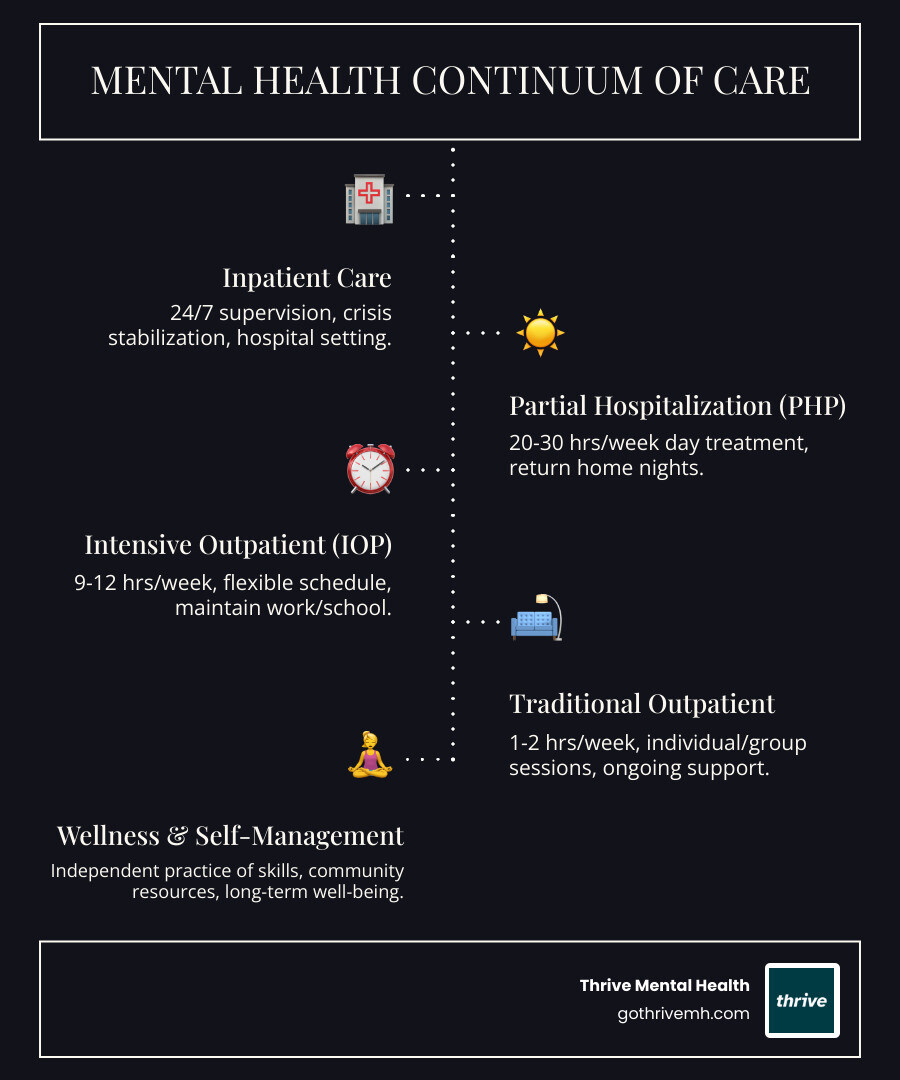
Think of mental health treatment like a ladder. At the top is the most intensive support for crisis. At the bottom is weekly therapy. In between, IOP vs PHP vs inpatient care offers the middle rungs that can make all the difference.
What is Inpatient Mental Health Care?
Inpatient care is the most intensive option: 24/7 residential care with constant medical supervision. It’s designed for crisis stabilization, when symptoms are so severe you need round-the-clock support to stay safe. It’s for those at high risk of harm to self or others, experiencing acute symptoms like psychosis, or who cannot function safely at home.
Inpatient care is short-term by design. The goal is stabilization, not a complete cure, preparing you to step down to a PHP or IOP. Stays typically last a few days to a couple of weeks. You pause your life to get the intensive medical attention needed to regain stability.
What is a Partial Hospitalization Program (PHP)?
A Partial Hospitalization Program (PHP), or “day treatment,” is like a full-time job for your recovery. You attend treatment 5-7 days a week for 20-30 hours total but go home every night.
PHPs are ideal as a step-down from inpatient care (when you’re stable but need daily structure) or to prevent hospitalization (when you’re struggling but not in crisis). During a PHP, you’ll participate in individual and group therapy, family counseling, medication management, and skills training, all while maintaining a connection to your home life. You can learn more about our PHP mental health services here.
What is an Intensive Outpatient Program (IOP)?
An Intensive Outpatient Program (IOP) provides structure without taking over your life. You attend therapy 3-5 days a week for 9-12 hours total, which is flexible enough to allow you to work, go to school, or care for your family.
IOPs are for those who need more than weekly therapy but less than a PHP. It’s ideal for stepping down from a PHP or managing disruptive but not debilitating symptoms. The power of an IOP is applying skills in your real life immediately. What you learn in group therapy can be practiced at work the next day. Many of our IOPs offer evening sessions so you don’t have to choose between recovery and your responsibilities. Learn more about our IOP programs.
IOP vs PHP vs Inpatient: The Ultimate Side-by-Side Comparison
Definitions are a start, but practical differences are what matter. This section breaks down what to expect from each level of care in the iop vs php vs inpatient continuum.
Key Differences in Intensity, Structure, and Autonomy
The key differences lie in intensity, structure, and autonomy. Time commitment ranges from 24/7 for Inpatient, to a full-time 20-30 hours/week for PHP, down to a flexible 9-12 hours/week for IOP. This also affects your living situation: you live at the facility for inpatient care but return home nightly for PHP and IOP. Medical supervision is constant in inpatient, daily during program hours in PHP, and available as-needed in IOP. Consequently, your autonomy increases as intensity decreases: from low in inpatient to high in IOP. Duration also varies: inpatient is for short-term crisis stabilization (days to weeks), PHP for intensive skill-building (4-8 weeks), and IOP for longer-term integration (8-12 weeks).
Here’s a quick reference table to see these differences side-by-side:
| Feature | Inpatient Care | Partial Hospitalization (PHP) | Intensive Outpatient (IOP) |
|---|---|---|---|
| Time Commitment | 24/7 Residential | 20-30 hours/week (like a job) | 9-12 hours/week (fits your schedule) |
| Living Situation | At the facility | At home | At home |
| Medical Supervision | Constant, 24/7 | Daily access to medical staff | Regular check-ins, as needed |
| Patient Autonomy | Low | Moderate | High |
How IOP vs PHP vs Inpatient Treatment Fits Into Your Life
The real question is, “how will this actually affect my day-to-day life?”
Inpatient care means pausing your life completely. You’re removed from your environment to create a protected space for crisis stabilization. It’s a necessary but temporary step.
PHP is like a full-time job for your recovery. Your days are filled with structured therapy, meaning you’ll likely need to take a leave from work or school. It’s an intensive commitment for those who need daily support but can be home at night.
IOP integrates into your life. Our Thrive Mental Health programs in Florida are structured with evening options so you can continue working, attending school, or caring for family. This integration is powerful: you immediately apply new coping skills in your real environment. This real-time feedback loop—practicing skills at work or home and discussing the results in your next session—makes recovery more sustainable. IOP’s flexibility doesn’t mean it’s “easier”; it’s for a different stage of recovery. It’s the ideal fit when you’re stable enough for daily life but need more structured support than weekly therapy can provide.
Who Needs What? Finding Your Fit in the Continuum of Care
The “best” program isn’t the most intensive one—it’s the one that matches where you are right now. Choosing a level of care is like choosing the right tool for a job. The goal is to get the support you actually need—not more, not less.

When to Choose Inpatient Care
If you are in crisis or thinking about harming yourself, call or text 988 immediately. You are not alone, and help is available 24/7.
Inpatient care is for when safety comes first. Choose this option if you are in a severe mental health crisis, having suicidal thoughts or plans to self-harm, or experiencing thoughts of hurting others. An unstable or unsafe home environment can also necessitate inpatient care, as can the need for medical detoxification. If you are unable to care for yourself (e.g., not eating or maintaining hygiene), inpatient provides the structure to stabilize you.
Who Thrives in a Partial Hospitalization Program (PHP)?
PHP is for those who need more than weekly therapy but are stable enough to sleep at home. It’s often a step-down from inpatient care, providing intensive daily structure (20-30 hours/week) to rebuild independence. PHP also acts as a preventive measure to avoid hospitalization if you’re medically stable but struggling with daily functioning. The key requirement is a safe home environment to return to each night. Our PHP options in Florida are designed for this level of healing.
Is an Intensive Outpatient Program (IOP) Right for You?
IOP is the sweet spot if your symptoms are disruptive but manageable enough to maintain work or school. It often serves as a step-down from PHP, providing continued accountability (9-12 hours/week) as you apply new skills. IOP also offers the structure to prevent relapse. It works best if you can handle daily responsibilities and have a reliable support system. Our Thrive Mental Health programs offer evening options so you don’t have to choose between getting help and keeping your job. If you need robust support but can’t step away from your life completely, our virtual and in-person options in Florida are built to fit your schedule.
The Bottom Line: Therapies, Costs, and Success Rates
Now let’s cover the practical details: the therapies offered, their effectiveness, and the costs. These factors are crucial for making a decision and moving forward.
Primary Treatment Modalities and Therapies
Whether you choose iop vs php vs inpatient care, you’ll receive evidence-based therapies. The difference is intensity, not quality. Common modalities include:
- Cognitive Behavioral Therapy (CBT)
- Dialectical Behavior Therapy (DBT)
- Individual and Group Therapy
- Family Counseling
- Medication Management
- Relapse Prevention
At Thrive Mental Health, we personalize these therapies to your life and goals. Our programs in Florida are designed with the flexibility you need to succeed.
How Effective Are These Programs?
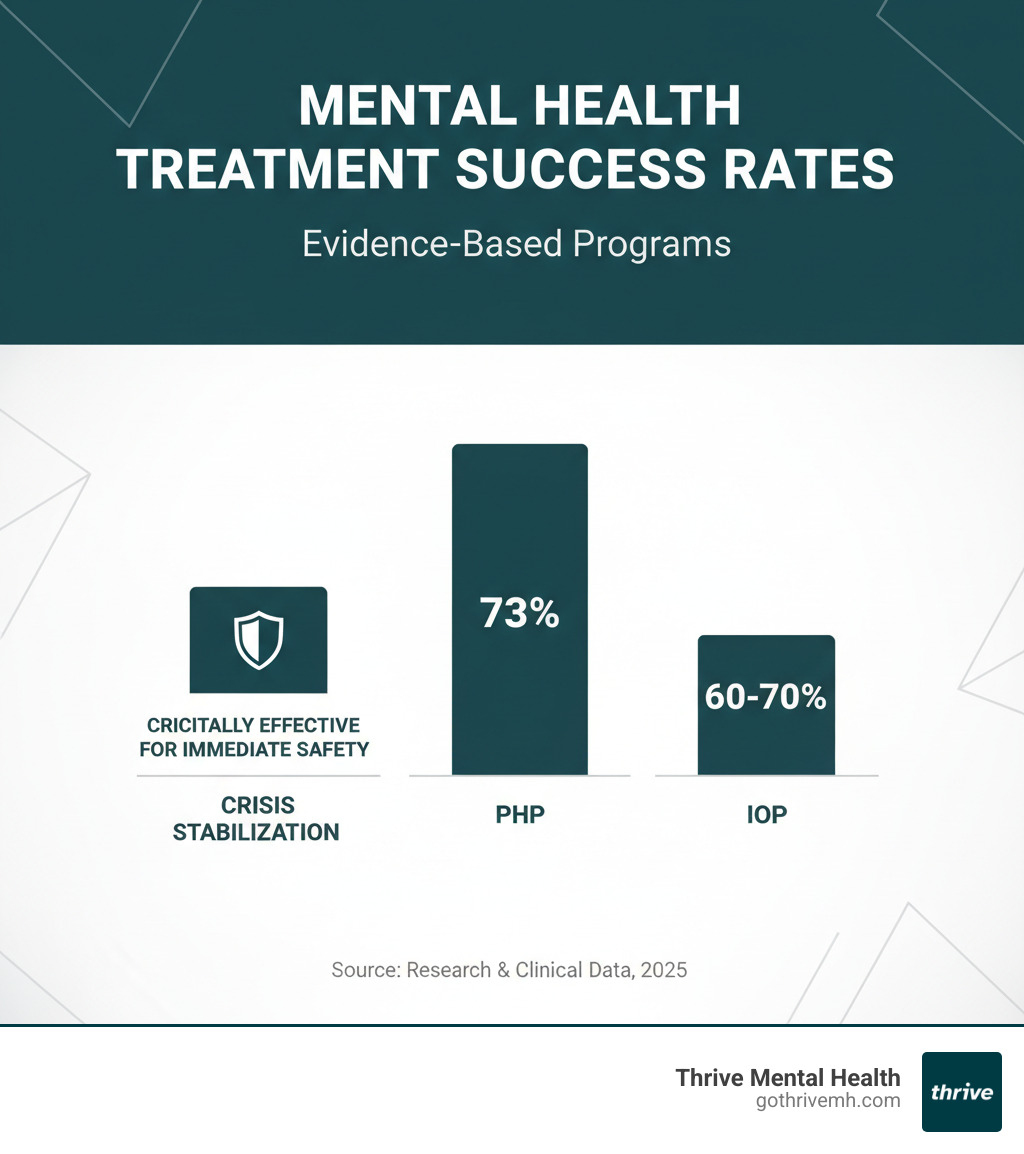
Research shows these programs work. PHPs have a success rate of approximately 73%, proving to be a cost-effective option for improving social function according to a review of PHPs. IOPs show success rates from 60% to 70%, with a 2015 literature review finding they significantly reduce substance use and improve mental health. Inpatient care is highly effective for its primary goal: crisis stabilization. The takeaway is that both IOPs and PHPs offer robust treatment with less life disruption than residential care.
Cost and Insurance Coverage in Florida
Cost is a crucial factor. Inpatient care is the most expensive, followed by PHP, with IOP being the most affordable of these intensive options. The good news is that most major insurance plans cover these services. At Thrive Mental Health, we work with Cigna, Optum, Florida Blue, and other major providers in Florida. To minimize out-of-pocket costs, it’s key to confirm your benefits.
We make this easy. You can verify your insurance in 2 minutes with no obligation for a clear breakdown of your coverage.

Frequently Asked Questions about Treatment Levels
Here are answers to the questions we hear most often about the iop vs php vs inpatient decision.
What is the main difference between PHP and IOP?
The main difference is time and intensity. A PHP is like a full-time job for your recovery, requiring 20-30 hours per week during the day. An IOP is more flexible, requiring 9-12 hours per week, often with evening sessions to fit around work or school. The quality of therapy is the same; the choice depends on the level of structure you need.
Can you work while in a PHP or IOP?
Working during a PHP is extremely difficult due to its 20-30 hour weekly daytime commitment; most people take medical leave. In contrast, IOPs are designed for working adults. Thrive Mental Health offers flexible evening schedules so you can maintain your job or school commitments while receiving treatment. You can explore our flexible IOP programs here.
How long do IOP and PHP programs last?
Program length varies based on individual needs. PHPs typically last 4-8 weeks, focusing on intensive stabilization and skill-building. IOPs often last longer, around 8-12 weeks, to allow for integrating new skills into daily life. However, treatment duration is flexible and adjusted based on your progress. At Thrive Mental Health, your care plan evolves as you grow stronger.
The Right Support is Waiting: Take the Next Step
You’ve made it this far, which means you’re already taking action. Choosing between iop vs php vs inpatient care is about honest matching—aligning the level of support with what you actually need right now. The right program provides enough structure for change without unnecessarily pausing the life you’re trying to improve.
In practice:
- Inpatient: For crisis and when you can’t safely care for yourself.
- PHP: For intensive daily support when you’re stable enough to be home at night.
- IOP: For robust, flexible therapy that integrates into your real world.
At Thrive Mental Health, our expert-led virtual and in-person IOP and PHP programs in Florida are built on this principle. With flexible evening options, we make evidence-based treatment accessible for people with jobs and families. We focus on measurable results and practical scheduling, so you get the support you need without sacrificing what matters to you.
Ready for support? Verify your insurance in 2 minutes (no obligation) → or call 561-203-6085. Our team will help you understand your coverage and find the right fit. There’s no pressure, just honest answers.
If you’re in crisis, call or text 988. You deserve immediate help, and it’s available 24/7.