
The 7 Best Virtual IOP Providers Accepting United Health

List 7 Best Virtual IOP for United Health
988 Lifeline Disclaimer
If you’re in crisis or having thoughts of self-harm, call or text 988 right now. You are not alone.
Why Finding the Right Virtual IOP Provider Can Make or Break Your Recovery
List virtual IOP providers that accept United Health and you’ll find dozens of results—but not all programs are created equal. If you’re searching for fast, flexible mental health care that takes your insurance, here’s what you need to know right now:
Quick Answer: Top Virtual IOP Providers Accepting United Healthcare
| Provider Type | Key Features | Best For |
|---|---|---|
| Thrive Mental Health | Evening/hybrid options, professional-focused, FL | Busy adults, professionals, dual diagnosis |
| Young Adult Programs | Ages 18–25, family therapy, college support | Transition-age youth, students |
| Eating Disorder Specialists | Dietitians, medical team, family-based care | Anorexia, bulimia, binge eating |
| Trauma & PTSD Tracks | EMDR, CPT, 24/7 crisis support | PTSD, complex trauma, veterans |
| Substance Use + MAT | Medication-assisted treatment, integrated care | Addiction, dual diagnosis |
| Dual Diagnosis Programs | Mental health + substance use together | Co-occurring conditions |
| National Telehealth Networks | Broad coverage, multiple states | Geographic flexibility |
All providers listed accept United Healthcare (in-network status varies by plan—always verify).
Virtual Intensive Outpatient Programs (IOPs) deliver 9–12 hours of therapy per week—far more than traditional weekly sessions—without the commute or waitlist. You get structured group therapy, individual sessions, and often family support, all from home. And yes, research shows virtual IOP works just as well as in-person care for most people.
But here’s the catch: United Healthcare covers virtual IOP when it’s “medically necessary” and provided by an in-network provider. That means you need to understand your benefits, find the right program, and get pre-authorization. This guide walks you through every step—so you can stop waiting and start healing.
As Nate Raine, CEO of Thrive Mental Health, I’ve spent over a decade helping people steer the intersection of mental health care, insurance, and technology. At Thrive, we specialize in virtual and hybrid IOP/PHP programs designed for busy adults and professionals—and we know how to list virtual IOP providers that accept United Health because we’ve helped thousands of clients cut through the confusion and get the care they deserve.
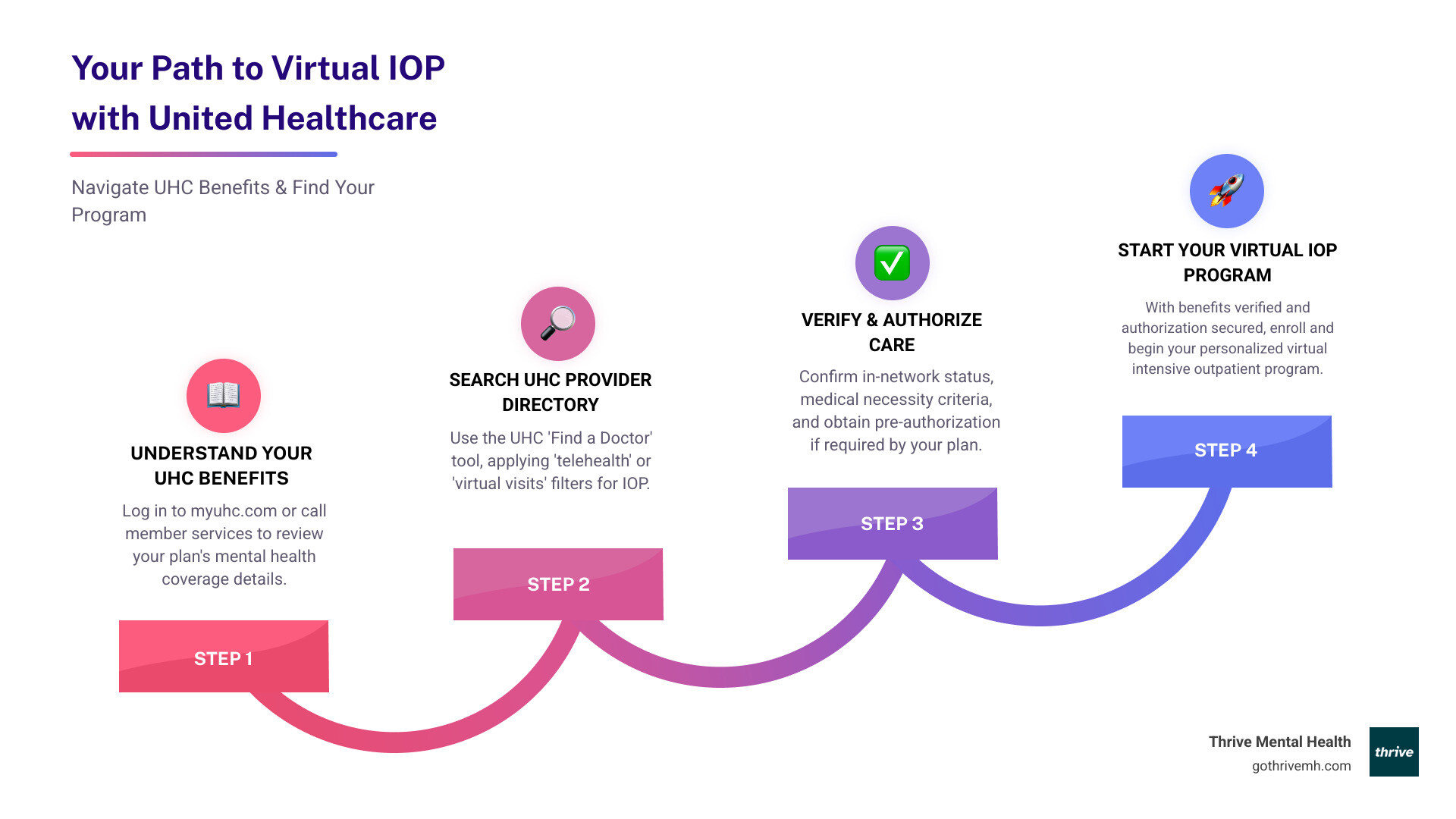
List virtual IOP providers that accept United Health terms to remember:
What Is Virtual IOP? [Is It as Effective as In-Person?]
Virtual IOP delivers the same evidence-based care as traditional IOP—just more flexible and accessible. Think of it as a robust mental health program that provides more support than weekly therapy but doesn’t require you to live at a treatment center. This means you can get high-quality treatment for several hours a day, multiple days a week, while still living at home, attending work or school, and managing your daily responsibilities.
We design our virtual IOPs to mirror the structure and therapeutic depth of in-person treatment. This includes individual therapy, group sessions, family therapy, and sometimes medication management. The goal is to provide comprehensive support that helps you manage your mental health issues and achieve lasting recovery.
But does it actually work? Yes! Research consistently shows that virtual IOP can be just as effective as in-person treatment, especially for motivated clients who actively engage in the program. Studies comparing online therapy to face-to-face therapy have found that 80% of participants thought online therapy was as effective or more effective than traditional therapy. For instance, some research indicates that clients experience clinically significant change faster in virtual settings than in traditional ones. This means you can achieve real healing without sacrificing convenience.
Who benefits most from virtual care?
Virtual care is a game-changer for many. If you’re a busy professional, a student, a parent with childcare responsibilities, or someone facing transportation challenges, virtual IOP offers unparalleled flexibility. It’s ideal for those who need structured support but can’t commit to daily in-person attendance. This includes individuals who are stepping down from higher levels of care (like residential treatment) and want to maintain consistent therapy from home. It also serves those in areas with limited access to specialized mental health services, allowing us to serve clients across Florida, no matter how remote their location.
Who needs in-person support?
While virtual IOP is highly effective for many, it’s not a one-size-fits-all solution. In-person support may be more appropriate for individuals facing severe withdrawal symptoms, serious medical concerns, or intense psychological distress that requires 24/7 supervision. If you’re experiencing an acute crisis, severe self-harm, or need constant medical monitoring, an inpatient or residential program might be a safer starting point. We believe in finding the right level of care for each individual, ensuring safety and effectiveness are always prioritized.
| Virtual vs. In-Person IOP | Virtual IOP | In-Person IOP |
|---|---|---|
| Cost | Often lower due to reduced overhead (no commute, etc.); similar copays with UHC | Potentially higher due to travel, sometimes higher facility fees |
| Access | Accessible from anywhere with internet; eliminates geographic barriers | Requires travel to a physical location; limited by local availability |
| Flexibility | Highly flexible scheduling (evening options, etc.); fits around work/school | Fixed schedules; less adaptable to personal commitments |
| Format | Secure, HIPAA-compliant video conferencing; individual, group, family sessions | Face-to-face sessions in a clinical setting; individual, group, family sessions |
| Effectiveness | Research shows comparable outcomes for many conditions | Traditional gold standard; provides physical separation from triggers |
How to Find Virtual IOP Providers That Accept United Health—Step-by-Step
Navigating insurance can feel like a labyrinth, but with United Healthcare, it doesn’t have to be. We’re here to help you cut through the noise and find the care you need.
Understand your United Healthcare (UHC) mental health benefits
United Healthcare, part of UnitedHealth Group, offers one of the nation’s largest provider networks, spanning all 50 states. This means your plan likely covers a wide range of behavioral health services, from individual therapy to substance use treatment, including virtual IOPs. UHC’s behavioral health benefits are designed to support your mental health journey, but the specifics of your coverage will depend on your individual plan.
Know your rights: The Mental Health Parity Act
Thanks to the Mental Health Parity and Addiction Equity Act (MHPAEA), UHC is legally required to cover mental health and substance use disorder services at the same level as physical health care. This means if your plan covers an in-person IOP for a physical condition, it generally must cover a virtual IOP for a mental health condition with similar copays, deductibles, and treatment limits. This act is crucial in ensuring you get the comprehensive care you deserve without unfair limitations.
In-network vs. out-of-network: What it means for your wallet
Choosing an in-network provider is usually the most cost-effective option. In-network providers have a contract with UHC to provide services at a negotiated rate, which typically means lower out-of-pocket costs for you. Out-of-network providers, while sometimes covered, often require higher deductibles, coinsurance, or may not be covered at all. Always verify a provider’s in-network status to avoid unexpected bills.
Coverage in Florida
United Healthcare has a strong presence in Florida. Whether you’re in Tampa Bay, Miami, Orlando, or Jacksonville, UHC plans generally offer coverage for virtual IOPs when medically necessary. However, plan specifics can vary even within the state. For example, some UHC plans might have different in-network providers or coverage limits depending on your employer or the specific plan you chose. It’s always best to verify your individual benefits.
What Mental Health Conditions Does UHC Cover for Virtual IOP?
United Healthcare typically covers virtual IOPs for a wide array of mental health and substance use conditions when deemed medically necessary. This often includes:
- Depression
- Anxiety (Generalized, Social, Panic)
- PTSD
- Trauma (Acute, Chronic, Complex)
- Substance Use Disorder (including alcohol and opioid use)
- Eating Disorders (Anorexia, Bulimia, Binge Eating)
- Dual Diagnosis (co-occurring mental health and substance use disorders)
- Mood Disorders (Bipolar, Schizophrenia)
- Self-harm and Suicidal Ideation
- Obsessive-Compulsive Disorders (OCD)
- Personality Disorders
- ADHD
- Perinatal Mood and Anxiety Disorders (including Postpartum Depression)
Approval depends on “medical necessity”—here’s how to get it.
“Medical necessity” is the golden ticket for insurance coverage. It means your doctor or therapist must demonstrate that the virtual IOP is essential for your health and well-being, and that a less intensive treatment wouldn’t be sufficient. This typically involves a clinical assessment and documentation of your symptoms, functional impairment, and previous treatment attempts. The provider you choose will usually handle the pre-authorization process, submitting the necessary paperwork to UHC on your behalf.
How to Check Your UHC Benefits & Predict Your Costs
Don’t let unexpected costs derail your recovery. Verifying your benefits upfront is crucial. Here’s how we recommend you do it:
- Log in to myuhc.com: This is your most reliable source. Your member portal provides personalized, plan-specific details, eliminating guesswork. You can review your benefits, check claims, and find in-network providers.
- Find your Summary of Benefits and Coverage: This document, usually available on your member portal, outlines exactly what’s covered, your cost-sharing responsibilities (copays, deductibles, coinsurance), and any limitations.
- Call the number on your card: For specific questions or to clarify anything, call the member services number on your UHC ID card. We recommend having your member ID ready and asking detailed questions about virtual IOP coverage, specific conditions, and out-of-pocket costs.
- Understand copays, deductibles, coinsurance:
- Copay: A fixed amount you pay for a covered service after meeting your deductible. For in-network therapy sessions with UHC, copays typically range from $0 to $50.
- Deductible: The amount you must pay out-of-pocket before your insurance starts to cover costs. If you have a $1,000 deductible, you’ll pay the first $1,000 of covered services yourself.
- Coinsurance: Your share of the costs of a covered health care service, calculated as a percentage (e.g., 20%) of the allowed amount for the service. You pay this after you’ve met your deductible.
- Pre-authorization: What to expect: For IOP services, UHC often requires pre-authorization. This means your provider needs to get approval from UHC before you start treatment. We handle this process for our clients to ensure a smooth start to their care.
How to Use the UHC Directory to Build Your List of Virtual IOP Providers
Finding the right provider can feel overwhelming, but UHC provides powerful tools to help.
- Steer the UHC provider directory: Start at UHC’s main provider search page. You can filter by location, specialty, and type of care.
- Use “telehealth” or “virtual visits” filters: This is key! When searching for virtual IOP providers that accept United Health, make sure to select filters for “telehealth” or “virtual visits” to narrow down your options to programs that offer remote care.
- Find the Behavioral Health section: UHC has a dedicated directory for mental health providers. Look for “Behavioral Health” or “Mental Health” sections on their website to ensure you’re searching the right pool of specialists.
- Use the UHC app for fast searches: The UHC app brings these powerful search tools to your smartphone. You can download it from your phone’s app store and have the entire United Healthcare therapist directory in your pocket for convenient, on-the-go searches.
- You can find a UHC provider directly here: Find a UHC provider here
7 Must-Have Features of Top Virtual IOPs That Take United Healthcare
When you’re ready to list virtual IOP providers that accept United Health, knowing what to look for can make all the difference. We believe the best programs offer more than just therapy sessions—they provide comprehensive, custom support that truly meets your needs.

1. Specialized Programs for Young Adults (18–25)
Young adulthood is a critical period where 75% of lifetime mental health conditions first appear. For those navigating college, early career, and significant life transitions, a specialized virtual IOP can be invaluable. These programs understand the unique pressures faced by young adults and offer custom support.
- Support for college, work, and life transitions: Programs focus on developing coping skills, managing academic or work stress, and fostering independence.
- Family therapy options: Family involvement is often the #1 predictor of success in IOP. Many programs include family sessions to improve communication and build a stronger support system, which is especially vital for young adults.
- UHC coverage for dependents: United Healthcare commonly covers virtual IOPs for young adults, including those on a parent’s plan, when offered by an in-network provider and deemed medically necessary.
2. Integrated Dual-Diagnosis Tracks
It’s common for mental health conditions and substance use disorders to co-occur. In fact, in 2023, about 20.4 million U.S. adults experienced both a mental health disorder and substance use disorder. Treating these issues separately often leads to relapse, as one can trigger the other. The best virtual IOPs offer integrated dual-diagnosis tracks that address both conditions simultaneously.
- Treating mental health and substance use together: This approach recognizes the interconnectedness of these challenges, providing comprehensive care that targets both the addiction and underlying mental health issues.
- Why integrated care speeds recovery: Combined treatment is considered a best practice for lasting recovery, with approximately half of individuals responding well to integrated programs. It helps break the cycle of self-medication and provides tools for sustainable well-being.
- Learn more about integrated dual diagnosis care: Learn about dual diagnosis care
3. Thrive Mental Health: Flexible Virtual IOP for Adults & Professionals
At Thrive Mental Health, we understand the demands of modern life. That’s why our virtual and in-person Intensive Outpatient (IOP) and Partial Hospitalization (PHP) programs are designed for adults and young professionals who need intensive support without putting their lives on hold.
- Designed for busy adults and professionals: We combine clinical expertise with flexible scheduling and measurable results. Our programs are structured for people who need more than once-a-week therapy but less than inpatient care, allowing you to maintain your work, school, or family commitments.
- Accepts United Healthcare, Cigna, Optum, Florida Blue, and more: We partner with most major insurance providers, including United Healthcare, to make our evidence-based treatment accessible. We aim to reduce financial barriers so you can focus on healing.
- Serving Florida: We’re committed to making high-quality mental health care accessible across the state. Our virtual programs ensure you can access our support from anywhere in Florida with a reliable internet connection.
- Evening and hybrid options: We offer flexible scheduling, including evening sessions, to fit your busy life. For those who prefer a blend, our hybrid options combine the convenience of virtual care with the benefits of in-person connection at our locations in Florida, including Tampa Bay, St. Petersburg, Miami, Orlando, Boca Raton, West Palm Beach, Jacksonville, Fort Lauderdale, Naples, and Sarasota.
- Find more about Thrive’s Virtual IOP: More about Thrive’s Virtual IOP
4. At-Home Eating Disorder Recovery
Eating disorders are complex, requiring specialized and comprehensive care. Several national virtual IOPs focus specifically on eating disorder recovery, making them accessible to individuals in Florida.
- Multidisciplinary teams: therapists, dietitians, medical staff: These programs employ a team approach, often including therapists, dietitians, and medical doctors, to address the physical, psychological, and nutritional aspects of eating disorders.
- Family-based and nutritional counseling: Many emphasize family involvement, particularly for adolescents, and provide specialized nutritional counseling to help re-establish healthy eating patterns and body image.
- Body image support: A core component is supporting clients in developing a healthier relationship with their body and food, fostering self-acceptance and resilience.
5. Trauma-Informed Care & PTSD Specialization
Trauma, whether acute, chronic, or complex, can significantly impact mental health. Top virtual IOPs offer trauma-informed care, creating a safe environment for healing and recovery.
- Evidence-based therapies: EMDR, CPT: Look for programs that use proven therapies like Eye Movement Desensitization and Reprocessing (EMDR) and Cognitive Processing Therapy (CPT), which are highly effective for PTSD and other trauma-related conditions.
- Safe, non-judgmental environment: A trauma-informed approach means understanding the widespread impact of trauma and integrating this knowledge into all aspects of treatment, fostering a sense of safety and trust.
- 24/7 crisis support: For individuals dealing with trauma, crisis support is paramount. The best programs offer access to support outside of regular session hours, ensuring you’re never alone when distress strikes.
If you’re in crisis, call/text 988 right now. You are not alone.
6. Substance Use Programs with Medication-Assisted Treatment (MAT)
For many struggling with substance use disorders, medication-assisted treatment (MAT) is a vital component of recovery. UHC covers MAT, including medications like methadone and buprenorphine, when combined with therapy.
- MAT for alcohol and opioid use: Virtual IOPs can integrate MAT, providing medical oversight and prescriptions (where appropriate and legal in a telehealth context) alongside behavioral therapies.
- Medication + therapy = better outcomes: Research consistently shows that combining medication with therapy significantly improves outcomes for substance use disorders, reducing cravings and lowering the chance of relapse.
- Explore Thrive’s addiction recovery programs: Thrive’s addiction recovery programs
7. How to Vet Your List of Virtual IOP Providers That Accept United Health
Once you have a potential list virtual IOP providers that accept United Health, it’s time to do your due diligence. Not all programs are created equal, and choosing the right fit is crucial for your recovery journey.
- Check state licensing and therapist credentials: Ensure the program and its clinicians are licensed in the state where you reside (Florida). Verify the credentials of the therapists and staff—they should be qualified professionals with experience in virtual care delivery.
- Ask about program structure, time commitment, and outcomes: Inquire about the weekly schedule, the types of therapies offered (individual, group, family), the length of the program, and how they measure client progress and outcomes. A transparent program will gladly share this information.
- Read real reviews and testimonials: Look for independent reviews and testimonials to get a sense of other clients’ experiences. Pay attention to feedback regarding the program’s effectiveness, the quality of the therapists, and the overall support provided.
Ready to take the next step? Verify your insurance with Thrive.
FAQs: United Healthcare & Virtual IOP—What People Ask (and Need to Know)
How much does virtual IOP cost with United Healthcare?
After your deductible, most pay a copay per session—often $0–$50. Always check your plan details. Your specific costs will depend on your plan’s copay, deductible, and coinsurance. We recommend verifying your benefits directly with UHC or through your member portal for the most accurate information.
Do I need a referral to start virtual IOP with UHC?
It depends on your plan type. HMO plans usually require a referral from your Primary Care Physician (PCP) to see a specialist or enroll in an IOP. PPO plans often do not require a referral, giving you more flexibility. Confirm with your plan or call the member services number on your ID card to be sure.
How do I know if a virtual IOP provider is in-network with my UHC plan?
The most reliable method is to log in to myuhc.com and use the provider search tool, filtering for “telehealth” or “virtual visits.” This will show you providers specific to your plan. We also recommend calling the provider directly with your member ID to double-check their in-network status and confirm your benefits.
What if I have Cigna, Optum, or Florida Blue instead?
Thrive accepts most major insurances in Florida, including Cigna, Optum, and Florida Blue. We work with a wide range of plans to make our virtual and hybrid IOP/PHP programs accessible. You can see all accepted plans and verify your coverage quickly on our website: See all accepted plans.
Can I switch from in-person to virtual IOP if my needs change?
Yes—many programs, including Thrive, offer hybrid options for maximum flexibility. This means you can transition between in-person and virtual care as your needs evolve, ensuring continuity of treatment without disruption. We believe in adapting to your life, not the other way around.
Summary: Your Fast Track to Recovery—Virtual IOP Providers That Accept United Health
Don’t let confusion or cost delay your recovery. List virtual IOP providers that accept United Health to find fast, flexible, and effective care. Virtual IOPs offer a powerful solution for those needing intensive mental health support without sacrificing their daily lives. By understanding your UHC benefits, knowing what to look for in a quality program, and leveraging the tools available, you can quickly access the high-level care you deserve. Stop waiting—it’s time to get back to life, work, and what matters most.
Learn about Thrive’s PHP programs: Learn about Thrive’s PHP programs
Explore virtual therapy options at Thrive: Virtual therapy options at Thrive