Online Therapy Pricing: Your Wallet-Friendly Guide

Online-Therapy Pricing: Smart 2025 Guide
Why Understanding Online-Therapy Pricing Matters Right Now
Online-therapy pricing can be confusing, creating another barrier for those already struggling with anxiety or depression. But you don’t have to choose between your mental health and your budget. Online therapy offers flexible, high-quality care that’s often more affordable than traditional options.
Quick Answer: What Does Online Therapy Actually Cost?
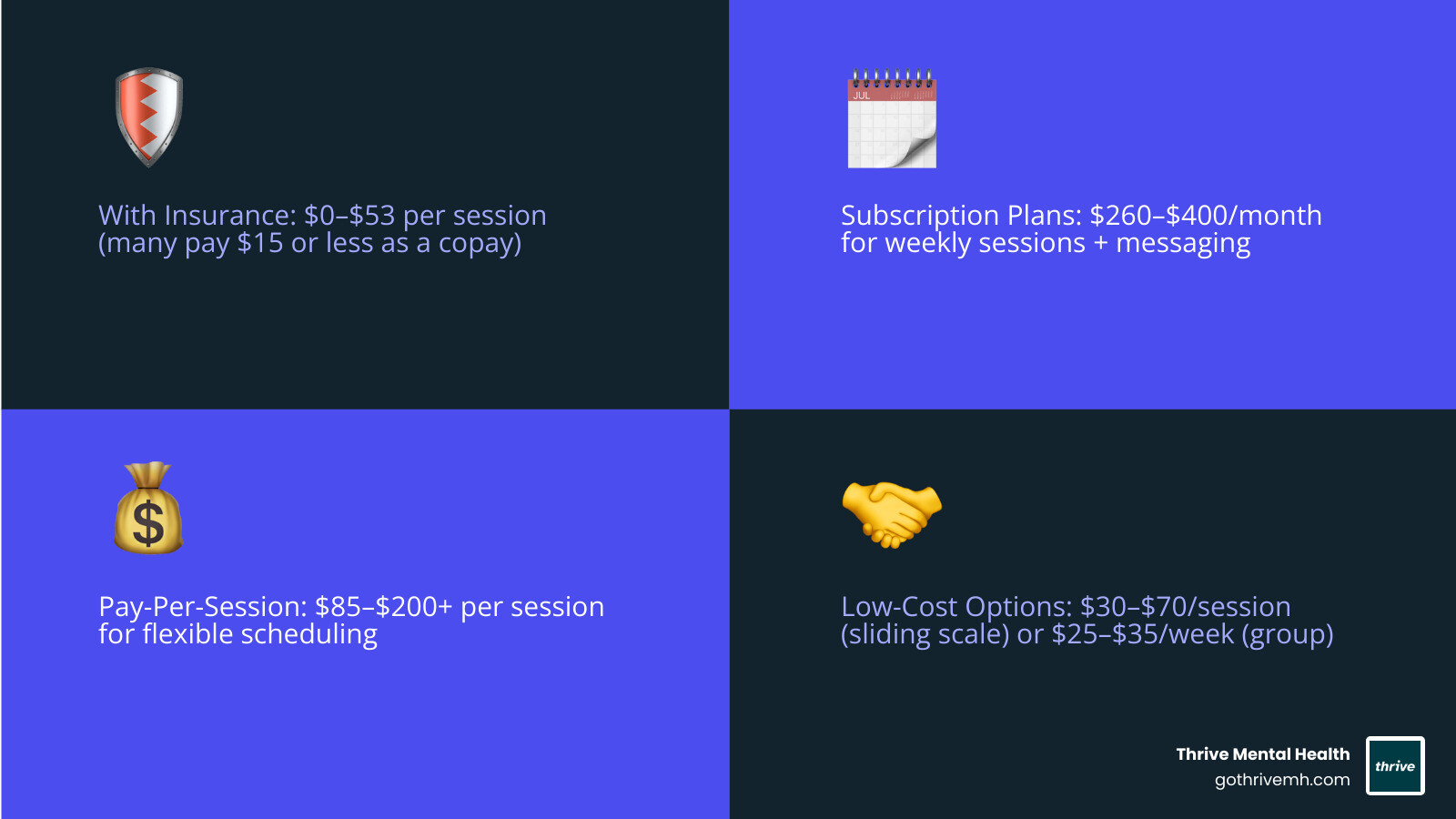
- With insurance: $0–$53 per session (many pay $15 or less as a copay)
- Without insurance (subscription plans): $260–$400 per month for weekly sessions + unlimited messaging
- Without insurance (pay-per-session): $85–$200+ per session
- Low-cost options: $30–$70 per session through nonprofit networks, or $25–$35/week for group therapy
Compare that to traditional in-person therapy, which averages $174 per session out-of-pocket, and you’ll see why so many are choosing virtual care. The cost of therapy isn’t just about dollars—it’s about access and time. Online therapy removes obstacles like commutes and office wait times, often at a significantly lower cost.
As Chief Clinical Officer at Thrive Mental Health, I’m Anna Green, LMHC, LPC. I’ve helped countless clients steer the financial side of care. I know that clear, transparent pricing is essential for making mental health support truly accessible.
Online vs. In-Person Therapy: A Cost Breakdown
When considering online-therapy pricing, it helps to see how it stacks up against traditional therapy. While effective, in-person care often comes with a high price tag.
According to a 2023 Milliman report, the average out-of-pocket cost for an in-person therapy session is $174 per hour. With commercial health insurance, you’re looking at an average of $23 for in-network visits and $53 for out-of-network providers. These numbers can make consistent care a financial burden.
In-person sessions are more expensive largely due to overhead costs like office rent, insurance, and licensing fees, plus the extensive education required for therapists.
Online therapy changes the equation. Online-therapy pricing can be as low as $0 with insurance, and many insured patients pay nothing for their visits. Virtual care also offers hidden savings: no money spent on gas or parking, no extra time off work for a commute, and no need to pay for childcare. These “small” costs add up, sometimes doubling the real cost of traditional therapy. Our virtual therapy services are designed to make mental health support fit your life and budget.
Here’s how the two approaches compare side-by-side:
| Feature | Online Therapy | In-Person Therapy |
|---|---|---|
| Average Cost (Out-of-Pocket) | $85–$200+ per session (or $260–$400/month subscription) | $174 per 1-hour session |
| Average Cost (Insured Copay) | $0–$53 (many pay $15 or less) | $23 (in-network), $53 (out-of-network) |
| Convenience | High (from home, no commute, flexible scheduling) | Moderate (requires travel, fixed office hours) |
| Hidden Savings | No travel, no parking, no childcare | Potential travel, parking, childcare costs |
| Session Format | Video, audio, text, messaging | Face-to-face in an office |
| Accessibility | Wider geographical reach, easier to find specialists | Limited by local providers and travel distance |

Factors That Influence Therapy Prices
Several factors can shift the actual online-therapy pricing you’ll encounter.
Therapist qualifications and experience make a significant difference. A newer therapist with a master’s degree may charge $25-$40 per session, while a clinical psychologist with a PhD and specialized experience can charge $100-$150 or more.
Geographic location still matters. Therapists are licensed by state, and their rates often reflect the local cost of living. A therapist in Miami might charge more than one in a smaller Florida town. Online platforms can connect you with licensed therapists across your state, potentially offering better rates than you’d find locally. This is especially relevant for clients in higher-cost areas of Florida, as we serve the entire state.
Session length offers another way to adjust costs. While 50 minutes is standard, some providers offer 30-minute sessions for around $100, which works well for regular check-ins.
Type of therapy also influences pricing. Standard talk therapy (CBT, DBT) is widely available at typical rates. Specialized modalities like Eye Movement Desensitization and Reprocessing (EMDR) or couples counseling often cost more. Our intensive outpatient (IOP) and partial hospitalization (PHP) programs are structured differently, providing comprehensive, evidence-based support when weekly therapy isn’t enough.
Understanding Online Therapy Pricing Models
When exploring online-therapy pricing, you’ll find different payment models designed to fit various lifestyles, budgets, and therapeutic needs. The three main models are subscription plans, pay-per-session options, and bundled service plans that may combine therapy with psychiatry.
Navigating Subscription-Based Online Therapy Pricing
Subscription models are the most popular way to access ongoing online therapy. For $260 to $400 monthly (about $65-$100 per week), you get consistent access to care.
Subscriptions typically include weekly live sessions (30-45 minutes via video or phone) and unlimited asynchronous messaging. This messaging feature is a key benefit, allowing you to contact your therapist between sessions for support, with responses typically within 24-48 hours on weekdays. Many platforms also include worksheets and journaling tools.
Subscriptions encourage consistency, which is crucial for making progress. It removes the weekly decision of whether you can afford a session. It’s also worth knowing that many platforms offer financial aid or sliding scale options based on income, student status, or military service. It’s always worth asking about these discounts during sign-up.
Subscription plans work best for conditions like anxiety and depression or for long-term personal growth. They are ideal if you value budget predictability and consistent support.
We take your privacy seriously, ensuring all our virtual services follow HIPAA Compliant Online Therapy standards.
The Pros and Cons of Pay-Per-Session Online Therapy Pricing
If a subscription feels like too much commitment, pay-per-session pricing offers maximum flexibility. You schedule and pay for sessions only when you need them.
For individual online-therapy pricing on a per-session basis, expect rates from $100 to $200 per session. Some specialized providers may charge more.
The main appeal is control over frequency and spending. You book and pay for sessions only when you need them, with no recurring fee. This is perfect for people with unpredictable schedules or those who need periodic check-ins.
The trade-off is that if you need weekly therapy, per-session costs can add up to more than a subscription over time. It requires more active management of your schedule and budget.
Pay-per-session is excellent for specific, short-term issues like navigating a work stressor or processing a breakup. It’s also a good way to try therapy or a specific therapist before committing. For instance, someone seeking Online Counseling for Trauma might start with a few appointments to build comfort before deciding on a long-term plan.
Neither model is inherently better—it depends on your mental health journey and what structure works for your life.
How Insurance Impacts Your Online-Therapy Pricing
Understanding how insurance affects your online-therapy pricing is critical—it can be the difference between paying $200 per session or just a $15 copay. The good news is that mental health parity laws now require many insurance plans to cover telehealth services similarly to in-person care.
In-network versus out-of-network: why it matters so much
Your cost depends heavily on whether your provider is “in-network” with your insurance. In-network providers have negotiated rates with your insurance company, meaning lower costs for you. You’ll typically only pay a copayment after meeting your deductible.
With in-network providers, the average insured copay for online therapy is $15 to $53 per session, with many paying $15 or less. This is far more manageable than the $174 average out-of-pocket cost.
Out-of-network providers are different. You may have to pay the full session fee upfront ($100-$200+) and submit a claim for partial reimbursement after meeting a higher out-of-network deductible.
Understanding copays and deductibles
- Your copay is the fixed amount you pay for each session after your deductible is met.
- Your deductible is the amount you must pay out-of-pocket before your insurance begins to cover costs.
Telehealth parity laws are on your side
Many states, including Florida where we serve clients, have telehealth parity laws. These laws require insurance companies to cover online mental health services just as they would in-person visits. Major providers like Cigna, Optum, and Florida Blue now widely cover online mental health. However, coverage details vary by plan. Research on insurance acceptance rates shows that verifying your specific benefits is crucial.
How to Use Your Insurance for Online Therapy
Here’s how to figure out what you’ll pay:
- Call your insurance provider using the number on your card.
- Ask specifically about “outpatient mental health services delivered via telehealth.” Find out about session limits, covered diagnoses, and accepted provider types (e.g., LPC, PhD, MD).
- Inquire about your copays and deductibles for both in-network and out-of-network providers.
- Use online benefits checkers. Many insurance companies and therapy platforms offer tools for quick answers.
At Thrive Mental Health, we want to remove every barrier to care. That’s why we make it easy to verify your insurance through our online tool in just a couple of minutes, with no obligation. We accept many major insurance providers and will help you understand your out-of-pocket costs before you begin.
Finding Affordable & Low-Cost Online Therapy
In Crisis? If financial stress or other life challenges feel overwhelming, please call or text 988 right now. Help is available 24/7.
Even with more affordable online-therapy pricing, cost can still be a barrier. If you don’t have insurance or are on a tight budget, know that accessible options exist. At Thrive Mental Health, we believe financial constraints shouldn’t prevent you from getting support.
Options for Therapy Without Insurance
If you’re paying without insurance, you have several options.
- Sliding scale fees: Many therapists adjust their rates based on your income. A session that costs one person $174 might cost you only $40. Always ask, “Do you offer a sliding scale?”
- Financial aid programs: Many online platforms offer discounts for students, veterans, or those with limited income. Look for these options during sign-up.
- Community mental health clinics: These publicly funded clinics provide services at very low cost, sometimes even free. There may be a waitlist, but the care is professional. The NAMI HelpLine can help you find local clinics.
- University training programs: University clinics offer low-cost therapy (as little as $30 per session) from graduate students who are supervised by licensed professionals. This is a great way to receive high-quality, affordable care.
Lower-Cost Alternatives: Group & Specialized Therapy
Group therapy is a powerful and affordable option, often costing just $25 to $35 per week. In a group, you connect with others who understand what you’re going through, which can be deeply healing. Our Virtual Group Therapy Sessions create a safe, supportive environment while being budget-friendly.
Online psychiatry services for medication management are also available, though they typically cost more than talk therapy. Plans may start around $95 per month, with initial evaluations costing up to $200 or more. Some platforms bundle therapy and psychiatry, which can save money.
Couples counseling addresses relationship dynamics and is often priced slightly higher than individual therapy. Online options typically range from $100 to $260 per month, which is still more affordable than most in-office couples therapy.

Frequently Asked Questions about Online Therapy Costs
We believe in being transparent about online-therapy pricing so you can make informed decisions. Here are the most common questions we hear.
How much does online therapy cost without insurance?
Without insurance, subscription plans cost $260 to $400 per month for weekly sessions and messaging. Pay-per-session options are typically $100 to $200 per session. Many providers also offer financial aid or sliding scale fees, which can lower costs to $30 to $70 per session.
Can I get online therapy for free?
Completely free one-on-one therapy is rare, but very low-cost options exist. Community mental health clinics and some non-profits offer free or low-cost services. University training programs are another affordable option. Also, check if your employer offers an Employee Assistance Program (EAP), which often includes a set number of free sessions.
Are there hidden fees with online therapy?
Reputable platforms are usually transparent. The most common hidden fee is for missed appointments (often $90-$125) if you cancel without 24-48 hours’ notice. Other potential costs include higher fees for initial psychiatric evaluations or the cost of prescription medication, which is rarely included in subscriptions. Always review the terms of service.
Is online therapy cheaper than in-person therapy?
Yes, in most cases. Out-of-pocket, traditional therapy averages $174 per session, while online subscriptions break down to $65 to $100 per week. Online therapy also saves you money on travel and childcare. With insurance, both can be affordable, often just a copay of $0 to $53, but online care retains its convenience and hidden savings.
Conclusion: Investing in Your Mental Health
Navigating online-therapy pricing can feel overwhelming, but with the right information, it becomes manageable. We’ve seen that online therapy is a flexible landscape with options to fit nearly any budget—from subscriptions ($260-$400/month) and pay-per-session models ($100-$200) to low-cost group therapy ($25-$35/week).
Insurance coverage has also improved significantly. Thanks to telehealth parity laws in Florida, many find their insurance covers online therapy for just a small copay. For those without insurance, financial aid, community clinics, and sliding scale fees make care attainable.
Investing in your mental health is one of the most practical, life-changing decisions you can make. It affects your work, your relationships, and your overall well-being. When we take care of our minds, everything else becomes more manageable.
Taking the first step can be scary, but you don’t have to do it alone. At Thrive Mental Health, we’ve built our programs—from virtual intensive outpatient (IOP) to partial hospitalization (PHP)—with busy professionals in mind. We offer evening sessions and expert-led, evidence-based treatment that meets you where you are.
The hardest part is often just starting. Once you do, you’ll wonder why you waited.
Ready for support? Thrive offers virtual and hybrid IOP/PHP with evening options. Verify your insurance in 2 minutes (no obligation) or call 561-203-6085. If you’re in crisis, call/text 988.