
Beyond the Clinic: Discovering Outpatient Mental Health Treatment Options

Outpatient Psychiatric Treatment: Discover 2025 Healing
Healing Without Halting Your Life
Outpatient psychiatric treatment allows you to receive professional mental health care while continuing to live at home and manage your daily responsibilities. Unlike inpatient treatment, which requires hospitalization, outpatient care means you attend scheduled therapy sessions and return home the same day.
Quick Overview: Outpatient Psychiatric Treatment at a Glance
| What It Is | Who It’s For | Key Benefit |
|---|---|---|
| Scheduled mental health appointments without overnight stays | Individuals with mild to severe symptoms who don’t need 24/7 supervision | Continue work, school, and family life while receiving expert care |
| Levels of Care | Time Commitment | Setting |
| Standard Outpatient (OP): Weekly therapy | 1 hour/week | Doctor’s office, clinic, or virtual |
| Intensive Outpatient (IOP): Structured support | 9-12 hours/week | Group + individual sessions |
| Partial Hospitalization (PHP): Highest outpatient level | 25-30 hours/week | Daily intensive treatment |
Whether you’re struggling with anxiety, depression, or trauma, outpatient care offers a path forward without pressing pause on your entire life. You can attend a therapy session and still make it to your morning meeting, applying coping skills from a group session to real-world situations immediately.
Research shows outpatient treatment is both cost-effective and flexible. After meeting the Part B deductible, Medicare beneficiaries typically pay 20% of the approved amount, and most major insurance plans cover a wide range of outpatient services.
At Thrive Mental Health, we’ve built our evidence-based outpatient psychiatric treatment protocols on the principle of flexible, comprehensive care for clients throughout Florida. Our Joint Commission telehealth accreditation demonstrates that virtual outpatient psychiatric treatment can meet the highest standards of quality and safety, allowing thousands of individuals to reclaim their lives.
Similar topics to outpatient psychiatric treatment:
What is Outpatient Psychiatric Treatment vs. Inpatient Care?
When you’re struggling with your mental health, understanding your care options is the first step. The main distinction between outpatient psychiatric treatment and inpatient care comes down to where you sleep at night and the level of supervision you need.
Outpatient psychiatric treatment means you attend scheduled appointments at a clinic, office, or via telehealth from home, and then return to your regular life. The care fits around your schedule. Inpatient treatment, on the other hand, requires you to stay overnight at a hospital or residential facility for round-the-clock supervision and intensive care, usually during an acute crisis.
| Feature | Outpatient Psychiatric Treatment | Inpatient Treatment |
|---|---|---|
| Level of Supervision | Scheduled sessions, return home daily | 24/7 medical supervision and monitoring |
| Environment | Doctor’s office, clinic, community center, or virtual; you live at home | Hospital or residential facility, highly structured |
| Cost-Effectiveness | Generally more affordable, widely covered by insurance | Typically more expensive due to continuous care |
| Daily Life Impact | Minimal disruption; maintain work, school, and family routines | Temporary removal from daily responsibilities |
| Ideal Candidate Profile | Stable home environment, motivated for change, not in acute crisis | Acute mental health crisis, risk of harm to self or others, needs medical detoxification |
| Treatment Intensity | Flexible, from weekly therapy to daily intensive programs (PHP) | Continuous, high-intensity crisis stabilization |
Neither option is “better”—they serve different needs. Many people transition from inpatient care to a Partial Hospitalization Program or Intensive Outpatient Program as they stabilize.
Defining Outpatient Psychiatric Treatment
Outpatient psychiatric treatment is any mental health care that doesn’t require an overnight stay. You attend your appointments—whether once a week for therapy or daily for a more intensive program—and then go home. This structure allows you to practice coping skills in your actual life, applying what you learn in therapy to real-world challenges at work and home. This real-time application is a key advantage, making treatment more practical and accessible. Because it doesn’t require 24-hour medical supervision, it’s also more affordable and widely covered by insurance, including Medicare Part B.
Understanding Inpatient Treatment
Inpatient treatment provides the most intensive level of psychiatric care in a hospital or residential facility. It’s necessary when someone is in a severe mental health crisis, poses a risk of harm to themselves or others, or requires medical detoxification. The primary goal is crisis stabilization in a safe, highly structured environment. Stays are typically short-term—days to a few weeks—before the individual transitions to a less intensive level of care, such as a PHP or IOP, to continue their recovery journey.
Exploring the Levels of Outpatient Care: From Weekly Therapy to PHP
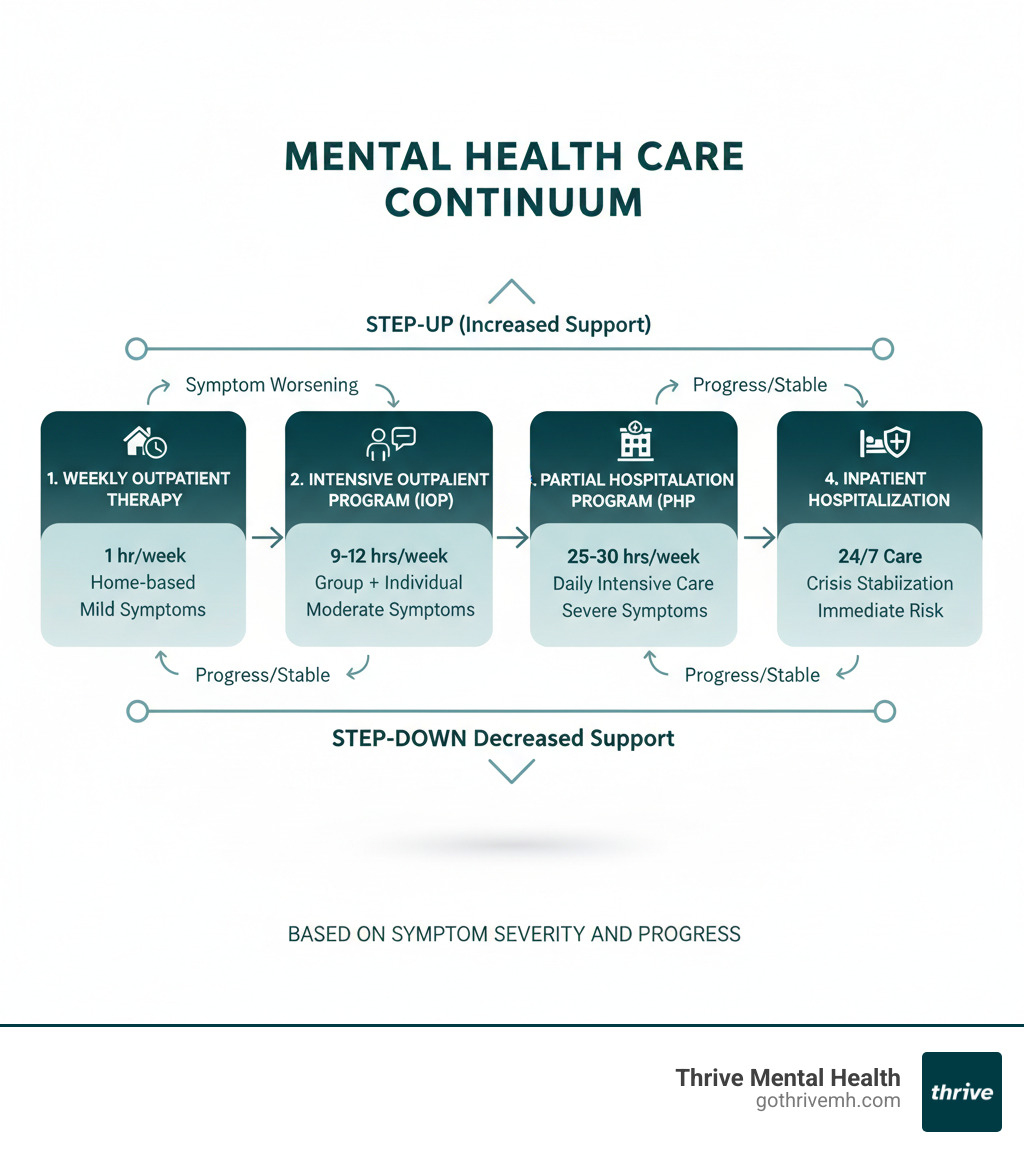
Outpatient psychiatric treatment isn’t one-size-fits-all. It’s a flexible continuum of care designed to match the level of support you need, exactly where you are in your journey. As your needs change, you can “step up” to more intensive care or “step down” to less structured support, ensuring your treatment is always right for you.

Standard Outpatient Programs (OP)
This is the most common form of therapy, involving weekly or bi-weekly sessions with a therapist and perhaps monthly medication check-ins with a psychiatrist. With a time commitment of just one to two hours per week, it’s ideal for individuals with mild to moderate symptoms who have a stable support system and can manage daily responsibilities. OP focuses on building coping skills and processing challenges in one-on-one sessions that fit easily into your existing schedule.
Intensive Outpatient Programs (IOP)
When weekly therapy isn’t enough but 24/7 care isn’t necessary, an Intensive Outpatient Program (IOP) bridges the gap. IOPs offer more structured outpatient psychiatric treatment for those needing extra support, often as a step-down from a higher level of care. You’ll typically attend 9-12 hours of therapy per week, spread across 3-5 days. These programs blend individual counseling with group therapy, which provides a powerful sense of community and shared understanding.
Thrive’s virtual IOP format allows residents across Florida to participate from home, fitting sessions around work or school. For more details, see our Comprehensive Guide to Intensive Outpatient Programs and explore the benefits of Virtual Intensive Outpatient Programs.
Partial Hospitalization Programs (PHP)
A Partial Hospitalization Program (PHP) is the most intensive form of outpatient psychiatric treatment. It provides hospital-level care without the overnight stay, involving 5-6 hours of treatment daily, five days a week. PHPs are designed as a direct alternative to inpatient hospitalization for those with severe symptoms but a safe home environment. They also serve as a critical step-down for individuals transitioning out of inpatient care, offering a structured path back to daily life.
While a PHP may require a temporary leave from work, it allows you to remain in your home and community. Our virtual PHP programs bring this intensive treatment directly to you, making it accessible for individuals across Florida. Learn more in our PHP Mental Health Services guide and compare it to IOP by reading IOP vs. PHP Mental Health: Understanding the Differences.
Core Components and Services of an Outpatient Program
Effective outpatient psychiatric treatment uses a multidisciplinary approach, combining different experts and therapeutic methods to create a comprehensive support system. At Thrive Mental Health, our programs are built on several core services that form the foundation of recovery.
- Psychiatric Evaluation: A thorough assessment with a psychiatrist to understand your history, symptoms, and whether medication may be helpful.
- Individual Therapy: One-on-one sessions with a licensed therapist to develop coping strategies and process thoughts and feelings in a judgment-free space.
- Group Therapy: Facilitated sessions with peers who understand your struggles, breaking down isolation and building a sense of community.
- Family Counseling: When appropriate, sessions to improve communication and build a supportive home environment, a key predictor of success in treatment.
- Medication Management: Ongoing monitoring by a psychiatrist to ensure medications are effective, adjust dosages, and manage side effects.
- Crisis Intervention: Access to support services between sessions to ensure you have help when you need it most.

How Treatment is Custom to Your Needs
Your treatment plan should be as unique as you are. Effective care begins with a comprehensive initial assessment where we listen to your story, challenges, and strengths. From there, we engage in collaborative treatment planning. You are an active participant in setting your goals and shaping your path to recovery. We consider your background, lifestyle, and personal preferences to create a plan that fits your life. As you progress, this plan evolves with you, ensuring your care is always responsive to your current needs.
The Role of Medication Management in Outpatient Psychiatric Treatment
Medication can be a crucial tool in outpatient psychiatric treatment, often working alongside therapy to create the stability needed for deeper therapeutic work. It is not required for everyone. If medication is a good fit, a psychiatrist will conduct a thorough evaluation and provide ongoing medication management. This includes regular check-ins to monitor effectiveness, adjust dosages, and ensure you understand how your medication works. The goal is to find the right balance to support your recovery, not just mask symptoms. Accurate medication history is vital for safety and effectiveness, a principle supported by scientific research.
Evidence-Based Therapies You Can Expect
Our outpatient psychiatric treatment programs are built on evidence-based therapies—approaches backed by science to create real, lasting change. You can expect to engage with a variety of proven methods, including:
- Cognitive Behavioral Therapy (CBT): Identifies and changes negative thought patterns and behaviors.
- Dialectical Behavior Therapy (DBT): Teaches skills in mindfulness, emotion regulation, distress tolerance, and interpersonal effectiveness.
- Eye Movement Desensitization and Reprocessing (EMDR): Helps process traumatic memories to reduce their emotional impact, often used for PTSD.
- Trauma-Focused Therapies: A range of approaches designed to heal from the effects of trauma.
- Acceptance and Commitment Therapy (ACT): Focuses on accepting difficult feelings while committing to actions aligned with your values.
- Exposure and Response Prevention (ERP): A specialized CBT for OCD that gradually reduces anxiety by facing feared situations.
- Mindfulness-Based Stress Reduction (MBSR): Teaches you to stay present and manage anxious or depressive thoughts.
These therapies are integrated into your sessions to provide practical tools for daily life. Learn more in our Evidence-Based IOP Complete Guide.
Who Benefits and What Conditions Are Treated?
Outpatient psychiatric treatment is effective for a wide range of people who are ready to heal but need to continue living their lives. It is ideal for individuals who are navigating significant mental health challenges but do not require 24/7 medical supervision.
You are an excellent candidate for outpatient care if you have a relatively stable home environment and are motivated to actively participate in your recovery. It’s for those who want to get better but can’t put their entire life on hold. Outpatient programs like PHP and IOP also serve as a crucial bridge for those transitioning from inpatient hospitalization, providing structured support while they reintegrate into their daily routines.
Our outpatient psychiatric treatment programs treat a comprehensive range of mental health conditions, including:
- Anxiety Disorders: Generalized anxiety, social anxiety, panic disorder, and agoraphobia.
- Depression: Major depressive disorder and persistent depressive disorder.
- Post-Traumatic Stress Disorder (PTSD): Treated with evidence-based trauma therapies.
- Bipolar Disorder: Managed with a combination of therapy and medication management.
- Obsessive-Compulsive Disorder (OCD): Addressed with specialized approaches like ERP.
- Substance Use Disorders: Integrated addiction treatment and mental health care.
- Eating Disorders: Anorexia, bulimia, binge eating disorder, and others.
- Personality Disorders: Including borderline, avoidant, and narcissistic personality disorder.
- ADHD, Mood Disorders, and Neurodivergence: Support for adults and young professionals.
- Self-Harm Urges and Suicidal Ideation: With appropriate safety planning in place.
- Gender Identity and Dysphoria: Affirming and specialized care.
- Perinatal Mood and Anxiety Disorders: Support for new and expecting parents.
- Psychotic Disorders: For individuals with appropriately stabilized symptoms.
Crisis Support Callout:
If your symptoms feel unmanageable or you are at risk of harming yourself or others, inpatient care may be necessary. If you are in crisis, call or text 988 immediately. You are not alone. Outpatient care is for individuals who are not in an acute crisis.
Practical Considerations: Choosing a Program, Costs, and Insurance
Finding the right outpatient psychiatric treatment program involves practical questions about scheduling, cost, and insurance. Getting clear answers to these questions can provide peace of mind as you take this important step.

How to Choose the Right Outpatient Program
Choosing a program is a personal decision. Look for one that aligns with your needs by considering the following:
- Licensed Professionals: Ensure the program is staffed by experienced, licensed psychiatrists, therapists, and counselors.
- Evidence-Based Practices: Ask about the therapeutic modalities used, such as CBT, DBT, or EMDR, and their effectiveness for your condition.
- Program Specialty: Find a program with expertise in treating your specific challenges, whether it’s trauma, eating disorders, or anxiety.
- Accessibility and Format: Consider whether in-person or virtual sessions work better for your schedule. Our virtual programs, accessible throughout Florida, eliminate commute times and offer flexibility, with evening options available for busy professionals.
- Personalized Care: A thorough initial assessment and a collaborative treatment plan show that a program sees you as an individual, not a case number.
For more guidance, read our article on Key Considerations in Choosing a Mental Healthcare Provider.
Navigating Costs and Insurance for Outpatient Psychiatric Treatment
Financial concerns shouldn’t be a barrier to care. Outpatient psychiatric treatment is significantly more cost-effective than inpatient hospitalization, and most insurance plans provide robust coverage.
We work with most major insurance providers, including Cigna, Optum, and Florida Blue. We recommend contacting your provider to confirm your benefits for OP, IOP, and PHP services. To simplify this, we offer a no-obligation insurance verification service that takes about two minutes.
If you have Medicare Part B, it covers a wide range of outpatient mental health services. After meeting your deductible, you typically pay 20% of the Medicare-approved amount for visits. Your annual depression screening is often covered at no cost.
For those with limited or no insurance, ask about self-pay rates and sliding scale options. Many programs, including ours, offer payment plans to make treatment manageable. The National Alliance on Mental Illness (NAMI) is also a valuable resource for information and advocacy.
Frequently Asked Questions about Outpatient Psychiatric Treatment
It’s natural to have questions when considering outpatient psychiatric treatment. Here are clear, concise answers to some of the most common ones we receive.
What is the main difference between an IOP and a PHP?
The primary difference is intensity and time commitment. An Intensive Outpatient Program (IOP) is a part-time commitment, typically 9-12 hours per week, allowing you to continue with work or school. A Partial Hospitalization Program (PHP) is more like a full-time job, with 25-30 hours of treatment per week. PHP serves as a direct alternative to inpatient care for those needing intensive support.
Can I work or go to school during outpatient treatment?
Yes. Flexibility is a key benefit of outpatient psychiatric treatment. Standard outpatient and IOPs are designed to fit around your schedule, with many programs offering evening and virtual options. Because PHPs are more intensive, they may require a temporary leave from work or school, but this allows you to focus fully on your recovery.
How long does outpatient treatment usually last?
The duration depends on your individual needs and the program. Standard therapy can be ongoing. Structured programs like IOP and PHP are time-limited, typically lasting from a few weeks to a few months (e.g., 9-12 weeks). Your treatment plan will include a clear path for stepping down to less intensive care as you meet your goals.
Is virtual outpatient treatment as effective as in-person?
Yes, research shows that for many people, virtual outpatient psychiatric treatment is just as effective as in-person care. Virtual treatment increases accessibility, eliminates travel, and allows you to receive expert care from the comfort and privacy of your home. The best format depends on your personal needs and preferences, which we can discuss during your assessment.
Take the Next Step Toward Healing
We’ve explored how outpatient psychiatric treatment offers a powerful way to heal without putting your life on hold. It’s flexible, effective, and designed to help you build a life you want to live, with professional support every step of the way. You learn skills in therapy and apply them to your real life, in real time.
At Thrive Mental Health, our virtual and hybrid programs bring expert-led, evidence-based care to you, wherever you are in Florida. We create individualized care plans because your story is unique, and we offer evening options because we know your life is busy.
You don’t have to do this alone. Our team is ready to answer your questions, verify your insurance, and help you take the first step toward feeling better.
Ready for support? Thrive offers virtual and hybrid IOP/PHP with evening options. Verify your insurance in 2 minutes (no obligation) → Start benefits check or call 561-203-6085. If you’re in crisis, call/text 988.