
Somatic Exercises to Improve Your Mental Health: Cut Anxiety and Pain in 10 Minutes a Day 2025

Somatic Exercises to Improve Your Mental Health are gentle, mindful movements that help you reconnect with your body, release stored stress, and calm an overactive nervous system. Unlike traditional workouts, these practices emphasize internal awarenesshow your body feels from the insideto address anxiety, trauma, and chronic tension at their source.
Quick Answer: What You Need to Know
- What they are: Body-centered movements focusing on physical sensations and the mind-body connection.
- How they help: Activate the calming “rest and digest” nervous system, lower cortisol, and release trapped emotions.
- Key benefits: Reduced anxiety, chronic pain relief, trauma processing, and improved emotional regulation.
- Simple examples: Body scans, belly breathing, grounding, gentle stretches, and shaking.
- Who they’re for: Anyone experiencing stress, anxiety, trauma symptoms, or chronic physical tension.
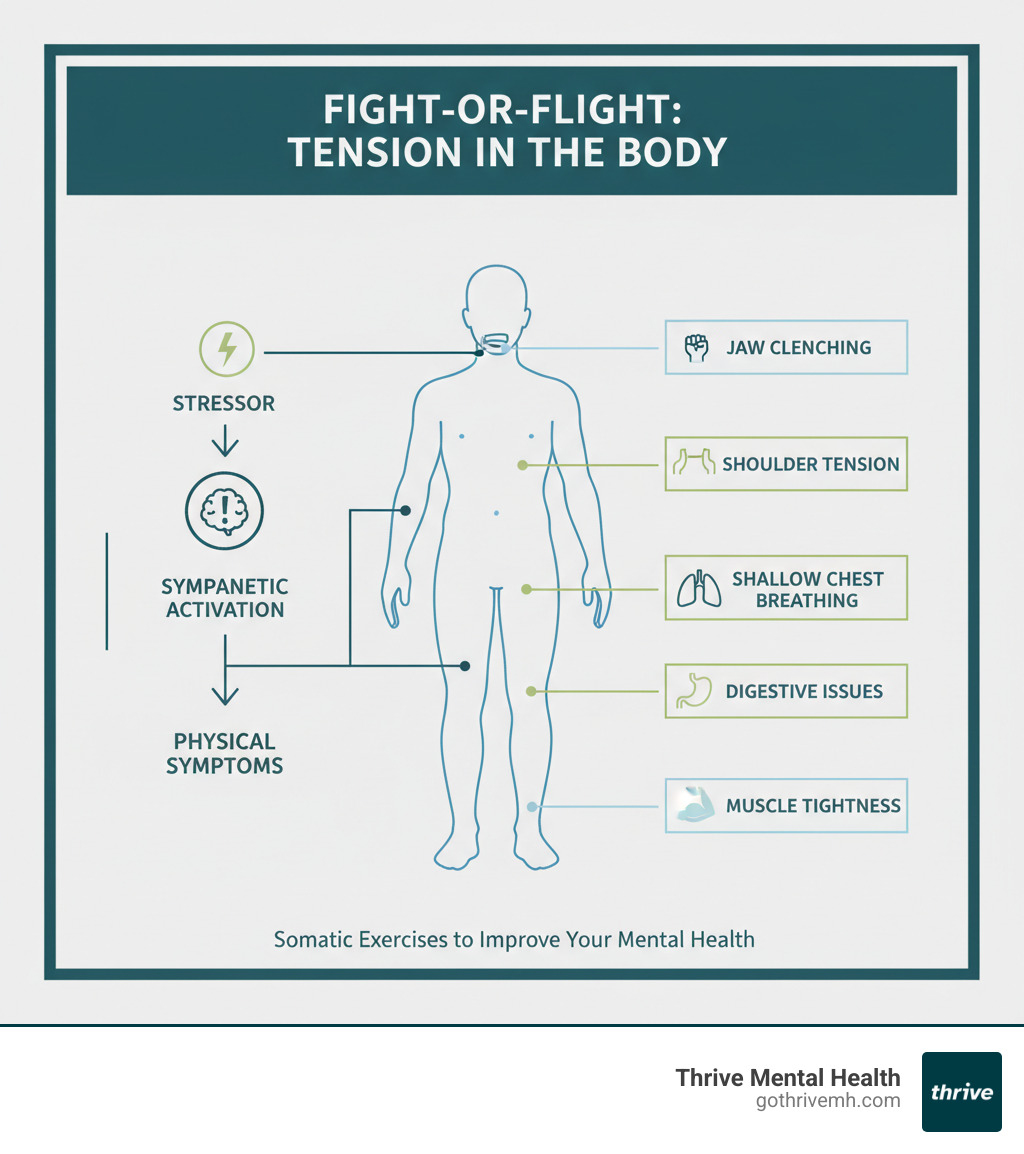
If you’ve ever felt anxiety tighten your chest or noticed your shoulders creeping toward your ears on a stressful day, you’ve experienced how emotions live in the body. Research shows that trauma and chronic stress reshape your nervous system, leaving you stuck in “fight or flight” mode. Somatic exercises work from the bottom up, using gentle movement and breathwork to signal safety to your nervous system. Studies show these practices can significantly reduce pain, slow breathing, lower heart rate, and decrease anxiety.
I’m Anna Green, LMHC, LPC, Chief Clinical Officer at Thrive Mental Health. With specialized training in trauma-informed care, I’ve seen how Somatic Exercises to Improve Your Mental Health empower people to find relief when talk therapy alone isn’t enough. This guide will walk you through the science and techniques you can start using today.
What Are Somatic Exercises? The Science of Mind-Body Healing
The word “somatic” comes from the Greek soma, meaning “the living body as experienced from within.” Coined by Professor Thomas Hanna in 1976, the term describes practices focused on internal physical sensations. When you practice Somatic Exercises to Improve Your Mental Health, you’re not trying to perfect a pose; you’re exploring what your body is telling you—noticing tension, breath, and emotions.
This focus on internal sensation builds the mind-body connection by strengthening your interoception—your ability to sense what’s happening inside your body. This awareness is crucial for mental health, as it helps you recognize how stress gets trapped and what your body needs to feel safe again. By paying attention to these signals, you learn to regulate your nervous system, shifting from a stressed state to a calmer one. Scientific research on the mind-body connection confirms that our mental and physical states are deeply intertwined.
How Somatic Exercises Differ from Traditional Workouts
Traditional workouts often chase external goals like strength or aesthetics. Somatic Exercises to Improve Your Mental Health are about feeling, not achieving. The movements are slow and intentional, giving you time to notice subtle sensations. Instead of pushing through discomfort, you explore it gently.
| Feature | Somatic Exercise | Traditional Gym Workout |
|---|---|---|
| Primary Goal | Internal awareness, tension release, nervous system regulation | Physical fitness, strength, endurance, aesthetics |
| Pace | Slow, mindful, intentional | Often fast, goal-oriented, challenging |
| Focus | How the body feels from the inside (interoception) | How the body looks or performs (external results) |
| Movement Style | Gentle, small, exploring range of motion | Repetitive, high-impact, pushing limits |
| Outcome | Reduced chronic pain, emotional regulation, mind-body connection | Muscle gain, weight loss, improved cardiovascular health |
This gentle approach helps release chronic tension patterns and retrains muscles to find more efficient, pain-free ways to move.
The Role of Neuroplasticity in Somatic Healing
Your brain can change. Neuroplasticity is the brain’s ability to form new neural connections throughout life. Chronic stress creates well-worn brain pathways that keep you in a state of hyper-vigilance. More info about how our brains can change shows we can adapt.
Somatic exercises use neuroplasticity to your advantage. By engaging in mindful movements, you teach your brain new, calmer ways to respond to stress. You’re interrupting old patterns and building new neural pathways that reinforce safety and well-being. Through gentle, repeated practice, you’re not just moving your muscles—you’re rewiring your brain’s response to stress, creating a more regulated and resilient nervous system.
The Mental and Physical Benefits of a Somatic Practice
When we begin working with Somatic Exercises to Improve Your Mental Health, we start to feel more at home in our own skin. The beauty of somatic work is how it addresses both mind and body simultaneously, creating lasting change by working with your nervous system, not against it.
Stress reduction is often the first benefit. As you tune into physical sensations, the cycle of worry and tension is interrupted, leading to anxiety relief. With less tension, emotional regulation becomes more accessible, and many people report an improved mood.
The physical benefits are equally profound. Chronic pain relief emerges as the body lets go of old muscle contractions. Better posture and increased flexibility develop naturally as tension is released.
How Somatic Exercises Help Manage Anxiety and Stress
Anxiety isn’t just in your thoughts—it’s in your body. When anxiety strikes, your sympathetic nervous system kicks into high gear. Somatic Exercises to Improve Your Mental Health offer a direct path out of this cycle by activating the parasympathetic nervous system—your body’s “rest and digest” mode. This is about sending your body physical signals that it’s safe to stand down.
Science backs this up. Research on breathwork for relaxation shows that intentional breathing can reduce anxiety and improve mood. When we engage in somatic movements, we’re physiologically lowering cortisol levels and calming the nervous system, addressing the root of the anxiety response.
If anxiety has been running your life, you don’t have to face it alone. Our virtual programs for Florida residents integrate somatic approaches with evidence-based therapy. Learn about our virtual programs for Anxiety Disorders to see how we can help.
Finding Relief from Chronic Pain and Physical Tension
Many of us carry tension we don’t even notice—in our jaws, shoulders, or lower back. Thomas Hanna called this sensory motor amnesia: a state where the brain loses conscious control over certain muscles, leaving them chronically contracted. This leads to persistent neck and back pain and stiffness.
Somatic exercises retrain the nervous system to release this tension. Through gentle, slow movements and focused attention, we regain conscious control over muscles that have been locked for years.
The results can be remarkable. A 2020 review on somatic pain relief found that people with chronic pain who practiced somatic movement regularly experienced an 86% decrease in pain days over one year. Research also shows significant improvements in mobility, balance, and flexibility, allowing people to move through their days with greater ease and comfort.
Somatic Exercises for Trauma Recovery and Emotional Regulation

When we experience trauma, the impact settles into our bodies as chronic tension, shallow breathing, or a constant feeling of being on edge. This is what we mean when we say trauma is stored in the body. While traditional talk therapy works from the “top-down” (thoughts first), it doesn’t always reach the physiological imprint of trauma.
Somatic Exercises to Improve Your Mental Health use bottom-up processing, starting with your body’s sensations to release what’s been held. This approach is highly effective for managing PTSD symptoms and building emotional regulation. Core techniques include:
- Titration: Working with small, manageable doses of discomfort before returning to a calm state.
- Pendulation: Gently moving your attention between feelings of discomfort and feelings of safety.
- Resourcing: Anchoring yourself in positive memories or calming sensations to create a feeling of safety.
These techniques help you create a sense of safety within your own body—something trauma often takes away.
Safely Processing Trauma with Somatic Techniques
Somatic Experiencing, developed by Dr. Peter Levine, is a respected approach to trauma healing. Levine noted that animals in the wild shake off traumatic experiences to discharge survival energy. Humans often suppress this natural response, trapping that energy and leading to nervous system dysregulation.
Somatic Experiencing guides you to mindfully notice body sensations, allowing your body to complete these interrupted survival responses and release stored energy. The pace is always controlled and safe to avoid re-traumatization. This bottom-up approach helps you regain a sense of calm by changing the physiological experience of trauma. If you’re working through trauma, explore our guide on Understanding Post-Traumatic Event Symptoms.
A Practical Guide to Somatic Exercises to Improve Your Mental Health at Home
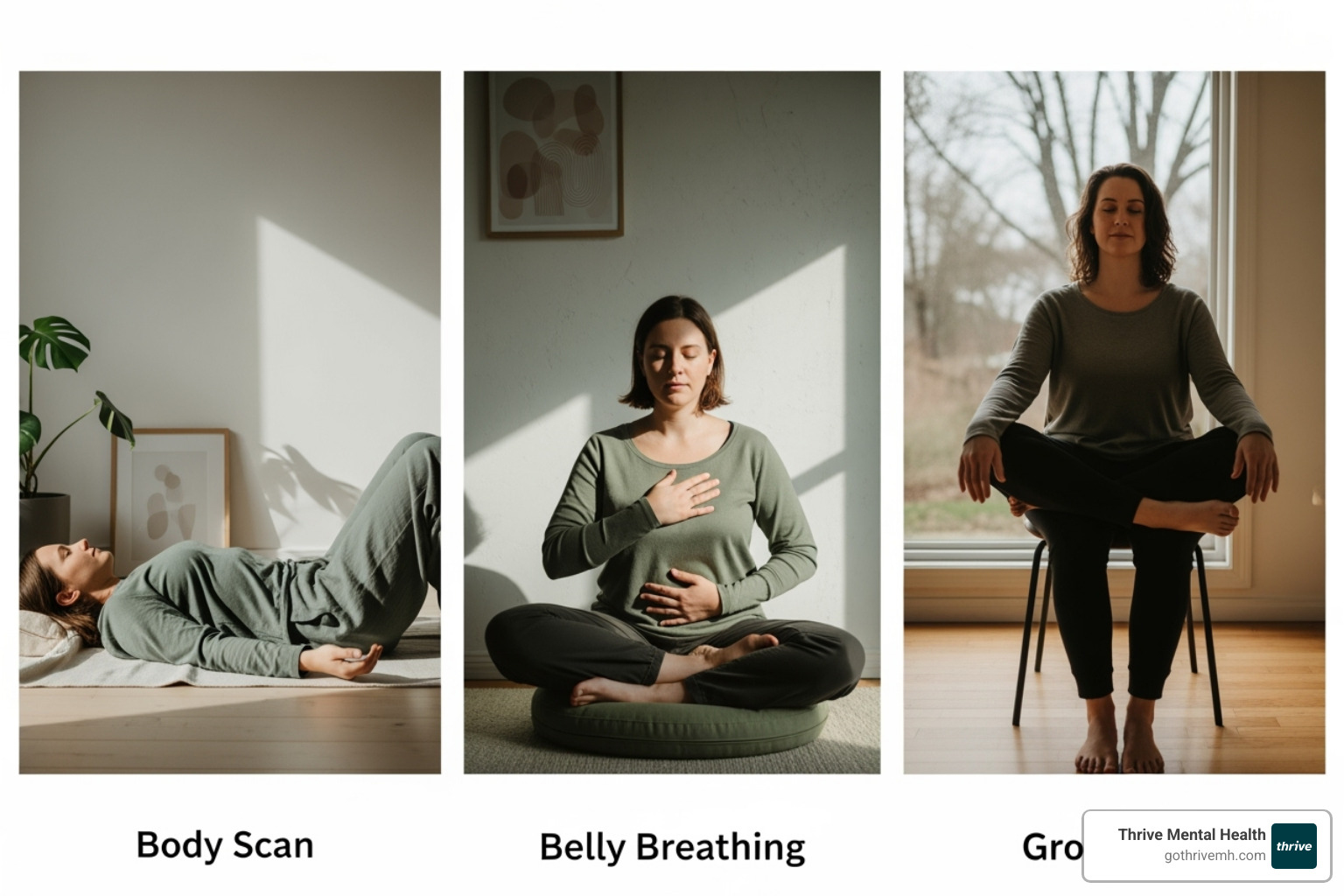
You don’t need special equipment, just your body, your breath, and a willingness to listen. Find a safe, quiet space and give yourself permission to move slowly and without judgment. Here are five simple exercises to try today:
1. Body Scan Meditation
The body scan is a foundational Somatic Exercise to Improve Your Mental Health that teaches you to feel what’s happening inside your body. It brings you back home to yourself by building internal awareness—noticing sensations like tightness or softness without judgment. This observation creates space for your body to naturally release tension.
How to do it:
- Lie down or sit comfortably. Close your eyes if it feels safe.
- Bring your attention to your feet. Notice any sensations—warmth, coolness, tingling—without trying to change anything.
- Slowly move your attention up through your body: ankles, legs, hips, abdomen, chest, back, hands, arms, and shoulders.
- Continue to your neck, jaw, face, and the crown of your head.
- If you find a tense spot, imagine breathing into that space, bringing softness with each inhale and releasing tension with each exhale.
- After scanning your whole body, take a moment to notice how you feel overall. Has anything shifted?
This practice can take 5-15 minutes. Even a two-minute scan can interrupt the stress cycle. If you’d like support, you can watch a guided Body Scan as you’re learning.
2. Diaphragmatic (Belly) Breathing
When we’re stressed, our breathing becomes shallow and rapid. Diaphragmatic breathing reverses this by engaging the diaphragm, a large muscle below your lungs. This simple shift activates the vagus nerve, which sends a calming signal to your brain and engages the parasympathetic nervous system. It’s a powerful tool you can use anywhere to slow your heart rate and lower cortisol levels.
How to do it:
- Lie on your back or sit upright. Place one hand on your chest and the other on your belly.
- Inhale slowly through your nose, directing the breath down so your belly rises. The hand on your chest should stay relatively still.
- Exhale slowly through your mouth or nose. Try to make your exhale slightly longer than your inhale to deepen the calming effect.
- Continue for 5-10 minutes, focusing on the gentle rise and fall of your belly. If your mind wanders, gently guide it back to your breath.
For a deeper dive, you can watch a Conscious Breathing exercise that guides you through the process.
3. Grounding Through the Feet
When you feel anxious or disconnected, grounding helps you reconnect to the present moment by focusing on physical sensation. This simple Somatic Exercise to Improve Your Mental Health can be done anywhere, anytime, to shift your nervous system toward calm.
How to do it:
- Stand or sit with your feet flat on the floor. If possible, take off your shoes.
- Bring all your attention to the soles of your feet. Notice the contact with the ground—the texture, temperature, and pressure.
- Gently press your feet into the floor, feeling the stability of the earth supporting you. Imagine roots growing from your feet, anchoring you.
- Notice how your weight is distributed. Take a few slow breaths, and with each exhale, imagine settling more deeply into the ground.
This practice is especially helpful when you feel overwhelmed or caught in anxious thoughts, bringing you back into your body and the present moment. To improve your practice, Watch a Grounding Your Weight exercise.
4. Gentle Spinal Mobilization (Arch and Flatten)
Hours spent at a desk can lead to significant spinal tension. This gentle exercise helps release that stiffness by mobilizing your spine and pelvis in sync with your breath. It’s not about how far you can move, but about bringing mindful awareness to the subtle movements of your spine.
How to do it:
- Lie on your back with your knees bent and feet flat on the floor, hip-width apart. Rest your arms at your sides.
- As you inhale, gently arch your lower back, creating a small space between your back and the floor. Your pelvis will tilt slightly forward.
- As you exhale, gently flatten your lower back against the floor, engaging your abdominal muscles. Your pelvis will tilt slightly backward.
- Continue this gentle “arch and flatten” rhythm, letting your breath guide the movement. Keep the motions small, slow, and smooth.
- Repeat 5-10 times, paying attention to how your spine becomes more fluid with each repetition.
For a visual guide, you can watch a Freeing the Spine exercise that demonstrates the mindful quality of these movements.
5. The “Shake It Out” Release
Animals in the wild instinctively shake their bodies to release stress after a tense encounter. This is a natural trauma-release mechanism that Somatic Exercises to Improve Your Mental Health help us access. When we experience stress or fear, our bodies flood with adrenaline. Shaking helps discharge this pent-up nervous energy, allowing your body to complete the stress cycle.
How to do it:
- Stand with your feet hip-width apart and knees slightly bent. Let your arms hang loosely.
- Start with small, gentle shakes in your feet and ankles. Let the vibration travel up through your legs, hips, torso, and arms.
- Let your jaw be loose. You can shake vigorously or gently—do what feels right for your body. Allow any sounds like sighs or groans to emerge.
- Continue for one to three minutes. When you’re ready, slowly come to a stop.
- Stand quietly for a moment and notice the sensations in your body. You might feel a pleasant tingling, warmth, or a sense of calm. This is your nervous system recalibrating.
This exercise is great for releasing the day’s tension or whenever you feel jittery from anxiety.
When to Seek Professional Guidance and How to Access Care
While at-home Somatic Exercises to Improve Your Mental Health are powerful, professional support is essential if you experience overwhelming emotions, have a history of severe trauma, or find yourself frequently dissociating (feeling detached from your body or reality). A trained therapist provides a safe container to explore difficult sensations without becoming re-traumatized.
Specialized modalities like Somatic Experiencing and Sensorimotor Psychotherapy integrate body-centered interventions with talk therapy to address the physiological impact of trauma. To learn more about different approaches, you can read our guide Comparing Somatic Therapy vs. EMDR.
Finding a Somatic-Informed Program
When seeking support, look for therapists with credentials like Somatic Experiencing Practitioner (SEP) or certification in Sensorimotor Psychotherapy. These professionals are trained to work safely with the nervous system.
At Thrive Mental Health, we integrate somatic techniques into our evidence-based programs for Florida residents. Our virtual and hybrid formats allow you to access expert care from home, making it easier to tune into your body. We invite you to explore our Virtual Intensive Outpatient Programs and Partial Hospitalization (PHP), or get started with Virtual Therapy. We also serve clients in Indiana, California, Arizona, and South Carolina.
Insurance Coverage for Mental Health Care
Navigating insurance can feel daunting, but we’re here to simplify it. Many major insurance providers, including Cigna, Optum, Florida Blue, Aetna, and UnitedHealthcare, cover intensive outpatient and partial hospitalization programs. Your specific plan will determine your out-of-pocket costs.
Our team has streamlined the benefits verification process. You can check your insurance coverage for our programs in just a few minutes—no obligation. Our virtual programs are fully available to residents throughout Florida, ensuring you can access care from anywhere in the state. Don’t let uncertainty about insurance stop you from getting the support you deserve. Call us at 561-203-6085 to discuss your options.
Frequently Asked Questions about Somatic Exercises
It’s natural to have questions before starting a new practice. Here are answers to common “People Also Ask” questions about Somatic Exercises to Improve Your Mental Health.
How often should I do somatic exercises?
510 minutes daily is enough to start. Consistency beats duration.
Can somatic exercises make me feel worse at first?
Sometimes. New body awareness can surface discomfort. Go slowly; if overwhelmed, work with a trained somatic therapist.
Is yoga a somatic exercise?
Yeswhen the focus is internal sensation and breath (e.g., gentle or restorative yoga), not performance.
How long until I notice results?
Many people feel calmer after one session; steady practice for 23 weeks builds lasting regulation.
Can I use somatic exercises during a panic attack?
Yes. Try grounding through the feet and slow belly breathing with longer exhales.
Suggested FAQ schema (JSON-LD)
{
“@context”: “https://schema.org”,
“@type”: “FAQPage”,
“mainEntity”: [
{
“@type”: “Question”,
“name”: “How often should I do somatic exercises?”,
“acceptedAnswer”: {“@type”: “Answer”, “text”: “Practice 5–10 minutes daily. Consistency beats length.”}
},
{
“@type”: “Question”,
“name”: “Can somatic exercises make me feel worse at first?”,
“acceptedAnswer”: {“@type”: “Answer”, “text”: “Yes, sometimes. Move slowly and seek a somatic therapist if feelings become overwhelming.”}
},
{
“@type”: “Question”,
“name”: “Is yoga a somatic exercise?”,
“acceptedAnswer”: {“@type”: “Answer”, “text”: “It can be if the focus is internal awareness and breath, not performance.”}
},
{
“@type”: “Question”,
“name”: “How long until I notice results?”,
“acceptedAnswer”: {“@type”: “Answer”, “text”: “Many feel relief immediately; 2–3 weeks of practice improves regulation.”}
},
{
“@type”: “Question”,
“name”: “Can I use somatic exercises during a panic attack?”,
“acceptedAnswer”: {“@type”: “Answer”, “text”: “Yes. Ground through your feet and use slow belly breaths with longer exhales.”}
}
]
}
Start Your Journey to Mind-Body Wellness Today
We hope this guide has illuminated the power of Somatic Exercises to Improve Your Mental Health. By integrating these mindful practices into your life, you can begin a journey of profound healing, cultivating body awareness and releasing stored tension to find a more peaceful existence.
At Thrive Mental Health, we are dedicated to supporting your journey. Our programs integrate somatic work with other evidence-based modalities like experiential and art therapy to provide holistic care.
Ready for support? Thrive offers virtual and hybrid IOP/PHP with evening options for residents of Florida. Verify your insurance in 2 minutes (no obligation) with our Start benefits check or call 561-203-6085. If you’re in crisis, call/text 988.