
Feeling Stressed? Let Your Body Lead the Way with Somatic Therapy

Somatic Therapy for Stress [2025]: Fast Relief You Can Feel in 1–15 Sessions
Tight jaw. Knotted shoulders. Exhausted but can’t switch off. If that’s you, somatic therapy for stress targets where stress actually lives—your body—so you can feel calm fast.
Quick takeaway: Somatic therapy for stress resets your nervous system so you sleep better, think clearer, and feel lighter—often in weeks, not months. Ignore it and stress compounds into headaches, burnout, and insomnia. Act now and you get control back.
Quick Answer: What Is Somatic Therapy for Stress?
- What it is: A body-first therapy using sensation, breath, and gentle movement to release stored stress.
- How it works: Completes the fight/flight/freeze cycle and resets your nervous system.
- Who it helps: Chronic stress, anxiety, PTSD, burnout, tension, and stress-linked pain.
- Key techniques: Grounding, breathwork, body scans, and micro-movements you can do anywhere.
- Results: Many feel relief in 1–15 sessions; studies show up to 90% improvement in PTSD symptoms.
Nearly 32% of U.S. adults report anxiety. It’s not “just in your head.” Your racing heart and clenched jaw are the stress. Somatic therapy works where it starts.
Somatic therapy flips the script: stop overthinking, start releasing. No need to relive trauma—you’ll track sensations, breathe, and let the body finish what stress started.
I’m Nate Raine, CEO of Thrive Mental Health. Here in Florida, we integrate somatic therapy for stress into our evidence-based IOP/PHP because it helps people finally get unstuck when talk therapy isn’t enough.
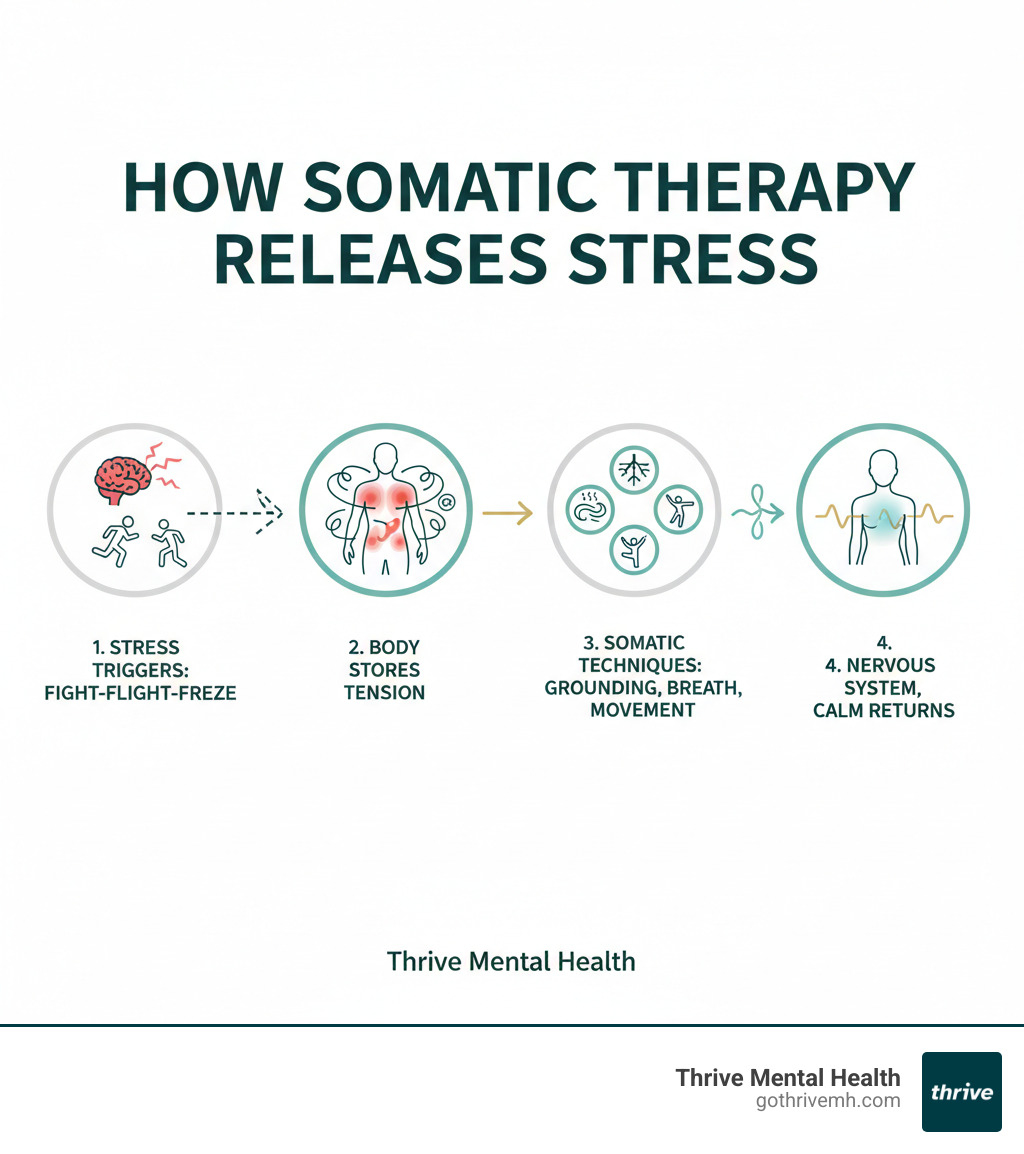
Somatic therapy for stress further reading:
What Is Somatic Therapy for Stress? [How It Works & Why It’s Different]
Stress isn’t just in your head—it’s physical. That knot in your stomach, the tension in your shoulders, the exhaustion that sleep won’t fix? That’s where stress actually lives. The word “soma” means “body,” and somatic therapy for stress works directly with these physical signals that talk therapy can miss.
Traditional talk therapy uses a “top-down” approach, working from your thoughts to influence your body. Somatic therapy is a “bottom-up” approach. Instead of trying to think your way out of stress, you start with your body to regulate your nervous system directly. You learn to listen to what your body is telling you and help it release what’s been held captive.
If you’ve ever thought, “I understand my stress, so why do I still feel this way?” it’s often a sign your body is holding onto something your mind has already processed. Somatic therapy helps your body catch up. For a deeper dive, Harvard Health offers a great overview: What is somatic therapy?
Somatic Therapy vs. Talk Therapy: What’s the Real Difference?
- Talk Therapy: Focuses on your thoughts, feelings, and experiences through verbal communication. It’s a “top-down” approach that engages your cognitive mind.
- Somatic Therapy: Focuses on your physical sensations, movements, and bodily responses. It’s a “bottom-up” approach that works from your body up to your thoughts and emotions.
At Thrive Mental Health, we find that combining these approaches offers the most complete healing, especially for those who feel “stuck.”
Core Principles: How Your Body Tells Its Story
Somatic therapy is guided by practical principles that help you work with your body’s natural wisdom:
- Interoception: Your ability to notice what’s happening inside your body, like your heart rate or muscle tension. Somatic therapy helps you tune into these signals.
- Self-regulation: Learning to calm your own nervous system with tools you can use anywhere, anytime.
- Titration and Pendulation: Processing difficult sensations in small, manageable doses (titration) while gently moving between feelings of comfort and discomfort (pendulation) to prevent overwhelm.
- Resourcing: Identifying and drawing on sources of strength, safety, and calm—like a positive memory or the feeling of your feet on the ground.
- Releasing Trapped Energy: The ultimate goal. When your body’s fight, flight, or freeze response is interrupted, the energy gets stuck. Somatic therapy helps you gently discharge this energy, allowing your nervous system to finally reset.
How Your Body Stores Stress (and How Somatic Therapy Releases It)
When you face a threat, your nervous system launches into survival mode: fight, flight, or freeze. Your body floods with stress hormones and tenses for action. When the danger passes, your body is designed to shake, breathe deeply, and complete the stress cycle.
But in modern life, we often can’t complete that cycle. You can’t run from a stressful meeting or fight off an overwhelming email. That survival energy gets stuck, and your nervous system never gets the signal that the danger has passed.
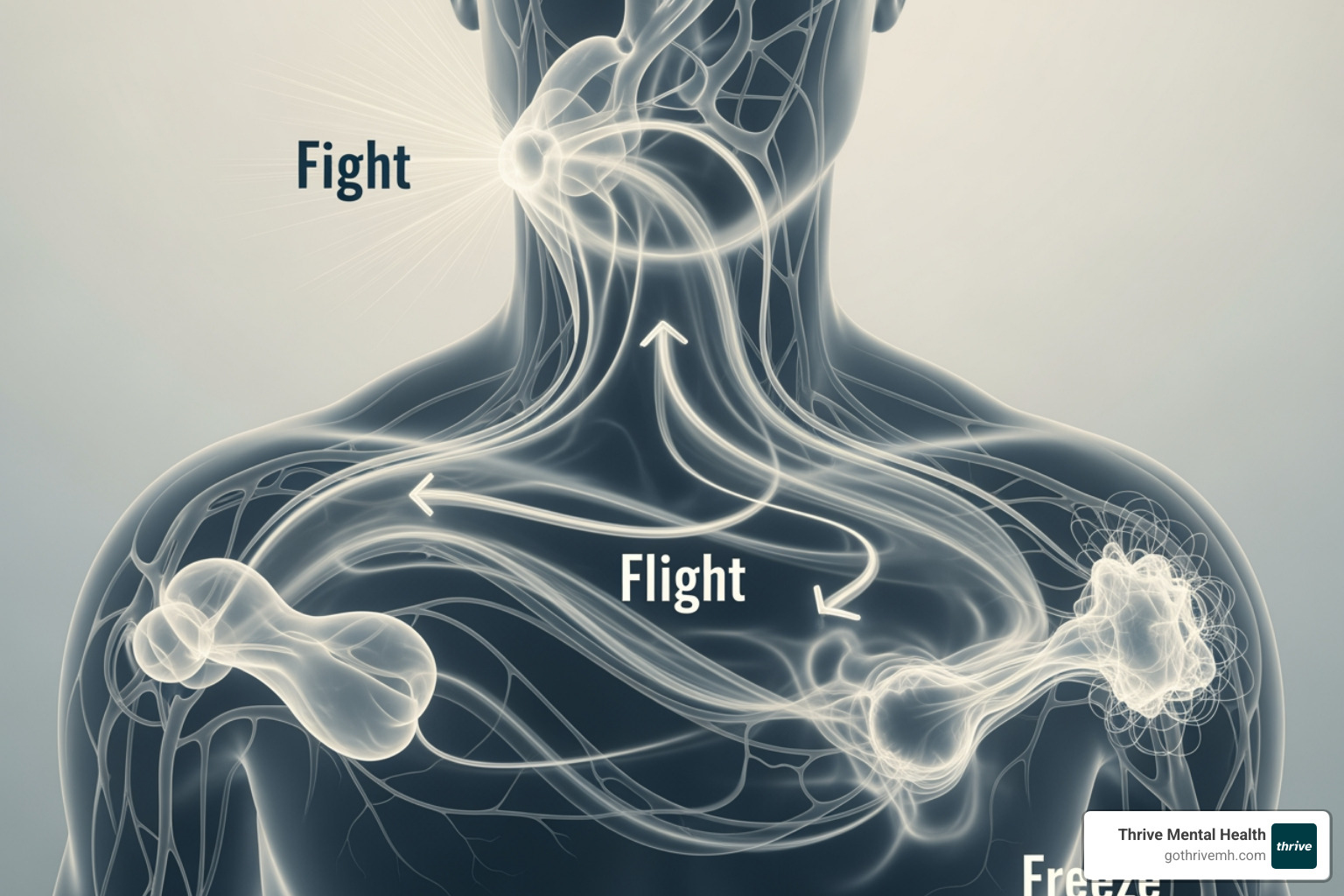
The nervous system’s fight, flight, and freeze responses to stress, addressed by Thrive’s somatic therapy.
This is why chronic stress hurts. The tension in your shoulders, the headaches, the stomach problems—they are your body holding onto unfinished stress responses. Somatic therapy for stress is life-changing because it helps your body release the stress it’s been carrying. We guide you to safely discharge that trapped energy, allowing your nervous system to finally reset.
What Techniques Are Used in Somatic Therapy for Stress?
At Thrive, we use a toolkit of evidence-based somatic techniques in our IOP and PHP programs. These are practical tools for releasing physical tension and reconnecting with your body safely.
- Grounding: Anchors you in the present moment when you feel disconnected. Feeling your feet on the floor is a simple way to ground yourself.
- Breathwork: Directly shifts your nervous system. Changing your breath pattern can tell your body to calm down.
- Movement: Releases stored stress through gentle, intentional motion like stretching or mindful walking.
- Self-touch: Sends powerful signals of safety to your nervous system, like placing a hand over your heart.
- Body Scan: A mindfulness practice of bringing non-judgmental awareness to different parts of your body to notice where stress is held.
- Visualization: Uses imagery, like picturing a safe place, to shift your internal state and calm your body.
Try These Somatic Exercises for Stress Relief—Right Now
- Grounding (5-4-3-2-1): Notice 5 things you can see, 4 things you can touch, 3 sounds you can hear, 2 things you can smell, and 1 thing you can taste. This pulls you out of anxiety and into the present.
- Box Breathing: Inhale for 4 counts, hold for 4, exhale for 4, and hold for 4. Repeat 3-6 times to quickly calm your body.
- Butterfly Hug: Cross your arms over your chest, hands on opposite shoulders. Gently tap your hands alternately in a slow, rhythmic pattern for a few minutes while breathing slowly.
- Body Scan: Sit or lie down comfortably. Slowly bring your attention from your feet up to your head, noticing any sensations without judgment. Breathe into areas of tension and imagine releasing it on the exhale. For a guided experience, try this Guided Body Scan Meditation.
Types of Somatic Therapy at Thrive: What’s Right for You?
At Thrive Mental Health, we know healing isn’t one-size-fits-all. Our IOP and PHP programs draw from multiple evidence-based somatic approaches, custom to your needs and integrated with trauma-informed care.
All approaches share the same goal: helping your body process and release what talk therapy alone can’t reach. Here are a few we use:
| Approach | Focus | Best For |
|---|---|---|
| Somatic Experiencing | Releasing stored survival energy from trauma by tracking bodily sensations. | PTSD, chronic anxiety, unresolved trauma. |
| Sensorimotor Techniques | Integrating body awareness with thoughts and emotions through mindful movement. | Complex trauma, dissociation, chronic stress. |
| Mindful Movement | Using gentle, body-based exercises (like yoga) to regulate the nervous system. | General stress, burnout, disconnection from the body. |
Our Florida-based therapists are trained in multiple modalities, so you get the right care for you. We offer virtual and hybrid IOP/PHP programs across the state, making specialized care accessible from anywhere in Florida.
What Conditions Can Somatic Therapy Help?
Because it addresses the mind-body connection, somatic therapy for stress is effective for a wide range of conditions:
- PTSD
- Anxiety and panic attacks
- Depression
- Chronic pain and physical tension
- Grief and loss
- Addiction and recovery
- Co-occurring disorders
What Does the Science Say? [Somatic Therapy Evidence]
The evidence supporting somatic therapy for stress is growing rapidly, and the results are compelling.
- A study on tsunami survivors using Somatic Experiencing found that 90% of participants had significant improvement or were completely free of PTSD symptoms.
- A 2021 review showed that Somatic Experiencing effectively reduced trauma symptoms, with participants showing significant improvements in just 1 to 15 sessions.
- A systematic review concluded that body-oriented therapies show a beneficial correlation with improving PTSD symptoms.
These findings align with what we see daily at Thrive: working with the body is a powerful, effective path to healing. You can read more here: Somatic experiencing for posttraumatic stress disorder: a randomized controlled outcome study.
How to Start Somatic Therapy for Stress in Florida
If you’re ready to feel relief, the first step is finding a licensed, trauma-informed therapist. At Thrive Mental Health, our team is trained in both somatic and evidence-based therapies to help you release stress where it lives.

Virtual somatic therapy for stress with Thrive Mental Health.
We make care accessible across Florida with virtual and hybrid IOP/PHP programs that include evening options. You can get expert help from the comfort of your home, anywhere in the state. Our programs are covered by Cigna, Optum, Florida Blue, and other major insurance plans.
Ready to see what’s covered? Verify your insurance in 2 minutes or call us at 561-203-6085.
What to Look for in a Somatic Therapist
- Specific Training: Look for certification in modalities like Somatic Experiencing or Sensorimotor Psychotherapy.
- Trauma-Informed Experience: Ensure they understand how to work with the nervous system safely.
- Clear Boundaries & Consent: A good therapist always asks for permission and respects your comfort level.
- Ask Them: “How do you use somatic therapy for stress in your sessions?” Their answer will tell you if they’re a good fit.
Benefits of Somatic Therapy for Stress
When you work with your body, you can expect:
- Fast Relief from Physical Symptoms: Less tension, fewer headaches, and better sleep, often within a few sessions.
- Better Emotional Control: The ability to respond calmly to stress instead of reacting.
- A Stronger Mind-Body Connection: You’ll learn to recognize stress signals before they become overwhelming.
- More Resilience to Future Stress: Your nervous system learns to handle challenges and bounce back faster.
- Deeper Self-Awareness: You’ll understand your triggers, patterns, and strengths on a whole new level.
Keep building your inner strength with our guide on How to Build Emotional Resilience.
FAQs: Somatic Therapy for Stress
Is somatic therapy legit?
Yes. It’s an evidence-based approach used by licensed clinicians. At Thrive, care is delivered by trained therapists and often covered by Cigna, Optum, Florida Blue, and other major plans.
How fast does it work?
Many people feel less tension and better sleep within a few sessions. For trauma-related stress, research shows significant gains in 1–15 sessions.
Can I do somatic therapy on my own?
You can use grounding and box breathing daily. For deeper stress or trauma, work with a trained therapist to stay safe and avoid overwhelm.
Do you offer virtual somatic therapy?
Yes. Thrive offers virtual and hybrid IOP/PHP with integrated somatic therapy across Florida, making it easy to get help from anywhere in the state.
How do I check insurance and get started?
It’s quick and no-pressure. Verify your insurance in about 2 minutes or call 561-203-6085 to talk with our team.
If you’re in crisis right now, don’t wait—call or text 988. The 988 Suicide and Crisis Lifeline is available 24/7, and you deserve immediate support.
Conclusion: Don’t Let Stress Control Your Life—Take Action Now
Group therapy for stress relief at Thrive Mental Health.
Ignoring stress doesn’t make it go away. It burrows deeper into your body, showing up as tension, exhaustion, and anxiety. Your body is keeping score, and it’s time to listen.
Somatic therapy for stress offers a way out by working directly with your nervous system to release what’s stuck. It’s about finishing the stress cycles that have kept you in survival mode for weeks, months, or even years.
At Thrive Mental Health, our virtual and hybrid IOP/PHP programs are built to deliver real, lasting relief. We integrate somatic techniques with evidence-based therapy, offering flexible scheduling and expert care across Florida. We work with major insurance providers like Cigna, Optum, and Florida Blue to make this life-changing care accessible.
You don’t have to stay stuck. A path forward is waiting.
Ready for support? Thrive offers virtual and hybrid IOP/PHP programs with evening options. Verify your insurance in 2 minutes (no obligation) → Start benefits check or call 561-203-6085. If you’re in crisis, call/text 988.