
Breaking Free: How Substance Abuse IOP Can Help

Substance Abuse IOP: Breakthrough Recovery 2025
Take Control—Flexible Recovery That Fits Your Real Life
If you’re looking into substance abuse IOP, here’s what you need to know right away:
What is Substance Abuse IOP?
- Intensive Outpatient Program (IOP) is a structured treatment for substance use disorders that offers 9+ hours of therapy per week.
- You attend therapy several days a week but live at home and maintain work, school, or family responsibilities.
- IOPs use evidence-based therapies like CBT and DBT, plus group support and family involvement.
- As effective as inpatient treatment for most people—research shows 50–70% report abstinence at follow-up.
- More affordable than residential care and covered by most major insurance plans.
- Ideal if you need more than weekly therapy but don’t require 24/7 medical supervision.
Millions of people are stuck in a painful middle ground: weekly therapy isn’t enough to break free from substance use, but taking weeks away from work, school, or family for inpatient treatment feels impossible. You want recovery—but you also need to keep your life moving forward.
That’s exactly what substance abuse IOP was designed for.
Intensive Outpatient Programs provide the structure, support, and evidence-based treatment you need to recover—without putting your entire life on pause. You get multiple therapy sessions each week, learn real coping skills, and practice them in your actual daily environment. You’re not isolated in a facility; you’re building a sustainable recovery while still showing up for the people and responsibilities that matter.
Research shows that IOPs are as effective as inpatient treatment for most individuals. With virtual options now widely available, you can access high-quality care from home—no commute, no waitlist, and often with evening sessions that fit around your schedule.
I’m Anna Green, LMHC, LPC, Chief Clinical Officer and founder of Thrive Mental Health. I’ve spent my career designing and leading substance abuse IOP programs that prioritize access and outcomes, helping people recover without sacrificing their daily lives.
What is a Substance Abuse IOP?
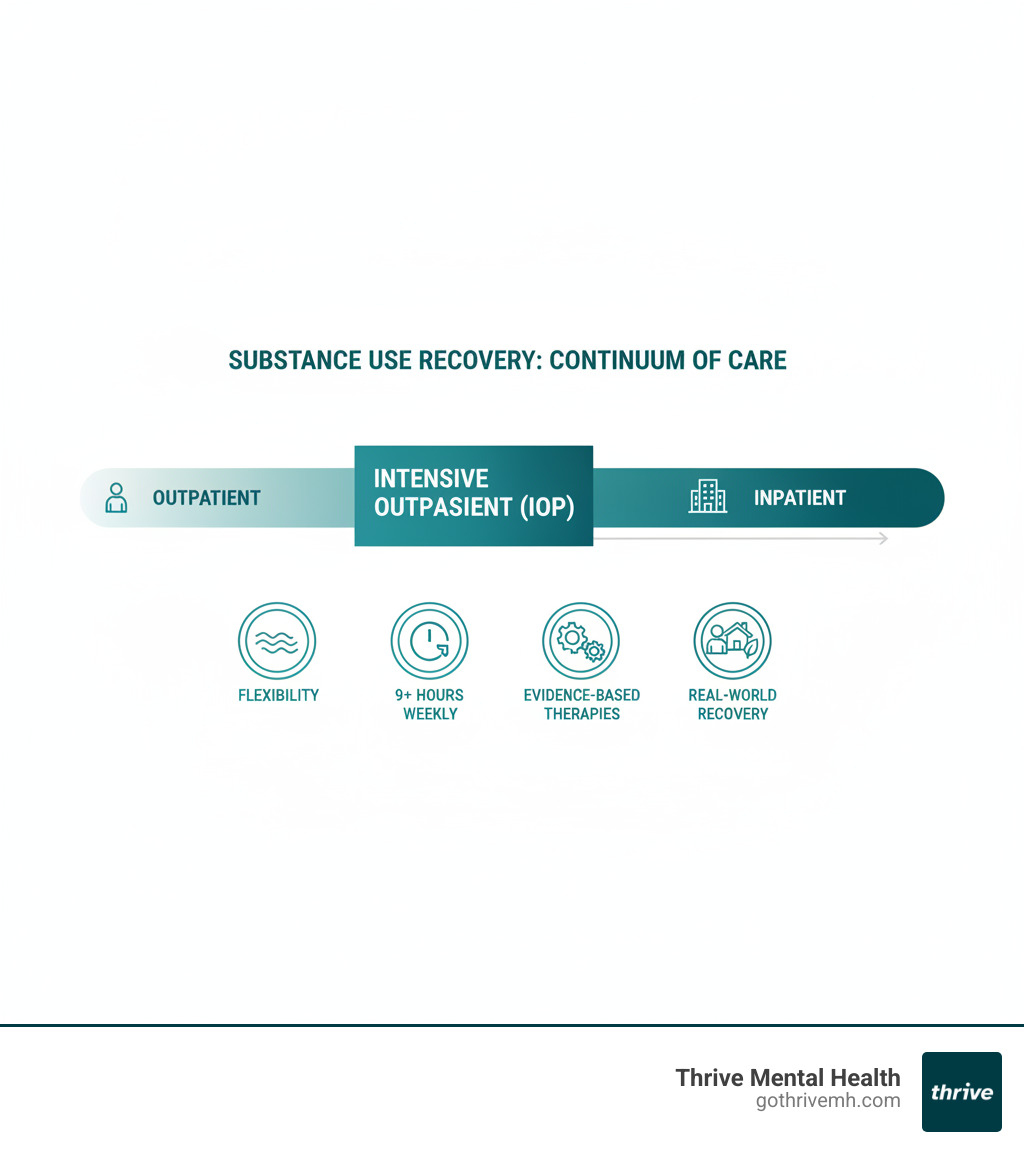
A substance abuse IOP is a structured treatment program for those who need more than weekly therapy but don’t require 24/7 residential care. You commit to 9 or more hours of therapy each week—typically spread across 3 to 5 days—while living at home, keeping your job, and caring for your family.
This approach allows you to learn new skills on Monday and apply them at work on Tuesday. Recovery happens in the context of your real life.
Classified as Level 2.1 care by the American Society of Addiction Medicine (ASAM), IOPs occupy a critical middle ground between standard weekly therapy and residential treatment. They are intensive enough to create real change, yet flexible enough to fit real life.
| Feature | Intensive Outpatient Program (IOP) | Traditional Outpatient Therapy |
|---|---|---|
| Time Commitment | Typically 9-12+ hours per week (3-5 days) | 1-2 hours per week (1-2 sessions) |
| Structure & Intensity | Highly structured, multiple group and individual sessions, psychoeducation | Less structured, primarily individual therapy, less frequent |
| Cost | More affordable than inpatient, often covered by insurance | Generally lower per session, but total cost can vary based on duration; often covered by insurance |
| Ideal Fit | Needs significant support but lives at home; stable environment; stepping down from higher care | Early stages of substance use; strong support system; needs less intensive intervention; long-term maintenance after IOP/PHP |
| Crisis Support | Often includes crisis intervention and 24/7 support lines | Typically limited to scheduled sessions; crisis support usually external |
| Living Situation | Lives at home, maintains daily routine | Lives at home, maintains daily routine |
| Medical Supervision | No 24/7 medical supervision required; no on-site medical detox | No medical supervision; no on-site medical detox |
How IOP Stands Out from Other Outpatient Options
Unlike residential treatment, in a substance abuse IOP, you go home every day. This isn’t a limitation; it’s a strength. You immediately get to practice coping skills in the real world, facing triggers with new tools and support.
IOP provides multiple sessions per week, including a mix of individual counseling, group therapy, and family involvement. This concentrated support helps you build momentum and break patterns that weekly therapy alone often can’t touch.
IOPs are for people who are medically stable and do not need on-site medical detox. This also makes them dramatically more affordable than inpatient care and often covered by insurance plans from providers like Cigna, Optum, Aetna, Florida Blue, and Anthem. The research is clear: substance abuse IOPs are as effective as inpatient treatment for most people, offering the same outcomes with less cost and disruption to your daily life.
IOP vs. Weekly Outpatient Therapy
If you’ve been going to therapy once a week and still feel stuck, IOP offers a fundamentally different level of care. With 9 or more hours of therapy per week, you build skills faster and have a stronger support system when cravings or triggers hit hard.
Group therapy is a core component, breaking the isolation that keeps so many people trapped. You learn from peers who get it because they’re living it too, practicing communication and vulnerability in a safe, supportive space.
Many IOPs also offer crisis support and 24/7 help lines, a lifeline you won’t typically get with weekly therapy. The structure itself—showing up multiple times a week—builds routine, accountability, and consistency, all of which are critical in early recovery. You’ll dive deep into relapse prevention, coping skills, and evidence-based therapies like CBT and DBT that rewire how you respond to stress.
If weekly therapy feels like trying to bail out a sinking boat with a teaspoon, IOP is the pump you need. Learn more about Thrive’s IOP services and how we tailor programs to fit your schedule—including virtual and evening options.
Who Thrives in a Substance Abuse IOP?
A substance abuse IOP is designed for a specific moment in recovery: when you need more support than weekly therapy can provide, but you don’t require 24/7 medical supervision or a complete pause on your daily life.

You might be a good fit for an IOP if you:
- Have a stable home environment where you can practice recovery skills.
- Have a support system of family or friends who are rooting for you.
- Are motivated to change and ready to commit to the process.
- Are stepping down from a higher level of care, like residential treatment, and need a bridge to independent living.
- Find that weekly therapy isn’t enough to manage your substance use or mental health symptoms.
- Are managing co-occurring disorders, such as anxiety and alcohol use, and need integrated treatment.
- Are a young professional or adult who needs to balance recovery with work, school, or family responsibilities.
What Makes IOP Work?
Success in an IOP depends on a few key factors. The program is most effective when you:
- Commit to attendance. Consistency builds momentum and reinforces new habits.
- Engage in the process. Be honest in therapy, participate in groups, and do the work outside of sessions.
- Have a supportive home life. Your environment needs to make sobriety possible.
- Are medically stable. IOPs do not provide medical detox. If you need detox, you must complete it before starting an IOP.
- Can manage daily responsibilities. The program’s flexibility is a strength, allowing you to practice recovery skills in your real-life situations.
Treating Co-occurring Mental Health & Substance Use
Co-occurring disorders are not the exception—they’re the norm. In 2021, 19.4 million Americans had both a substance use disorder and a mental health condition. For too long, treatment has tried to separate these issues, but they are deeply interconnected. Anxiety can fuel drinking; trauma can drive opioid use.
At Thrive Mental Health, our substance abuse IOP programs are built on integrated, dual diagnosis care. We treat your anxiety, depression, or trauma at the same time as your substance use, using evidence-based therapies like Cognitive Behavioral Therapy (CBT) and Dialectical Behavior Therapy (DBT).
This integrated approach leads to recovery that actually sticks. When you understand the root causes of your substance use and learn tools to manage underlying mental health symptoms, you’re not just getting sober. You’re building a life where sobriety makes sense.
To learn more about how we integrate mental health support into our programs, learn more about Thrive’s IOP services.
If you’re in crisis, call/text 988 right now. You are not alone.
Inside Thrive’s IOP: From Assessment to Aftercare
Your journey with Thrive’s substance abuse IOP is a structured, personalized process designed for your unique path to recovery, from your first call to long-term support.

- Comprehensive Assessment: Our licensed professionals conduct a thorough assessment to understand your full story—not just your substance use, but your mental health, life circumstances, and goals.
- Personalized Treatment Plan: Based on your assessment, we create a customized roadmap for your recovery, outlining specific goals and therapies. This plan evolves as you progress.
- Intensive Therapy: You’ll engage in a mix of individual, group, and family therapy over several weeks, learning new skills and applying them in your daily life.
- Aftercare Planning: Before you finish, we work with you to develop a comprehensive aftercare plan to support your long-term success. Research shows that consistent aftercare participation dramatically increases rates of sustained abstinence.
Recovery is a marathon, not a sprint. We emphasize continuous care and provide resources for long-term support to help you build a foundation for lasting change. Learn more about Thrive’s IOP services.
Core IOP Services & Evidence-Based Therapies
Our substance abuse IOP integrates proven therapeutic approaches for a holistic recovery experience.
- Individual Therapy: One-on-one sessions to explore personal challenges and develop coping strategies.
- Group Therapy: A cornerstone of IOP, fostering community and peer support to reduce isolation.
- Family Involvement: Sessions to improve communication and educate loved ones on how to support your recovery.
- Psychoeducation: Vital information about addiction, mental health, and relapse prevention.
- Medication Management: Psychiatric consultation for medication to support recovery or manage co-occurring conditions.
- Evidence-Based Therapies: Our clinicians use proven methods like Cognitive-Behavioral Therapy (CBT) to change negative thought patterns, Dialectical Behavior Therapy (DBT) to build skills in emotional regulation, and Motivational Interviewing (MI) to strengthen your commitment to change.
Relapse Prevention & Coping Skills
A core focus of our substance abuse IOP is equipping you with robust relapse prevention strategies and a toolkit of healthy coping skills.
- Identifying Triggers: Recognize the internal and external cues—people, places, emotions—that can lead to cravings.
- Managing Cravings: Learn and practice techniques to effectively manage cravings until they pass.
- Stress Management: Find healthy ways to cope with stress, anxiety, and other difficult emotions.
- Communication Skills: Improve how you express needs, set boundaries, and build a supportive recovery network.
- Building Healthy Routines: Establish structure, healthy habits, and meaningful activities to reduce the likelihood of relapse.
The evidence for IOP effectiveness is strong. Multiple studies show substantial reductions in substance use post-treatment, reinforcing our commitment to this proven model. You can read more about the evidence here.
Virtual IOP: Recovery Anywhere, Anytime
Virtual substance abuse IOP delivers the same intensive, evidence-based care as in-person programs—right to your home. It’s a powerful, evidence-based way to access treatment without rearranging your entire life.

At Thrive Mental Health, our virtual IOP removes the barriers that too often stand between people and recovery.
- Accessibility: Overcome geographical barriers and transportation issues. If you’re in a rural area or a busy city, our virtual platform meets you where you are. All you need is a stable internet connection and a private space.
- Flexibility: We offer evening and weekend sessions to fit around your schedule. You can often start within 24 hours of your assessment—no waitlists, no delays.
- Proven Effectiveness: Research shows virtual therapy is just as effective as in-person care. You’ll still get nine hours per week of group and individual therapy with Masters-level clinicians using proven methods like CBT and DBT. Many people find it easier to open up from the comfort of home.
- Practical Benefits: You save time and money by eliminating commutes. Practicing recovery skills in your actual home environment makes the transition to long-term sobriety feel more natural.
At Thrive, we see virtual care as an evolution in how we deliver compassionate, effective treatment. If you’re ready to explore how flexible, online care can work for your life, Explore Thrive’s Virtual Therapy.
Insurance & Cost: What to Know
Cost should not be a barrier to getting help. Thanks to the Affordable Care Act, mental health and substance use disorder services are essential health benefits, meaning most insurance plans are required to cover treatment like substance abuse IOP.
Coverage details like deductibles and co-pays vary by plan. Our team makes it simple by verifying your benefits for you. We work with all major insurance providers, including Cigna, Optum, Aetna, Florida Blue, and Anthem.
We proudly serve residents across Florida, with virtual and hybrid programs accessible from major cities like Tampa Bay, St. Petersburg, Miami, and Orlando to communities throughout the state. Our programs are designed to be accessible no matter where you live in Florida.
Don’t let fear of cost stop you from finding out what’s possible. Verify your insurance in 2 minutes—it’s quick, confidential, and comes with zero obligation. You deserve to know your options before making any decisions about your care.
Frequently Asked Questions about Substance Abuse IOP
When you’re considering an Intensive Outpatient Program, you probably have a lot of practical questions. Here are the answers to the ones we hear most often.
How many hours a week is IOP?
Most substance abuse IOPs require at least 9 hours of therapy per week, though many programs offer between 9 and 12 hours. These hours are typically spread across 3 to 5 days, creating a consistent rhythm that provides significantly more support than weekly therapy.
Can I work or go to school during IOP?
Absolutely. This is one of the biggest advantages of an IOP. Substance abuse IOPs are designed with flexibility in mind, so you can keep up with work, school, or family while getting the help you need. Many programs, including ours at Thrive, offer evening and virtual options to make this even easier.
What’s the success rate for IOP?
The research on substance abuse IOPs is consistently encouraging. Studies show that IOPs are as effective as inpatient treatment for most people, with 50% to 70% of participants reporting abstinence at follow-up. Success is also about improved mental health, stronger coping skills, and better overall stability.
Does insurance cover IOP?
Yes, most major insurance plans cover Intensive Outpatient Programs. Thanks to the Affordable Care Act, mental health and substance use disorder services are considered essential health benefits. We work with many major providers including Cigna, Optum, Aetna, Florida Blue, and Anthem. Coverage specifics vary by plan, but our team is here to help you figure it out. We’ve made the verification process as simple as possible: you can check your benefits here in about 2 minutes with no obligation.
Is IOP available in Florida?
Yes. Thrive Mental Health offers both virtual and hybrid substance abuse IOP programs for residents throughout Florida. Whether you’re in Tampa, St. Petersburg, Miami, Orlando, or anywhere else in the state, you can access our expert-led, evidence-based care from the comfort of your home.
Take the Next Step: Flexible, Proven Recovery Starts Here
You’ve learned that substance abuse IOP offers a powerful, evidence-based path to recovery. It’s effective, flexible, and often more affordable than residential care, allowing you to build lasting sobriety without putting your life on hold. We believe that recovery should integrate seamlessly into your life, not disrupt it.
At Thrive Mental Health, we are dedicated to providing expert-led, evidence-based care to residents across Florida. Whether you’re seeking treatment for substance use, co-occurring mental health conditions, or both, our virtual and hybrid IOP and PHP programs are designed to empower you. We offer evening options to fit your schedule and leverage the power of connection and community to support your healing journey. If you’re exploring the differences between levels of care, you might find our guide on Compare PHP vs. IOP helpful.
If you’re in crisis, call/text 988 right now. You are not alone.
Ready for support? Thrive offers virtual and hybrid IOP/PHP with evening options. Verify your insurance in 2 minutes (no obligation) → Start benefits check or call 561-203-6085. If you’re in crisis, call/text 988.
Internal Links:
- IOP Services
- PHP vs. IOP
- Virtual Therapy
- Verify Insurance
- Related Blog: “What to Expect in Virtual IOP”
FAQ Schema
{
  "@context": "https://schema.org",
  "@type": "FAQPage",
  "mainEntity": [
    {
      "@type": "Question",
      "name": "How many hours a week is IOP?",
      "acceptedAnswer": {
        "@type": "Answer",
        "text": "Most substance abuse IOPs require a minimum of 9 hours of therapy per week, though some programs may offer up to 12 or more hours. These sessions are typically spread over 3 to 5 days, providing a structured and consistent schedule that offers significantly more support than standard outpatient care."
      }
    },
    {
      "@type": "Question",
      "name": "Can I work or go to school during IOP?",
      "acceptedAnswer": {
        "@type": "Answer",
        "text": "Yes! One of the primary benefits of an IOP is its flexibility. These programs are specifically designed to allow you to continue living at home and maintain your daily responsibilities, including work, school, or family care, while receiving intensive treatment. Many IOPs, especially virtual ones like ours at Thrive, offer evening and weekend options to accommodate your schedule."
      }
    },
    {
      "@type": "Question",
      "name": "What’s the success rate for IOP?",
      "acceptedAnswer": {
        "@type": "Answer",
        "text": "The evidence base supporting the effectiveness of substance abuse IOPs is strong. Research indicates that IOPs are as effective as inpatient treatment for most individuals seeking care, with studies consistently reporting that 50% to 70% of participants achieve abstinence at follow-up. Success is often measured by reductions in substance use, improved mental health symptoms, and better overall functioning."
      }
    },
    {
      "@type": "Question",
      "name": "Does insurance cover IOP?",
      "acceptedAnswer": {
        "@type": "Answer",
        "text": "Yes, most major insurance plans typically cover Intensive Outpatient Programs. Due to the Affordable Care Act, mental health and substance use disorder services are considered essential health benefits. Providers like Cigna, Optum, Aetna, Florida Blue, and Anthem often cover IOPs. We highly recommend verifying your specific benefits. Thrive makes it easy to check your benefits here."
      }
    },
    {
      "@type": "Question",
      "name": "Is IOP available in Indiana and California?",
      "acceptedAnswer": {
        "@type": "Answer",
        "text": "Yes, Thrive Mental Health proudly offers virtual and hybrid substance abuse IOP programs for residents in many states, including Indiana (Indianapolis, Fort Wayne) and California (Sacramento, Los Angeles, San Diego), as well as Florida, South Carolina, and Arizona. Our flexible, expert-led care is accessible from anywhere within these states."
      }
    }
  ]
}