
Testing, Testing… Autism Tests You Can Take Right Now

Feeling Different? Here’s Why an Autism Test Might Be Your First Step
An autism test is a screening tool designed to identify traits associated with Autism Spectrum Disorder (ASD) in adults and children. These tests help people understand patterns of behavior, social communication differences, and sensory sensitivities they may have experienced throughout their lives.
Quick Answer: Top 3 Free Autism Screening Tests
| Test Name | Questions | Time | What It Measures |
|---|---|---|---|
| Autism Spectrum Quotient (AQ) | 50 | 10-15 min | Social skills, communication, attention to detail |
| RAADS-R | 80 | 20-30 min | Social relatedness, interests, language, sensory traits |
| CAT-Q | 25 | 5-10 min | Masking and camouflaging behaviors |
Important: Online tests are screening tools only—not diagnoses. A score indicating autism traits means you should seek professional evaluation, not that you definitively have ASD.
Many adults find they’re autistic later in life, particularly women and those who learned to mask their traits. Maybe you’ve always felt like you were performing in social situations, struggling with sensory overload, or finding comfort in routines that others find rigid. These experiences aren’t character flaws—they’re signs your brain might process the world differently.
A screening test takes minutes. It can’t diagnose you, but it can answer whether your lifelong patterns align with autism. Around 47% of people who test positive on the AQ screening meet full diagnostic criteria when professionally evaluated. That’s significant data pointing toward real answers.
At Thrive Mental Health, our clinical teams in Florida support neurodivergent adults navigating autism test results and seeking clarity through comprehensive evaluation. This guide walks you through which tests to take, what your results actually mean, and your next steps toward professional assessment.
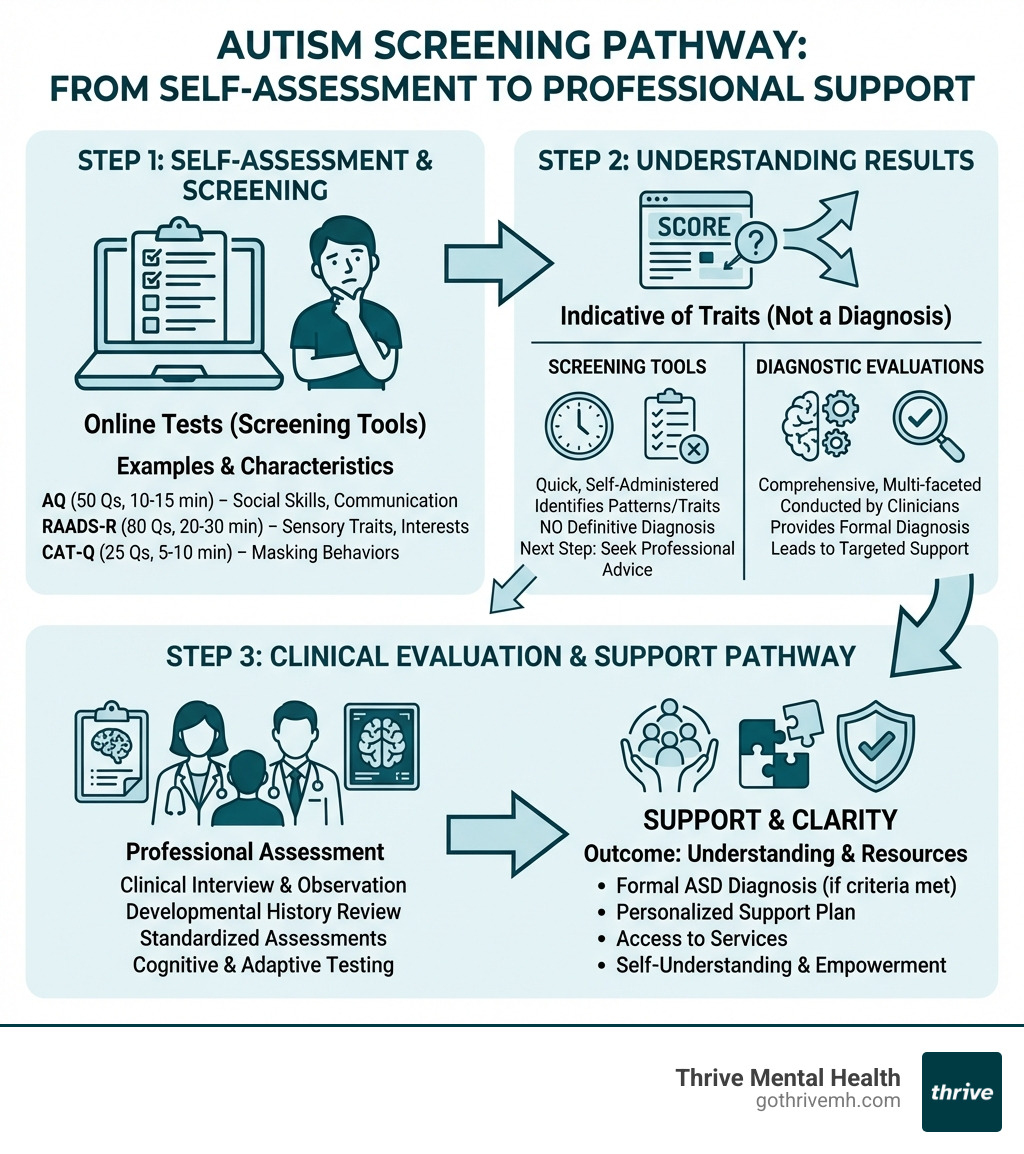
3 Free Autism Screening Tests You Can Take in the Next 15 Minutes [And What They Really Mean]
We understand the urge to find answers quickly. If you’ve been noticing social-communication challenges, sensory sensitivities, repetitive behaviors, or other symptoms that may be indicative of autism, taking an initial autism test can be a powerful first step. These self-administered questionnaires are designed to measure autistic traits and give you an idea of whether professional evaluation might be beneficial. They’re accessible, quick, and can offer valuable insights into your experiences.
Here are three prominent online autism test options you can explore right now:
-
Autism Spectrum Quotient (AQ): This widely recognized test consists of 50 questions and is designed to measure autistic traits in adolescents and adults aged 16 and older. It typically takes about 10-15 minutes to complete. One study found that approximately 47% of individuals who test positive using the AQ test meet the criteria for an ASD diagnosis after further evaluation, making it a valuable initial screener. You can take a version of the Autism Spectrum Quotient Test to get started.
-
Ritvo Autism Asperger Diagnostic Scale-Revised (RAADS-R): The RAADS-R is a more in-depth autism test, featuring 80 questions. It takes about 20 to 30 minutes to complete and focuses on measuring traits across four key areas: social relatedness, circumscribed interests, language, and sensory-motor processing. Research studies show the RAADS-R has strong accuracy, correctly identifying about 97% of adults with autism spectrum disorder. A score of 65 or higher on the RAADS-R suggests you might have autism spectrum disorder and should get further evaluation. You can find an online version of The Ritvo Autism Asperger Diagnostic Scale-Revised (RAADS-R) to take.
-
Camouflaging Autistic Traits Questionnaire (CAT-Q): This newer autism test consists of 25 statements and focuses specifically on “masking” or camouflaging autistic traits. Masking refers to the conscious or unconscious efforts an individual makes to hide or blend in with neurotypical social norms. The CAT-Q is particularly relevant for late-diagndiagnosed or self-identifying autistic adults, especially women and other demographics who might have developed sophisticated coping mechanisms. The CAT-Q consists of 25 statements and is divided into three key dimensions, which include compensation, masking, and assimilation.
What is the Autism Spectrum Quotient (AQ) test?
The Autism Spectrum Quotient (AQ) test is a self-administered 50-question questionnaire developed by Simon Baron-Cohen and his team at the Cambridge Autism Research Centre. It’s designed to measure autistic traits in adults and adolescents aged 16+, suitable for people with an IQ over 80. The test assesses traits across five main areas: social skills, attention switching, attention to detail, communication, and imagination.
While the AQ test is considered one of the more valid tools available for adult self-screening, it’s important to remember it’s a preliminary tool, not a diagnostic one. It helps identify individuals who might benefit from a more detailed assessment. Historically, some questions within the AQ test have been criticized for their outdated assumptions, such as implying all autistic individuals lack imagination or are fascinated by dates. However, the test has undergone updates to address these concerns, recognizing the diverse ways autism presents.
What is the RAADS-R test and what does it measure?
The Ritvo Autism Asperger Diagnostic Scale-Revised (RAADS-R) is an 80-question autism test specifically designed for adults. It’s a modified version of an earlier scale, developed to be a clinical adjunct diagnostic tool. The RAADS-R is particularly useful for identifying adults whose symptoms may have been overlooked in childhood due to its retrospective nature, assessing both developmental and current traits.
This test shows strong accuracy in research studies, correctly identifying about 97% of adults who have autism spectrum disorder. It also has low rates of false positives, meaning it’s good at differentiating autism from other mental health conditions like anxiety or ADHD. Interestingly, some research suggests that autistic women may score higher on the RAADS-R than autistic men, unlike the AQ where the reverse is often true. This makes the RAADS-R a meaningful companion test for women exploring whether they might be autistic.
The RAADS-R measures four key areas:
- Social Relatedness: This section explores how an individual connects with others, understands social rules, and engages in reciprocal social interactions. Questions might touch on empathy, social cues, and comfort in group settings.
- Circumscribed Interests: This area assesses intense focus on specific topics, preference for routines, and difficulties with changes in plans or environment. It looks at the depth and breadth of one’s interests.
- Language: This part examines aspects of verbal and nonverbal communication, including literal interpretation, understanding sarcasm or idioms, and the use of language in social contexts.
- Sensory-Motor: This section digs into how an individual processes sensory information (e.g., sensitivity to light, sound, textures) and aspects of body movement or coordination.
A score of 65 or higher on the RAADS-R suggests that you might have autism spectrum disorder and should seek further evaluation from a qualified professional.
Why is the Camouflaging Autistic Traits Questionnaire (CAT-Q) important?
The Camouflaging Autistic Traits Questionnaire (CAT-Q) is a crucial, newer autism test because it addresses a phenomenon known as “masking” or “camouflaging.” Masking generally refers to the conscious or unconscious efforts an individual makes to hide or suppress their autistic traits to fit into neurotypical social expectations. This can involve mimicking neurotypical behaviors, forcing eye contact, scripting conversations, or suppressing stims (self-stimulatory behaviors).
The CAT-Q consists of 25 statements divided into three key dimensions: compensation, masking, and assimilation. It helps shed light on how much energy individuals expend to appear “normal” in social situations. This is particularly relevant for many late-diagnosed or self-identifying autistic adults, especially women and other marginalized groups, who often learn to camouflage their traits from a young age. While effective in the short term, consistent masking can lead to significant mental health challenges like autistic burnout, anxiety, depression, and a delayed diagnosis. Understanding your CAT-Q score can be a powerful step in recognizing the impact of masking on your well-being.

Online Autism Test Accuracy: Can a Quiz Really Tell You if You’re Autistic? [The Hard Truth]
We get it—the appeal of a quick online autism test is strong. You answer a few questions, get a score, and suddenly, years of feeling “different” might start to make sense. But here’s the hard truth: while these tests are incredibly valuable, they are screening tools, not diagnostic instruments. They can’t, and shouldn’t, provide a definitive diagnosis.
Screening vs. Diagnosis: Understanding the Difference
Think of it this way: a screening test is like a smoke detector. It can tell you if there might be smoke, prompting you to investigate further, but it can’t tell you if your house is on fire or what caused the smoke. Only a professional evaluation can do that.
Online screening tools, like the AQ, RAADS-R, and CAT-Q, are designed to identify potential autistic traits. They rely on self-reporting, meaning your answers are based on your own perceptions and memories. This introduces a “self-reporting bias,” where individuals might intentionally (or unintentionally) answer in a way that aligns with a desired outcome, or they might struggle to accurately assess their own traits. As one source notes, self-assessment tools are limited in scope and not a dynamic or comprehensive evaluation. A clinician, on the other hand, can explore experiences more deeply through follow-up questions and observations.
While these tests can be accurate in identifying traits – the RAADS-R, for example, is highly accurate in research studies for identifying adults with ASD – they are not substitutes for a comprehensive professional assessment. They can produce false positives (indicating traits when autism isn’t present) or false negatives (missing traits, especially in individuals who are adept at masking).
Empowerment Through Self-Knowledge
Despite their limitations, online autism tests are incredibly empowering. They offer:
- Validation: Finally, a framework for understanding lifelong patterns of behavior and interaction that may have felt confusing or isolating.
- Direction: A clear indicator that further investigation with a professional might be beneficial.
- Self-Advocacy: The results can equip you with language and insights to start a conversation with a healthcare provider, helping you advocate for a formal evaluation.
If you’re exploring the possibility of autism and are looking for resources to better understand yourself, we offer comprehensive support for adults in Florida. You can find more info about our personalized treatment plans that can help you steer your journey.
Red Flags for Online Tests
When exploring online resources, be wary of any autism test that:
- Promises a diagnosis: No online test can officially diagnose you.
- Aggressively upsells treatments: Be cautious of tests that immediately push you towards expensive, unverified treatments.
- Gatekeeps results behind payment: Ethical screening tools provide results freely.
You Took a Test. Now What? Your Action Plan After a Positive Result [Don’t Panic]
So, you’ve taken an autism test online, and your score suggests you might have autistic traits. First, take a deep breath. Don’t panic. This score is data, an indicator, not a definitive diagnosis. It’s a powerful piece of self-knowledge, and it means you’ve taken an incredible step toward understanding yourself better.
Don’t Panic: A Score is Data, Not a Destiny
A high score on an online autism screening doesn’t mean your life is suddenly different. It means you have a valuable piece of information that can help you seek clarity and support. Many adults find immense relief in understanding why they’ve always felt “different,” and this insight can be a catalyst for positive change and self-acceptance.
Talk to a Professional: Your Next Critical Step
If your screening results suggest autistic traits, your next crucial step is to seek a professional evaluation. This is where a formal diagnosis can be made, and it opens the door to appropriate support and resources.
- Start with your primary care doctor: Your primary care provider (PCP) is an excellent first point of contact. They can discuss your concerns, review your screening results, and provide a referral to a specialist who can conduct a comprehensive autism assessment.
- Seek a specialist: Look for a psychologist, psychiatrist, or neurodevelopmental specialist who has experience working with adults on the autism spectrum. Not all mental health professionals specialize in adult autism diagnosis, so it’s important to find someone with specific expertise. In Florida, you’ll find qualified professionals in major metropolitan areas like Tampa, Miami, and Orlando. For those needing high-acuity mental healthcare, we can help guide you to appropriate referrals. Find out more about our virtual high-acuity mental healthcare referrals.

Prepare for an Evaluation: Gather Your Story
To make the most of your professional evaluation, come prepared. The diagnostic process relies heavily on developmental history and current experiences.
Here’s what to gather:
- Developmental History: Try to recall information from your childhood. Ask parents or guardians about your early development, including:
- When you reached developmental milestones (walking, talking).
- Your motor skills (were you clumsy? did you have fine motor challenges?).
- Feedback from teachers or caregivers about your behavior, social interactions, or learning difficulties.
- Any unusual or intense interests you had as a child.
- Note Current Challenges: Document your current experiences, including specific examples of:
- Social communication challenges: Difficulty with eye contact, understanding social cues, engaging in “small talk,” making or keeping friends, or understanding non-literal language (sarcasm, idioms).
- Repetitive behaviors and routines: Strong need for routine, distress at unexpected changes, repetitive movements (stimming), or highly specific interests.
- Sensory sensitivities: Over- or under-reactivity to sounds, lights, textures, tastes, or smells.
- Intense interests: Highly focused and deep interests in specific topics, often to the exclusion of others.
- Masking behaviors: How you try to hide or compensate for social difficulties.
This detailed information will provide the specialist with a comprehensive picture, aiding in an accurate diagnosis.
The Official Diagnosis: What a Professional Autism Test Involves [Beyond the Quiz]
If you’ve taken an online autism test and decided to pursue a formal diagnosis, you’re entering a more comprehensive and rigorous process. This is the “gold standard” for determining if you meet the criteria for Autism Spectrum Disorder.
The Role of a Healthcare Professional
A formal diagnosis of ASD can only be made by a qualified healthcare professional, such as a developmental pediatrician, child neurologist, psychiatrist, or psychologist specializing in autism. They don’t rely on a single test but conduct a comprehensive evaluation that includes:
- Clinical Interviews: Detailed conversations with you (and often family members, if possible) about your developmental history, current symptoms, and challenges.
- Behavioral Observations: The professional will observe your behavior, communication, and social interactions in various settings.
- Standardized Assessments: Administering specific diagnostic tools designed to assess autism.
- Ruling Out Other Conditions: Part of the professional’s role is to ensure that your symptoms are not better explained by another mental health or neurological condition. This is known as differential diagnosis. The Centers for Disease Control and Prevention (CDC) provides excellent resources on clinical testing and diagnosis for Autism Spectrum Disorder.
DSM-5 Criteria: The Diagnostic Blueprint
The diagnostic process for ASD is guided by the American Psychiatric Association’s Diagnostic and Statistical Manual, Fifth Edition (DSM-5). This manual provides standardized criteria that professionals use to diagnose mental health conditions, including ASD. To meet the diagnostic criteria for ASD, an individual must demonstrate:
- Persistent deficits in social communication and social interaction across multiple contexts: This includes challenges in social-emotional reciprocity (e.g., abnormal social approach, failure of back-and-forth conversation), nonverbal communicative behaviors (e.g., poor eye contact, lack of facial expressions), and developing, maintaining, and understanding relationships.
- Restricted, repetitive patterns of behavior, interests, or activities: This can manifest in at least two of the following:
- Stereotyped or repetitive motor movements, use of objects, or speech (e.g., hand flapping, echolalia).
- Insistence on sameness, inflexible adherence to routines, or ritualized patterns of verbal or nonverbal behavior (e.g., extreme distress at small changes, rigid thinking).
- Highly restricted, fixated interests that are abnormal in intensity or focus.
- Hyper- or hyporeactivity to sensory input or unusual interests in sensory aspects of the environment (e.g., indifference to pain/temperature, adverse response to specific sounds or textures).
These symptoms must be present in the early developmental period, cause clinically significant impairment in social, occupational, or other important areas of current functioning, and not be better explained by intellectual disability or global developmental delay.
Key Diagnostic Tools Used by Professionals
While online screeners are a starting point, professionals use a battery of in-depth tools for diagnosis:
- Autism Diagnostic Observation Schedule (ADOS-2): Considered a “gold standard” observational assessment, the ADOS-2 is a semi-structured, standardized assessment of communication, social interaction, and play/imaginative use of materials for individuals suspected of having ASD.
- Autism Diagnostic Interview-Revised (ADI-R): This is a comprehensive, structured interview conducted with parents or primary caregivers. It covers developmental history in the areas of social interaction, communication, and restricted/repetitive behaviors.
- Clinical Observation: Beyond formal tests, the clinician’s trained eye will observe your behavior, body language, and interaction style throughout the assessment.
- Psychological Testing: This may include cognitive assessments (IQ tests) and adaptive functioning measures to understand your strengths and challenges across various domains.
This thorough process ensures an accurate diagnosis, which is crucial for accessing appropriate support and understanding your unique neurotype. If you’re considering an autism diagnosis and treatment in Florida, understanding this process is key.
Frequently Asked Questions about the Autism Test Process
Can an online autism test provide a diagnosis?
No, an online autism test cannot provide a diagnosis. These tests are screening tools designed to help you identify if you have traits associated with autism. A formal diagnosis requires a comprehensive evaluation by a qualified healthcare professional, such as a psychologist or psychiatrist, who will use standardized diagnostic criteria and clinical judgment.
How much does a professional autism assessment cost for adults?
The cost of an adult autism assessment can vary significantly depending on your location and the provider. Generally, costs can range from $1,000 to over $2,000. However, many insurance plans, such as Cigna, Optum, and Florida Blue, may cover a portion or all of the cost if the assessment is deemed medically necessary and conducted by an in-network provider. We encourage you to check your insurance coverage with us to understand your potential out-of-pocket expenses. This is particularly relevant for residents in our Florida service areas, including Tampa, Miami, and Orlando.
Are there specific autism test considerations for women?
Yes, absolutely. Autism in women often presents differently than in men, leading to many women being undiagnosed until adulthood. Women tend to be more adept at “masking” or camouflaging their autistic traits to fit into social norms. This can make them score lower on some traditional screeners like the AQ test. Therefore, tests like the RAADS-R, which research suggests women may score higher on, and the CAT-Q, which specifically measures camouflaging behaviors, are particularly helpful for women exploring an autism diagnosis. A clinician experienced in diagnosing autism in women is crucial for an accurate assessment.
Your Results Are In: It’s Time for Real Support
Taking an autism test online is a powerful first step toward understanding yourself. It can provide clarity and validate lifelong feelings of being different. But it’s not the final destination. A formal diagnosis from an expert opens the door to personalized support that can transform how you steer work, relationships, and your own mental health.
At Thrive Mental Health, we believe in accessible, evidence-based care. While we don’t provide autism diagnoses, we offer expert-led virtual and in-person programs in Florida designed for adults seeking to manage their mental health. Whether you’re navigating a new understanding of your neurotype or seeking strategies to thrive, our programs can help you build coping skills, improve communication, and improve your overall well-being.
Ready for support? Thrive offers virtual and hybrid IOP/PHP programs with evening options. Verify your insurance in 2 minutes (no obligation) → Start benefits check or call 561-203-6085. If you’re in crisis, call/text 988.