
The Ins and Outs of Therapy

Therapy General: 2025’s Ultimate Relief
Is Therapy Worth It? Here’s What the Science Says.
Therapy is a powerful, evidence-based tool for improving your mental health, navigating life changes, or simply becoming a better version of yourself. Whether you’re dealing with anxiety, depression, or just feeling stuck, therapy provides structure and proven strategies to help you move forward faster than you could alone.
But stigma and myths still keep many people from seeking help. Some believe therapy is “for the weak” or that “talking doesn’t fix anything.” The truth? Therapy is one of the strongest steps you can take—and decades of research prove it works.
This guide cuts through the noise to show you what Therapy General is, how it works, and how to find the right fit. You’ll learn what to expect, how to maximize your progress, and what modern options like virtual IOPs can offer if weekly therapy isn’t enough.
I’m Nate Raine, CEO of Thrive Mental Health, and I’ve spent over a decade making high-quality, outcome-driven treatment accessible across Florida—because everyone deserves the tools to thrive.
What is Therapy and Why Should You Care? (Even If You Feel “Fine”)

Psychotherapy, or talk therapy, is a professional partnership designed to help you understand your thoughts, emotions, and behaviors—and give you the tools to change what isn’t working. It’s not just venting; it’s personal training for your mind, using proven psychological methods to solve real problems.
Who is therapy for? Pretty much everyone at some point. While it’s highly effective for diagnosed conditions like depression, anxiety, and PTSD, most people seek therapy for the hard parts of being human:
- Major life transitions: A new job, a move, a divorce, or new parenthood.
- Relationship issues: Constant arguments, disconnection, or unhealthy patterns.
- Grief and loss: The death of a loved one, a breakup, or a job loss.
- Trauma: Evidence-based approaches like EMDR can help you heal without getting stuck in the past.
- Stress management: With more than 75% of all physician visits being stress-related, therapy teaches coping skills that protect your mental and physical health.
- Personal growth: You don’t need to be broken to want to improve. Therapy builds self-awareness, communication skills, and resilience.
Despite over 41 million U.S. adults attending therapy annually, stigma and myths persist. Let’s debunk them:
- “Therapy is for the weak.” Wrong. It takes courage to face your problems head-on. Asking for help is a sign of strength.
- “Talking doesn’t help.” Therapy isn’t just talking; it’s a structured process using evidence-based techniques to learn new skills and create lasting change.
The bottom line: Therapy General is for anyone who wants to feel, function, and live better. You don’t need to wait for a crisis. To learn more, check out these 5 Benefits of Mental Health Therapy You Should Know.
The Who & What of Therapy: Finding Your Match in Modalities and Professionals

Finding the right therapist and therapy style can feel overwhelming. Let’s cut through the confusion of credentials and modalities to help you find a match that won’t waste your time or money.
Who Provides Therapy? Understanding the Credentials
Different credentials mean different training and specialties. Here’s a quick breakdown:
- Psychiatrists (MDs): Medical doctors who can prescribe medication and provide therapy. Best for conditions where medication management is a primary need.
- Psychologists (PhD or PsyD): Doctoral-level experts in psychotherapy, psychological testing, and diagnosis. They cannot prescribe medication in most states.
- Licensed Professional Counselors (LPC/LMHC): Master’s-level professionals trained to help with coping strategies, emotional regulation, and life challenges.
- Licensed Marriage and Family Therapists (LMFT): Master’s- or doctoral-level specialists in relationship dynamics and family systems.
- Licensed Clinical Social Workers (LCSW): Master’s-level therapists who take a holistic view, considering your environment and social factors alongside your mental health.
| Professional Role | Education Level | Primary Focus | Can Prescribe Medication? |
|---|---|---|---|
| Psychiatrist (MD) | Medical Doctor (MD) | Medical management of mental illness, psychotherapy | Yes |
| Psychologist (PhD/PsyD) | Doctorate (PhD/PsyD) | Psychotherapy, assessment, diagnosis | No (except in a few states with advanced training) |
| LPC/LMHC | Master’s Degree | Counseling, coping strategies, emotional regulation | No |
| LMFT | Master’s/Doctorate | Relationship dynamics, family systems | No |
| LCSW | Master’s Degree (MSW) | Psychotherapy, social and environmental factors | No |
The best fit matters more than the credential. A great therapist with the right training for you is what counts.
Common Types of Therapy General: A Quick Guide
Therapists use different approaches, or “modalities,” as tools. Many use an integrative approach, blending techniques to fit your needs.
- Cognitive Behavioral Therapy (CBT): The gold standard for many issues. It helps you identify and change unhelpful thought and behavior patterns. It’s practical, skills-based, and highly effective for anxiety and depression.
- Dialectical Behavior Therapy (DBT): An intensive therapy that teaches skills for managing overwhelming emotions, relationship chaos, and self-harm urges. It focuses on mindfulness, distress tolerance, emotion regulation, and interpersonal effectiveness.
- Eye Movement Desensitization and Reprocessing (EMDR): A powerful approach for trauma and PTSD. It uses bilateral stimulation (like eye movements) to help the brain reprocess traumatic memories and reduce their emotional charge.
- Psychodynamic Therapy: Explores how past experiences, especially early relationships, influence your present behavior and feelings. It helps you understand the “why” behind your patterns.
- Humanistic Therapy: Focuses on your potential for growth. It’s less about “fixing” a problem and more about helping you become your most authentic self in a supportive, non-judgmental environment.
For more details, see our guide to Understanding the Different Types of Mental Health Therapy.
How Does Cognitive Behavioral Therapy (CBT) Actually Work?
CBT is one of the most researched forms of Therapy General. It’s built on a simple but powerful idea: your thoughts, feelings, and behaviors are interconnected. Change one, and the others follow.
In practice, you and your therapist identify automatic negative thoughts (e.g., “I’m going to fail this presentation”). Then, you learn to challenge them with evidence, a process called cognitive restructuring. You might also conduct behavioral experiments, like facing a small social fear to prove your anxious predictions wrong. CBT gives you practical coping skills to use for life. It’s an active, collaborative therapy focused on learning better ways to handle psychological problems, as outlined by the American Psychological Association.
At Thrive Mental Health, our IOP and PHP programs integrate CBT and other evidence-based methods. If you need more than weekly therapy, we offer structured treatment that creates lasting change. We accept most major insurance, including Cigna, Optum, and Florida Blue.
Your Therapy Journey: From First Call to Lasting Change
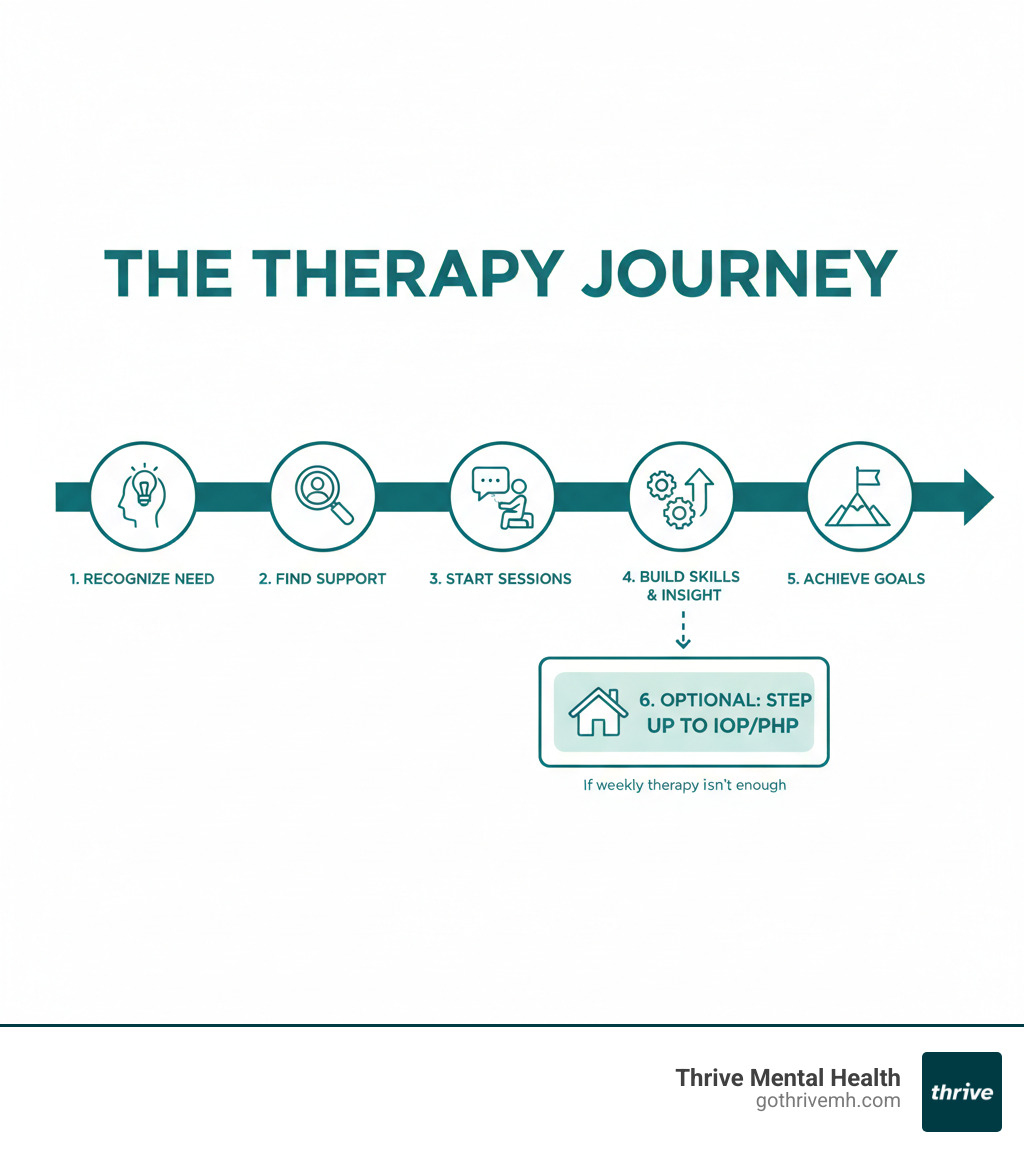
Starting therapy can feel intimidating, but the process is more straightforward than you think. Here’s how to steer it, from finding the right person to making real progress.
How to Find the Right Therapist (Without Wasting Time or Money)
The connection you have with your therapist—the therapeutic alliance—is a top predictor of success. Finding the right fit is crucial.
- Clarify Your Needs: What do you want to work on? Anxiety, trauma, relationship issues? Knowing your goals helps narrow the search.
- Use Online Directories: Websites like Psychology Today allow you to filter therapists by location, specialty, and insurance.
- Check Your Insurance: Review your provider’s directory (e.g., Cigna, Optum, Florida Blue) to find in-network options and avoid high out-of-pocket costs. At Thrive, you can verify your insurance for our Florida programs in just two minutes.
- Ask for Referrals: Your doctor or trusted friends may have recommendations.
- Schedule Consultation Calls: Most therapists offer a free 10-15 minute chat. Use this time to ask about their approach and see if you feel a connection. Don’t be afraid to “shop around”—comfort and trust are key.
What to Expect in Your First Therapy Session
Your first session is about setting the foundation. It’s normal to feel nervous, hopeful, or even a little scared.
- Paperwork: You’ll start with forms about your history and what brought you to therapy. Honesty is key, as this information provides essential context.
- The Conversation: Your therapist will ask about your goals and what you hope to achieve. This is a collaborative discussion to clarify what you’ll work on together.
- Building Rapport: The session is also about getting to know each other. Your therapist will listen, ask questions, and explain their approach. It’s a two-way interview, so ask your own questions too.
Some people feel immediate relief; others feel drained. Both are normal. Give it a few sessions to decide if it’s the right fit.
Maximizing Your Therapy General Experience
Therapy isn’t a passive process. To get the most out of it, you need to be an active participant.
- Be Honest: Your therapist can only help with what you share. The therapy room is a confidential space for the messy, uncomfortable stuff.
- Do the Homework: Many therapies, like CBT, involve practice between sessions. This is how you integrate new skills into your daily life and make change stick.
- Give Feedback: If something isn’t working, say so. A good therapist will appreciate your honesty and adjust their approach.
- Be Patient: Progress isn’t always linear. Healing takes time and can be uncomfortable. Trust the process and stick with it.
If you need more support than weekly therapy, learn about our approach to therapy through IOP programs.
The Fine Print: Privacy, Risks, and the Evolution of Care

Understanding the logistics of Therapy General helps you enter treatment with confidence. Here’s what you need to know about confidentiality, potential downsides, and how care has evolved.
Is Therapy Actually Confidential?
Yes. Your privacy is legally protected by the Health Insurance Portability and Accountability Act (HIPAA). What you say in therapy stays in therapy, with a few specific exceptions designed to protect you and others:
- Risk of Harm: If your therapist believes you are an imminent danger to yourself or an identifiable person, they are legally required to intervene.
- Abuse: Therapists are mandated reporters, meaning they must report suspected child abuse, elder abuse, or abuse of a vulnerable adult.
- Court Orders: In rare cases, a court can subpoena therapy records.
Your therapist will review these limits with you in your first session. For more detail, see the APA Ethical Principles on Confidentiality.
Are There Risks or Downsides to Therapy?
While highly effective, Therapy General isn’t always easy. It’s common to feel worse before you feel better, as confronting painful emotions can be temporarily draining. Research suggests 5-10% of people experience a temporary worsening of symptoms as part of the healing process.
Other potential downsides include:
- Time and Cost: Therapy is an investment. Even with insurance from providers like Cigna or Optum, copays and scheduling can be challenging.
- Finding the Right Fit: A poor therapeutic match can stall progress. It’s okay to switch therapists if the connection isn’t there.
- Approach Mismatch: Sometimes a specific therapy style, like CBT, just doesn’t click. This is why flexible programs like IOP therapy often integrate multiple modalities.
How Therapy Has Changed: From Freud’s Couch to Virtual IOPs
Mental health care has transformed dramatically. It evolved from Freud’s psychoanalytic couch to behaviorism’s focus on learned patterns, and then to the humanistic movement’s emphasis on empathy and personal growth. Today, evidence-based practice is the standard, with therapies like CBT, DBT, and EMDR rigorously tested and proven effective.
The biggest revolution has been telehealth. Virtual therapy has shattered geographical barriers, making specialized care accessible to anyone in Florida. For those needing more support, Intensive Outpatient Programs (IOPs) and Partial Hospitalization Programs (PHPs) offer a game-changing solution. Our Virtual IOP Programs provide the structure of intensive care with the flexibility to live your life. Modern Therapy General is designed to fit you, not the other way around.
Frequently Asked Questions about Therapy
This is one of the most common questions we hear, and the answer is: it varies. For specific issues, short-term Therapy General (around 6-20 sessions) can show significant results. For example, CBT for anxiety or depression can often be effective within 3 to 10 months with weekly sessions. However, for complex trauma, personality disorders, or deep-seated behavioral patterns, therapy may be a longer-term commitment, potentially lasting a year or more. Progress is rarely linear; there will be ups and downs, but consistent effort typically yields lasting change.
How much does therapy cost and does insurance cover it?
The cost of Therapy General varies significantly based on the therapist’s credentials, location, and session length. Individual therapy sessions can range from $75 to $200+ per hour.
Many insurance plans, including major providers like Cigna, Optum, and Florida Blue, offer mental health benefits that cover psychotherapy. The Mental Health Parity and Addiction Equity Act of 2008 mandates that group insurers of more than 50 employees must cover mental and physical health equally. However, coverage details like deductibles, copayments, and the number of covered sessions can differ greatly. We strongly encourage you to contact your insurance provider to understand your specific benefits.
For higher levels of care like our Intensive Outpatient (IOP) and Partial Hospitalization (PHP) programs, coverage structures may be different. Our PHP programs, for instance, are designed to be covered by insurance for those who meet medical necessity criteria.
What’s the difference between therapy and talking to a friend?
While talking to a supportive friend can be incredibly helpful, it’s fundamentally different from Therapy General. Here’s why:
- Professional Training and Expertise: A therapist is a highly trained professional with specialized education in psychology, counseling, or social work. They possess the clinical expertise to diagnose, treat, and guide you through complex psychological issues using evidence-based techniques. Your friend, no matter how well-meaning, does not have this training.
- Objectivity and Neutrality: A therapist provides an objective, non-judgmental perspective. They are not emotionally invested in your life in the same way a friend is, allowing them to offer unbiased insights and challenge your perspectives constructively.
- Confidentiality: As discussed, therapy sessions are confidential, with specific legal limits. This creates a safe space for you to share anything without fear of judgment or repercussions in your social life.
- Structured Process: Therapy follows a structured process with clear goals and a treatment plan designed to help you make specific changes. Friends offer support, but not a guided path to psychological healing and growth.
- Focus on You: Therapy is entirely devoted to your well-being and growth. While friends offer mutual support, a therapeutic relationship is one-sided in its focus, ensuring your needs are prioritized.
Conclusion: Taking the First Step Toward a Healthier You
Therapy General is a powerful investment in your quality of life. From understanding different therapy types like CBT and DBT to finding the right professional, a personalized path to healing is more accessible than ever. Modern options like virtual therapy and structured programs like IOPs and PHPs offer flexible, evidence-based care throughout Florida. Taking the first step is a courageous act that can equip you with lasting resilience and coping skills.
Ready for support? Thrive offers virtual and hybrid IOP/PHP programs with evening options. Verify your insurance in 2 minutes (no obligation) → Start benefits check or call 561-203-6085. If you’re in crisis, call/text 988.
If you’re in crisis, call/text 988 right now. You are not alone.
People Also Ask
Q: How long does therapy take to work?
A: It varies. Short-term therapy (6-20 sessions) can be effective for specific issues like mild anxiety. Deeper issues like complex trauma may require a year or more. Progress isn’t always linear, but consistency is key.
Q: How much does therapy cost and does insurance cover it?
A: Sessions can range from $75-$200+. Many insurance plans (like Cigna, Optum, Florida Blue) cover mental health care, but you should always verify your specific benefits, copays, and deductibles. Higher levels of care like our PHP program are also often covered when medically necessary.
Q: What’s the difference between therapy and talking to a friend?
A: A therapist is an objective, trained professional who uses evidence-based techniques in a confidential setting. A friend offers valuable support but is personally involved and lacks the clinical expertise to treat mental health conditions.
Q: What should I consider when choosing a therapist?
A: Consider their credentials, specialty, and approach. Most importantly, schedule a consultation call to see if you feel a sense of trust and comfort. The therapeutic relationship is a key factor in success.
Q: Can therapy really help with chronic stress and physical symptoms?
A: Yes. Since over 75% of doctor visits are linked to stress, therapy is highly effective. It teaches you stress management skills that can reduce psychological distress and alleviate related physical symptoms like headaches, fatigue, and digestive issues.